

Real-Time Trade Documentation: What to Record Live
Most traders journal after the trade and forget half the details. Learn how recording entry confluences, lessons, and emotions during the trade builds a better edge.
You close the trade, open your journal, and stare at a blank page. What were the confluences again? Were you nervous before entry or calm? Did you almost skip it?
By the time most traders sit down to journal, the details that matter most have already faded. The emotional context, the exact reasoning, the split-second decisions. All gone. What remains is a sanitized version of the trade, reconstructed from memory and stripped of the raw data that actually drives improvement.
Recording trade details in real time solves this problem. Not after the session. Not the next morning. During the trade itself.
TL;DR
Journal entries written after the session miss the emotional and decision-making details that drive real improvement.
Record three things live: your entry confluences, your emotional state, and one lesson or observation.
Voice notes let you capture context without leaving the chart.
Real-time documentation turns every trade into usable data for your monthly review.
A 30-second voice note during a trade is worth more than a 10-minute journal entry written from memory the next day.
Why After-the-Fact Journaling Fails
Most traders treat their journal like homework. They finish the session, grab a template, and fill in the blanks. Entry price, exit price, pair, timeframe. Done.
But the journal entry they need, the one that would actually improve their trading, requires context they can no longer access. How confident were they at entry? Did they hesitate? Was the setup a perfect match for their plan or did they stretch the criteria?
Sound familiar? You probably have a stack of journal entries that all read the same way. Clean. Factual. And completely useless for finding patterns in your behavior.
The problem is memory decay. Within an hour of closing a trade, you have already started rewriting the story. Winners get cleaner in hindsight. Losers get rationalized. The messy middle where the real lessons live gets smoothed over.
What to Record Live (And Nothing Else)
You do not need to write a novel during a trade. You need three data points captured in the moment:
1. Entry confluences. List the specific factors that put you in the trade. Not "the setup looked good." Actual confluences: higher timeframe bearish, 15-minute market shift confirmed, flip zone mitigated, liquidity swept above the swing high. Whatever your plan requires, name each one.
2. Emotional state. One or two words. Calm. Rushed. Hesitant. Overconfident. Bored. This is the data point you will never remember accurately after the session. If you felt a knot in your stomach before clicking buy, that matters. Write it down now.
3. One observation or lesson. Something you noticed during this specific trade. "Price pulled back further than expected before moving." "Almost skipped this because of the last loss." "News in 2 hours, tightened stop."
That is it. Three data points. Thirty seconds of effort. Everything else can be filled in during your post-trade review.
The Voice Note Method
Typing during a live trade is clunky. Your hands are on the mouse, your eyes are on the chart, and switching to a text field breaks your focus.
Voice notes fix this. Speak your entry confluences out loud as you take the trade. Speak your emotional state. Speak the observation. Your phone, your platform, or your journal tool records it.
Here is what a real-time voice note sounds like in practice:
"Entering GBP/USD short. Higher timeframe bearish, lower highs and lower lows. 15-minute fractal shift confirmed. Flip zone plus liquidity sweep above the swing high. Feeling confident but slightly rushed because I almost missed the entry. Lesson: waited for the sweep before entering, good patience."
That took 15 seconds. And it contains more useful data than most traders capture in their entire post-session review.
Walkthrough: Live Documentation on a EUR/USD Short
You are watching EUR/USD during the New York session. The 4-hour chart shows bearish structure. Price mitigates a supply zone and shifts bearish on the 15-minute chart. You mark a flip zone and wait for a liquidity sweep above the nearest swing high.
The sweep happens. You enter short at 1.0920 with a stop at 1.0940 (20 pips) and a target at 1.0860 (60 pips). You are trading 0.5 lots.
You grab your phone and record: "EUR/USD short at 1.0920. Confluences: 4H bearish, 15M shift, flip zone mitigated, liquidity swept above 1.0935 swing high. Feeling calm, confident setup. Observation: I considered entering before the sweep but stuck to the plan."
Price dips 30 pips in your favor, then reverses back to 1.0915. You feel the urge to move your stop tighter. Another voice note: "Price pulled back to 1.0915. Up 5 pips but was up 30. Feeling anxious. Reminder: stop is placed above structure, no reason to move it."
Four hours later, price hits your target at 1.0860.
When you sit down for your post-session review, you have two voice notes with exact confluences, two emotional snapshots, and two behavioral observations. Compare that to what you would remember 3 hours later: "Took a short on EU. It worked."
When to Capture (The Three Trigger Points)
You do not need to narrate your entire session. Record at these three moments:
At entry. Confluences and emotional state. This is the most important note because it captures why you took the trade while the reasoning is still crisp.
During drawdown or unexpected movement. If price does something that tempts you to intervene (move your stop, close early, add to the position), record what you are feeling and what you are tempted to do. This is where awareness exercises become practical data.
At exit. Whether you hit your target, got stopped out, or closed manually. One sentence on whether you followed the plan and one sentence on what you would do differently.
Three notes per trade. Under two minutes of total effort.
Turning Live Notes Into Journal Entries
Raw voice notes and scribbled lines are not a finished journal. They are ingredients. Here is how to process them:
After your session, open your journal template and transfer the live data into the structured fields. The entry confluences go into your setup section. The emotional state goes into your psychology column. The observations become your lesson field.
The difference is that now you are organizing real data instead of reconstructing it from memory. You are not guessing what you felt. You have a recording of it.
Over time, these live notes create a pattern library that no after-the-fact journal can match. You start seeing connections: "Every time I note 'rushed' at entry, the trade loses." Or "Trades where I felt calm and listed four confluences have a 70% hit rate."
That is the kind of insight that changes your trading. Not because you had a fancy template, but because you captured the data when it was real.
The Habit That Makes It Stick
Most traders who try live documentation quit after a week. Not because it is hard, but because they do not have a trigger.
Build the habit into your execution sequence. Place your order, then immediately record. Make the voice note part of the trade itself, not an add-on you remember sometimes. If you are the type who skips journaling entirely, read why traders skip their journal and apply the same fixes here.
Start small. One voice note at entry for every trade this week. That is it. Once it becomes automatic, add the drawdown note and the exit note.
How EdgeFlo Supports Live Documentation
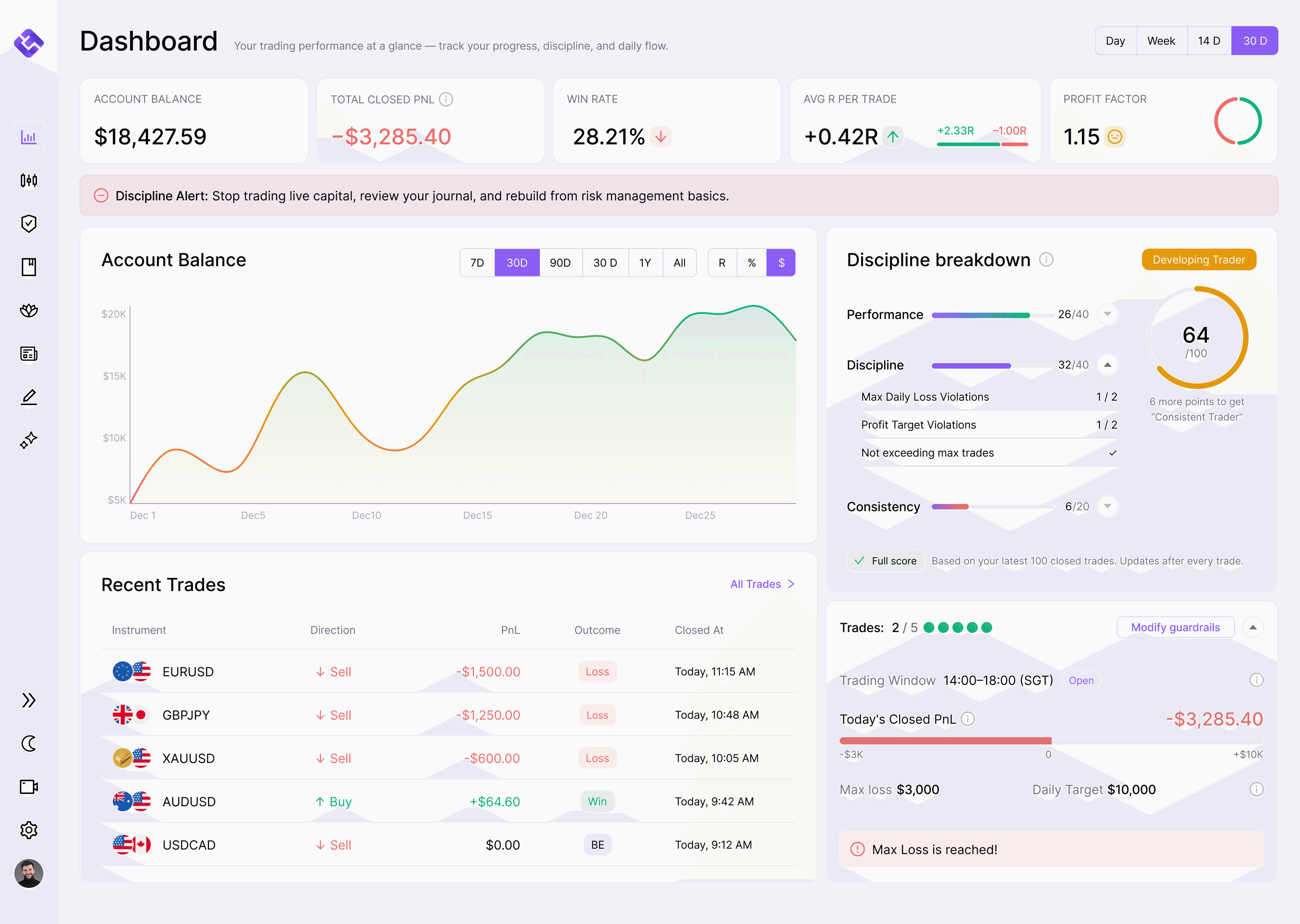
EdgeFlo's trading journal includes voice-to-text capture, which lets you speak your notes without leaving the chart. Your entry confluences, emotional state, and observations go directly into the journal entry tied to that trade.
The journal also auto-imports your trade data (pair, entry, exit, P&L), so you only need to capture the context that the platform cannot see: your reasoning, your emotions, and your in-the-moment lessons.
After your session, FloAI (Plus) surfaces patterns across your journal entries, connecting the emotional tags and behavioral notes you recorded live to your actual performance data. The patterns that would take you weeks of manual review to spot show up in your weekly AI report.
The Edge Brief
Receive Insights on trading psychology, discipline, and the behavioral patterns that create consistent traders from our Founder and the EdgeFlo team, delivered to your inbox.
Think different. Trade different.
What should I record during a live trade?
Is voice recording better than typing for live trade notes?
How long should a live trade note take?
Should I document winning trades or just losses?

Turn discipline on.
Every session.
EdgeFlo is the environment serious traders operate inside.
Start 7-Day Free Trial
Cancel anytime.
No long-term commitment.

Think Different, Trade Different.