

Reaction Based Entry: Wait for the V-Shape
Reaction-based entry waits for price to prove direction with a V-shape sweep and structure break. The two-signal confirmation that filters bad trades.
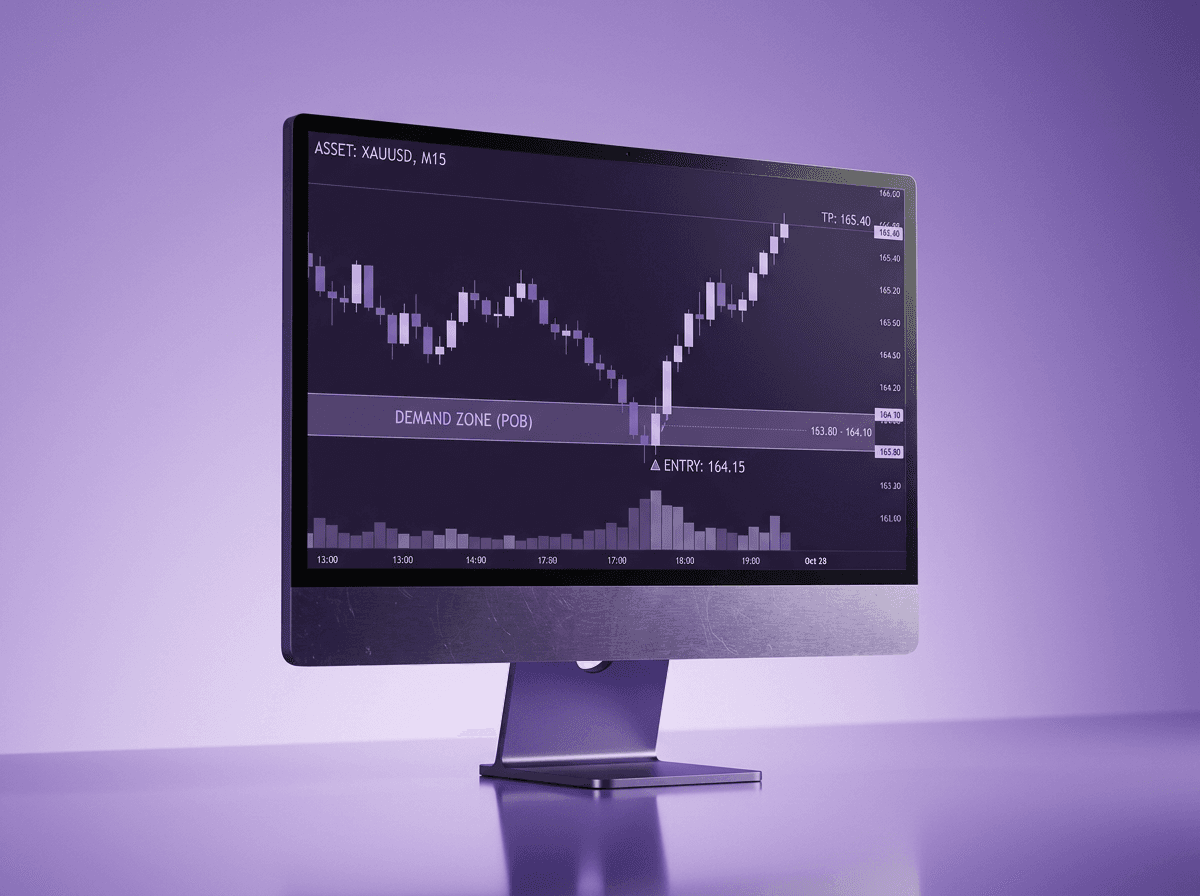
You spot a supply zone on the 15-minute chart. Price is approaching it. Your finger hovers over the sell button. But price has not reacted yet. It has not swept anything. It has not confirmed anything. You are guessing, not reacting.
Reaction-based entry flips that process. Instead of predicting what price will do at a level, you wait for price to show you what it did. The entry comes after the proof, not before it.
TL;DR
Reaction-based entry requires two confirmations before you pull the trigger: a V-shape reversal after a liquidity sweep, and an internal structure break.
This approach eliminates predictive entries (placing trades before price proves direction) and replaces them with reactive ones.
You will take fewer trades, but the trades you take carry stronger confirmation and higher win rates.
Build this two-signal model into your mechanical trading plan as a non-negotiable entry rule.
The hardest part is waiting. The market rewards the traders who let price prove itself first.
The Problem with Predictive Entries
Most traders enter too early. They see a supply zone, a demand zone, or a key level, and they place an order hoping price will react. Sometimes it works. Price touches the zone and reverses perfectly. But more often, price pushes through the zone, triggers the stop loss, and then reverses.
The difference between a predictive entry and a reaction-based entry is simple. Predictive entry says: "I think price will reverse here, so I am entering now." Reaction-based entry says: "Price has reversed here, and the reversal looks real, so I am entering now."
That shift from "I think" to "price showed me" changes everything. You are no longer betting on your analysis being right. You are confirming your analysis was right, and then acting on the confirmation.
Does this mean you sometimes miss the first part of the move? Yes. Absolutely. But you also miss the trades where the zone fails, the sweep keeps going, and the stop gets hit. Over 100 trades, the trades you avoid are worth more than the extra pips you give up.
The Two-Signal Confirmation Model
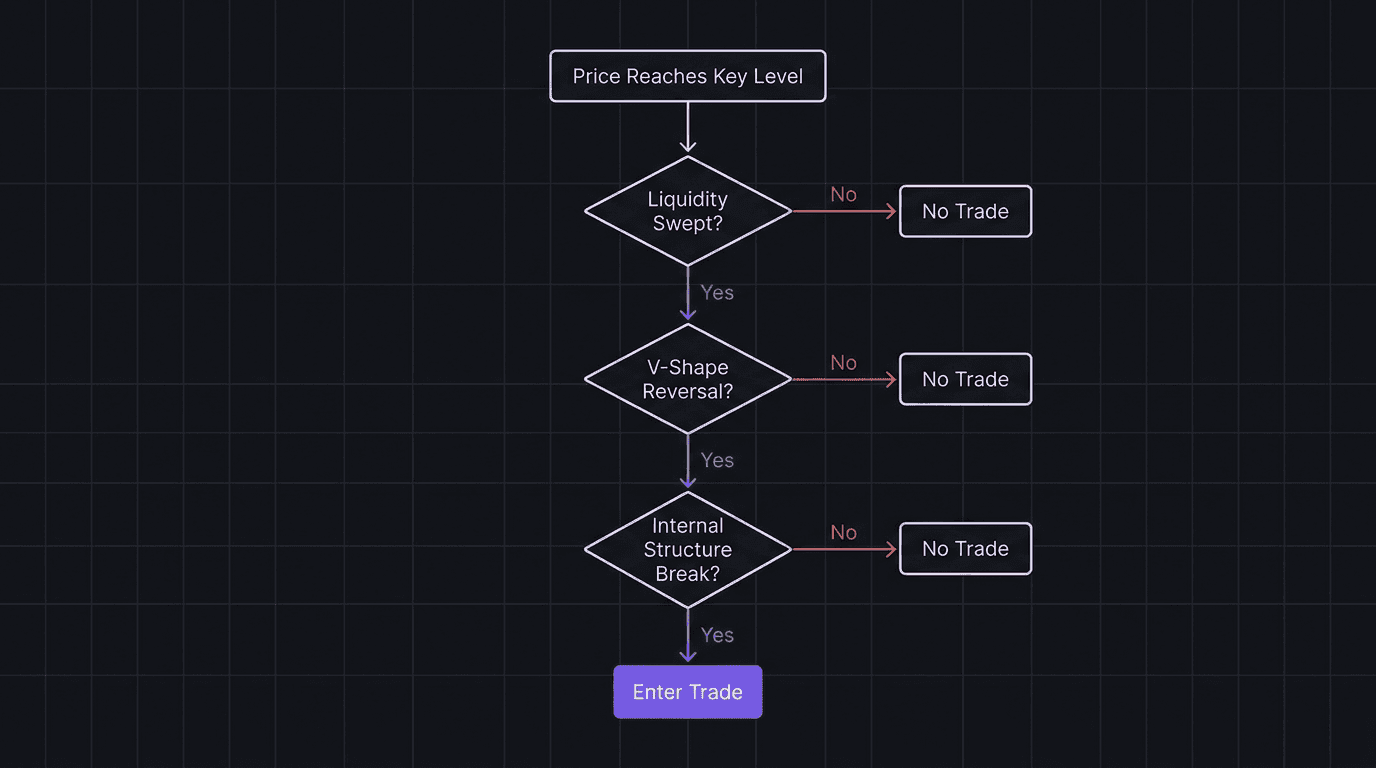
Reaction-based entry uses two signals that must appear in sequence. Missing either one means no trade.
Signal 1: V-Shape Reversal After a Liquidity Sweep
Price must push past a key level (a swing high, swing low, or obvious liquidity pool), trigger the resting orders, and immediately snap back. This V-shape is the first sign that the level is real. Institutions swept the liquidity they needed and started pushing price in the opposite direction.
What qualifies as a V-shape:
Price extends past the level by at least 5 pips on most forex pairs (15-minute chart)
The reversal happens within one to three candles
The reversal candle closes back on the correct side of the level (above the demand zone for longs, below the supply zone for shorts)
What does not qualify:
Price slowly drifts past the level and slowly drifts back (not a V-shape, just noise)
Price pushes past the level and stays there for 5 or more candles before reversing (that is potential accumulation, not a snap)
Price touches the level but does not push past it (no sweep means no fuel was grabbed)
Signal 2: Internal Structure Break
After the V-shape, price must break the most recent internal structure point. For a bullish entry (buying after a sweep of a swing low), price must break above the last internal lower high. For a bearish entry (selling after a sweep of a swing high), price must break below the last internal higher low.
This structure break confirms that the V-shape was not just a bounce. It confirms that the internal trend has actually shifted. Without this break, the V-shape could be a temporary reaction before price resumes in the original direction.
The two signals together form a filter that catches the high-probability moves while filtering out the fakeouts.
Walkthrough: Reaction-Based Long Entry
Pair: EUR/USD. 15-minute chart. Higher timeframe trend is bullish (4-hour making higher highs and higher lows). A demand zone sits between 1.0850 and 1.0860. Sell stops are visible below the swing low at 1.0848.
Before entry, check your pre-trade checklist: Higher TF bias is bullish. You have a demand zone and visible liquidity. The session is the London open (3:15 AM EST). Checklist items satisfied. Now wait for the reaction.
3:18 AM EST: Price drops to 1.0842, sweeping 6 pips below the swing low. Sell stops are triggered.
3:20 AM EST: A large bullish candle forms, closing at 1.0863. The candle body is entirely above the demand zone. V-shape formed. Signal 1 confirmed.
3:25 AM EST: Price pushes up to 1.0870, breaking above the last internal lower high at 1.0865. Signal 2 confirmed.
Entry: Long at 1.0868, after the structure break candle closes.
Stop loss: Below the sweep wick at 1.0838. Stop distance: 30 pips.
Risk calculation: 1% of a $10,000 account = $100. At 30 pips, the lot size is 0.33 lots (0.33 lots times $10/pip times 30 pips = $99, within $100 risk).
Target: The next swing high at 1.0940, giving 72 pips of target distance. That is a 2.4R trade (72 pips / 30 pips = 2.4R).
Outcome: Price rallied to 1.0940 over the next 4 hours. The trade hit target for +2.4R.
Math check: 0.33 lots times $10/pip times 30 pips = $99 risk. 0.33 lots times $10/pip times 72 pips = $237.60 profit. $237.60 / $99 = 2.4R. Verified.
If the trader had entered predictively at the demand zone (say, 1.0855 with a 15-pip stop at 1.0840), the sweep to 1.0842 would have stopped them out for a full loss. The predictive entry failed. The reaction-based entry succeeded. Same analysis, same zone, different timing.
Walkthrough: When the Reaction Does Not Confirm (No Trade)
Same pair, different day. Higher timeframe is bearish. A supply zone sits at 1.0920 to 1.0930. Buy stops above the swing high at 1.0935.
9:05 AM EST (New York open): Price pushes to 1.0938, sweeping the buy stops.
9:10 AM EST: Price drops to 1.0928. Then stalls. Two more candles form, both small-bodied, hovering around 1.0925 to 1.0930. No sharp rejection. No V-shape. The reversal is slow and uncertain.
9:20 AM EST: Price drifts down to 1.0920 but does not break the last internal higher low at 1.0910. No structure break.
Decision: No trade. Signal 1 failed (no V-shape, slow reversal). Signal 2 failed (no structure break). Even though the zone was correct and the sweep happened, the reaction did not confirm.
Outcome: Price eventually dropped to 1.0890 over the next 3 hours. The trade would have worked with a very wide stop. But the point of reaction-based entry is not to catch every move. It is to catch the moves where the confirmation is strong. This one was not.
This is what separates a solid trading edge from gambling. You have a clear model. Sometimes the model says no. You listen.
Building the Model Into Your Plan
Reaction-based entry works best when it is codified, not improvised. Write it into your trading plan as an if-then rule:
If price sweeps a marked liquidity level and forms a V-shape reversal within 3 candles and breaks internal structure, then enter in the direction of the break with a stop below the sweep wick.
If any of those three conditions is missing, then no entry, regardless of how good the zone looks.
This is the kind of rule that belongs in your if-then plan. It removes the decision from the moment and puts it into the system. You are not deciding whether to enter during the heat of a session. The system already decided, weeks ago, what the entry criteria are. Your job during the session is to check the criteria, not invent new ones.
Why Waiting Is the Hardest Part
Every trader who adopts reaction-based entry goes through the same frustration: watching price reverse at their zone without them because the V-shape did not form, or the structure break was one candle away.
That frustration is the cost of admission. The trades you miss because confirmation did not arrive are the same trades that would have stopped you out if you entered predictively. You are trading missed opportunities for avoided losses. Over 100 trades, that exchange is massively in your favor.
The hardest moment is when you miss a 3R winner because the V-shape took 4 candles instead of 3. You will feel like the model failed you. It did not. The model protected you from the 30 other times when a 4-candle reaction turned into a continuation.
Think of it this way: the A+ trade setup is the one where every box is checked. If one box is unchecked, it is not an A+ setup. It might be a B setup, and B setups have lower expectancy. The discipline to only trade A+ setups is what creates the edge.
Common Reaction-Based Entry Mistakes
Entering on the sweep candle before it closes. The V-shape is not confirmed until the candle closes. A sweep wick can extend, and what looked like a V-shape at 3:18 might look like a breakdown by 3:20. Wait for the close.
Skipping the structure break because the V-shape "looked strong." Strong V-shapes fail all the time. The structure break is not optional. It is signal 2 for a reason.
Widening the model after a miss. You miss a trade because the V-shape took 4 candles. So you change your rule to "4 candles is fine." Then you miss one at 5 candles and change it again. Now you have no model. Stick with the original criteria and let the data tell you if they need adjusting after 50 or more trades.
Applying reaction-based entry against the higher timeframe trend. If the 4-hour is bullish and you see a V-shape reversal after a sweep of a swing high, that is not a sell signal. That is a continuation signal. The V-shape must align with your directional bias, not contradict it.
How EdgeFlo Supports Your Entry Model
EdgeFlo's Edge plan builder lets you document your exact entry criteria and keep them visible during execution. Write your two-signal model into the plan: "V-shape + structure break required before entry." Every time you open a trade, the plan is right there next to the chart.
After the trade, the post-trade self-reporting asks whether you followed your plan. If you entered without the structure break, you tag it. Over time, that self-reporting data shows you how often you break your own entry rules and what it costs you.
The plan is not enforced in real time. It is a reference and a self-accountability tool. But having it visible during execution makes it harder to skip steps when the market is moving fast and your instinct says "just enter." The plan says wait. You see the plan. You wait. That is the discipline cycle that reaction-based entry demands.
The Edge Brief
Receive Insights on trading psychology, discipline, and the behavioral patterns that create consistent traders from our Founder and the EdgeFlo team, delivered to your inbox.
Think different. Trade different.
What is a reaction-based entry in trading?
How is reaction-based entry different from predictive entry?
What two signals confirm a reaction-based entry?
Does waiting for reaction-based entry mean missing trades?

Turn discipline on.
Every session.
EdgeFlo is the environment serious traders operate inside.
Start 7-Day Free Trial
Cancel anytime.
No long-term commitment.

Think Different, Trade Different.