

Ranging Market Risk: Protect Capital in Sideways Price
Ranging markets kill traders who keep their normal position size. Learn to cut risk in sideways conditions and only re-scale when direction confirms.
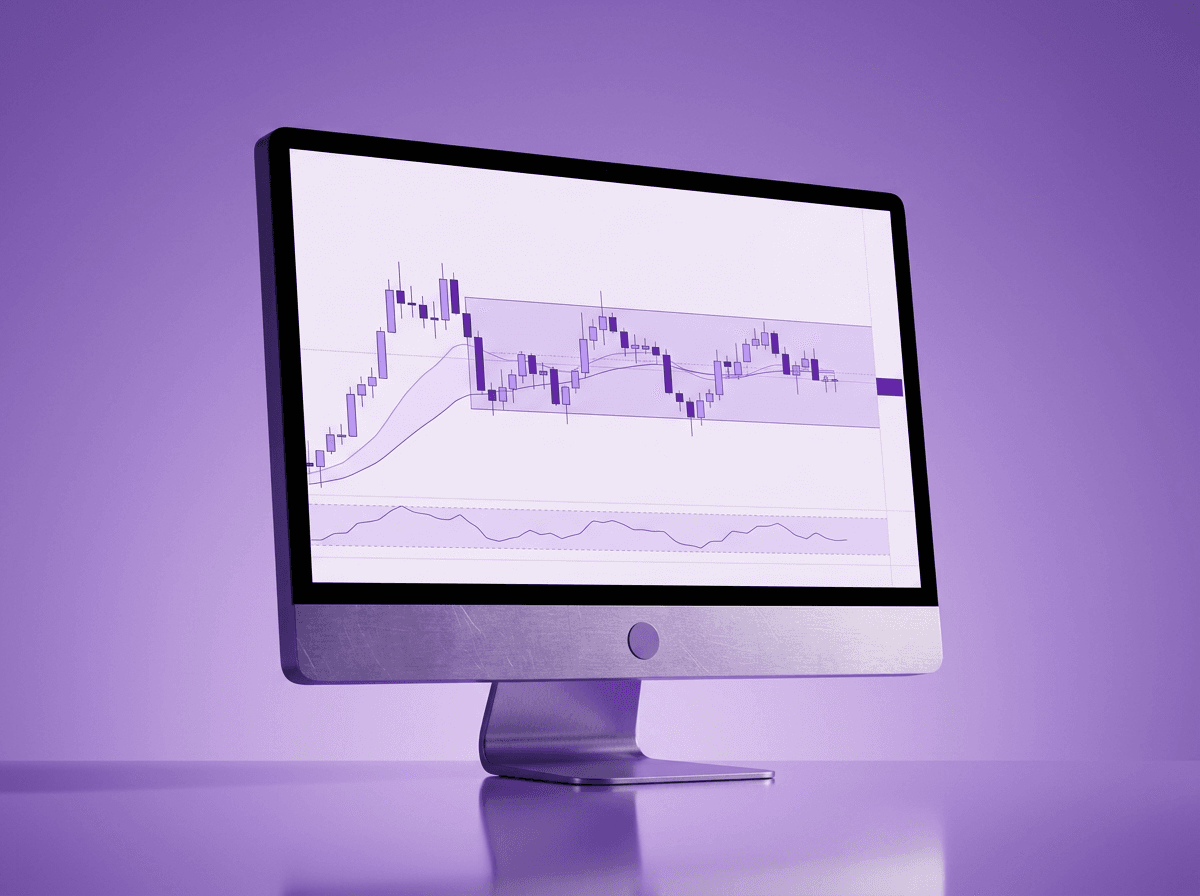
Ranging markets do not announce themselves. One day you are riding clean trends, the next day every setup chops you out before it reaches target. Your strategy has not changed. The market environment has.
The core problem: your risk settings are calibrated for trending conditions. When price trends, momentum carries your trade to target. When price ranges, that momentum disappears. The same 1% risk per trade now has a lower probability of hitting target and a higher probability of getting stopped out on noise.
Traders who keep their normal position size in a range bleed capital slowly. Not through one big loss, but through a string of small ones that compound into a serious drawdown. The fix is not a new strategy. It is adjusting your risk to match the environment.
TL;DR
Ranging markets require smaller position sizes because setups lose their momentum edge.
Cut risk by 50% or more when order flow stalls between a swing high and swing low.
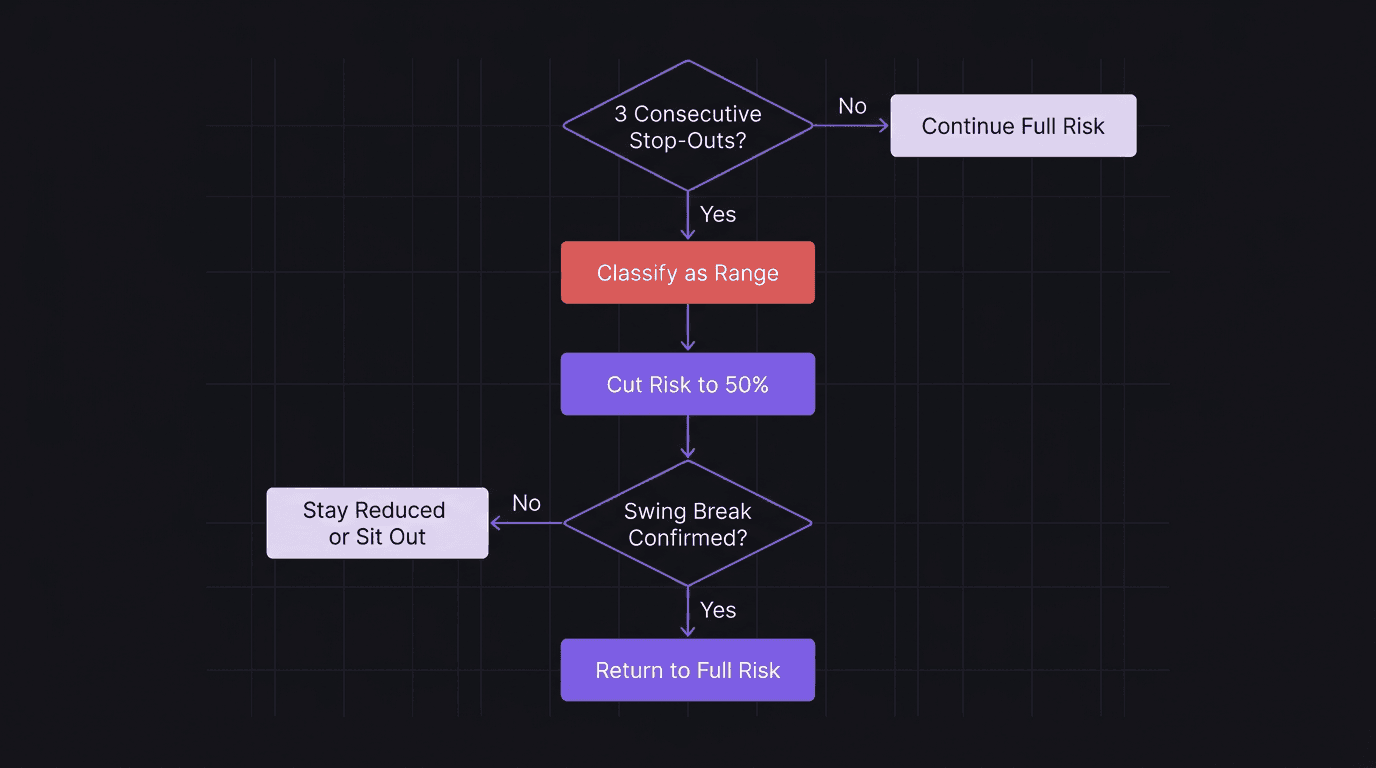
Three consecutive stop-outs is the mechanical trigger to classify the market as ranging and reduce size.
Only return to full risk after a swing-level break of structure confirms direction.
The damage from not adjusting is cumulative: 5 small losses at full size add up faster than most traders expect.
Why Ranges Are More Dangerous Than Trends
In a trending market, the math works in your favor. Your entries get momentum behind them. A 1:2 risk-to-reward target is realistic because price has fuel to travel the distance.
In a range, the math works against you. Your stop loss is the same size, but your target hits resistance (the other side of the range) before reaching your normal take-profit level. So your effective reward-to-risk drops, sometimes below 1:1, while your win rate also drops because entries get faked out by range-bound noise.
Here is the scenario most traders face:
Normal trending setup: 1% risk, 2R target, 50% win rate. Expected value per trade = (0.50 times 2%) minus (0.50 times 1%) = +0.5%.
Same setup in a range: 1% risk, but target gets cut to 1.2R by range resistance, win rate drops to 35% because of false breakouts. Expected value = (0.35 times 1.2%) minus (0.65 times 1%) = 0.42% minus 0.65% = negative 0.23%.
Math check: 0.35 times 1.2% = 0.42%. 0.65 times 1% = 0.65%. 0.42% minus 0.65% = negative 0.23%. Correct.
Every trade in the range has a negative expected value with normal sizing. You are paying money to participate in a market that cannot produce what your strategy needs.
Recognizing the Range Before It Costs You
The structural signs of a ranging market:
Price fails to break swing levels. The weak swing low holds (in a bearish trend) or the weak swing high holds (in a bullish trend). Price bounces back inside the range.
Internal order flow flips repeatedly. Bullish to bearish to bullish again, each time within a tight price range. No internal trend sustains itself for more than one or two legs.
Supply and demand zones produce short reactions. Price touches a zone, bounces 20 pips, then reverses. No sustained impulse legs follow the reaction.
Candles overlap heavily. Long wicks on both sides. No clean directional bodies.
The mechanical trigger: three consecutive stop-outs on setups that require directional follow-through. If your strategy needs momentum and you get stopped out three times in a row, the market is not providing what your strategy needs. Classify it as ranging and adjust.
Do not wait for five or six losses to acknowledge it. Three is enough. Waiting longer just adds to the damage.
Walkthrough: The Range That Drained $600
A trader is running a breakout strategy on GBP/USD with 0.5 lots and a 1% risk per trade on a $10,000 account (risk = $100 per trade). The swing trend was bearish, and they are looking for continuation shorts.
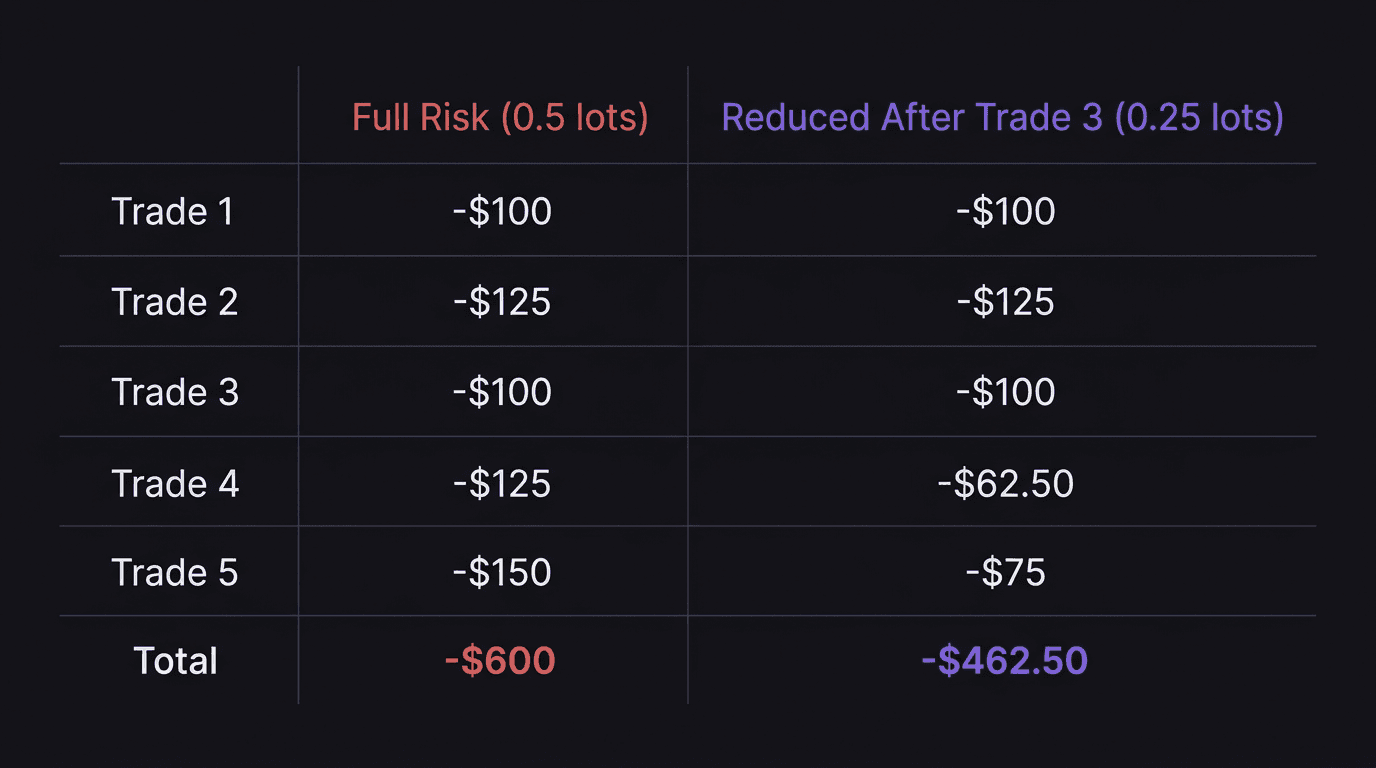
Trade 1: Bearish BOS signal. Short entry with 20-pip stop. Price reverses and stops out. Loss: 0.5 lots times $10 per pip times 20 pips = $100.
Trade 2: Another bearish BOS. Short with 25-pip stop. Price reverses at a demand zone and stops out. Loss: 0.5 lots times $10 per pip times 25 pips = $125.
Trade 3: Internal flow shifts bearish again. Short with 20-pip stop. Price sweeps below a key level and immediately reverses, stopping out. Loss: $100.
The trader is now down $325. They have not recognized that the swing low is holding and the market is ranging. They take two more trades.
Trade 4: Short with 25-pip stop. Loss: $125. Trade 5: Short with 30-pip stop, widened in frustration. Loss: $150.
Total damage: $100 + $125 + $100 + $125 + $150 = $600. That is 6% of the account, gone in one session, on a market that was never going to trend.
If the trader had applied the 3-strike rule after Trade 3 and cut risk to 0.25 lots:
Trade 4 (reduced): 0.25 lots times $10 per pip times 25 pips = $62.50. Trade 5 (reduced): 0.25 lots times $10 per pip times 30 pips = $75.
Total damage with the adjustment: $325 (first three at full size) + $62.50 + $75 = $462.50 instead of $600. That is a $137.50 saving, and it grows larger with every additional trade in the chop.
Math check: $100 + $125 + $100 + $62.50 + $75 = $462.50. $600 minus $462.50 = $137.50 saved. Correct.
The Risk Reduction Protocol
When you classify the market as ranging, follow this protocol:
Step 1: Cut position size by at least 50%. If you trade 0.5 lots normally, drop to 0.25 lots. If you risk 1% per trade, drop to 0.5%. This is the minimum adjustment. In extremely choppy ranges, cut to 25% of normal.
Step 2: Only trade the extremes. Inside a range, the only areas with reasonable probability are the very edges. A short from the range high (the swing supply area) or a long from the range low (the swing demand area). Anything in the middle of the range is a coin flip.
Step 3: Target the opposite boundary. Do not set trend-extension targets in a range. If you short from the range high, your target is the range low. If you long from the range low, your target is the range high. Adjust your reward calculation to the actual range distance.
Step 4: Enforce a tighter daily loss limit. Your normal daily loss limit might be 3% or 5%. In a range, tighten it to 2% or less. This forces you to stop earlier and prevents the "I can make it back" spiral that ranges create.
Step 5: Do not re-scale until direction confirms. Full risk comes back only after a swing-level break of structure. One candle closing outside the range is not enough. You need the break plus the first pullback that holds structure above (or below) the broken boundary.
Why Patience Is Your Best Risk Tool
Here is the uncomfortable truth: the most profitable thing you can do in a ranging market is often nothing.
Not reducing size. Not trading the extremes. Nothing. Sit on your hands and wait for the range to break.
Most traders cannot do this. They feel like they should be trading because the market is open. Each candle that forms without them is a missed opportunity. That feeling is the same one that causes lot sizes that are too big and entries that are too frequent.
Patience in trading is not passive. It is an active decision to protect capital by refusing to deploy it in a low-probability environment. If you earn 2% per week in trending conditions but lose 1.5% per week in ranging conditions, eliminating the ranging-week losses entirely adds 6% per month to your bottom line.
You do not need to make money every day. You need to stop losing money on the wrong days.
Walkthrough: What Sitting Out Looks Like
A trader recognizes the range on Wednesday afternoon after the 3-strike rule triggers. They close their platform and do not trade for the rest of the session. Thursday is the same range. They check the chart, see no break, and do not trade.
Friday morning, price breaks below the range low with a clean bearish candle close. The first pullback holds structure below the broken boundary. The trader re-enters at full risk on the pullback short.
Result: they avoided two days of range losses (estimated $250 to $400 based on average chop damage) and caught the breakout trade that produces a 3R winner at full size.
The two days of sitting out were not wasted time. They were the most profitable decision of the week.
Setting Up Risk-Per-Trade Rules for Both Environments
The adjustment needs to be mechanical, not discretionary. Write it into your risk-per-trade rules so it triggers automatically.
Market Condition | How to Identify | Risk Per Trade | Max Trades Per Day |
|---|---|---|---|
Strong trend (swing and internal aligned) | Clean BOS, impulse legs, zones producing continuation | Full (e.g., 1%) | Per your normal plan |
Weak trend (swing trending, internal choppy) | BOS signals working but pullbacks are erratic | 75% of normal (e.g., 0.75%) | Reduce by 1-2 trades |
Range (no swing break, internal flipping) | 3 consecutive stop-outs, failed swing break | 50% of normal (e.g., 0.5%) | Maximum 2-3 trades |
Extreme chop (every setup fails immediately) | 5+ consecutive stop-outs, no impulse legs | 25% of normal or sit out | 0-1 trades |
Print this table. Put it in your trading plan. Check it at the start of every session and re-check after every third trade.
The goal is not to avoid all losses in ranges. The goal is to make range losses small enough that they do not eat into the profits you earn when the market trends again.
How EdgeFlo Keeps Your Risk in Check
When the market ranges, your judgment is the first thing to degrade. Three losses in a row trigger frustration. Frustration triggers oversizing. Oversizing triggers account damage.
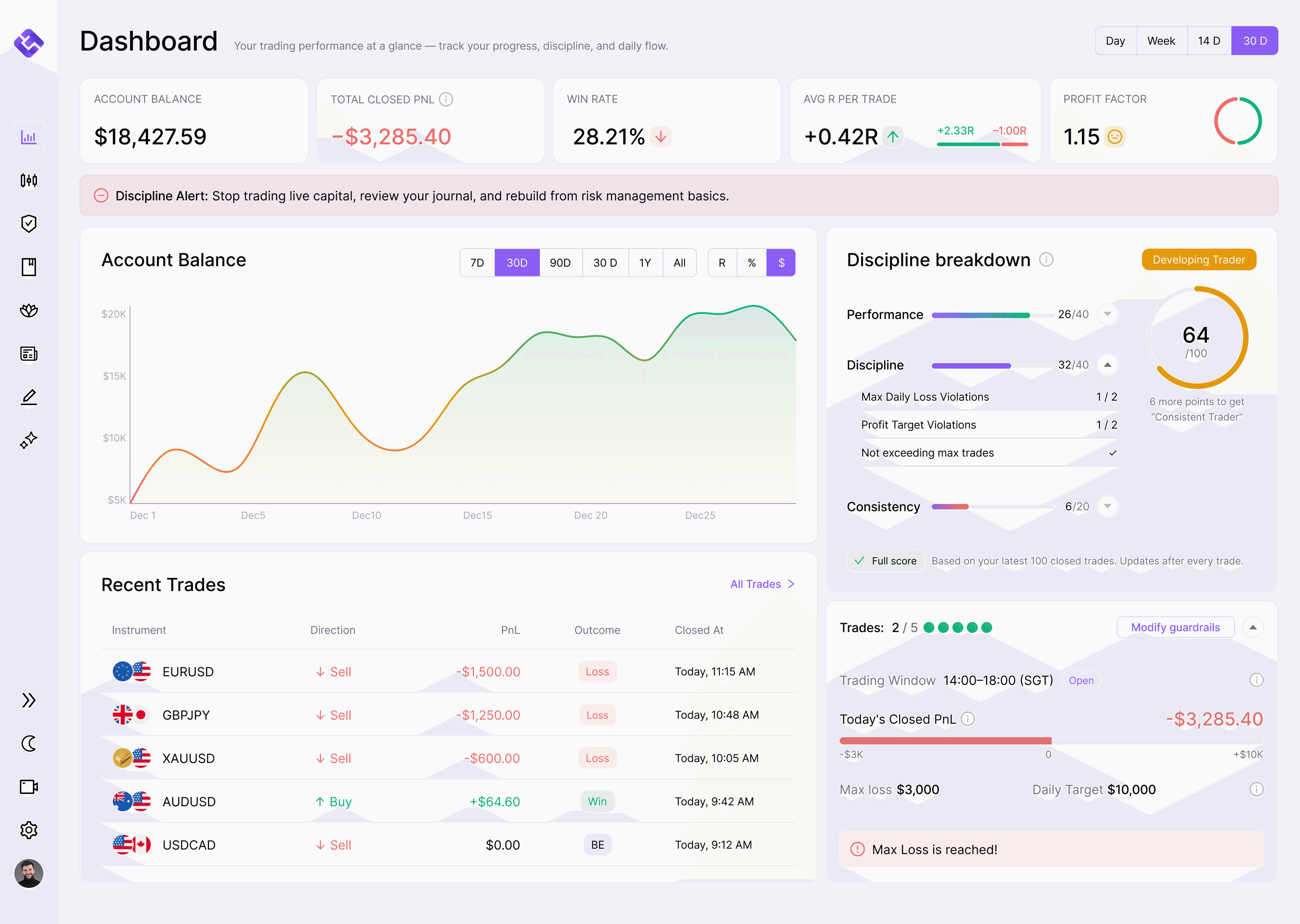
EdgeFlo's daily loss limit guardrail restricts trading when you hit your preset threshold. In a range, this kicks in earlier because your adjusted daily limit is tighter. You can override the guardrail if you decide the next setup is worth it, but the restriction makes the override a conscious act, not an automatic one.
The auto risk calculator recalculates your lot size from the stop distance and your chosen risk percentage. When you drop from 1% to 0.5% risk during a range, the calculator adjusts your lot size instantly. No manual math, no fumbling with a calculator while the market is moving.
Combine the guardrail with a risk-adjustment rule stored in your trading plan, and the system catches you before the emotional spiral begins. That is environment design: making the right action easier than the wrong one.
The Edge Brief
Receive Insights on trading psychology, discipline, and the behavioral patterns that create consistent traders from our Founder and the EdgeFlo team, delivered to your inbox.
Think different. Trade different.
How do I manage risk in a ranging market?
Why is normal position sizing dangerous in a range?
When should I stop trading a ranging market?
How do I know the range is over?

Turn discipline on.
Every session.
EdgeFlo is the environment serious traders operate inside.
Start 7-Day Free Trial
Cancel anytime.
No long-term commitment.

Think Different, Trade Different.