

Qualitative Trading Journal: Track What Numbers Miss
A qualitative trading journal captures emotions, decision rationale, and context that numbers miss. Learn the three questions to answer after every trade.

A qualitative trading journal captures what your spreadsheet cannot: why you took the trade, how you felt during it, and what was happening in your head when you moved your stop or closed early.
Numbers tell you the outcome. Qualitative notes tell you the cause. And in trading, understanding the cause is what actually changes your behavior.
If you have ever looked at your monthly stats, seen a negative number, and genuinely had no idea what went wrong, that is the gap a qualitative journal fills.
TL;DR
A qualitative trading journal records emotions, decision rationale, mental state, and context notes for every trade.
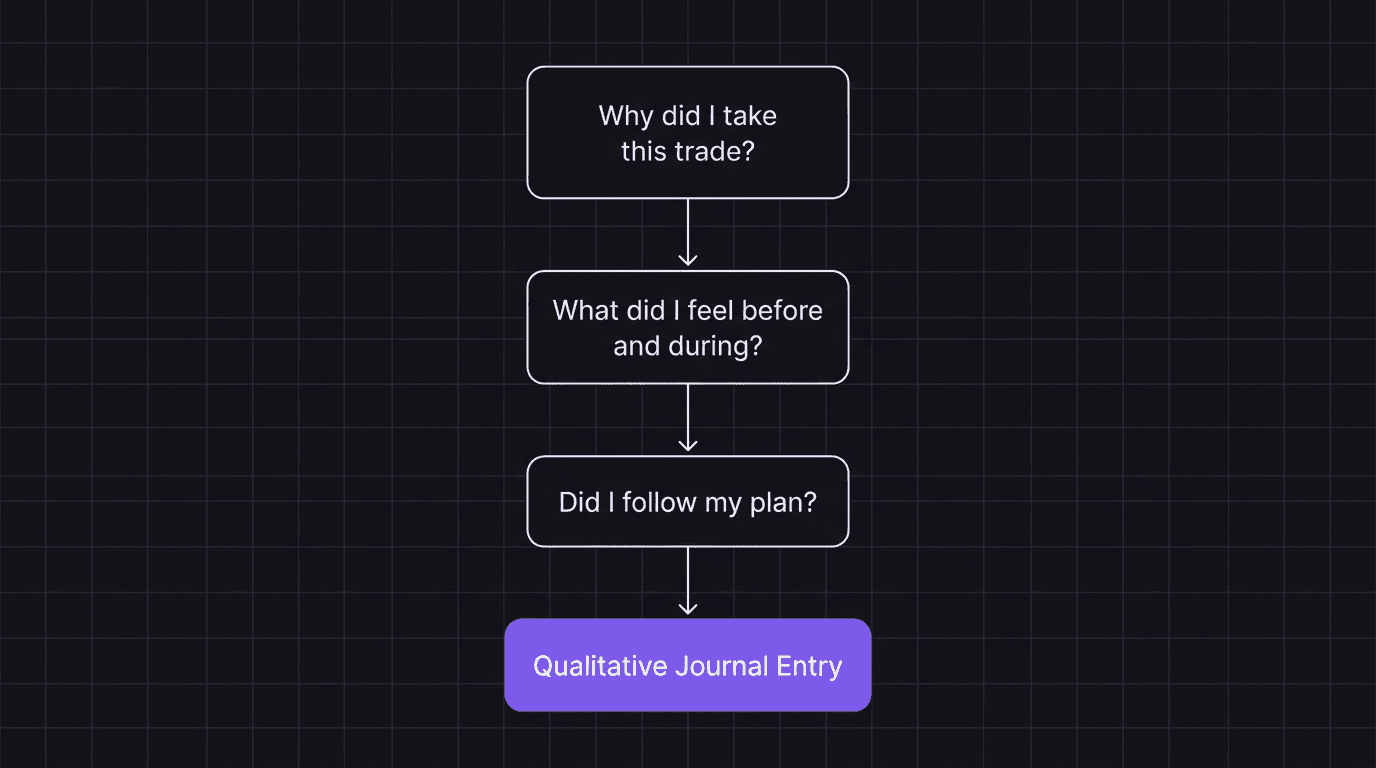
Three post-trade questions drive the entire process: why did I enter, what did I feel, and did I follow my plan?
Emotion tagging creates a searchable record that links your mental state to trade outcomes.
Qualitative data reveals the human errors that numbers alone cannot explain.
When patterns emerge across 20 or more entries, you have enough evidence to change a rule.
What Qualitative Journaling Captures
Your broker account shows you took a trade on EUR/USD at 1.0850 and exited at your stop for a 1R loss. The quantitative data is clean: one loss, negative P&L, standard risk.
But what the numbers miss is everything that matters for improvement.
Were you anxious before entering because you had already missed two setups that morning? Did you feel pressure to take something before the session ended? Was your mental state already tilted from a loss the day before? Did you actually follow your entry criteria, or did you skip the final confirmation because the candle was moving fast?
Qualitative journaling captures all of this. It is the written record of your mental state and the decisions it produced.
Think of it this way. If your quantitative journal is the scoreboard, your qualitative journal is the game film. Coaches do not just look at the final score. They watch the footage, study every play, and figure out why things went right or wrong. Your trade notes serve the same purpose.
The Data You Should Be Recording
Every qualitative entry should cover:
Your thought process at entry. Why did you take this trade? What did you see on the chart? What was your reasoning?
Your emotional state. Were you calm, anxious, bored, frustrated, overconfident? Be honest.
Context notes. What was happening around you? Did you trade during a news event? Were you rushed? Distracted?
Decision rationale for any mid-trade changes. Did you move your stop? Take early profit? Why?
What you learned. One specific takeaway from this trade, win or loss.
This does not need to be an essay. Three to five sentences per trade is enough. The goal is honesty, not length.
The Three Questions to Answer After Every Trade
You do not need a complicated framework to build a useful qualitative journal. Three questions, answered honestly after every single trade, give you more insight than most traders get in a year.
Question 1: Why did I take this trade?
Not "because the setup was there." Be specific. What exact criteria did you see? Did the trade match your plan or did you bend a rule? If you entered because of fear of missing out, write that. If you entered because every checkbox on your checklist was ticked, write that too.
Question 2: What did I feel before and during the trade?
This is where most traders lie to themselves. "I felt fine" is not an answer. Were you excited? Bored? Desperate to make back yesterday's loss? Emotion tagging forces you to name the feeling. Over time, you build a map connecting specific emotions to specific outcomes.
Question 3: Did I follow my plan?
Binary answer. Yes or no. If no, write down exactly which rule you broke and why. If yes, note that too, because a plan-following loss is a completely different animal than an off-plan loss. Both lost money, but only one is a problem.
Walkthrough: A Qualitative Entry That Exposed the Real Problem
Consider this scenario. A trader takes a short on GBP/USD during the London session. The setup met three of four entry criteria, but the fourth (a clean break of structure on the 15-minute chart) was borderline. The trader entered anyway because they had been flat all week and felt restless.
The trade hit the stop loss for a 1R loss.
In the quantitative journal, this looks like any other loss. One more red line on the spreadsheet.
But the qualitative notes tell a different story:
Entry: Took the short even though BOS on M15 was marginal. I was frustrated after three days with no setups. Felt like I needed to trade something. Emotion: restless, slightly desperate. Plan adherence: no, criteria 4 was not fully met.
Now the trader has evidence. This was not a probability loss. This was a discipline failure driven by boredom and frustration. And if similar notes appear after 5 or 10 more trades, the pattern is undeniable: restlessness leads to criteria-bending, which leads to low-quality entries.
No spreadsheet would ever surface that insight. Only the written notes can.
Connecting Emotions to Outcomes
Emotion tagging is the most powerful feature in a qualitative journal, and most traders never use it.
The idea is simple. Every trade gets one or two emotion tags. Calm. Anxious. Confident. Frustrated. Bored. Revenge. FOMO.
After 30 or 40 tagged trades, you filter your results by emotion. What is your win rate on trades tagged "calm"? What about trades tagged "frustrated"? The connection between emotions and outcomes becomes visible in the data.
This is not soft psychology. This is measurable. If your win rate on "calm" trades is 50% and your win rate on "frustrated" trades is 20%, you have a concrete, data-backed reason to stop trading when you notice frustration building.
Sound familiar? Most traders suspect their emotions hurt their performance. Emotion tagging turns that suspicion into proof.
Building Your Emotion-Outcome Map
After your first month of emotion-tagged entries, create a simple table:
Emotion Tag | Total Trades | Win Rate | Avg R |
|---|---|---|---|
Calm | 15 | 47% | 1.8R |
Anxious | 8 | 25% | 0.6R |
FOMO | 5 | 20% | 0.3R |
This is the kind of data that changes behavior. Not because someone told you to "manage your emotions," but because you can see, in your own numbers, exactly what each emotional state costs you.
Your post-trade review should include reviewing this table monthly and updating it with fresh data.
When Qualitative Data Changes Your Rules
Qualitative journaling is not just for self-awareness. It is where rule changes come from.
Here is how it works. You notice a pattern in your notes. Over the last quarter, seven out of ten trades taken after 2 PM your local time were tagged "fatigued" or "rushed." Six of those seven were losses.
The numbers in your quantitative journal would show those losses, but they would be mixed in with all your other trades. The qualitative notes isolate the pattern and point directly at the cause: you trade worse in the afternoon because you are tired.
Now you have enough evidence to make a rule change. "I will not take new entries after 2 PM." This is not a guess or a feeling. It is a data-driven decision that came from your own written records.
The review process is where these patterns surface. Weekly reviews catch small emotional patterns. Monthly reviews catch bigger behavioral trends. Quarterly reviews are where rule changes get implemented.
When NOT to Change Your Rules
One or two bad qualitative entries do not justify a rule change. You need a pattern across at least 15 to 20 trades before the evidence is strong enough.
If you changed a rule every time you had a bad day, you would rewrite your plan weekly and never build consistency. The qualitative journal protects you from that trap too, because you can look back and see whether the problem is a genuine pattern or a one-off bad session.
How EdgeFlo Captures Qualitative Data
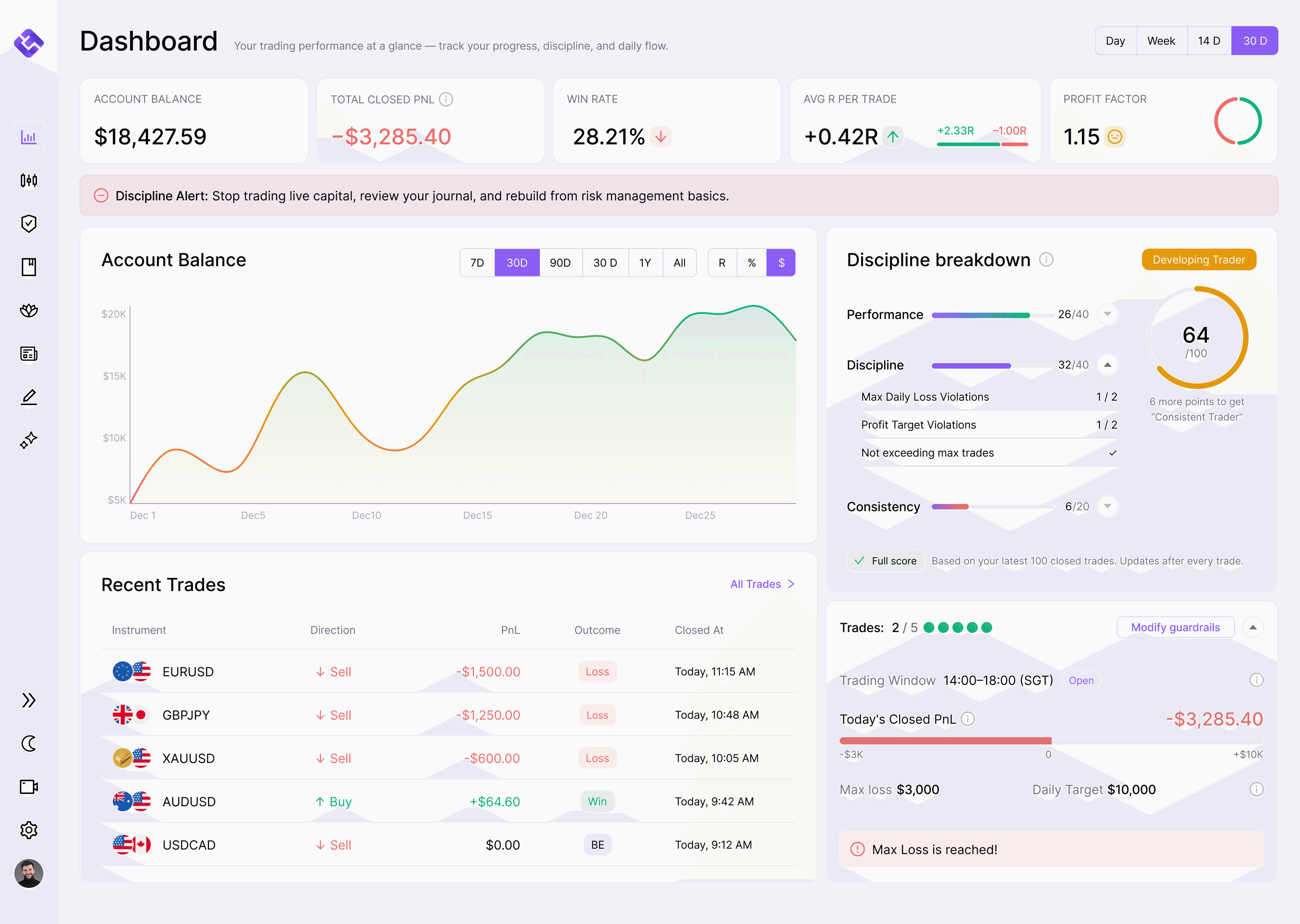
EdgeFlo's trading journal includes emotion tagging built into the trade review flow. After each trade, you tag your emotional state and add context notes directly alongside the auto-imported quantitative data.
The weekly AI report (Plus plan) surfaces patterns in your emotion tags and flags correlations between mental state and performance that you might miss during manual review. It does not tell you what to feel. It shows you what your feelings cost.
If you have been keeping qualitative notes in a separate notebook or document, EdgeFlo brings those notes into the same interface as your charts, your metrics, and your trade plan, so everything connects.
The Edge Brief
Receive Insights on trading psychology, discipline, and the behavioral patterns that create consistent traders from our Founder and the EdgeFlo team, delivered to your inbox.
Think different. Trade different.
What is qualitative trading journaling?
How is qualitative journaling different from quantitative journaling?
What should I write in a qualitative trade journal?
How often should I review my qualitative journal notes?

Turn discipline on.
Every session.
EdgeFlo is the environment serious traders operate inside.
Start 7-Day Free Trial
Cancel anytime.
No long-term commitment.

Think Different, Trade Different.