

Pullback Trading: Fractal, Internal, and Swing
Not all pullbacks are equal. Learn how to classify fractal, internal, and swing pullbacks and adjust your trade plan for each type.

A pullback is price moving temporarily against the trend before continuing. But not all pullbacks are the same. Fractal pullbacks last a few candles and barely register. Internal pullbacks develop between swing points and create real trading opportunities. Swing pullbacks are the deepest retracements and can look like reversals if you do not know the difference. The type of pullback determines your trade plan: your entry zone, stop placement, target, and how long you should expect to hold.
Most traders treat every dip in an uptrend the same way. That is a mistake. A 15-minute fractal pullback does not deserve the same response as a multi-day swing pullback.
TL;DR
Fractal pullbacks are minor, candle-level retracements. Noise. Usually not tradeable on their own.
Internal pullbacks happen between swing points and create the best continuation entries.
Swing pullbacks are deep retracements that test the entire trend. They can become reversals.
Identify the pullback type before deciding whether to enter, wait, or step aside.
The first sign of a pullback at each level is a market structure shift at the level below it.
Three Types of Pullbacks
Price cannot move in one direction forever. Every impulse move is followed by a retracement. The question is always: how significant is this retracement?
The answer depends on which structural level the pullback is occurring at.
Fractal pullbacks are the smallest. They show up as a few candles moving against the immediate direction. On a 15-minute chart, a fractal pullback might last 2-3 candles. These are caused by short-term profit-taking, order flow imbalances, or simply the natural breathing rhythm of price. Fractal pullbacks rarely reach significant zones and often resolve so quickly that trading them is impractical.
Internal pullbacks are the meat of the move. They happen between your swing high and swing low. After an impulse that creates a new swing high, internal structure begins pulling back. Internal pullbacks typically retrace into the discount zone of the impulse move (below the 50% midpoint) and create clear supply and demand zones for entries.
Swing pullbacks are the deepest. They retest the entire previous impulse move. A swing pullback in a bullish trend can retrace all the way back to the swing low. These pullbacks are the scariest to trade because they look and feel like reversals. The difference is whether the swing low holds or breaks.
Fractal vs Internal vs Swing Pullback
The structural level of the pullback determines everything about how you respond to it. Here is how to classify what you are seeing.
Reading the Signals
A fractal market shift (wick break against the trend on the smallest level) is the first sign that a pullback is starting. But which kind of pullback?
If the fractal shift resolves quickly and price resumes trending, it was a fractal pullback. No big deal.
If the fractal shift leads to an internal market structure shift (body close against the trend on the internal level), the pullback is now internal. This is where your attention should sharpen. Internal pullbacks create the zones where continuation entries form.
If the internal pullback deepens and price eventually creates a swing BOS against the trend, the pullback has become a reversal. At this point, the original trend is over. New market structure is forming.
The cascade goes: fractal shift, then internal shift, then swing break. Each level up means the pullback is deeper and more significant. You do not have to predict which level the pullback will reach. You just have to read which confirmation has printed so far.
How Deep Is It Going?
Here is a rough framework:
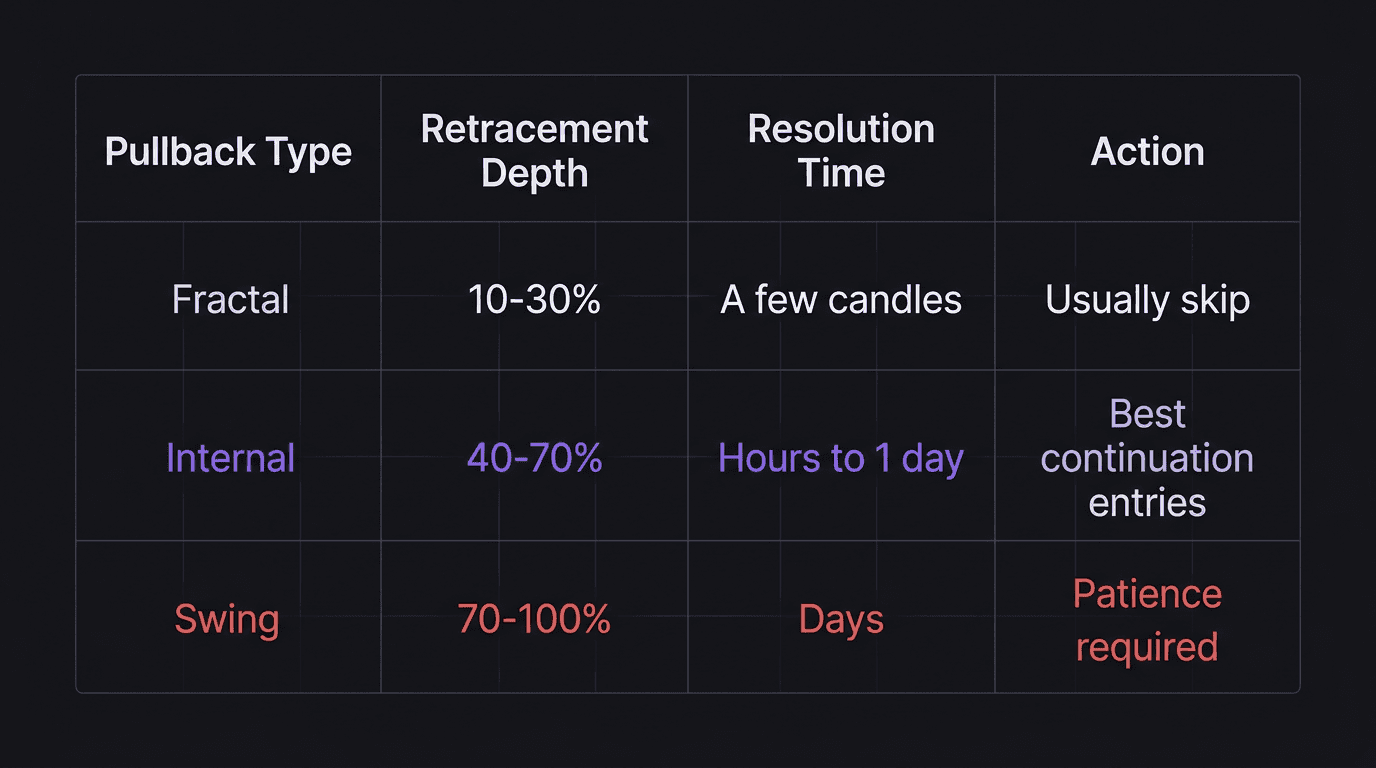
Fractal pullback: Retraces 10-30% of the last impulse. Barely enters premium zone. Resolves within a few candles.
Internal pullback: Retraces 40-70% of the swing impulse. Enters the discount zone. Takes hours to a day to resolve.
Swing pullback: Retraces 70-100% of the entire previous swing. Tests the swing low (or high). Can take days.
These are guidelines, not exact numbers. The structural confirmation is what matters, not the percentage depth.
How to Trade Each Pullback Type
Each pullback type demands a different plan. Using the same approach for all three is one of the most common trading mistakes.
Fractal Pullbacks: Usually Skip
Fractal pullbacks are mostly noise. If you are already in a position, a fractal pullback should not make you exit. If you are waiting for an entry, a fractal pullback does not give you a meaningful zone to enter from.
The exception: fractal pullbacks can provide micro-entries within a larger internal pullback. If internal structure has already shifted back with the trend and you are waiting for a precise entry, a fractal pullback into a lower timeframe zone can give you a tight stop. But this is advanced execution, not a standalone strategy.
Internal Pullbacks: Your Bread and Butter
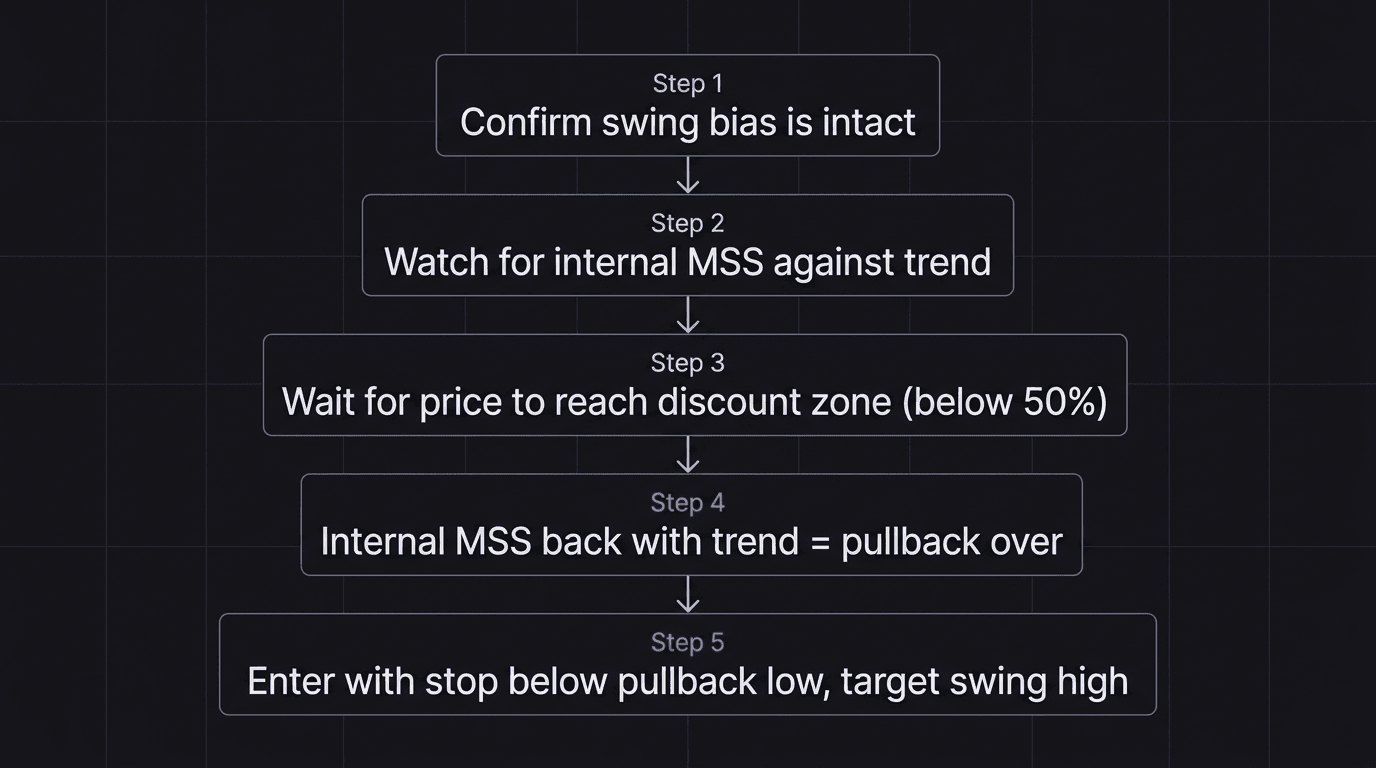
Internal pullbacks are where the best continuation trades live. Here is the process.
Step 1: Confirm your swing bias is intact. Higher highs and higher lows (bullish) or lower highs and lower lows (bearish) on the higher timeframe.
Step 2: Watch for an internal MSS against the trend on your setup timeframe. This confirms the pullback has started.
Step 3: Wait for price to retrace into the discount zone of the last impulse. This is your entry area.
Step 4: Wait for an internal MSS back with the trend. This confirms the pullback is over and continuation is starting.
Step 5: Enter with a stop below the pullback low (for bullish) and target the swing high.
Walkthrough: Internal Pullback on EUR/USD
EUR/USD 1-hour chart. Swing structure is bullish. Most recent swing high at 1.0940, swing low at 1.0830.
Price pulls back from 1.0940. Internal structure shifts bearish on the 1-hour (body close below a minor swing low at 1.0915). This is the internal MSS that confirms the pullback has started.
Price drops into the discount zone, below the 50% level at 1.0885. It reaches 1.0860, which is inside a demand zone from a previous swing.
A 1-hour candle then closes its body above the internal swing high at 1.0880. Internal structure has shifted back bullish. Swing is bullish. Internal just shifted bullish. Alignment.
You enter long at 1.0882. Stop below the pullback low at 1.0855 (27 pips). Target: retest of swing high at 1.0940 (58 pips). Risk to reward: 2.15R.
Your trading playbook defines this setup: bullish swing, internal pullback into discount, internal bullish MSS, enter on alignment.
Swing Pullbacks: Patience Required
Swing pullbacks test your patience and your convictions. Price retraces so deeply that it feels like the trend is over.
The key question: Has the swing low (in a bullish trend) or swing high (in a bearish trend) been broken with a body close?
If no, the pullback is still a pullback. The trend structure is intact even though it feels terrible. You wait for internal structure to realign with the swing direction, then enter.
If yes, the pullback is no longer a pullback. It is a trend change. Update your bias.
Walkthrough: Swing Pullback That Looked Like a Reversal
GBP/USD daily chart. Bullish swing structure. Swing high at 1.2850, swing low at 1.2580.
Price drops from 1.2850 all the way to 1.2600. That is a 250-pip drop and it retraces 92% of the impulse. It looks catastrophic. Social media is calling the top.
But the swing low at 1.2580 has not been broken with a body close. The daily candle at 1.2600 has a wick to 1.2588 but closes at 1.2602. Swing structure is technically still intact.
Price consolidates between 1.2600-1.2630 for two days. Internal structure shifts bullish on the 4-hour chart. You enter long at 1.2635 with a stop below 1.2575 (below the swing low, 60 pips). Target: swing high at 1.2850 (215 pips). Risk to reward: 3.6R.
The pullback was terrifying. But the structure was clear. The swing low held.
When the Pullback Becomes a Reversal
This is the most important read you make as a pullback trader. Here are the signals:
Signal 1: Swing point breaks with a body close. This is the definitive confirmation. If a bullish trend's swing low breaks with a body close, the trend is over. No debate.
Signal 2: Internal structure fails to realign. After an internal pullback, internal structure should eventually shift back with the swing trend. If internal structure keeps making lower highs and lower lows (in a bullish trend) and never realigns, the pullback is becoming a reversal.
Signal 3: The pullback exceeds the origin. If price retraces past the starting point of the impulse move that created the swing high, the entire move has been erased. Even without a formal swing BOS, this is a strong warning.
When you see these signals, step aside. Do not try to catch the bounce. Wait for new swing structure to form in the new direction, then trade with that structure.
Knowing when to stop treating a pullback as a buying opportunity is what separates breakeven traders from profitable ones. It is uncomfortable. It means accepting that your original bias was right until it was not. But the alternative is averaging into a loss and hoping, which is not a strategy.
How EdgeFlo Supports Pullback Trading Discipline
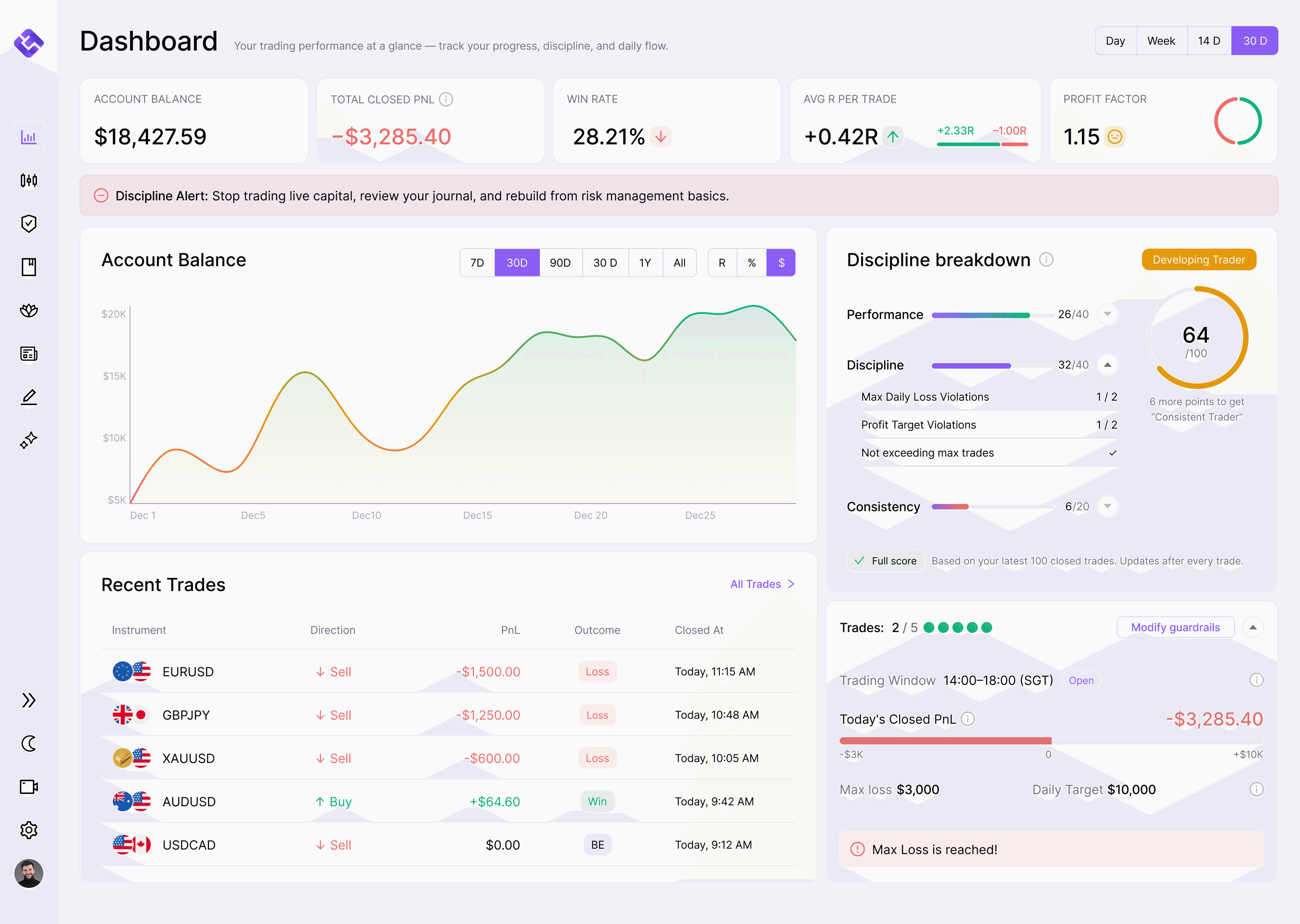
The hardest part of pullback trading is not the analysis. It is sitting through the pullback without panicking, exiting early, or revenge-entering. EdgeFlo's trade plan builder keeps your pullback rules (which level, which zone, which confirmation) visible next to your chart. You do not have to remember whether you decided to trade internal or swing pullbacks today. The plan is right there.
EdgeFlo's journal lets you categorize trades by pullback type. After 30-50 trades, you can see which pullback type you trade best and which one causes the most mistakes. That data guides your playbook refinement.
Most traders intellectually understand pullback structure. The gap between understanding and execution is where EdgeFlo fits. It turns your pullback rules into a visible, trackable system so discipline is a feature of your environment, not a test of your willpower.
The Edge Brief
Receive Insights on trading psychology, discipline, and the behavioral patterns that create consistent traders from our Founder and the EdgeFlo team, delivered to your inbox.
Think different. Trade different.
How do I know if a pullback is over?
Should I trade during a pullback or wait for it to finish?
What is the difference between a pullback and a reversal?
How deep should a healthy pullback go?

Turn discipline on.
Every session.
EdgeFlo is the environment serious traders operate inside.
Start 7-Day Free Trial
Cancel anytime.
No long-term commitment.

Think Different, Trade Different.