

Process Journaling: Track Actions, Not Just P&L
Process journaling tracks whether you followed your plan, not just whether you made money. Learn what to log and why it matters more than P&L.
Process journaling tracks whether you followed your trading plan, not whether you made money. Most traders only log P&L. They know they finished the week up $400 or down $200, but they have no idea which trades followed their rules and which ones were impulse entries. A process journal flips this. You record the action you took, the rule behind it, and whether you executed as planned. Over time, that data shows you exactly where your consistency breaks down and where your edge actually comes from.
TL;DR
Process journaling records actions (did you follow the plan?) instead of just outcomes (did you profit?).
After every trade, log the setup, your emotional state, and whether you followed entry and exit rules.
A profitable trade taken off-plan is a warning, not a win.
Weekly pattern review turns scattered entries into clear improvement targets.
Consistent process logging reveals leaks that P&L alone will never show you.
What Is Process Journaling
A process journal is a post-trade log that focuses on execution quality, not dollars. The idea comes straight from how real businesses operate. Every business runs on systems and processes. If the system breaks, the output suffers. Trading works the same way. Your strategy is the system. Your daily execution is the process. And your journal is the only tool that tells you whether the process ran correctly.
Think of it like a pilot's checklist. After every flight, the crew doesn't just write "landed safely." They note every step they performed, any deviation from procedure, and what conditions they faced. The outcome (safe landing) is secondary. What matters is whether the process was followed. Because a safe landing with a skipped step is a near-miss, not a success.
In trading terms: you write down what setup you saw, what your plan said to do, what you actually did, and how you felt while doing it. That last part matters more than you think. If you followed every rule but felt panicked the entire time, that is useful data. If you broke a rule but felt calm and confident, that is also useful data (and a red flag).
The logic is straightforward: consistent action leads to consistent results. You cannot know whether your actions are consistent if you never record them.
P&L Journaling vs Process Journaling
P&L journaling is what most traders start with. You open a spreadsheet, type in the pair, the entry price, the exit price, and the profit or loss. Maybe you add the date. That is the entire record.
Here is what P&L journaling tells you: how much money you made or lost. Here is what it does not tell you: why.
You could have five winning trades in a week, all taken off-plan. Pure luck. A P&L journal says "great week." A process journal says "five rule violations that happened to work out." Which one tells you the truth?
The reverse is equally important. You might have a week of small losses where every single trade followed your plan perfectly. Your P&L journal says "bad week." Your process journal says "flawless execution in a choppy market." That is the kind of week you want to replicate, not avoid.
Sound familiar? Most traders who struggle to build a journaling habit hit this exact wall. They log numbers, see red, get discouraged, and stop writing. Process journaling survives that cycle because it gives you something useful even during losing streaks.
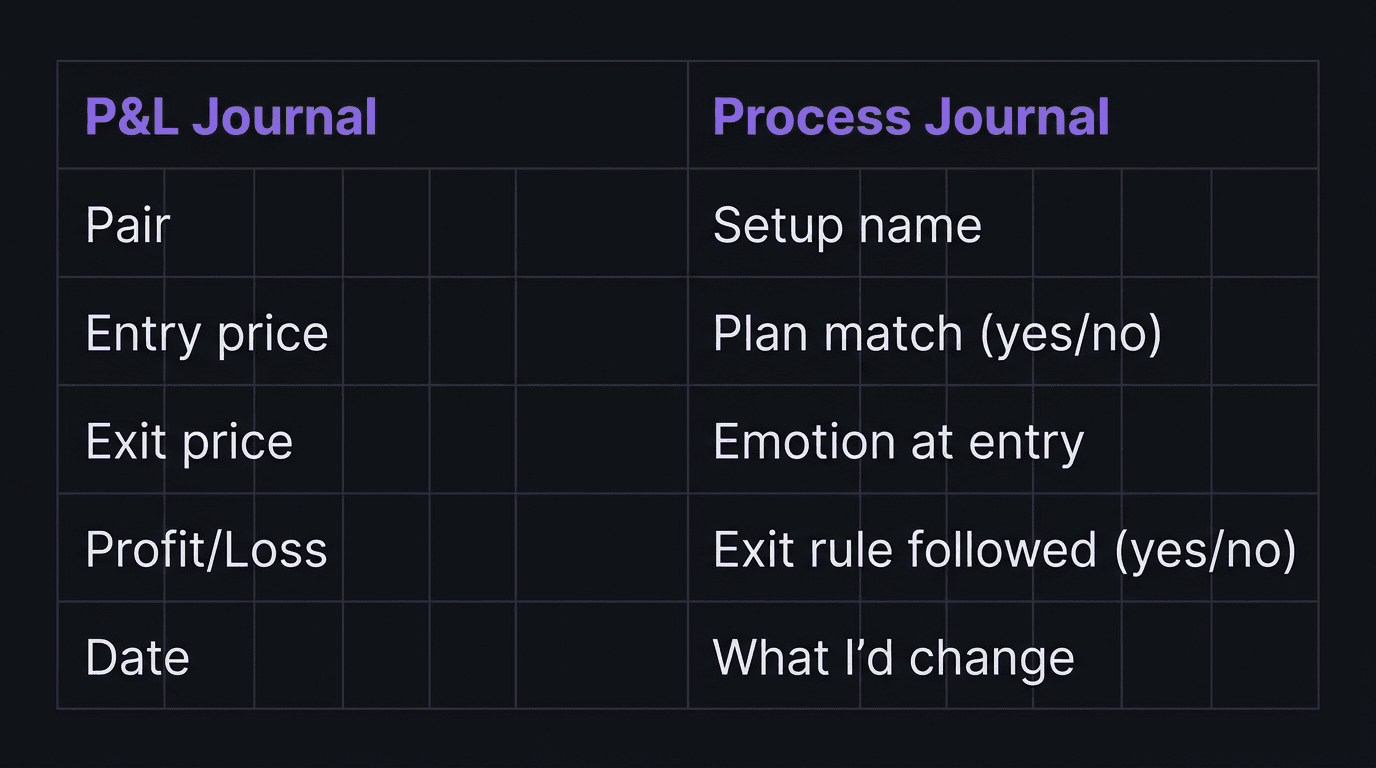
The difference is not just what you write. It is what you can do with the data afterward. P&L data tells you your win rate. Process data tells you why your win rate is what it is.
What to Log After Every Trade
Keep it short. If your journal entry takes ten minutes, you will stop doing it within two weeks. Here are the fields that matter.
Setup name. What pattern or criteria triggered the trade? "London session breakout from demand zone" is useful. "Looked good" is not.
Plan match. Did this trade meet every criterion in your trading journal template? Yes or no. Binary. No partial credit.
Emotion at entry. One word. Calm, anxious, excited, bored, frustrated, confident. Be honest. Nobody reads this but you.
Exit rule followed. Did you exit where your plan said to exit, or did you close early, move your stop, or hold past your target? Again, yes or no.
One-line lesson. What would you do differently, or what went right that you want to repeat? One sentence. Force yourself to distill it.
That is five fields. You can fill them out in under two minutes while the trade is still fresh. The key is doing it immediately. If you wait until the end of the session, your memory edits the story. You start rationalizing the impulse trade as "close enough to my plan." You soften the emotion from "panicked" to "slightly uncertain."
Write it while the feelings are still uncomfortable. That is where the real data lives.
How Process Journals Reveal Hidden Leaks
Here is the thing about trading leaks: they hide in winning trades. A P&L journal never catches them because the trade made money.
Imagine you take three trades in a week. All three hit target. Your P&L journal shows three green entries. But your process journal shows that trade one followed your plan, trade two was an impulse entry on a pair you do not normally trade, and trade three had you moving your stop loss twice before it finally worked out.
One good trade. Two accidents that happened to pay. Without the process log, you would think all three were proof that your system works. With it, you can see that two-thirds of your "wins" were not wins at all. They were bad losses in disguise, just with a positive sign.
Over a few weeks, patterns emerge. Maybe you notice that every Friday afternoon trade breaks a rule. Maybe your "bored" entries have a 20% plan-match rate while your "calm" entries sit at 85%. Maybe you follow your exit rules on winners but panic-close losers at half the intended stop.
These patterns are invisible in P&L data. They are obvious in process data. And once you see them, you can fix them.
This is the real purpose of journaling: it exists so you can replicate your wins, learn from your mistakes, and do more of what works and less of what doesn't. But you can only replicate wins you actually understand. A win you cannot explain is not repeatable.
Walkthrough: One Week of Process Entries
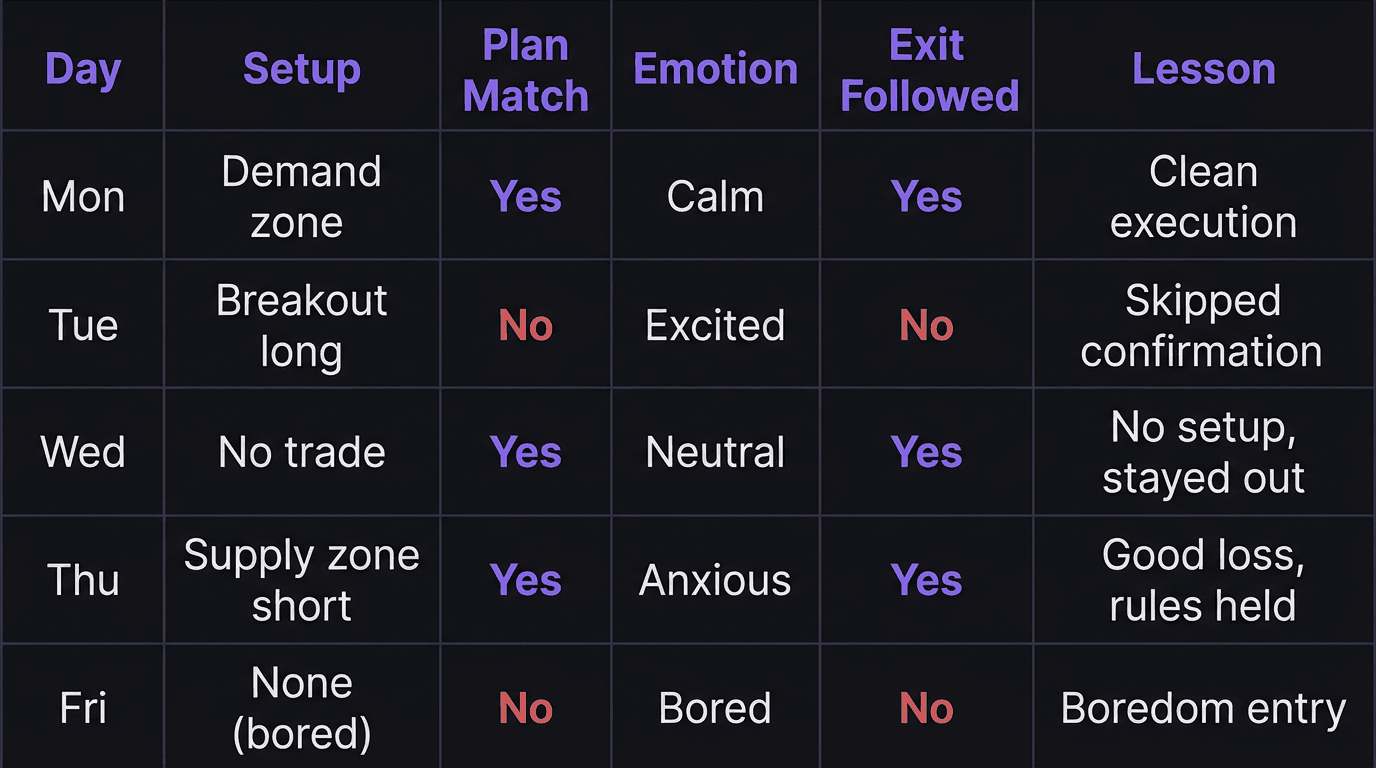
Monday: EUR/USD London Session
Setup: Demand zone entry after liquidity sweep. Plan match: yes. Emotion: calm. Exit followed: yes, took full target at 1.5R. Lesson: clean execution, patience paid off.
Tuesday: GBP/USD New York Open
Setup: Breakout long after news. Plan match: no (entered before confirmation candle). Emotion: excited. Exit followed: no (moved stop to break-even early, got stopped out before target). Lesson: excitement at entry is a warning sign. Confirmation candle exists for a reason.
Wednesday: No trade
Sat on hands. No valid setup appeared. Logged "no trade, plan followed." This entry matters. It proves you can do nothing when the market gives you nothing.
Thursday: EUR/USD London Session
Setup: Supply zone short after break of structure. Plan match: yes. Emotion: slightly anxious (two-day gap since last trade). Exit followed: yes, hit stop loss at 1R. Lesson: anxiety from inactivity, but rules held. Good loss.
Friday: AUD/USD Sydney Carryover
Setup: None in plan. Plan match: no (boredom trade). Emotion: bored. Exit followed: partial (closed at small profit before target). Lesson: boredom entry, early exit. Two rule breaks on one trade.
The Weekly Review
Now read Monday through Friday back to back. Three valid setups (Monday, Wednesday's sit-out, Thursday). Two off-plan trades (Tuesday and Friday). Both off-plan trades came with emotional flags: excitement and boredom.
The pattern: rule breaks cluster around emotional extremes. Not fear or anger. Excitement and boredom. That is a leak you can act on. Next week, you might add a simple gate: if the emotion word is "excited" or "bored," wait five minutes and re-check the plan before entering.
That single adjustment, found through five two-minute journal entries, could prevent two losing trades per week. Over a month, that compounds. This is what trading consistency actually looks like in practice. Not willpower. Data.
When you review your losing trades through this lens, you stop asking "what went wrong with the market" and start asking "what went wrong with my process." That second question has answers you can actually control.
How EdgeFlo Supports Process Journaling
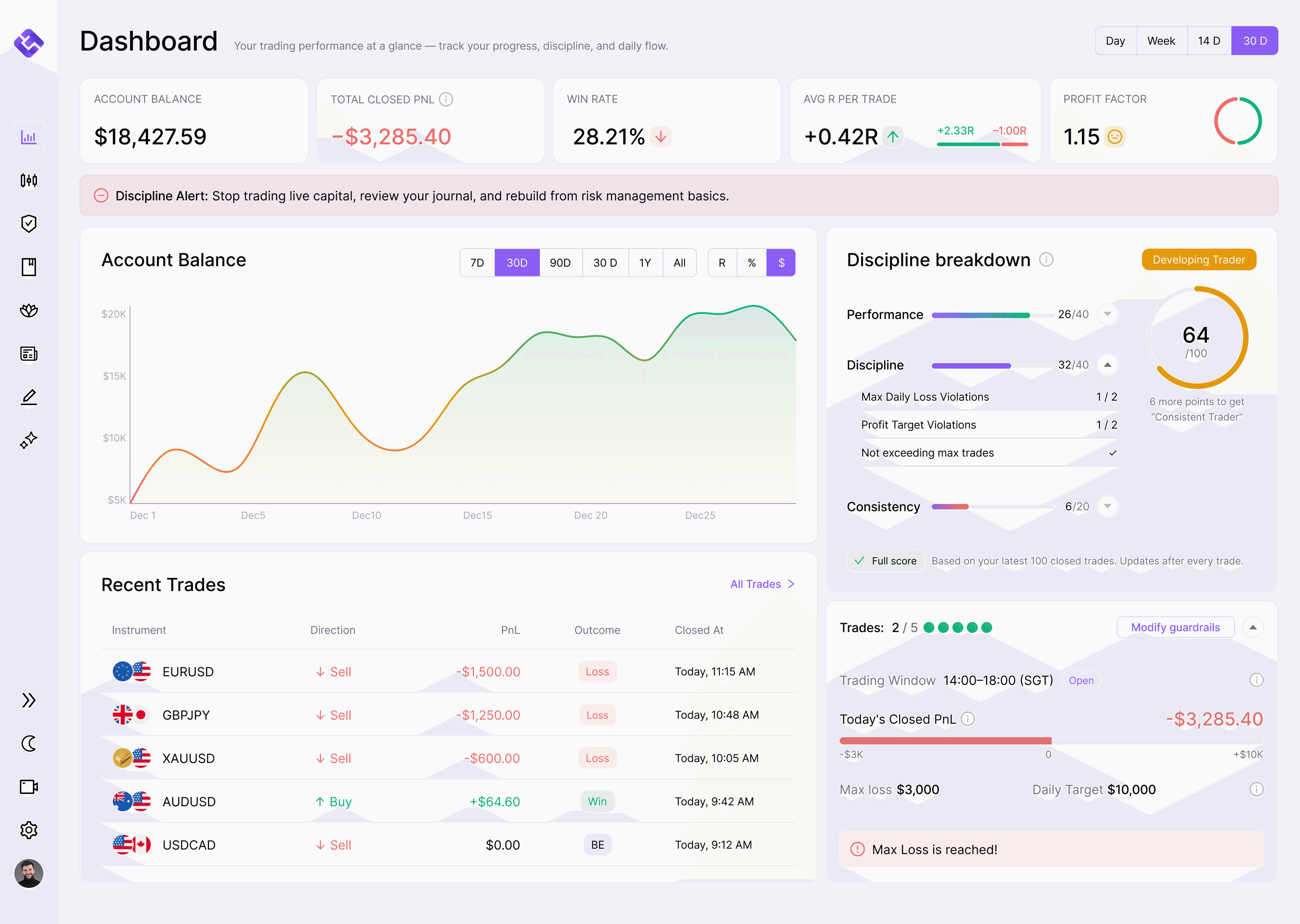
EdgeFlo's journal auto-imports your trades, so the mechanical part (pair, entry, exit, P&L) is already filled in. You do not waste time on data entry that a machine handles better than you.
The process layer sits on top. Emotion tagging lets you mark each trade with how you felt at entry, turning that one-word field from the walkthrough into structured, searchable data. After a few weeks, you can filter your journal by emotion and see your plan-match rate for each state. That pattern from the walkthrough (excitement and boredom causing rule breaks) shows up as a clear filter result, not a guess.
Post-trade self-reporting in the Edge plan builder closes the loop. You document your plan rules, and after each trade, you report whether you followed them. The plan and the journal live in the same place, so the gap between "what I said I'd do" and "what I actually did" is visible on one screen. No switching between apps, no forgetting to cross-reference.
The Edge Brief
Receive Insights on trading psychology, discipline, and the behavioral patterns that create consistent traders from our Founder and the EdgeFlo team, delivered to your inbox.
Think different. Trade different.
What is process journaling in trading?
How is process journaling different from P&L journaling?
What should I write in a process journal after a trade?
How often should I review my process journal?

Turn discipline on.
Every session.
EdgeFlo is the environment serious traders operate inside.
Start 7-Day Free Trial
Cancel anytime.
No long-term commitment.

Think Different, Trade Different.