

Good Loss vs Bad Loss in Trading
Not all trading losses are equal. Learn to separate plan-following losses from rule-breaking losses and journal each type differently to improve faster.
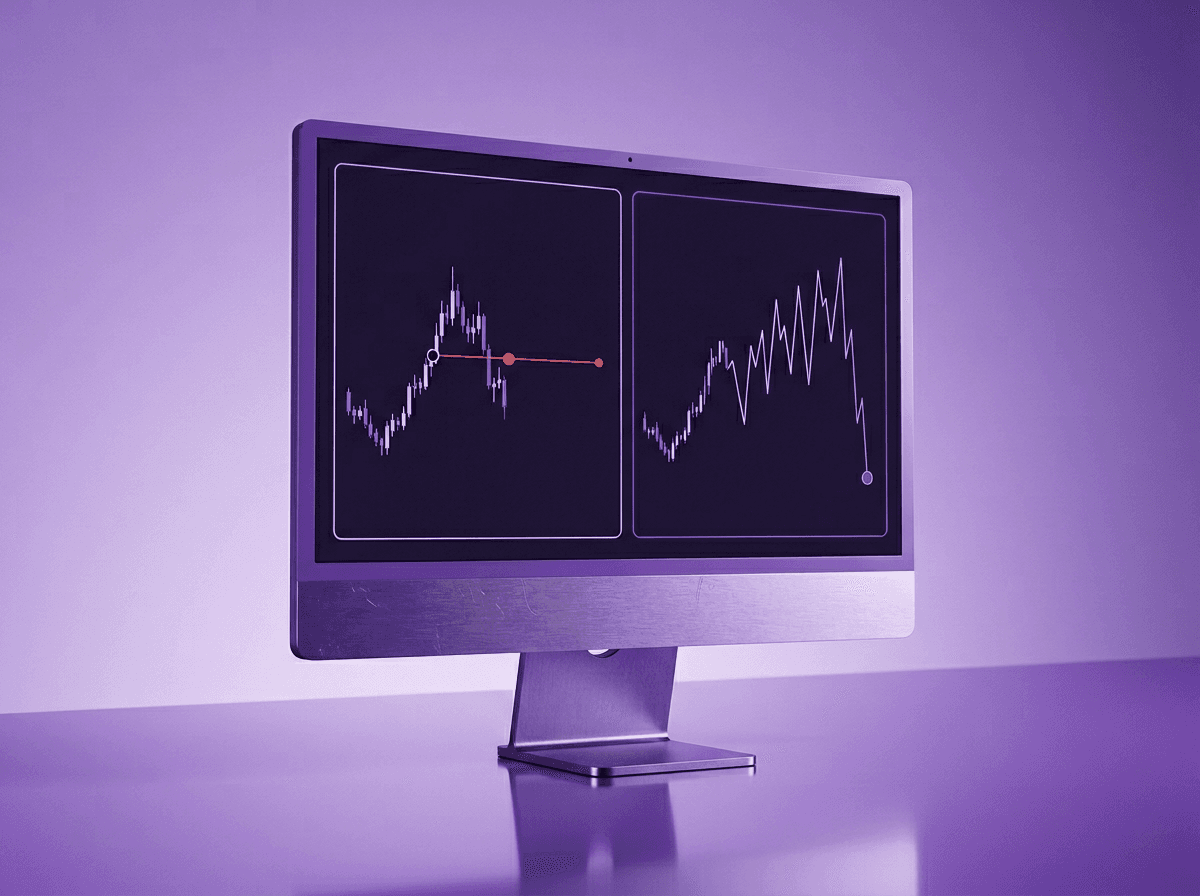
A loss where you followed every rule in your trading plan is fundamentally different from a loss where you entered on impulse, ignored your stop level, or traded out of ego. The first is a cost of doing business. The second is a self-inflicted wound. Most traders treat every loss the same way: they feel bad, try to forget it, and move on. That is how the same mistakes keep repeating.
The distinction between a good loss and a bad loss is the single most useful framework for your trading journal. It separates variance (which you cannot control) from discipline failures (which you can fix). Once you start categorizing your losses this way, your journal stops being a guilt log and becomes a diagnostic tool.
TL;DR
Good losses happen when you follow your plan and the market goes against you. No fix required.
Bad losses happen when you break your rules. These require root cause analysis.
A trader lost $30,000 in one week: two bad losses from impulse and ego, one good loss from variance.
Journal good losses with a note on market conditions. Journal bad losses with the specific rule you broke and the emotional trigger.
Over time, bad loss patterns reveal the behavioral fixes that actually improve your results.
Two Types of Trading Losses
Every loss you take falls into one of two categories. The category determines what you do next.
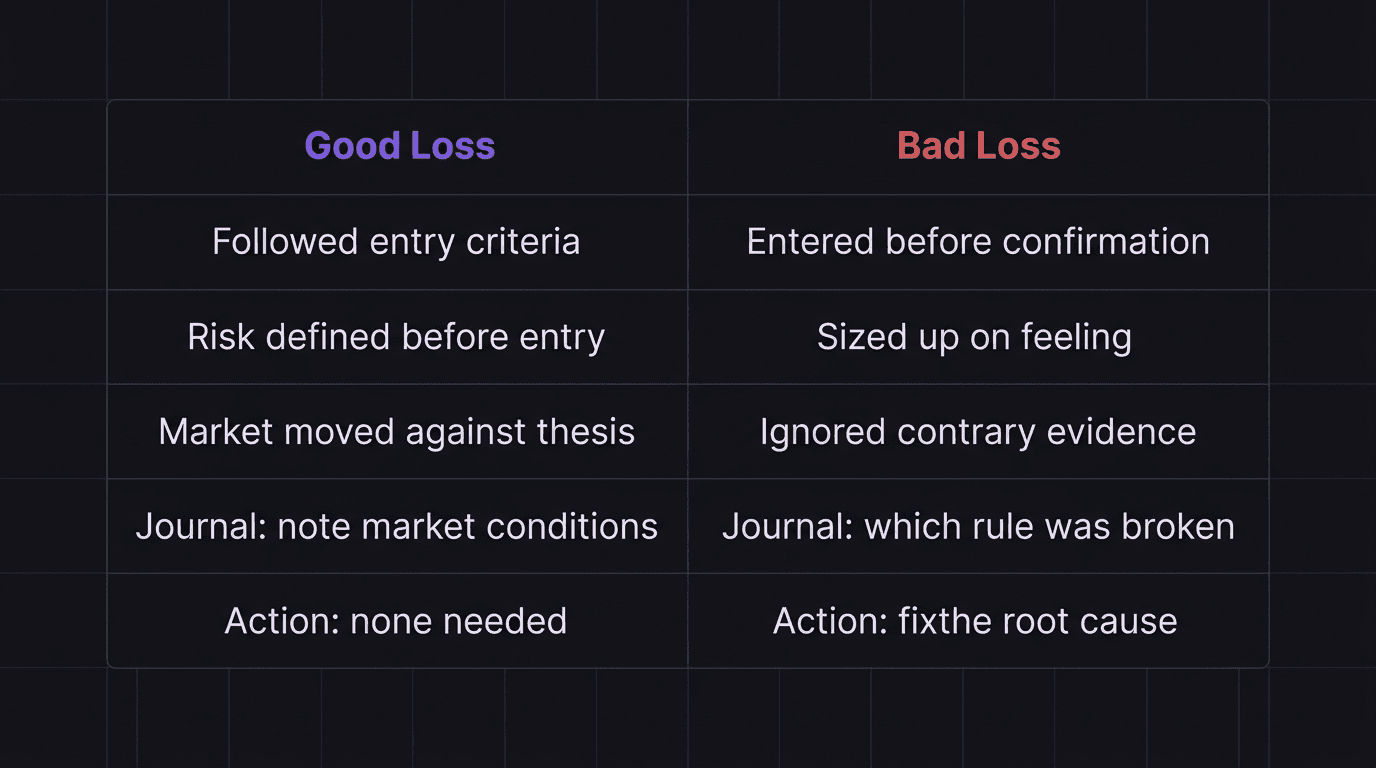
Good loss: You followed your entry criteria, placed your stop loss at the correct level, sized your position according to your risk rules, and the trade still lost. This is variance. It is the statistical reality of probabilistic thinking. If your win rate is 40%, six out of every ten trades will lose. Some of those losses will come in clusters. None of that means your plan is broken.
Bad loss: You broke at least one of your own rules. Maybe you entered before your setup confirmed. Maybe you skipped the stop loss. Maybe you sized up because you "felt good" about the trade. Maybe you were chasing the previous loss. The market might have gone against you anyway, but the process failure is what makes it a bad loss.
The outcome does not define the category. The process does. A trade can lose $10,000 and still be a good loss if every step was executed according to plan. A trade can make $5,000 and still be a "bad win" if you broke three rules and got lucky.
What Makes a Loss Good
A good loss meets three criteria:
1. Your entry matched your plan. You waited for confirmation. You entered at the level your system specified. You did not jump in early because you were afraid of missing the move.
2. Your risk was defined before entry. Stop loss was placed at a logical level (below structure, beyond the invalidation point). Position size was calculated based on your risk percentage, not on how confident you felt.
3. The market moved against your thesis. Not because you read the chart wrong in an obvious way, but because market conditions changed, news came in, or the probability simply did not play out this time.
Walkthrough: A Good Loss in Practice
GBP/JPY, 1H timeframe, Week 1 of June. A trader found a fractal market shift to the downside. He waited for price to liquidate the strong low (following his entry model). He placed his stop loss above the swing high and his take profit at the demand zone below. The entry was clean, the setup had confluence, and the position size was 1R ($10,000). Price consolidated, then reversed and hit the stop loss. Loss: $10,000.
After reviewing this trade, the trader confirmed: "I followed my plan on this trade. Maybe because of variance, maybe because the conditions of the market were choppy."
The correct response to this loss is simple. Log it, note the market conditions (choppy June price action), and move on. No rule change needed. No emotional breakdown warranted. This is what trading costs.
What Makes a Loss Bad
A bad loss fails at least one of the three criteria above. Here are the most common ways:
Impulse entry. You entered before your setup confirmed. The plan said "wait for liquidation of the strong low," and you bought at the first sign of strength because waiting felt like wasting time.
Ego-driven holding. The market gave you clear evidence that your thesis was wrong (structure shift, failed break), and you refused to accept it. You held because being wrong felt worse than losing money.
Revenge entry. You lost the previous trade and immediately took another one, not because the setup was there but because you needed to win. The motivation was emotional recovery, not plan execution.
Size inflation. You felt confident and bumped your lot size above what your risk calculator prescribed. The loss was larger than it should have been, and the oversized dollar amount triggered further emotional reactions.
Walkthrough: Two Bad Losses in Practice
GBP/JPY, 1H timeframe, June 3. The trader's plan called for waiting until price liquidated a strong low before entering long. He was coming off a profitable month and skipped his plan review that morning. He entered early on impulse because the chart "looked good." Price ran up $3,500 in unrealized profit, reversed, and hit his stop. Loss: $10,000. Bad loss. Rule broken: entered before confirmation, skipped plan review.
GBP/JPY, 1H timeframe, later that week. After losing $10,000, the trader entered short. He saw signs that price was shifting bullish but refused to accept it. He described it as ego and pride: "I wasn't trading the charts. I was trading my emotions." He was also trying to make back the first $10,000. Price reversed and hit his stop. Loss: $10,000. Bad loss. Rules broken: ignored contrary evidence, traded for revenge, ego-driven entry.
Same trader, same pair, same week. Two bad losses and one good loss. The good loss needed no fix. The bad losses pointed directly at the behavioral patterns that needed to change.
Journal Each Type Differently
Your journal template should capture different information for good losses and bad losses. Here is how.
Good Loss Journal Entry
For a plan-following loss, you need three things:
Market conditions at entry. Was the market trending, ranging, or choppy? Was there a news event? This helps you spot whether your system underperforms in specific conditions.
Setup grade. Was this an A+ setup with full confluence, or a B-grade setup you took because nothing else was available? Track this over time to see if B-grade setups consistently lose.
One-line note. "Followed plan, choppy conditions, variance loss." That is enough. Do not overanalyze a good loss. The whole point is that it does not need fixing.
Bad Loss Journal Entry
For a rule-breaking loss, you need more:
Which specific rule did you break? "Entered before confirmation" is specific. "Didn't follow the plan" is too vague to fix.
What was your emotional state at entry? Frustrated from a previous loss? Overconfident from a winning streak? Anxious about proving yourself? Name the emotion. Tag it.
What triggered the rule break? This is the root cause. Complacency from a good month. Public pressure to show a win. Fear of missing out. Boredom from waiting.
What would you do differently with the same chart? This is the actionable fix. "Wait for the liquidation candle before entering" is concrete. "Be more disciplined" is not.
Over time, your bad loss entries reveal patterns. If 70% of your bad losses happen on Mondays after a winning week, that is a pattern you can act on. If most of your bad losses come from entering before confirmation, you know exactly which part of your process needs reinforcement.
A proper post-trade review separates the losses you should accept from the losses you should fix. Without that separation, every loss feels the same, and traders either ignore all losses (repeating mistakes) or overreact to all losses (changing a working strategy after normal variance).
Your trading review process should include this categorization for every trade. Not just losses. Bad wins (where you broke rules but got lucky) are more dangerous than good losses, because they reinforce exactly the behaviors that will eventually destroy your account.
How EdgeFlo Helps You Categorize Losses
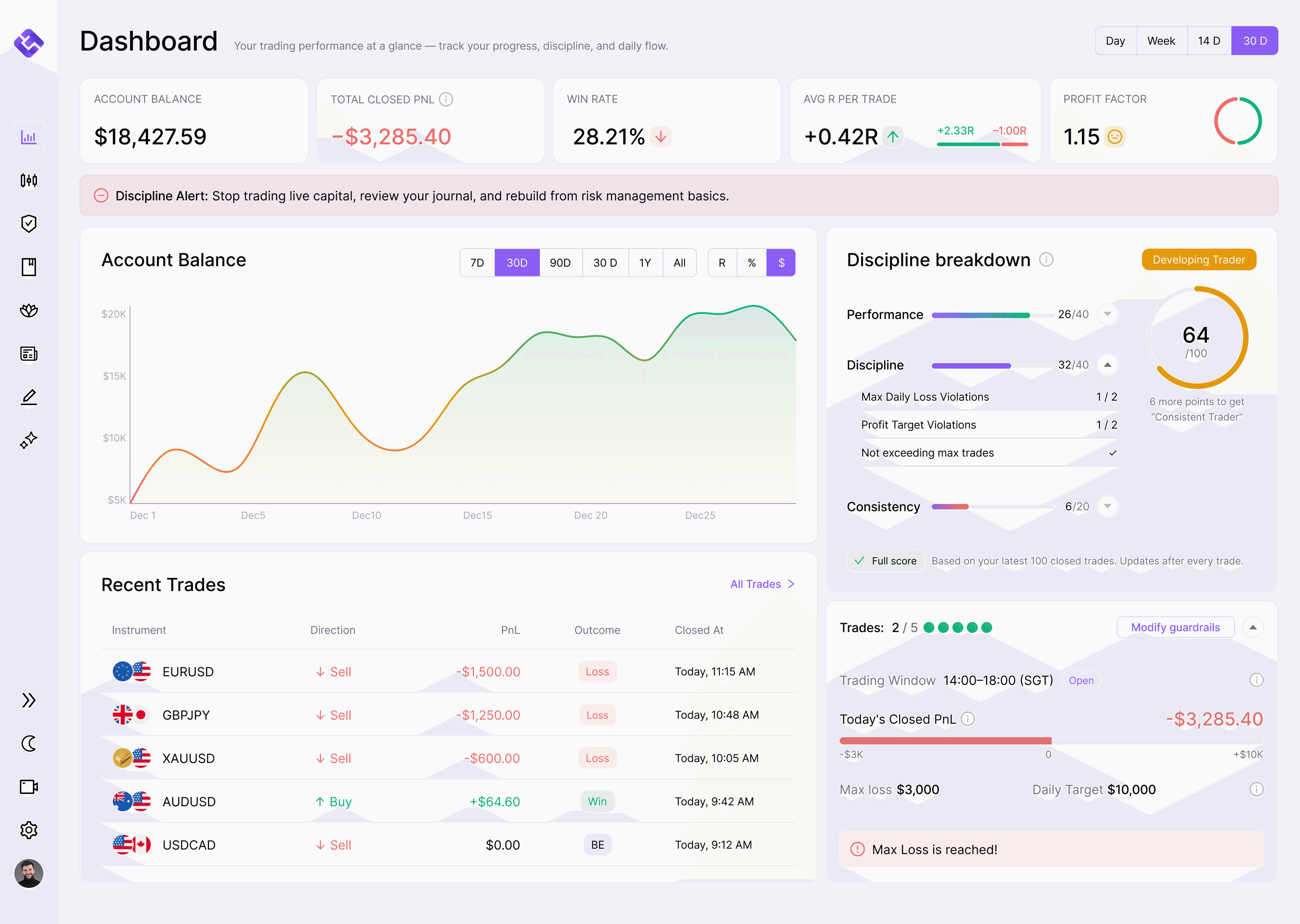
EdgeFlo's journal supports emotion tagging on every trade entry, so you can mark your emotional state at the time of entry and review it later. When you sit down for a weekly or monthly review, the tagged data shows which trades were calm, plan-following executions and which ones were reactive.
Post-trade self-reporting in EdgeFlo lets you note whether you followed your plan immediately after closing each position. That real-time capture is more honest than trying to remember a week later. The data builds over time into a clear picture of your discipline patterns, showing you exactly where your process breaks down and how often.
The separation between good losses and bad losses is not something you need to calculate. It is something you tag, track, and review. Over months, it becomes the most useful data in your entire trading operation.
The Edge Brief
Receive Insights on trading psychology, discipline, and the behavioral patterns that create consistent traders from our Founder and the EdgeFlo team, delivered to your inbox.
Think different. Trade different.
What is a good loss in trading?
What is a bad loss in trading?
Should I journal winning trades too?
How do I stop feeling bad about losing trades?

Turn discipline on.
Every session.
EdgeFlo is the environment serious traders operate inside.
Start 7-Day Free Trial
Cancel anytime.
No long-term commitment.

Think Different, Trade Different.