

Outcome Independence in Trading
Stop stressing over individual trade results. Learn the repetition mindset that keeps funded traders calm and consistent through wins and losses.
Outcome independence means your next trade looks exactly the same regardless of whether your last trade won or lost. Same setup criteria. Same position size. Same emotional state. Most traders know this intellectually but cannot do it in practice because they treat every trade as if it determines their future. One funded trader described the shift simply: "If I made $3,000 once, I can do it thousands of times. Why stress?" That sentence captures the entire concept. Your edge plays out over hundreds of trades. No single trade matters enough to change how you execute the next one.
TL;DR
Outcome independence is not about ignoring results. It is about measuring results over 50-100 trades instead of reacting to each one.
Attachment to individual trades causes revenge trading, fear entries, and early exits. Every emotional trading mistake traces back to caring too much about the last trade.
The repetition mindset is the fix. "I did it once, I can do it a thousand times" removes urgency from any single trade.
Track rule adherence, not P&L, as your daily metric. This shifts your identity from "profitable trader" to "disciplined executor."
What Outcome Independence Actually Means
Outcome independence does not mean you stop caring about money. That would be ridiculous. You are trading to make money. It means you stop letting individual results control your behavior.
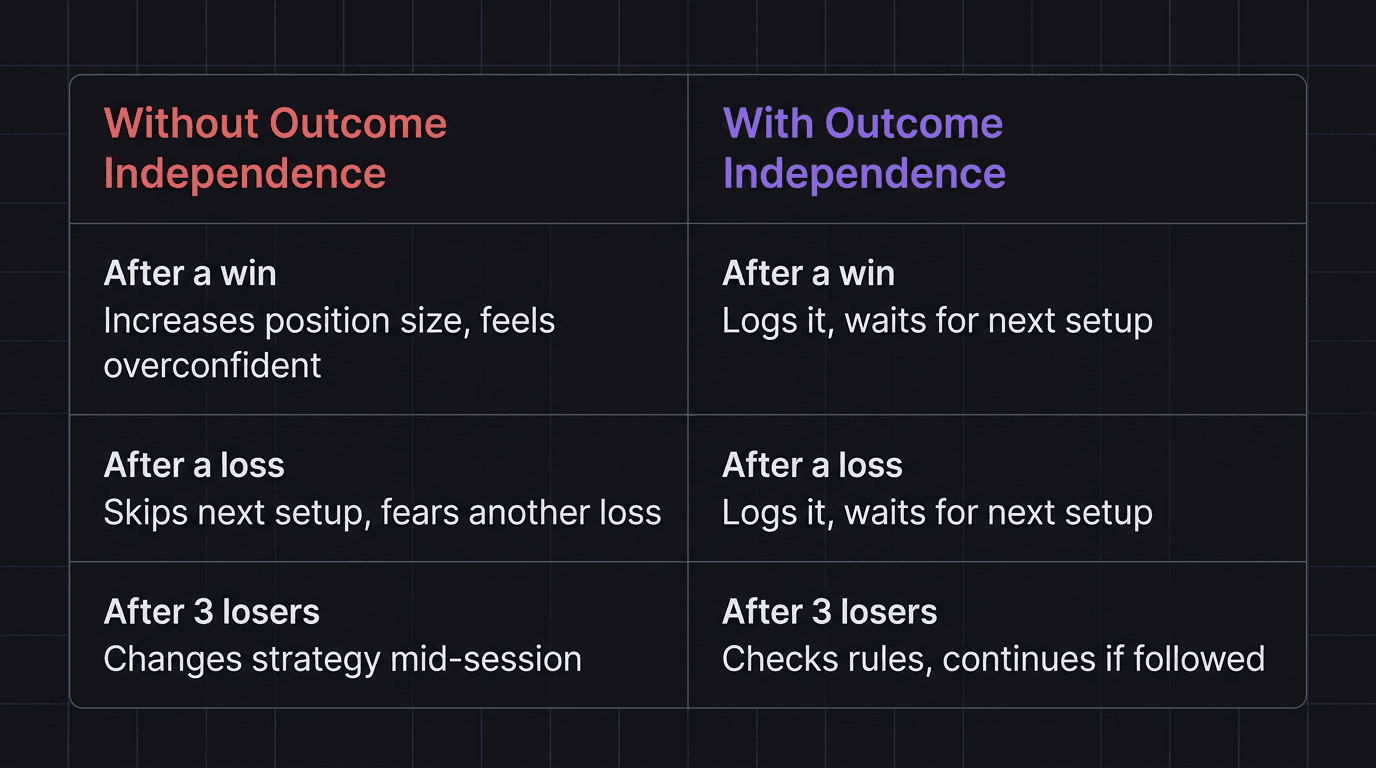
Here is the distinction. A trader without outcome independence:
Wins a trade and gets excited. Takes a bigger position on the next one because they feel confident.
Loses a trade and gets anxious. Skips the next valid setup because they fear another loss.
Has three losers in a row and starts changing their strategy mid-session.
A trader with outcome independence:
Wins a trade. Logs it. Waits for the next setup.
Loses a trade. Logs it. Waits for the next setup.
Has three losers in a row. Checks if they followed rules. If yes, continues. If no, stops trading for the day.
The second trader's behavior is identical after a win and a loss. That is the definition.
Why this is so hard
Your brain is wired to see patterns in recent events. If your last two trades lost, your brain screams "something is wrong, change course." If your last two trades won, your brain whispers "you're hot, press harder."
Both signals are noise. Your strategy's edge does not appear in 2-trade samples. It appears over 50, 100, 200 trades. Reacting to a 2-trade sample is like judging a coin by flipping it twice, getting two heads, and concluding the coin is broken.
Knowing this intellectually does not help much. Probabilistic thinking in trading is a skill that has to be practiced, not just understood.
Why Attachment to Results Causes Bad Trades
Every major trading mistake traces back to outcome attachment. Not some of them. All of them.
Revenge trading happens because you are attached to recovering a loss. The loss feels personal, so you take an unplanned trade to "fix" it.
Overtrading happens because you are attached to hitting a daily profit target. You have made $800 and your target is $1,000, so you force a trade that is not there.
Fear of pulling the trigger happens because you are attached to avoiding losses. Your last setup failed, so you hesitate on the next one even though it meets all your criteria.
Moving your stop loss happens because you are attached to being right. The trade is going against you, but admitting the loss feels worse than risking more.
Walkthrough example: A trader is long GBP/USD from 1.2715 with a stop at 1.2690 and a target at 1.2775. The trade is a valid London session setup based on a liquidity sweep below the Asian range low. Price moves to 1.2740, then pulls back to 1.2720. The trader is now flat on a trade that was up 25 pips.
A trader attached to outcomes thinks: "I was up 25 pips and now I'm flat. I should have taken profit. If this hits my stop, I'll have missed a winner AND taken a loss." They move their stop to breakeven at 1.2715 to "protect" themselves. Price dips to 1.2712 (3 pips below breakeven), stops them out, then rallies to 1.2780.
A trader with outcome independence thinks: "My stop is at 1.2690. My target is at 1.2775. Price is between the two. Nothing to do." They stay in. Price hits target.
Same setup, same entry, opposite outcomes. The only difference was whether the trader was attached to the intermediate result.
The Repetition Mindset
The most useful mental model for outcome independence comes from a trader who built $850K in funded accounts. His perspective was straightforward: if I made $3,000 once, I can make it thousands of times. So why would I stress about any single trade or any single day?
This is not bravado. It is math applied to psychology. If your strategy has a proven edge and you have demonstrated that edge over hundreds of trades, then any individual loss is just one data point in a large sample. The loss does not change your edge. It does not change your ability. It is one trade.
How the repetition mindset works in practice
You need proof before the mindset feels real. Nobody can just decide to be detached from money. The belief has to come from evidence.
Step 1: Build a track record of at least 100 trades following your rules. These can be on demo, sim, or small live accounts. What matters is that you followed your exact plan 100 times and recorded the results.
Step 2: Calculate your actual edge. Win rate, average R, expectancy per trade. Write these numbers down where you can see them during trading.
Step 3: Internalize the sample size. When you know your win rate is 48% over 100 trades with an average winner of 2.1R, you know that any individual loss is expected and priced in. The loss is not a failure. It is part of the 52% that funds the 48%.
Step 4: Reframe losing streaks. Five losses in a row at a 48% win rate happens roughly once every 30 trading sequences. It is not rare. It is scheduled. You just do not know which 5 trades it will be.
Once you have this evidence, the repetition mindset stops being a motivational quote and starts being an obvious fact. Of course you can do it again. You have done it 100 times already.
How to Practice Detachment Daily
Outcome independence is a daily practice, not a one-time decision. Here are concrete methods that build the habit.
Metric swap
Stop tracking daily P&L as your primary number. Instead, track rule adherence percentage. At the end of each session, count how many trades you took and how many followed your plan exactly. If you took 3 trades and all 3 met your entry criteria, hit your stop or target (no manual exits), and used correct position size, your score is 100%. That is a perfect day even if all three were losers.
This swap changes what "success" means on a daily level. You stop asking "did I make money today?" and start asking "did I execute my process today?" The money follows the process over time, and you have 100+ trades of evidence proving it.
The post-trade check
After every trade, ask yourself two questions:
Did I follow my rules?
Would I take this trade again if I saw the same setup tomorrow?
If both answers are yes, the result does not matter. Log it and move on. If either answer is no, that is useful information, but the information is about your process, not about the market.
Session limits
One of the strongest detachment tools is simply not giving yourself the chance to react to outcomes. One funded trader enforced a strict rule: trade London or New York, never both. If he made $3,000 in London, he did not trade New York to try to make more. If he lost $1,500 in London, he did not trade New York to try to recover.
The session ends. The results stand. Tomorrow is another independent sample.
What NOT to do: After a $2,400 loss on a EUR/USD short that hit your stop at 1.0945, you feel the pull to get back in during the New York session. EUR/USD drops to 1.0910 and you think "I was right about direction, just wrong about timing." You short again without a proper setup, just trying to recover. The pair bounces to 1.0955 and you are down $3,600 for the day instead of $2,400. You were not trading the market. You were trading your attachment to the previous result.
Building trading confidence through process
True confidence does not come from winning trades. It comes from knowing you will execute correctly regardless of what happens. A trader who follows their rules through a 5-trade losing streak and stays calm is more confident than a trader who made $10,000 last week and is terrified of giving it back.
The repetition mindset builds this kind of confidence. Each time you execute your process without reacting to the outcome, you add evidence that you can do this. Over months, that evidence becomes unshakeable.
How EdgeFlo Supports Outcome Independence
The hardest moment for outcome independence is right after a loss, when your brain is telling you to do something different. EdgeFlo's guardrails create a structural barrier between that impulse and your next trade.
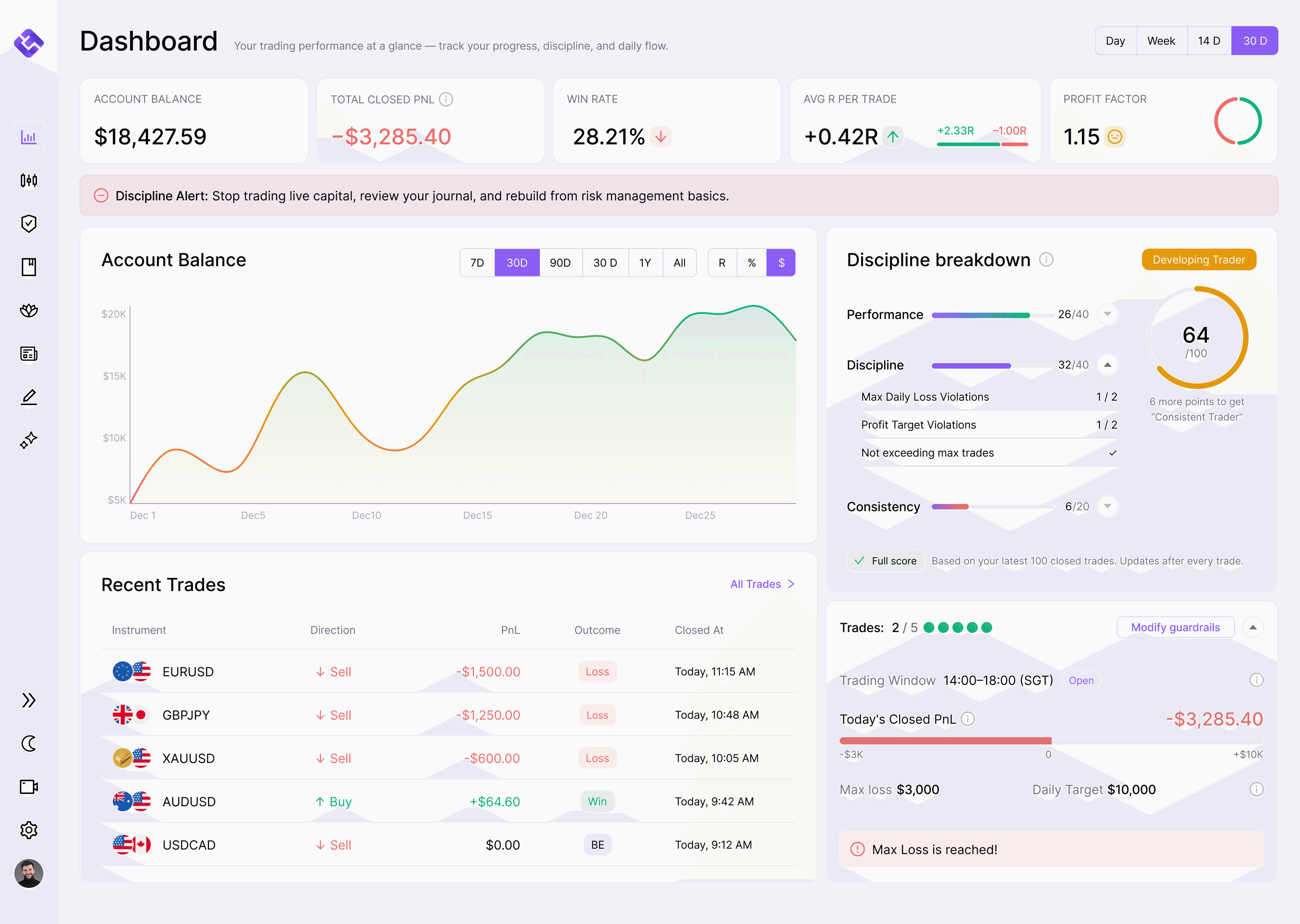
Set a daily loss limit, and EdgeFlo will restrict your trading when you hit it. You can override it, but you have to make that choice deliberately. This pause is often enough to break the revenge cycle. Instead of immediately re-entering a position to chase a loss, you are forced to acknowledge what just happened and decide consciously whether to continue.
The trading journal reinforces the detachment practice over time. When you review a week of trades and see that your 5 winners and 4 losers all followed the same rules, you start seeing individual results as noise. The journal makes the pattern visible in a way that pure memory cannot. And when you tag the emotional state behind each trade, you begin to notice exactly which outcomes trigger your worst decisions, giving you a specific target for improvement instead of a vague goal of "being more disciplined."
The Edge Brief
Receive Insights on trading psychology, discipline, and the behavioral patterns that create consistent traders from our Founder and the EdgeFlo team, delivered to your inbox.
Think different. Trade different.
What does outcome independence mean in trading?
How do I stop caring about individual trade results?
Is outcome independence the same as not caring about money?
Can you really be detached from a $3,000 loss?

Turn discipline on.
Every session.
EdgeFlo is the environment serious traders operate inside.
Start 7-Day Free Trial
Cancel anytime.
No long-term commitment.

Think Different, Trade Different.