

Price Action Without Context: Why Patterns Alone Fail
Candlestick patterns lose money without context. Direction and location turn random signals into high-probability setups. See the same pattern win and lose.
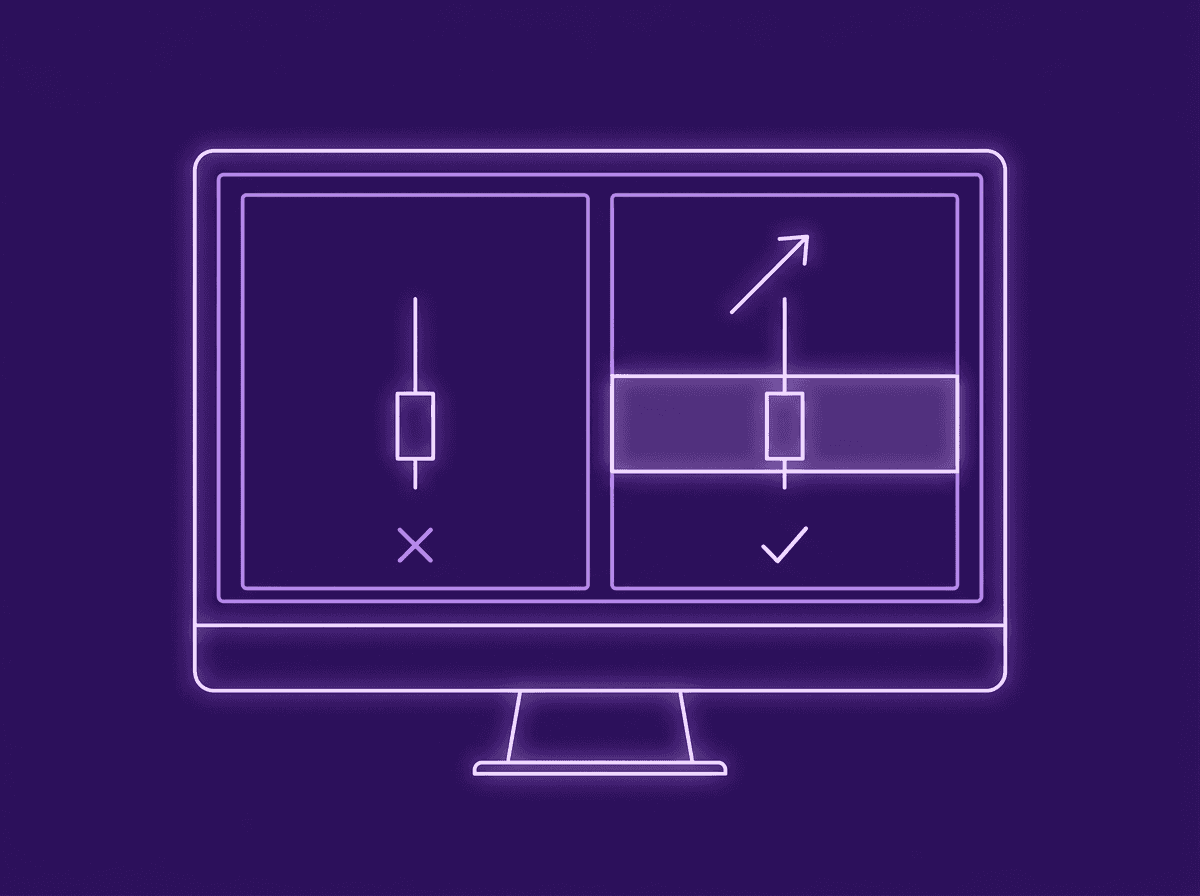
You see a perfect pin bar on the 15-minute chart. Long lower wick, small body, rejection clear as day. You buy. Price drops 40 pips and stops you out.
Three days later, the same pin bar pattern appears on the same pair. You hesitate this time. Price rallies 120 pips without you.
Both were pin bars. Both looked textbook. One lost money, one printed money. The difference was not the candle. It was where the candle appeared.
TL;DR
Candlestick patterns are not signals. They are reactions that only mean something at the right location.
A pin bar at a random level is noise. A pin bar inside a demand zone in discount pricing is a confirmation.
The market moves like a story, not a dictionary. Patterns without plot context are just shapes.
Before looking at any candle pattern, answer two questions first: What is the direction? What is the location?
Adding this filter turns pattern trading from a coin flip into a structured edge.
Why Pin Bars at Random Locations Lose
A pin bar tells you one thing: in that single candle, price tried to go one direction and was rejected. That is it. It does not tell you whether the rejection will continue into the next candle, or the candle after that, or whether the entire trend is about to reverse.
Buyers stepped in at a major demand zone and are about to drive price up for 200 pips.
Price temporarily bounced during a strong bearish trend and will continue crashing within 30 minutes.
A news spike created a wick that has zero structural meaning.
All three produce the same candle shape. The chart does not label them differently. Your job is to know the difference before you risk money on one.
The traders who memorize 15 candlestick patterns and trade them wherever they appear are doing the equivalent of buying every stock that has a green day. Sometimes it works. Over 100 trades, the randomness eats them alive.
The Market Moves Like a Story
Price action is a narrative, not a catalog. Every candle is a sentence in a longer paragraph. Reading one sentence without knowing the paragraph, the chapter, or the book gives you zero understanding of what happens next.
The higher timeframe structure is the book. It tells you the overall plot: bullish (buyers in control), bearish (sellers in control), or ranging (nobody in control).
The swing range is the chapter. It tells you the current section of the story: where the latest battle started and where it might end.
The point of interest (demand or supply zone) is the paragraph. It tells you the specific scene: where institutional orders sit, where the fight will happen.
The candlestick pattern is the sentence. It tells you the immediate reaction: what happened in this one moment.
Reading the sentence without the paragraph, chapter, and book is like opening a novel to page 247, reading one line, and betting your savings on what happens on page 248. You might guess right. But you have no structural reason to expect you will.
Direction and Location Give Patterns Meaning
Here is the filter that turns patterns from gambling into edge:
Step 1: Direction. Open the 4-hour chart. Is the structure bullish or bearish? If bullish, you are only looking for buy patterns. If bearish, only sell patterns. This eliminates half of all false signals immediately.
Step 2: Location. Is price at a point of interest within the discount zone (for buys) or premium zone (for sells)? If yes, patterns here carry weight because institutional orders likely sit at this level. If price is in the middle of the range, patterns here are noise.
Step 3: Pattern. Only now do you look at the candle. Is there a rejection? A break and close? A failure to continue? If yes, and direction and location are aligned, you have a trade.
The pattern is step three, not step one. Most traders run this sequence backwards. They see the pattern, then try to justify it with direction and location after the fact. That is confirmation bias dressed up as analysis.
Walkthrough: Same Pattern, Different Context
Setup A: Pin bar in no-man's land.
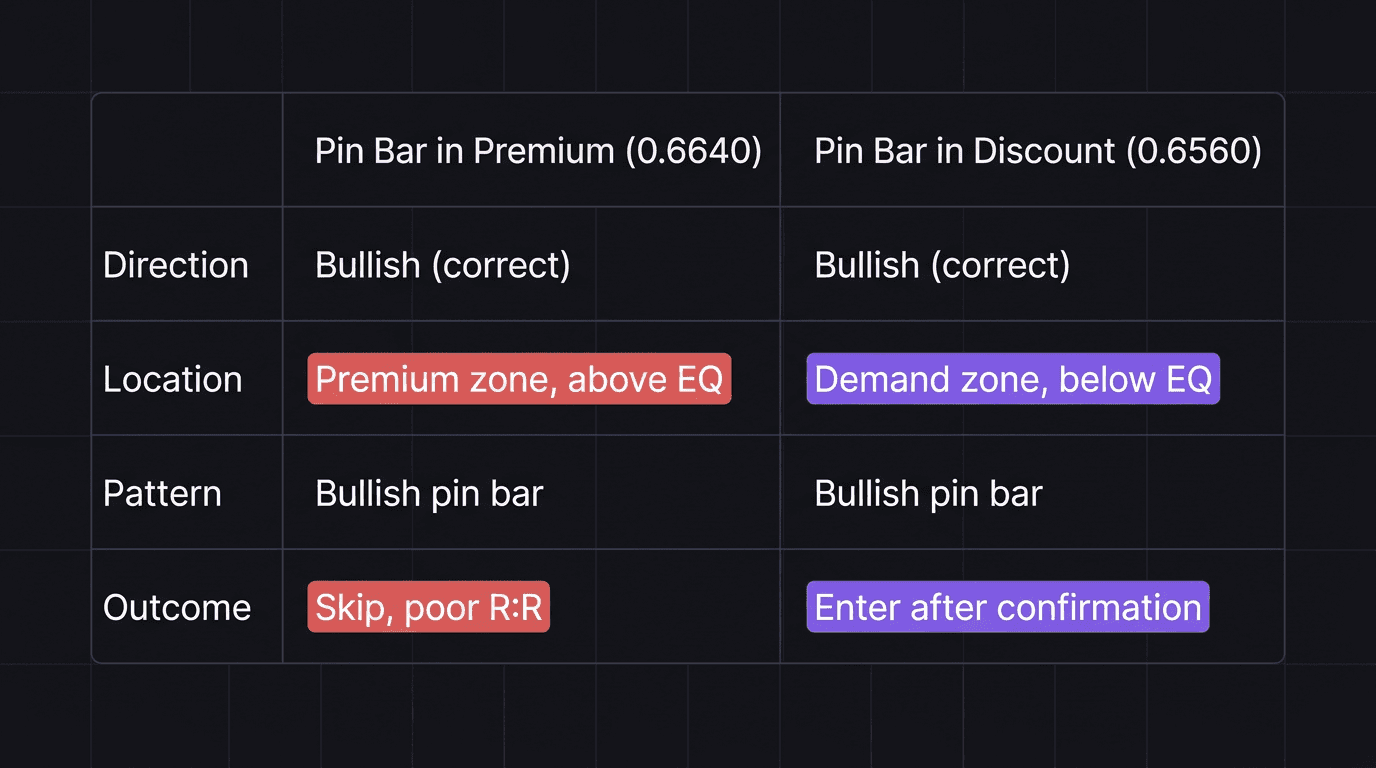
AUD/USD, 4H bullish structure. Swing range from 0.6550 to 0.6680. Equilibrium at 0.6615. Price is currently at 0.6640, deep in premium territory. On the 15-minute chart, a bullish pin bar appears with a clean lower wick.
Should you buy? No. The direction is bullish (good), but the location is wrong. Price is in premium, above equilibrium. A bullish pin bar in premium is not a buy signal. It is a temporary pause in what is probably a deeper pullback. You would be buying high with a wide stop and tight target.
Setup B: Pin bar inside a demand zone in discount.
Same pair, two days later. Price has pulled back to 0.6560, deep in discount. There is a demand zone from 0.6550 to 0.6565. On the 15-minute chart, the same bullish pin bar appears, with an identical lower wick.
Should you buy? If the other confirmations are present (engulfing follow-through, break of the last lower high, failure to continue lower), yes. The direction is bullish. The location is a demand zone in discount. The pattern has structural backing.
Same candle. Opposite decisions. One loses money. One makes money. Context is the variable.
How EdgeFlo Keeps Context in Your Trade Plan
Reading about context is straightforward. Remembering to check it when a perfect-looking candle appears on your screen, and your finger is hovering over the buy button, is the real challenge.
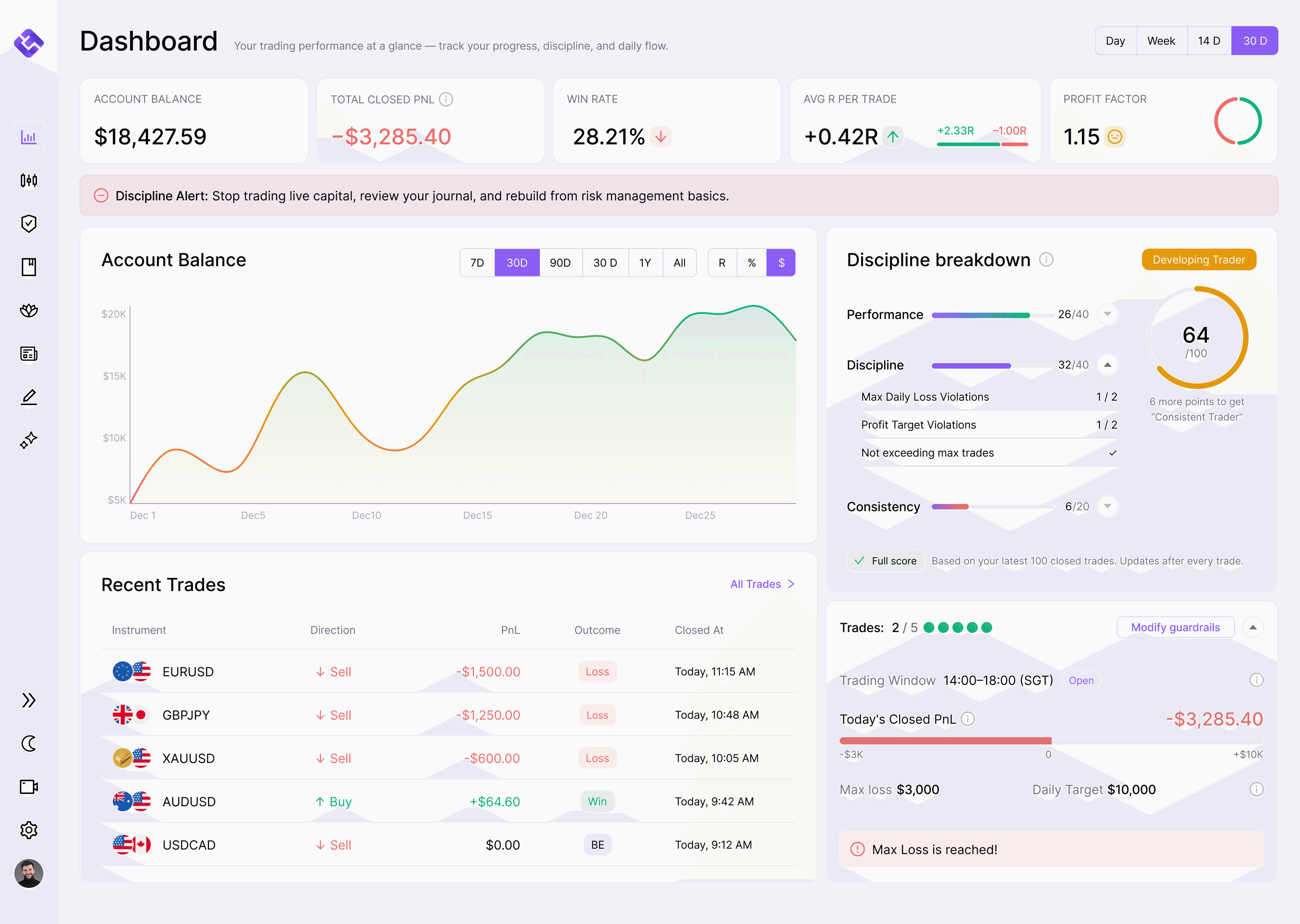
EdgeFlo's Edge plan builder lets you write your trading plan with direction and location as explicit steps that come before pattern recognition. You define: "I only look for candle confirmations after direction and location are confirmed." That plan stays visible while you trade.
After each trade, the post-trade reporting asks whether you followed the sequence. Over time, your journal builds a dataset showing that context-first entries outperform pattern-first entries. When your playbook shows the difference in black and white, skipping step one and step two stops being tempting. It starts feeling like throwing money away.
The Edge Brief
Receive Insights on trading psychology, discipline, and the behavioral patterns that create consistent traders from our Founder and the EdgeFlo team, delivered to your inbox.
Think different. Trade different.
Why do candlestick patterns fail without context?
What gives a price action pattern context?
Can a pin bar at a random level still win?
How do I add context to my price action analysis?

Turn discipline on.
Every session.
EdgeFlo is the environment serious traders operate inside.
Start 7-Day Free Trial
Cancel anytime.
No long-term commitment.

Think Different, Trade Different.