

Break of Structure: Body Close vs Wick Rules
Learn how to confirm a valid break of structure using candlestick body close rules. Know when a wick break counts and when it traps you.
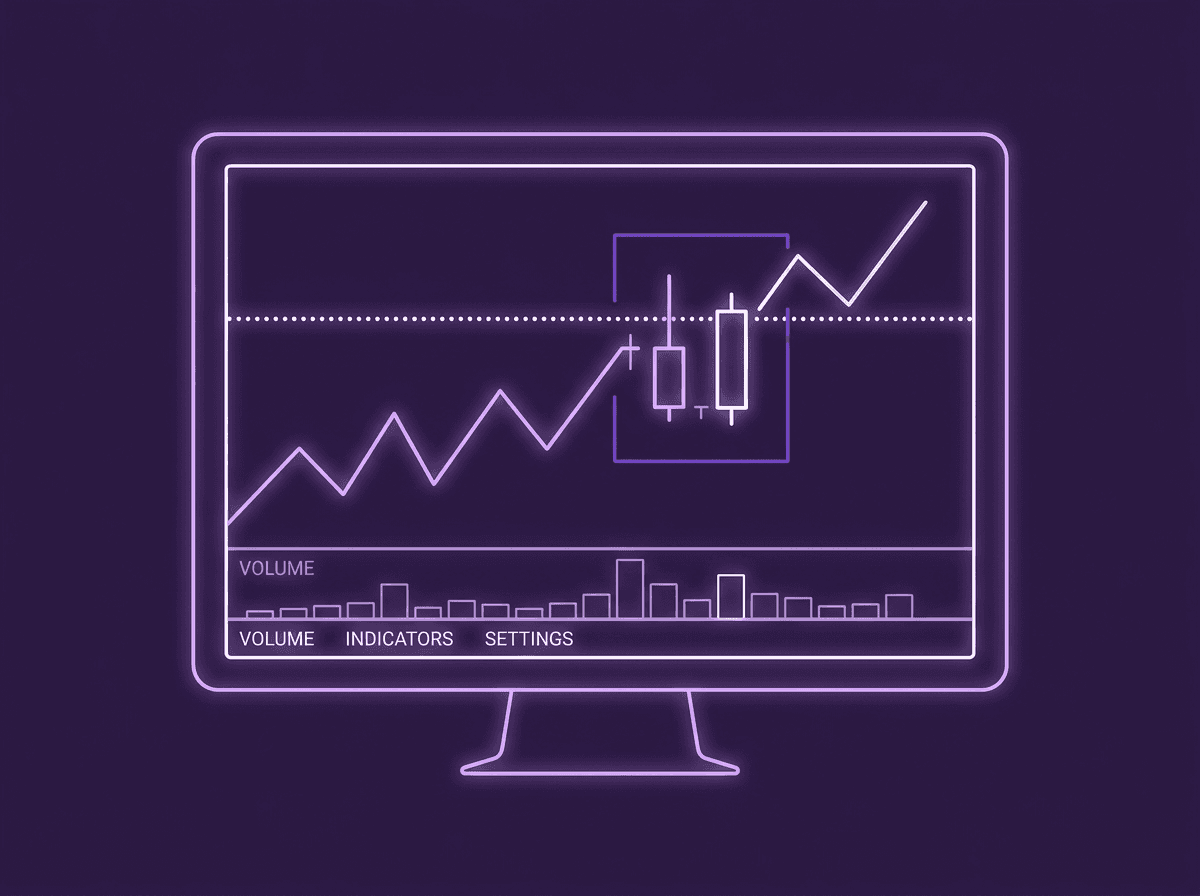
A break of structure (BOS) is confirmed when a candlestick closes its body beyond a previous swing high or swing low. Not the wick. The body. This single rule filters out most false breakout traps that catch traders off guard. If the wick pokes through but the body closes below (or above) the level, the structure has not broken.
That distinction between body and wick is where most BOS mistakes happen. Get it right and you stop chasing phantom breakouts. Get it wrong and you enter trades that reverse within minutes.
TL;DR
A valid break of structure requires a candlestick body close past the swing point, not just a wick.
Wick breaks only count at the fractal level, not at swing or internal structure levels.
BOS continues the existing trend. A break against the trend is a market structure shift (MSS), not a BOS.
The body close rule is 100% mechanical. No interpretation needed.
False BOS traps almost always come from counting wick breaks as valid.
What Is a Break of Structure
A break of structure marks the moment price commits to continuing its current direction. In an uptrend, price makes higher highs and higher lows. When price breaks above a previous swing high with a body close, that is a bullish BOS. It confirms the uptrend is still intact.
In a downtrend, the opposite. Price makes lower highs and lower lows. A bearish BOS happens when price closes its body below a previous swing low.
The key word is "continues." BOS is a trend continuation signal, not a reversal signal. If price breaks a swing point against the prevailing trend, that is a market structure shift, which is a different event with different rules.
Strong highs and strong lows matter here. A swing high becomes "strong" when price creates a lower low after it. That high is now a protected level. BOS only counts when price breaks through one of these protected levels. Random minor highs and lows are noise.
Think of it this way. You are watching EUR/USD on the 1-hour chart. Price has been making higher highs and higher lows for three days. The most recent swing high sits at 1.0920. For structure to break bullish, you need a 1-hour candle that closes its body above 1.0920. A wick that touches 1.0925 but closes at 1.0915? That is not a BOS.
Body Close vs Wick Break
This is the rule that separates mechanical traders from guessers.
At swing and internal structure levels, only a body close counts. The candlestick body represents where price actually settled. The wick represents where price visited but could not hold. A wick touching a level is price testing it. A body closing beyond it is price committing to it.
At the fractal level, wick breaks count. Fractal structure is candle-by-candle movement, the smallest structural unit. Because fractal moves are so granular, the rules are more aggressive. A wick piercing a fractal high or low is enough to register a shift.
Why the difference? Scale and commitment.
Swing structure represents the largest price moves on your chart. It takes real buying or selling pressure to break a swing high or low with a full body close. Wicks, on the other hand, are often liquidity sweeps where price grabs stop losses sitting above or below a level and then reverses.
Internal structure sits between your swing highs and swing lows. It still requires body confirmation because internal moves carry meaningful directional weight.
Fractal structure is noise-level price action. Waiting for body closes at this level would filter out too many signals, so the rules relax.
Here is a practical way to think about it:
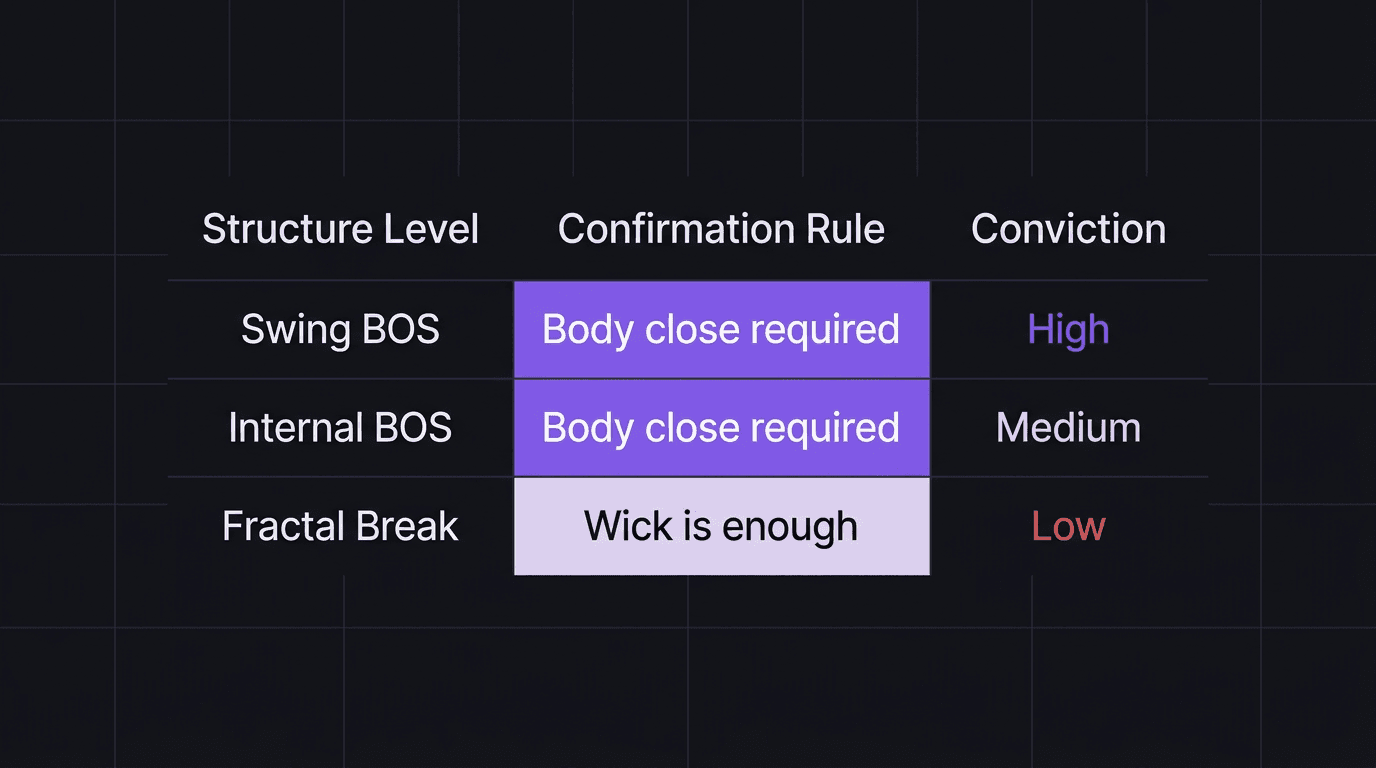
Swing BOS: Body close required. High conviction signal.
Internal BOS: Body close required. Medium conviction signal.
Fractal break: Wick is enough. Low conviction, used mainly as an early warning.
How to Confirm a Valid BOS
The confirmation process is mechanical. No judgment calls needed.
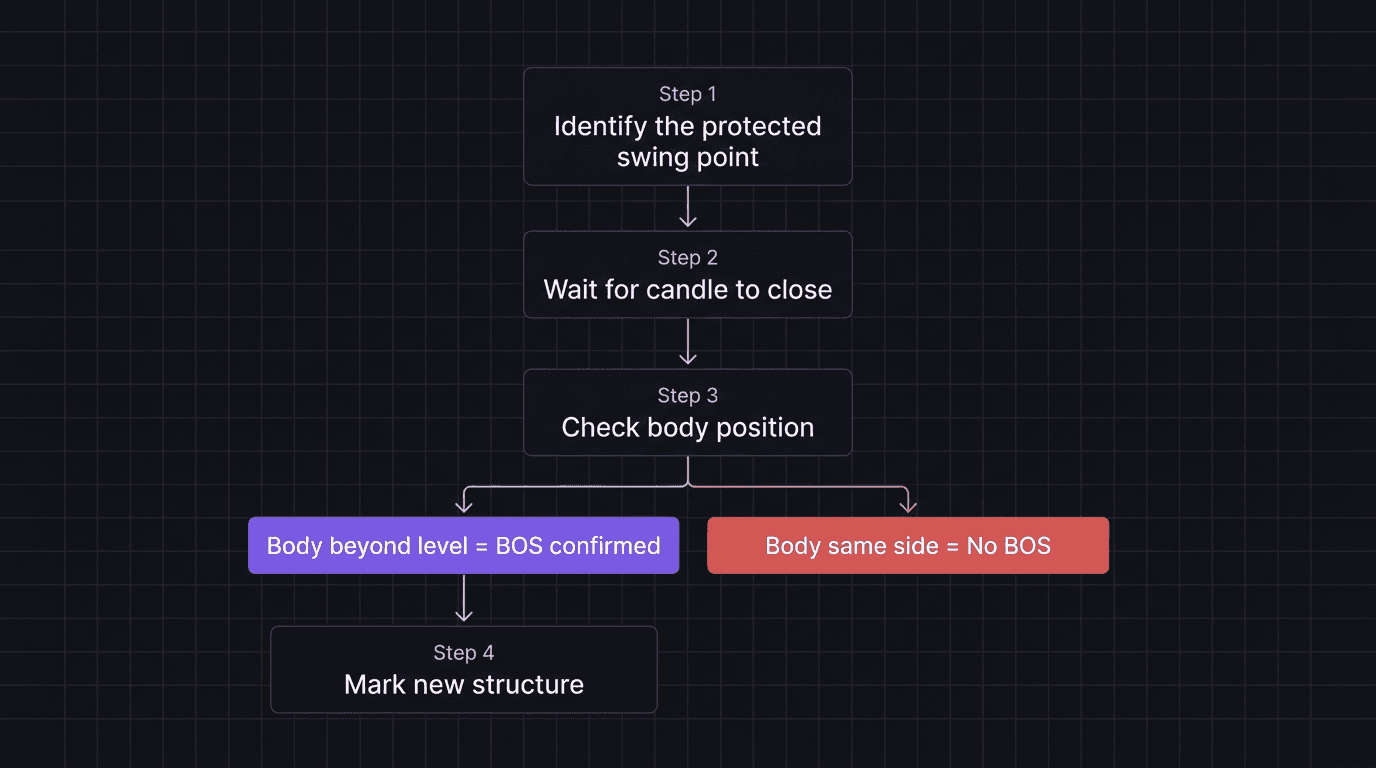
Step 1: Identify the protected swing point. On your chart, find the most recent swing high (in an uptrend) or swing low (in a downtrend) that qualifies as a strong high or strong low. A strong high is created when price subsequently makes a lower low. A strong low is created when price subsequently makes a higher high.
Step 2: Wait for a candle to close. Do not react to live price touching the level. Wait for the candle to print its final close. This is where patience pays.
Step 3: Check the body position. Is the candle's body, not the wick, fully beyond the swing point? If yes, BOS is confirmed. If the body is still on the same side of the level even by a fraction of a pip, no BOS.
Step 4: Mark the new structure. After a valid BOS, the broken level often becomes a supply or demand zone. Mark it. Price frequently returns to retest these levels before continuing.
Walkthrough: Valid BOS on GBP/USD
You are watching GBP/USD on the 4-hour chart. The pair has been bearish, making lower highs and lower lows. The most recent swing low is at 1.2640, formed after a pullback to 1.2710.
Price drops through the London session. A 4-hour candle prints with a body close at 1.2632. The wick reached 1.2618, but you do not care about the wick. The body closed below 1.2640. That is a valid bearish BOS.
You now mark the origin of the move (the supply zone around 1.2700-1.2710) and wait for a pullback into that zone for a short entry. Your trading playbook tells you the next target is the swing low below 1.2580.
Walkthrough: False BOS Trap on EUR/USD
Same setup, different outcome. EUR/USD 1-hour chart. Price is bullish. The most recent swing high sits at 1.0920.
During the New York session, a candle's wick pierces to 1.0928. Traders watching the wick assume structure has broken. They enter long. But the candle closes at 1.0914, body below the swing high.
No BOS. Price reverses and drops to 1.0870 over the next three candles. Everyone who entered on the wick is stopped out. The body close rule would have kept you flat.
Common BOS Mistakes
Mistake 1: Counting wick breaks as valid BOS. This is the most common error. You have seen it in the walkthrough above. The fix is simple: wait for the close, check the body. That is it.
Mistake 2: Using weak highs and lows. Not every swing point matters. If a high forms and price never made a lower low after it, that high is "weak." Breaking a weak high does not carry the same structural significance. Focus on strong highs and strong lows only.
Mistake 3: Ignoring the timeframe hierarchy. A BOS on the 5-minute chart does not override the structure on the 4-hour chart. If the 4-hour is bearish and the 5-minute shows a bullish BOS, that 5-minute break is likely a pullback within the larger bearish move, not a trend change. Always respect the higher timeframe.
Mistake 4: Trading BOS in isolation. A valid BOS tells you direction, not entry. It confirms structure but does not give you a price to enter at. You still need to wait for a pullback into a zone, align with your bias, and manage risk. BOS is one piece of the puzzle.
Mistake 5: Confusing BOS with MSS. A break of structure in the direction of the trend is a BOS. A break against the trend is a market structure shift. They look similar on the chart but carry completely different implications. Confusing them leads to trading reversals as continuations and continuations as reversals. Make sure you are backtesting this distinction regularly.
Sound familiar? Most of these mistakes come from rushing. The body close rule exists specifically to slow you down and demand proof before you commit capital.
How EdgeFlo Supports Structured Trading
The body close rule is mechanical, and mechanical rules work best when your trading environment keeps them visible. EdgeFlo's Edge feature lets you document your BOS confirmation rules directly inside your trade plan. Your plan sits next to your chart during every session, so you are never guessing whether you should wait for the close or jump in early.
After each trade, EdgeFlo's journal auto-imports your execution data. You can tag trades where you followed the body close rule versus trades where you jumped on a wick. Over time, that data shows you exactly how much the discipline is worth in dollars. The pattern becomes undeniable.
The discipline gap between knowing the BOS rule and actually following it under pressure is where most traders leak money. EdgeFlo closes that gap by turning your rules into a visible, trackable system instead of something you try to remember in the moment.
The Edge Brief
Receive Insights on trading psychology, discipline, and the behavioral patterns that create consistent traders from our Founder and the EdgeFlo team, delivered to your inbox.
Think different. Trade different.
Does a wick break count as a break of structure?
What is the difference between BOS and MSS?
Can you trade a break of structure on any timeframe?
Why do traders get trapped by false breaks of structure?

Turn discipline on.
Every session.
EdgeFlo is the environment serious traders operate inside.
Start 7-Day Free Trial
Cancel anytime.
No long-term commitment.

Think Different, Trade Different.