
Pleasure and Pain: The Trader's Two Drives
Every trading mistake traces back to seeking pleasure or avoiding pain. Learn how these two drives control your decisions and how to use awareness to break the cycle.
Every trade you have ever taken was motivated by one of two forces: the desire to feel good, or the desire to stop feeling bad.
That is not a philosophical observation. It is the operating system running underneath every decision you make with money on the line. Your brain, at its most primitive level, is a pleasure-seeking, pain-avoiding machine. And in trading, those two drives create most of the damage.
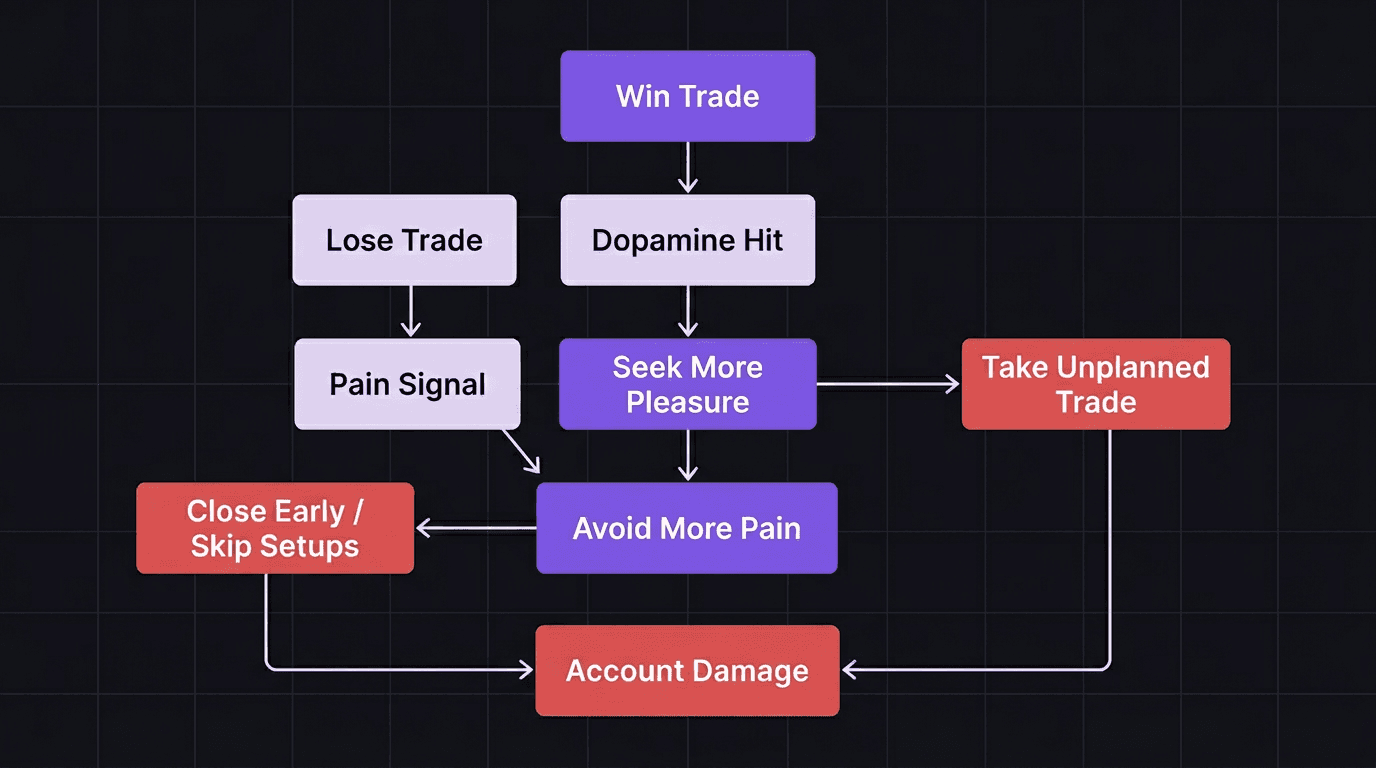
You close winners too early because unrealized profit feels fragile (pain avoidance). You take revenge trades because you want the rush of making it back (pleasure seeking). You overtrade because the dopamine from winning feels too good to stop. You skip valid setups after a losing streak because the possibility of another loss feels unbearable.
If you have ever asked yourself "why do I keep doing the same stupid thing?" the answer almost always lives here.
TL;DR
Your brain runs on two core drives: seek pleasure and avoid pain.
Pain avoidance causes premature exits, skipped trades, and hesitation.
Pleasure seeking causes overtrading, revenge trading, and oversized positions.
Awareness of which drive is active is the first step to overriding it.
Rules and structure beat willpower because they remove the decision from an emotional brain.
Two Drives, One Wrecked Account
Think about the last time you bought something impulsive online. You clicked "buy" because it felt good in the moment (pleasure). Or maybe you avoided opening a bill because looking at it would feel bad (pain avoidance). Trading works the same way, except the price tags are much higher.
The seek pleasure drive shows up when you chase trades, increase lot size after a win, or keep trading past your daily plan because the winning streak feels electric. The avoid pain drive shows up when you close a position the instant it moves against you, hesitate on entries after a loss, or refuse to review your journal because you do not want to face what is in there.
These are not character flaws. They are biological programs that kept your ancestors alive when a rustle in the bushes could mean a predator. The problem is that your brain cannot tell the difference between a lion in the grass and a 20-pip drawdown on GBP/USD.
How Pain Avoidance Destroys Execution
Pain avoidance is the quieter of the two drives, and it does the most damage.
Walkthrough: The Early Exit That Cost $400
You enter a short on EUR/USD at 1.0920 during the London session. Your plan says stop loss at 1.0950 (30 pips) and take profit at 1.0840 (80 pips). You are trading 0.5 lots, which at $10/pip means $5/pip.
Price drops 15 pips in your favor. Then a single bullish engulfing candle appears and price pulls back 10 pips. You are now up only 5 pips, and your brain screams: "You had $75 and now you only have $25. Get out before it goes to zero."
You close at 1.0915 for $25 profit. Two hours later, price hits your original target at 1.0840. The $400 you planned for turned into $25 because your pain avoidance reflex could not tolerate the temporary discomfort of watching unrealized profit shrink.
Sound familiar? This is not a discipline problem. It is a wiring problem. Your amygdala treated that pullback like a physical threat, and your prefrontal cortex (the rational part) did not get a chance to intervene.
How Pleasure Seeking Drains Accounts
The pleasure drive is louder and more seductive. After a win, your brain gets a hit of dopamine. It wants more. And it does not care whether the next trade matches your plan.
Walkthrough: The Revenge Spiral After a Good Week
Monday through Wednesday, you hit three winning trades on AUD/USD. Total gain: $450 from 0.5 lots trading clean setups. Thursday, you take a loss of $150. Perfectly normal. Your strategy runs at roughly a 40% win rate with a 3:1 reward.
But that loss stings more than it should because you have been riding a dopamine high for three days. Your brain does not process the loss as a cost of business. It processes it as a threat to your pleasure streak.
So you take another trade. No setup, just a feeling. You lose $150 more. Now you are down $300 on the day, and the revenge trading loop kicks in. You take a third trade to "get it back," and you lose $200 more.
In 90 minutes, you gave back $650 of a $450 week. Net result: negative $200 instead of positive $300. The dopamine chase turned a profitable week into a losing one.
The Smoke Detector Problem
Your amygdala works like a smoke detector. When it senses danger, it sounds the alarm instantly, about 0.5 seconds after perceiving a threat. The prefrontal cortex, which handles rational evaluation, takes several seconds to process the same information.
That lag matters. In those few seconds between alarm and rational thought, your hand is already on the mouse. You have already clicked "close position" before the logical part of your brain has finished asking "wait, is this actually a problem?"
This is why telling yourself to "just be disciplined" does not work. The alarm fires faster than your discipline can activate. You need structural solutions, not willpower.
What Actually Works: Interrupt the Drive
You cannot eliminate the pleasure and pain drives. They are hardwired. But you can build systems that slow down the gap between impulse and action.
Name the drive in real time. Before clicking anything, ask: "Am I seeking pleasure or avoiding pain right now?" Just labeling the drive engages your prefrontal cortex and slows the amygdala response. Write it in your journal entry if you need to.
Pre-commit to your exit levels. Set your stop loss and take profit before the trade. Write them in your plan. When the urge to close early hits, you have already made the decision in a calm state. The emotional brain is overriding a decision you made rationally, and seeing that written down makes the override conscious.
Use a post-trade pause. After any trade (win or loss), wait 15 minutes before scanning for the next setup. This breaks the dopamine chase loop after wins and prevents pain-avoidance skip patterns after losses.
Review which drive was active. In your journal, add one field: "Was this trade motivated by pleasure seeking, pain avoidance, or plan execution?" After 20 trades, the pattern will be obvious. Many traders who struggle with self-sabotage discover that 70% or more of their off-plan trades are driven by a single drive.
How EdgeFlo Helps You See the Pattern
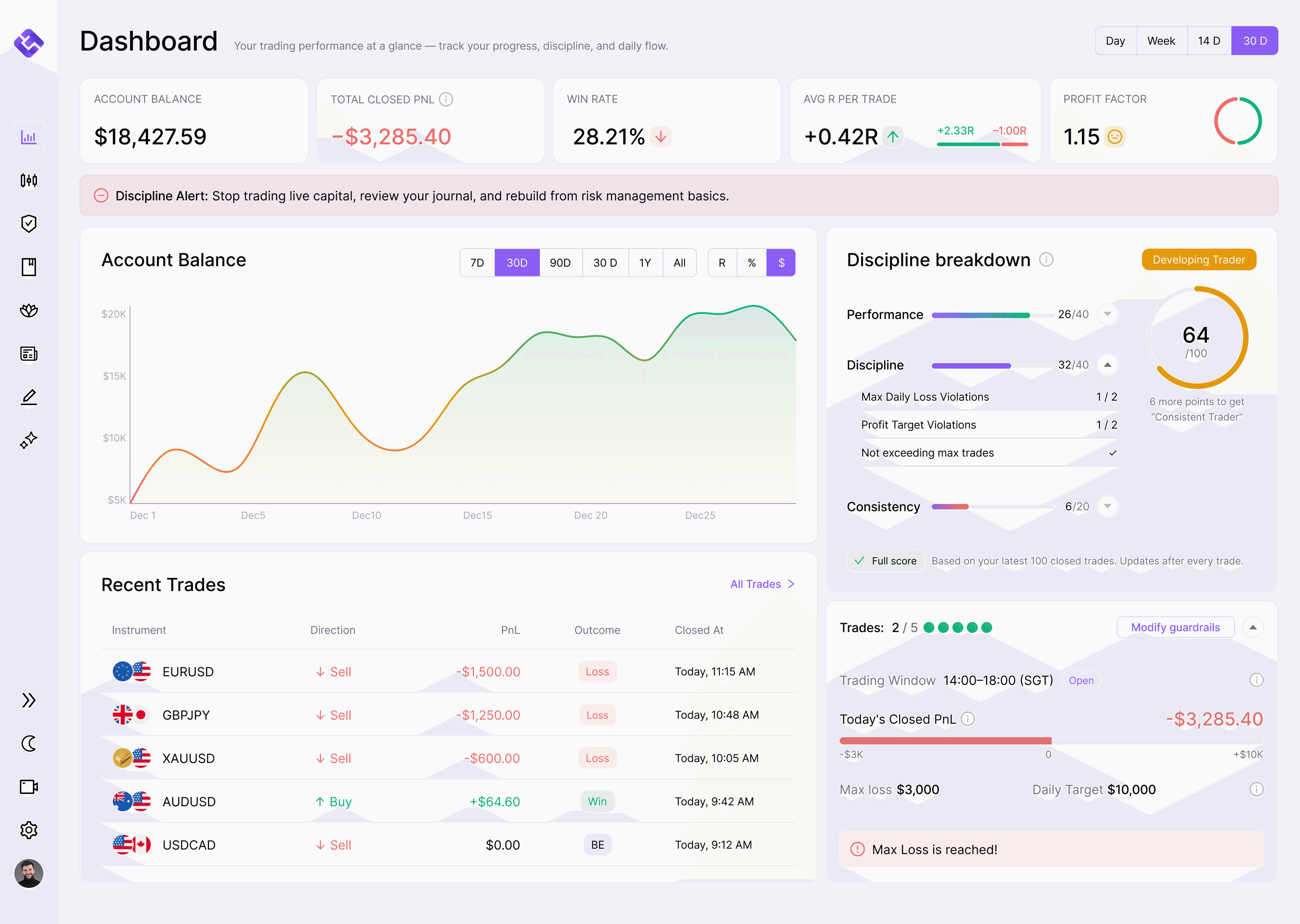
EdgeFlo's trading journal includes emotion tagging on every trade. Instead of guessing which drive was active three days later, you tag it at the moment of entry and exit. Over time, your weekly AI report surfaces patterns you cannot see yourself: whether your worst trades cluster after wins (pleasure seeking) or after losses (pain avoidance).
Sanctuary provides guided reset routines that create a deliberate pause between the emotional impulse and the next action. The pause does not eliminate the drive. It gives your prefrontal cortex time to catch up.
The Edge Brief
Receive Insights on trading psychology, discipline, and the behavioral patterns that create consistent traders from our Founder and the EdgeFlo team, delivered to your inbox.
Think different. Trade different.
What are the two main drives behind trading mistakes?
How does pain avoidance hurt trading performance?
Can you eliminate the pleasure and pain response in trading?
Why do traders seek pleasure through overtrading?

Turn discipline on.
Every session.
EdgeFlo is the environment serious traders operate inside.
Start 7-Day Free Trial
Cancel anytime.
No long-term commitment.

Think Different, Trade Different.