

Overnight Trade Rules: Set Them Before You Sleep
Falling asleep with open positions and no plan is how good trades turn into losses. Learn the exact rules to set before bed so overnight moves do not wreck you.
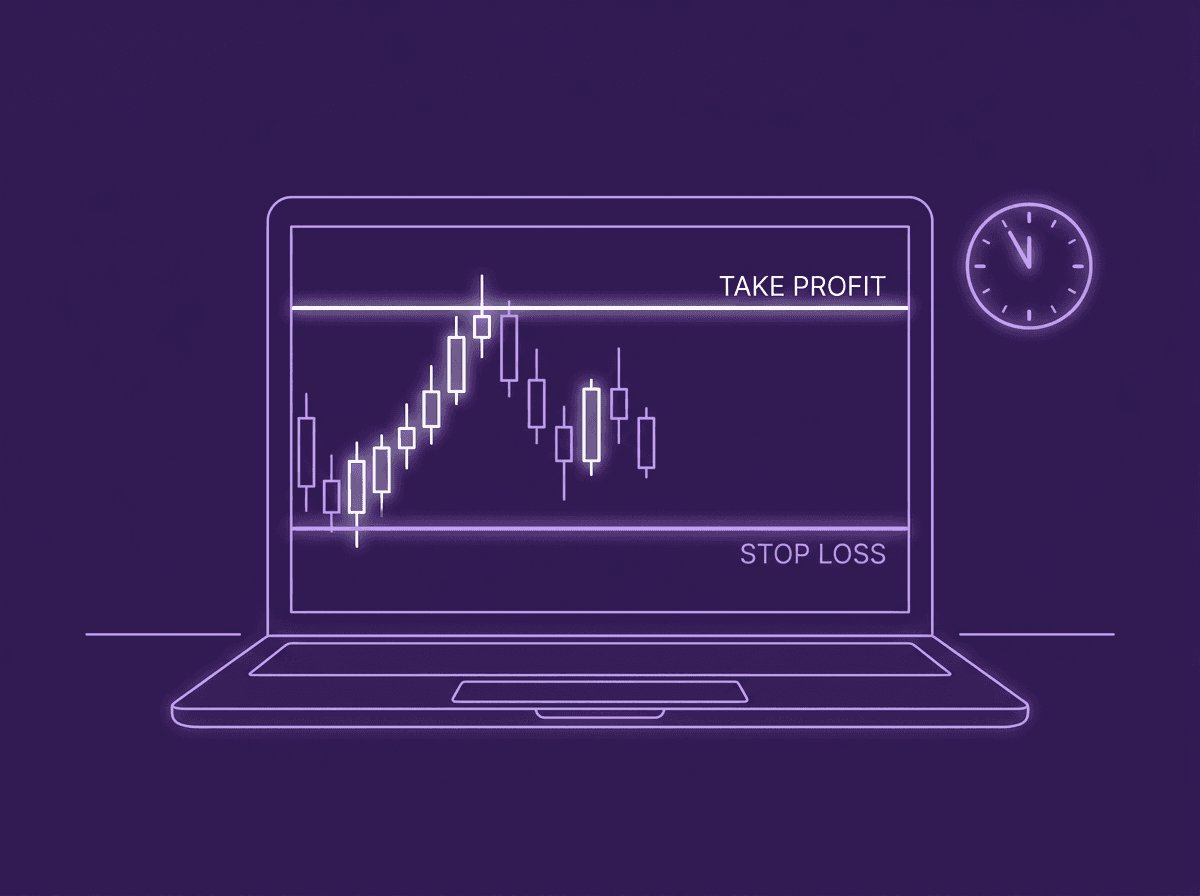
You had a beautiful entry. Price was moving in your favor. You went to bed feeling good about it.
By morning, price had reversed, blown through your take profit zone, pulled all the way back, and stopped you out for a loss. Sound familiar?
The trade was fine. The overnight plan was missing.
TL;DR
Every open position needs a hard stop loss and take profit set before you close your laptop.
Check the economic calendar for overnight news events that could spike your pair.
Reduce position size or tighten stops if news lands in your sleep window.
Trailing stops work for trades already in profit, but confirm the trail width survives normal overnight noise.
If the setup does not justify holding through a full session change, close it before bed.
Why Overnight Positions Need Specific Rules
Forex runs 24 hours. Your brain does not. Between the time you close your eyes and the time your alarm goes off, the Tokyo session opens, the Sydney session winds down, and institutional desks in Asia execute flows that move price.
You cannot react to any of it. That is the whole problem.
During the day, you can see price approaching your level and make a judgment call. Tighten the stop? Move to break even? Take partials? Those options disappear the second you fall asleep. Whatever orders sit on the server are the only protection you have.
Traders who hold positions overnight without a plan are not swing trading. They are hoping. And hope is not a risk management tool.
The Pre-Sleep Checklist (5 Minutes)
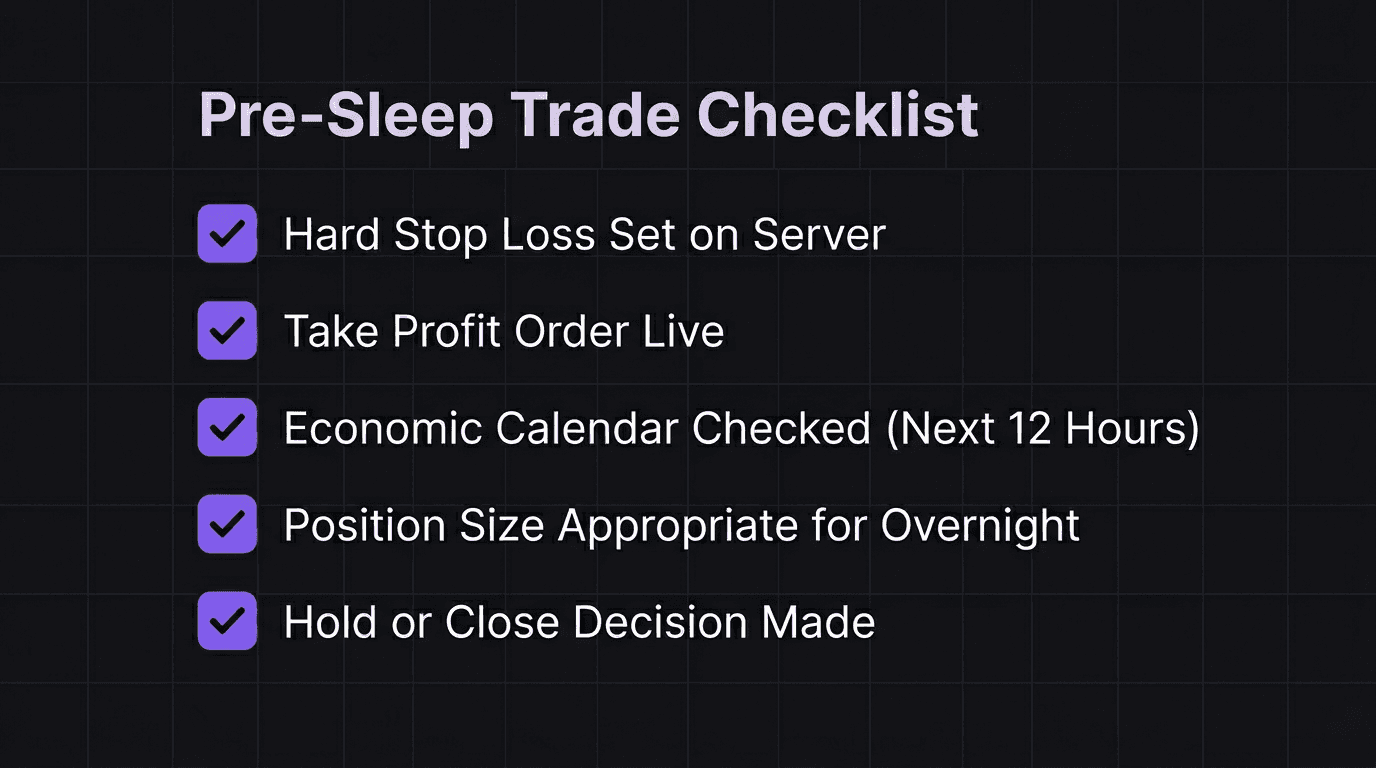
Before you close the laptop, run through these five checks. Every time. No exceptions.
1. Confirm Hard Stop Loss Is Set
This sounds obvious, but trades get stopped out overnight for one reason more than any other: the stop loss was never actually placed. Mental stops do not work when you are unconscious.
Open your platform. Verify the stop loss order is live on the server, not pending in your head.
2. Confirm Take Profit Is Set
Same logic. If price runs 120 pips in your favor at 3 AM, you want that profit captured. Leaving a trade open with no TP means you are relying on yourself to wake up at the exact right moment. That does not happen.
If you are unsure where to place your TP, default to the nearest technical exit level that aligns with your plan.
3. Check the Economic Calendar
Pull up the next 12 hours of scheduled events. If NFP, CPI, an interest rate decision, or any red-flag event lands during your sleep window, you have a decision to make. Three options:
Tighten your stop so a spike against you stays within your risk-per-trade limit.
Take partial profits to lock in some gain and reduce exposure.
Close the position entirely and re-enter after the news settles.
There is no wrong answer. The wrong move is doing nothing and hoping the news goes your way.
4. Evaluate Position Size for Overnight Risk
A trade you sized for an intraday move might be too large for overnight holding. Overnight spreads widen. Liquidity thins between sessions. Slippage increases.
If your stop loss is 30 pips on GBP/USD and you are trading 1 standard lot, your risk is $300. That number does not change overnight, but the probability of gapping through your stop does increase around session rollovers. If the position feels large for the conditions, reduce it.
5. Decide: Hold or Close
Not every trade deserves overnight exposure. Ask yourself one question: does the higher-timeframe structure still support my direction?
If yes, set your levels and sleep. If the trade was a short-term scalp that has already played out most of its move, take the profit and walk away. Holding a 2R winner overnight to chase 3R is a gamble, not a strategy.
Walkthrough: Overnight Hold on EUR/USD
You enter a short on EUR/USD at 1.0920 during the New York session. Your analysis shows bearish structure on the 4-hour chart, with a supply zone mitigation and a market shift confirmation on the 15-minute. Your stop loss sits at 1.0950 (30 pips above entry) and your take profit is at 1.0850 (70 pips below entry).
It is 10 PM. Price is at 1.0905, already 15 pips in your favor. You check the calendar: no major news until London open. You decide to hold.
Pre-sleep adjustments: You trail your stop to 1.0935, locking in a worst-case loss of 15 pips instead of 30. Your take profit stays at 1.0850. If Tokyo session flows push price against you, you lose a fraction of what you originally risked. If price continues down, your TP catches it.
That is the whole routine. It took two minutes and turned a risky overnight hold into a controlled position.
Walkthrough: When Closing Is the Right Call
You are long GBP/USD at 1.2680 during late London. Stop loss at 1.2650 (30 pips), take profit at 1.2740 (60 pips). By 9 PM, price is at 1.2710, up 30 pips. But you check the calendar and see US CPI data releasing at 1:30 AM your time.
CPI is a market mover. GBP/USD routinely swings 50 to 80 pips on CPI surprises. Your stop is only 30 pips from current price. Even a trailing stop cannot protect you from a gap through your level.
Decision: Close at 1.2710 for a 1R gain. Re-evaluate after CPI.
A 1R win beats waking up to a 1R loss because you wanted more. The setup may reappear after the news clears.
The Overnight Mistake That Costs the Most
It is not a bad stop placement. It is no stop at all.
Traders remove their stop loss before bed "to give the trade room." This is the single fastest way to turn a controlled loss into an account-breaking event. A 30-pip stop loss might feel tight, but an unlimited loss on a leveraged position while you sleep is not a risk, it is reckless.
If your stop feels too tight for overnight conditions, the answer is to widen the stop and reduce position size so the dollar risk stays the same. Never remove the stop entirely.
The set-and-forget approach works precisely because the orders are set once and left alone. Removing orders after setting them defeats the entire system.
Session Gaps and Slippage
Forex does not gap like stocks, but it still has thin liquidity windows. The period between New York close and Tokyo open (roughly 5 PM to 7 PM Eastern) is the lowest-volume window in the 24-hour cycle. Spreads widen. Fills get worse.
If your stop sits in a zone where liquidity thins, you may get filled a few pips worse than your level. This is normal, and it is why you should never size a position so tightly that a few pips of slippage turns a manageable loss into a problem.
Build slippage into your overnight risk calculation. If you plan for 30 pips of risk, assume 33 to 35 in the worst case and size accordingly.
How EdgeFlo Helps You Manage Overnight Trades
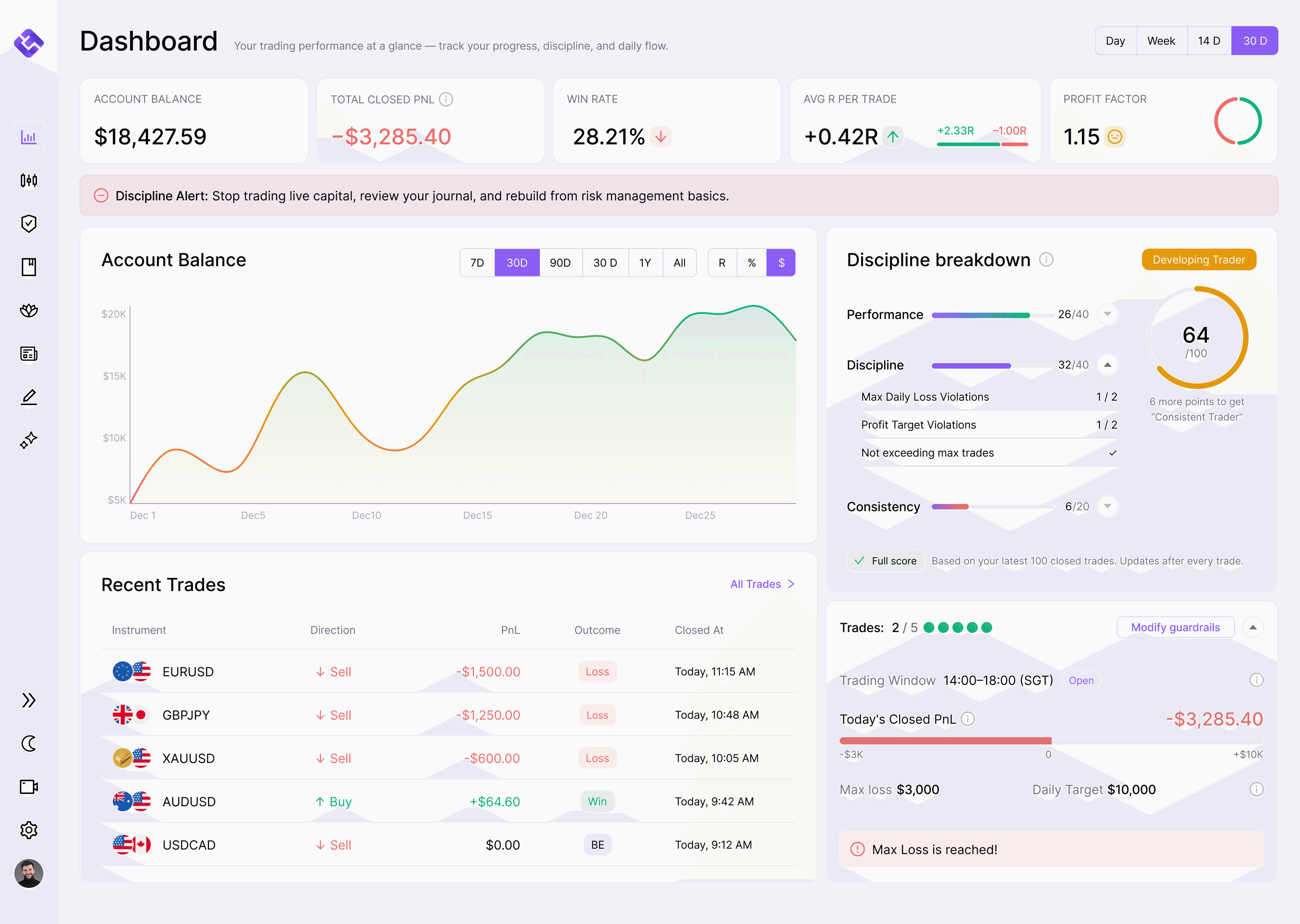
EdgeFlo's guardrails restrict trading when your daily loss limit is approached, which means even overnight moves that go against you trigger a warning when you log in (you can override it, but you have to make a conscious choice). This stops the morning revenge trade that often follows a bad overnight fill.
The Edge plan keeps your overnight rules visible every time you open the platform. If your plan says "no open positions without SL and TP before sleep," that rule sits on screen as a reference, not buried in a document you wrote three months ago.
Your trading journal auto-imports overnight trades, so you can review exactly what happened while you slept and tag whether the overnight hold was a good decision or a pattern you need to fix.
The Edge Brief
Receive Insights on trading psychology, discipline, and the behavioral patterns that create consistent traders from our Founder and the EdgeFlo team, delivered to your inbox.
Think different. Trade different.
Should I close all trades before going to sleep?
How wide should my stop loss be for overnight trades?
Does overnight swap cost matter for swing trades?
What if high-impact news drops while I am sleeping?

Turn discipline on.
Every session.
EdgeFlo is the environment serious traders operate inside.
Start 7-Day Free Trial
Cancel anytime.
No long-term commitment.

Think Different, Trade Different.