

Order Flow Journal: Log Why You Pulled the Trigger
An order flow journal records the structure that triggered your entry, not just the result. Learn what to log so review sessions actually improve execution.
Most traders log the result. Price went up, you made money, done. But when you sit down on Sunday to review, that entry tells you nothing about why you took the trade or whether the reasoning was sound.
An order flow journal fixes that. Instead of recording what happened to the trade, you record what you saw in the structure before you clicked buy or sell. The swing range direction. The internal order flow state. Which zone triggered the entry. Whether you traded with the flow or against it. That context is what turns a trade log into a tool that actually improves your execution over time.
TL;DR
A standard trade log records results; an order flow journal records the structural reasoning behind each entry.
Log the swing order flow direction, internal structure state, zone type, and flow alignment for every trade.
Reviewing structural context reveals whether losses came from bad reads or bad setups.
Entries taken against the current internal order flow carry higher risk and need separate tracking.
Weekly batch reviews catch recurring alignment mistakes that single-trade reviews miss.
Why a Standard Trade Log Falls Short
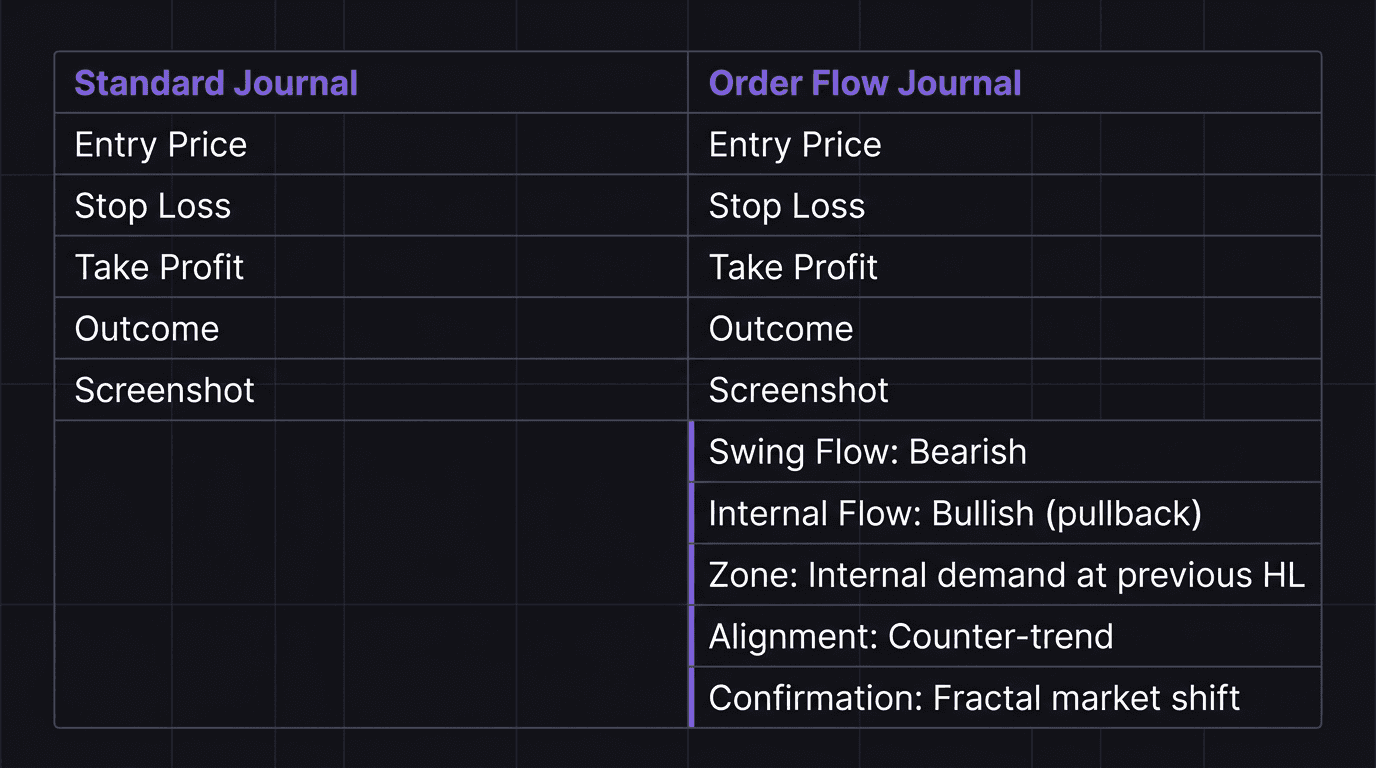
You probably already have some version of a journal. Entry price, stop loss, take profit, outcome. Maybe a screenshot. That covers the mechanics of the trade, but it skips the entire decision-making process.
Here is the problem: two trades can look identical on paper and have completely different structural reasoning. One might be a continuation entry aligned with both swing and internal order flow. The other might be a counter-trend entry taken against the internal flow because you saw a demand zone react.
Both might hit the same target. Both might have the same risk-to-reward. But one was a high-probability setup and the other was a coin flip that happened to work.
Without logging the structural context, your journal template cannot distinguish between the two. So you learn nothing from the review.
The 5 Fields That Change Everything
Your order flow journal only needs five additional fields beyond what you already track. These are quick to fill in during or right after the trade.
1. Swing Order Flow Direction
Is the higher timeframe trend bullish or bearish? This comes from your swing highs and swing lows. If price is making lower highs and lower lows on the swing structure, the swing order flow is bearish. Period.
Write one word: "bullish" or "bearish."
2. Internal Order Flow State
What is the internal structure doing right now? During a bearish swing trend, the internal order flow might be temporarily bullish because price is pulling back. That is normal. But it means your long entries are counter-trend.
Write one word: "bullish" or "bearish." If you are entering during a pullback phase, note "pullback" next to it.
3. Zone Type That Triggered Entry
Which supply or demand zone did price react from? Be specific. Was it a swing-level supply range? An internal demand zone? A flip zone where demand failed and became supply?
Write the zone type and its approximate location: "internal demand at previous higher low" or "swing supply range from the last lower high."
4. Flow Alignment
This is the most important field. Were you trading with or against the current order flow?
If the swing flow is bearish and the internal flow is bearish and you are selling from a supply zone, that is full alignment. If the swing flow is bearish but the internal flow is bullish (pullback phase) and you are buying from a demand zone, that is counter-trend.
Write "aligned" or "counter-trend."
5. Confirmation Type
What specific confirmation did you wait for before entering? A market shift? A fractal break of structure? An internal break of structure?
Write the confirmation: "internal BOS to the downside" or "fractal market shift at extreme supply."
Walkthrough: Logging a Bearish Continuation Entry
You are tracking EUR/USD on the 1-hour chart. The swing structure is bearish: lower highs, lower lows. Price pushed down, created a break of structure, then started pulling back into the previous supply range.
The internal order flow turned bullish during the pullback. Price made higher highs and higher lows on the internal structure as it climbed toward the supply zone. You waited.
Price entered the supply range. You watched for the internal order flow to shift back to bearish. Eventually, the last internal higher low broke to the downside. That was your market shift confirmation.
You entered short from the supply zone that formed after the internal shift, with your stop above the supply range high and your target at the previous swing low.
Here is what your order flow journal entry looks like:
Pair: EUR/USD
Timeframe: 1H
Swing Flow: Bearish
Internal Flow: Bearish (just shifted from bullish pullback)
Zone: Swing supply range from last lower high
Alignment: Fully aligned (swing bearish + internal bearish)
Confirmation: Internal market shift to bearish
Entry: Short at supply zone after internal BOS
Stop: Above supply range high
Target: Previous swing low
Risk: 1% of account
Outcome: (filled after trade closes)
That entry gives you everything you need for a meaningful post-trade review. When you come back to it, you can evaluate whether the structural read was correct, whether the confirmation was solid, and whether full alignment trades like this one tend to work out in your data.
Walkthrough: Logging a Counter-Trend Entry (The Mistake Version)
Same chart. Price is still in a bearish swing trend, but the internal order flow just shifted bullish. You see a demand zone near the start of the pullback and you enter long.
Your order flow journal:
Swing Flow: Bearish
Internal Flow: Bullish (pullback just started)
Zone: Internal demand at start of pullback
Alignment: Counter-trend
Confirmation: None (entered on zone reaction only)
Price rallies for two candles, then stalls inside a supply zone from the left side. You get stopped out.
When you review this entry, the problem is obvious. Counter-trend entry with no confirmation, near a supply zone visible on the left. The journal makes the mistake visible in a way that a simple "loss, 1R" entry never would.
How to Use the Journal in Weekly Reviews
Individual entries are useful, but the real power shows up when you review a batch of 10 to 20 trades together. This is where the trading review process turns raw data into actionable changes.
Sort your trades by alignment first. Look at your "aligned" trades separately from your "counter-trend" trades. Compare win rates between the two groups.
Most traders discover something uncomfortable: their counter-trend trades win at a much lower rate, but they take just as many of them. The journal makes that pattern undeniable.
Then look at zone types. Do you win more from swing-level zones or internal zones? Do flip zones produce better entries for you? Does the type of confirmation matter?
These questions are impossible to answer with a standard trade log. With an order flow journal, the data is right there.
A strong trading feedback loop depends on this kind of structured data. Without it, you are reviewing outcomes and hoping patterns emerge. With it, you are reviewing decisions and finding specific leaks.
Common Mistakes When Logging Order Flow
Logging after the fact with hindsight. Fill in the structural fields before or during the trade, not after you know the outcome. If you wait, you will unconsciously frame the structure to match the result.
Skipping the counter-trend label. Nobody wants to write "counter-trend" next to their entry. But that honesty is exactly what makes the journal work. If you only log aligned trades accurately, your journal analysis will be skewed.
Overcomplicating the zones. You do not need to write a paragraph. "Swing supply from last LH" is enough. The goal is speed and consistency, not a thesis.
Not tracking when you passed on a trade. Some of the best order flow journal entries are for trades you did not take. If the structure was messy, or the alignment was wrong, or you could not find a clean zone, log it as "no trade" with the reason. That builds discipline data over time.
How EdgeFlo Supports Order Flow Journaling
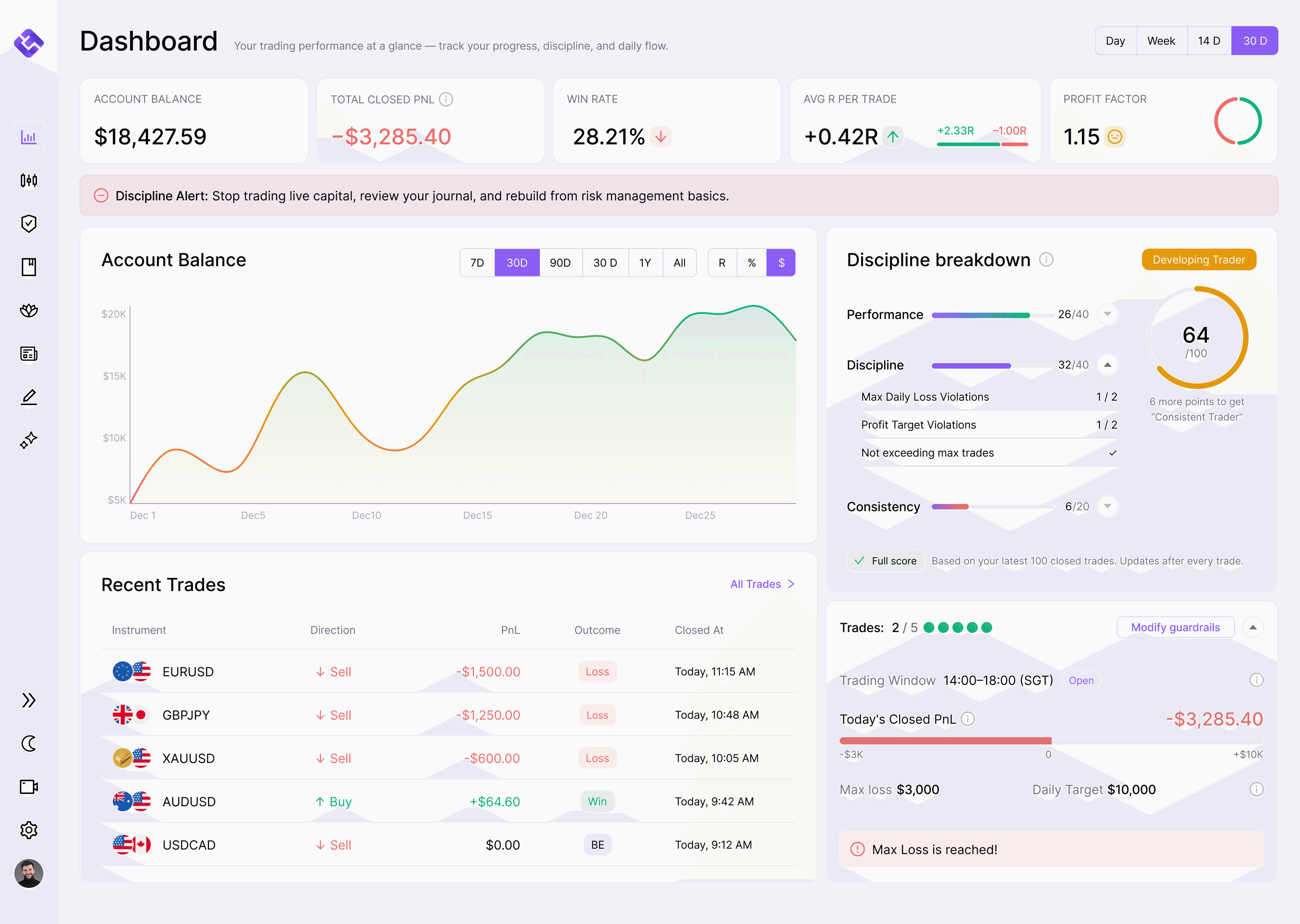
EdgeFlo's trading journal auto-imports your executed trades, so the basic fields (entry, stop, target, outcome) are already filled in. That removes the friction of manual logging and lets you focus on adding the structural context that matters.
The emotion tagging feature adds another layer. If you tagged a trade as "FOMO" or "revenge," you can cross-reference that with your alignment field. You might find that your emotional entries are almost always counter-trend. That is a pattern worth seeing.
For Plus members, the weekly AI report surfaces trends across your logged trades. When your order flow journal has consistent structural data, FloAI can highlight patterns like "your aligned bearish continuation trades win at 62% while counter-trend pullback longs win at 31%." That kind of insight is what turns journaling from a chore into a feedback system.
The Edge Brief
Receive Insights on trading psychology, discipline, and the behavioral patterns that create consistent traders from our Founder and the EdgeFlo team, delivered to your inbox.
Think different. Trade different.
What should an order flow journal include?
How is an order flow journal different from a normal trade journal?
How often should I review my order flow journal?
Can I use an order flow journal for scalping?

Turn discipline on.
Every session.
EdgeFlo is the environment serious traders operate inside.
Start 7-Day Free Trial
Cancel anytime.
No long-term commitment.

Think Different, Trade Different.