

Order Flow Basics: How Buy and Sell Orders Match
Every buy order needs a sell order to match. Learn how order flow works in forex, what happens when you click buy, and why forex fills are instant.
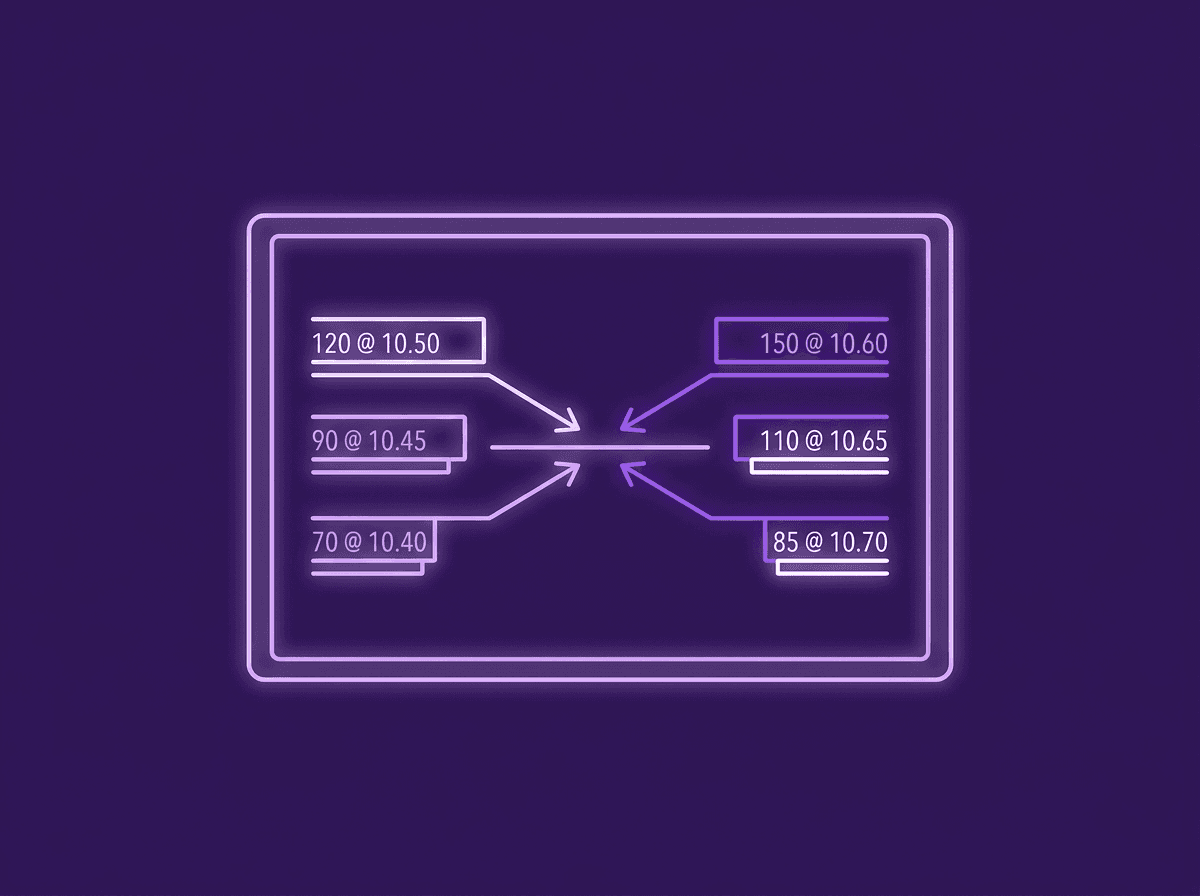
Every buy order needs a sell order. Every sell order needs a buy order. This is not a metaphor. It is the mechanical requirement that makes every trade possible. When you click buy on EUR/USD, someone else is clicking sell at the same price at the same moment. Without that match, no trade happens. Understanding this simple reality changes how you think about price movement, liquidity, and why the market behaves the way it does.
Every trade requires two parties: your buy needs someone else's sell, and your sell needs someone else's buy.
Forex is a zero-sum game: for every dollar you make, someone else loses a dollar.
When you click buy, your order matches with the lowest available sell order on the book.
Forex fills are instant because the market has trillions in daily volume and millions of participants.
Understanding order matching helps you see price moves as order flow, not random candles.
Every Buy Order Needs a Seller
This is the single most important concept in order flow: no trade exists without both sides. Your buy order cannot execute in a vacuum. It needs a counterparty, someone willing to sell at the price you want to buy.
In a busy grocery store, you do not think about this. You grab an item, you pay the price, you leave. But imagine a store with only one loaf of bread and two customers who both want it. Suddenly, the matching problem matters. Who gets the bread? The one willing to pay a higher price.
The forex market is that grocery store, scaled to trillions. Millions of participants are placing buy and sell orders every second. Your job as a trader is not just to decide direction. It is to understand that your order is entering a two-sided marketplace where someone is always taking the other side.
This is why traders who think "everyone is bullish on EUR/USD right now" are fundamentally confused. If everyone were bullish, there would be no sellers, and no trades would execute. Every bullish candle you see on a chart represents matched orders: buyers got their fills because sellers were willing to sell at those prices.
Zero-Sum Game in Plain English
For every winner in the market, there is a loser. Your $500 profit on a EUR/USD long came from someone who lost $500 on the other side of that trade. Not necessarily one person. The loss is spread across multiple counterparties. But the total is always zero.
This is not depressing. It is clarifying. It means the market is not a magical wealth-creation machine. It is a transfer mechanism. Wealth moves from one participant to another based on who has better information, better timing, and better process.
Walkthrough: The zero-sum reality. You buy 0.5 lots of EUR/USD at 1.0840 and sell at 1.0880 for a 40-pip gain. At $5 per pip (0.5 lots), that is $200 profit. On the other side, a collection of traders who sold at 1.0840 are now holding losing positions. Some got stopped out for losses. Some are still holding and underwater by $200 collectively. Your gain is their loss. The market did not create $200 from nothing. It transferred it.
Knowing this changes your perspective on losses too. When you lose a trade, you did not "waste" money. You transferred it to the trader who took the other side and got the direction right. Your stopped-out position becomes the liquidity that someone else uses to profit. And when you understand where that liquidity clusters, as covered in liquidity pools, you can start positioning yourself on the profitable side of the transfer more often.
What Happens When You Click Buy
The mechanical process takes less than a second, but understanding it removes a lot of mystery.
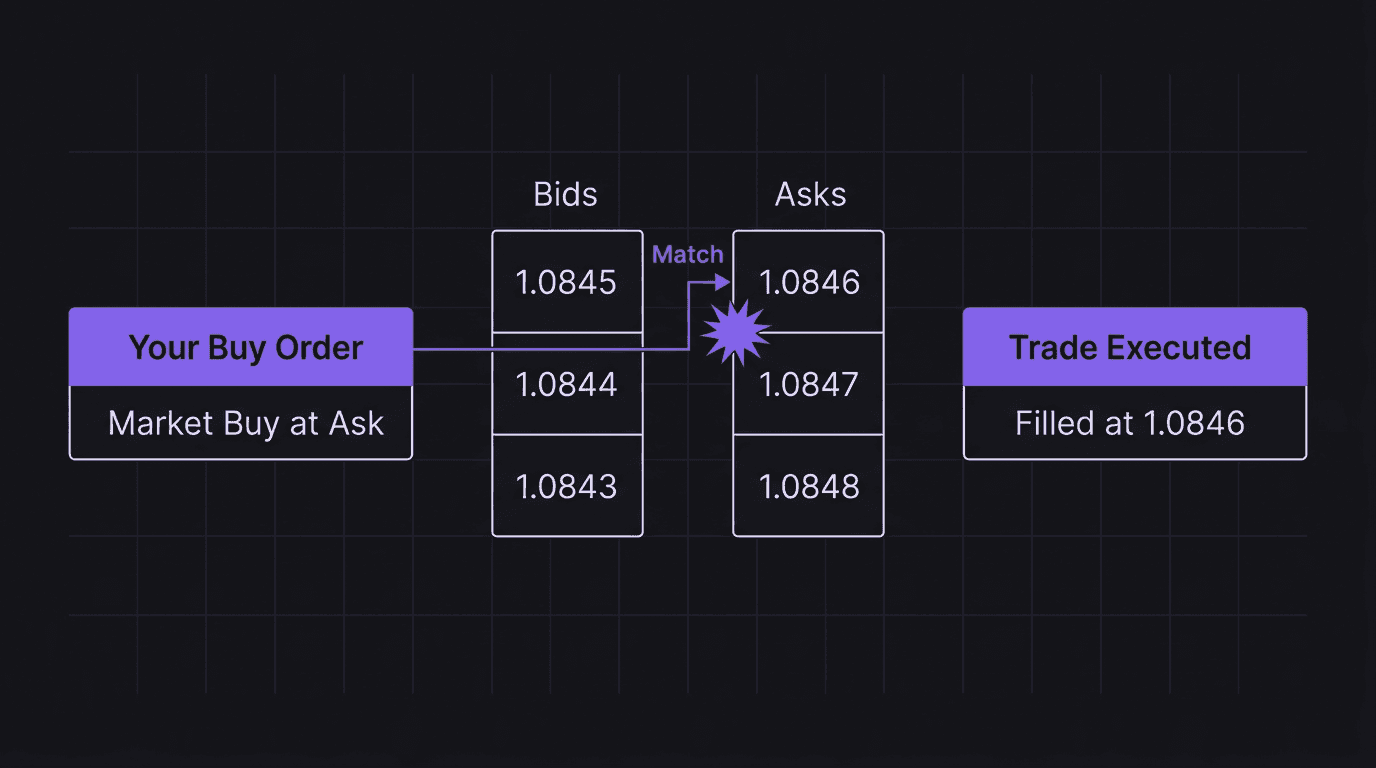
Step 1: You see EUR/USD quoted at 1.0845 (bid) / 1.0846 (ask). The bid is the highest price someone is willing to buy at. The ask is the lowest price someone is willing to sell at. The 1-pip gap between them is the spread.
Step 2: You click buy. Your broker sends a market buy order to the liquidity providers.
Step 3: Your buy order matches with the lowest available sell order, which is at 1.0846 (the ask). The seller was already sitting there, waiting.
Step 4: Both orders are filled. You now own 1 lot (or whatever size you traded) of EUR/USD at 1.0846. The seller has sold that amount at 1.0846. The trade is complete.
The entire process happens in milliseconds. You never see the seller. They never see you. The matching engine handles it all. But the important point is that a real counterparty was required. If there were no sell orders at 1.0846, your order would have to go to the next available price, maybe 1.0847 or 1.0848. That is slippage, and it only happens in low-liquidity conditions.
Walkthrough: What bad order matching looks like. A small-cap stock has thin liquidity. You place a market buy for 500 shares. The ask shows 100 shares at $45.20, 150 shares at $45.25, and 250 shares at $45.35. Your 500-share order eats through all three levels: 100 at $45.20, 150 at $45.25, and 250 at $45.35. Your average fill is $45.28, not $45.20. In forex on major pairs, this almost never happens because the order book is so deep that your entire order fills at the quoted price.
Why Forex Is Easy to Enter and Exit
The forex market trades over $7 trillion per day. That number is almost incomprehensible, but practically it means one thing: your order size is irrelevant.
If you are trading a $10,000 account at 0.1 lots, you are moving $10,000 notional. The market does $7 trillion. Your trade is 0.00000014% of daily volume. There will always be a counterparty. Always.
This is why forex spreads on major pairs stay tight (1 to 2 pips during active sessions). There are so many participants placing orders at every price level that the bid and ask are almost always next to each other. Competition between sellers pushes the ask down. Competition between buyers pushes the bid up. The gap stays small.
Compare that to trading an obscure penny stock where spreads can be 5% of the price and fills can take minutes. Or the housing market, where "filling your order" means months of negotiation. Forex gives you the luxury of instant, precise entry timing because the liquidity is always there.
The one exception is during news releases. When a major economic report hits (like Non-Farm Payrolls), market makers pull their resting orders briefly because they do not want to get filled at a stale price. For those few seconds, spreads widen and slippage increases. Outside of those moments, the forex market is the smoothest, most liquid trading environment available.
How EdgeFlo Makes Execution One-Click Clean
Understanding order flow is the theory. Executing cleanly is the practice. The gap between the two is where most retail traders leak money: hesitating on an entry, fumbling with lot size calculations, or accidentally placing the wrong order type.
EdgeFlo's one-click trading strips out the friction. You set your risk parameters in advance (stop distance, risk percentage) and the platform calculates the lot size. When the setup triggers, one click enters the order with your stop already placed. No manual calculation under pressure. No accidentally buying when you meant to sell.
That speed matters more than most traders realize. In a market where order matching happens in milliseconds, spending 15 seconds adjusting your lot size can mean entering 3 to 5 pips worse. Over hundreds of trades, those extra pips compound into real money. Clean execution is not about trading faster. It is about removing the points where human error creeps in.
The Edge Brief
Receive Insights on trading psychology, discipline, and the behavioral patterns that create consistent traders from our Founder and the EdgeFlo team, delivered to your inbox.
Think different. Trade different.
What is order flow in forex?
Is forex trading a zero-sum game?
What happens mechanically when I click buy?
Why do forex orders fill so fast?

Turn discipline on.
Every session.
EdgeFlo is the environment serious traders operate inside.
Start 7-Day Free Trial
Cancel anytime.
No long-term commitment.

Think Different, Trade Different.