

Only Deploy Capital on A+ Setups
Your job is capital allocation: decide which trades deserve your money. A+ setups align direction, location, and execution. Everything else is a skip.
Most traders think their job is to find trades. Open the chart, spot a pattern, enter a position. The more trades, the more opportunities, the more money. That math sounds logical and it is completely wrong.
Your actual job as a trader is capital allocation. You have a limited amount of money. Each trade you take puts some of that money at risk. Your only real decision is: does this particular trade deserve my capital, or does it not?
When you think in terms of capital allocation instead of trade finding, your entire behavior changes. You stop scanning for entries and start filtering for quality. You stop chasing and start waiting. The number of trades drops. The quality of each trade rises. And your account grows because you stopped bleeding money on setups that were "good enough."
TL;DR
Your job is not finding trades. It is deciding which trades deserve your capital.
An A+ setup requires direction, location, and execution to all align. If any element is missing, it is not A+.
Taking B setups dilutes your winners and creates unnecessary losses that compound over time.
Some weeks produce zero A+ setups. Doing nothing those weeks is the correct play.
The hard part is not spotting A+ setups. It is ignoring everything else.
Your Job Is Capital Allocation
Think about how a fund manager allocates capital. They do not throw money at every opportunity that crosses their desk. They evaluate each one against strict criteria: Does it meet our risk profile? Does the return justify the risk? Is there a better use of this capital elsewhere?
You should operate the same way, just at a smaller scale. Your trading account is your fund. Every trade is a capital deployment decision. And every bad trade is capital that could have been deployed on a winner.
When you enter a mediocre setup and lose 1% of your account, you did not just lose 1%. You lost the opportunity to deploy that 1% on the next A+ setup that appeared two days later. That opportunity cost is invisible but real.
This reframe changes everything. You stop asking "Is this trade good enough?" and start asking "Is this the best use of my capital right now?" The answer, most of the time, is no. And that is the correct answer.
What Makes a Setup A+
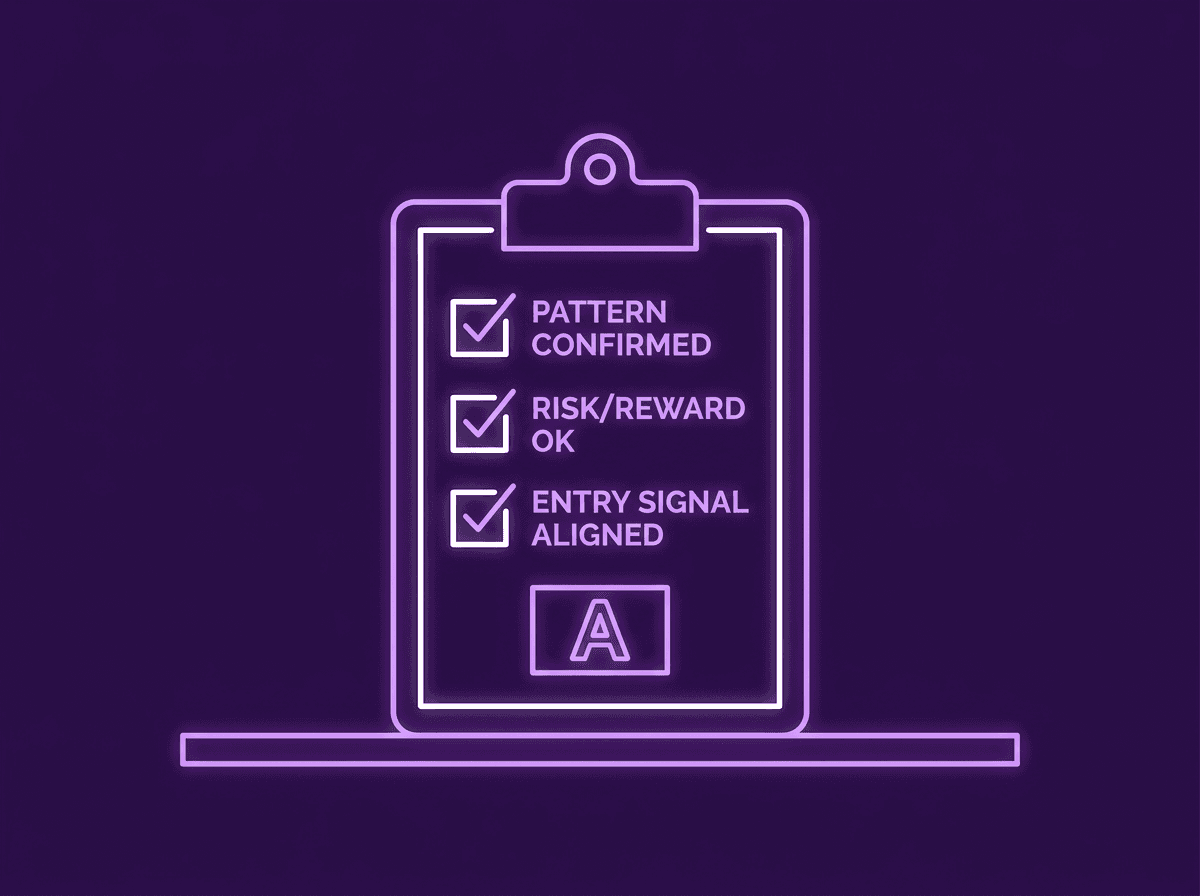
An A+ setup checks every box in the three-step framework:
Direction confirmed. The higher timeframe (4H) shows clear bullish or bearish structure. Higher highs and higher lows for bullish. Lower highs and lower lows for bearish. If the structure is messy, choppy, or contradictory, this box is unchecked.
Location confirmed. Price has reached a point of interest (demand zone for buys, supply zone for sells) in the correct pricing area (discount for buys, premium for sells). The zone is unmitigated and sits near the extreme of the swing range. If price is in the middle of nowhere or at a weak zone, this box is unchecked.
Execution confirmed. On the lower timeframe (15m), all three confirmations are present: strong rejection candle, break and close in the bias direction, and failure to continue against the bias. If any confirmation is missing, this box is unchecked.
Three boxes. All checked. That is A+. Two out of three is B grade. One out of three is C grade. You only deploy capital on A+.
The Cost of Taking B Setups
B setups are seductive because they almost qualify. Direction is clear, location is decent, but the confirmation is weak. Or direction and confirmation are great, but price is in the premium zone instead of discount. Close enough, right?
Over 10 trades, "close enough" looks fine. You win some, lose some. Over 100 trades, the math exposes the problem.
Walkthrough: A+ vs B Setup Comparison
Consider 10 weeks of trading where you take one trade per week.
4 wins at average 3.2R.
2 losses at 1R each.
Net result: (4 x 3.2) minus (2 x 1.0) = 12.8 minus 2.0 = +10.8R.
Win rate: 4/6 = 67%.
A+ trades: same results, 4 wins at 3.2R, 2 losses at 1R. Net: +10.8R.
B trades: 1 win at 1.5R, 3 losses at 1R each. Net: 1.5 minus 3.0 = minus 1.5R.
Combined net: 10.8 minus 1.5 = +9.3R.
Total win rate: 5/10 = 50%.
Trader B took 67% more trades and ended up with 14% less profit. The B setups did not just add nothing. They actively subtracted from the bottom line. And the psychological damage is worse: Trader B's win rate dropped from 67% to 50%, which feels like they are getting worse at trading even though their A+ performance was identical.
This is why B setups are more dangerous than outright bad trades. Bad trades are obviously wrong. B setups feel justified. They erode accounts slowly, and you do not notice until the monthly review shows mediocre results despite "doing everything right."
Walkthrough: Recognizing What to Skip
EUR/USD, 4H. Bullish structure, clear higher highs and higher lows. You identify a demand zone at 1.0880 in discount pricing.
Price pulls back to 1.0910 and starts showing some bullish candles on the 15-minute. You see a small engulfing candle, but it barely exceeds the previous candle. There is no break of the last lower high. No rejection with displacement.
This is a B setup. Direction is confirmed. Location is okay (below equilibrium, but not at the demand zone). Execution is incomplete (weak candle, no structural break). Two out of three boxes are partially checked.
The correct decision: do nothing. Set your alert at 1.0885 and close the chart. If price reaches the zone and gives proper confirmation, you enter. If price bounces from 1.0910 and never reaches your zone, you missed nothing because there was nothing to take.
The trader who enters at 1.0910 with a weak confirmation gets a 1.5:1 R:R trade that has maybe a 40% chance of working. The trader who waits gets either a 3:1+ R:R trade with a 60% chance of working, or no trade at all. Both outcomes are better than the B setup.
How EdgeFlo Guardrails Protect Your Capital
Knowing the difference between A+ and B setups is the intellectual part. Actually skipping the B setups when you are bored, frustrated from a losing day, or convinced "this one will be different" is the behavioral part.
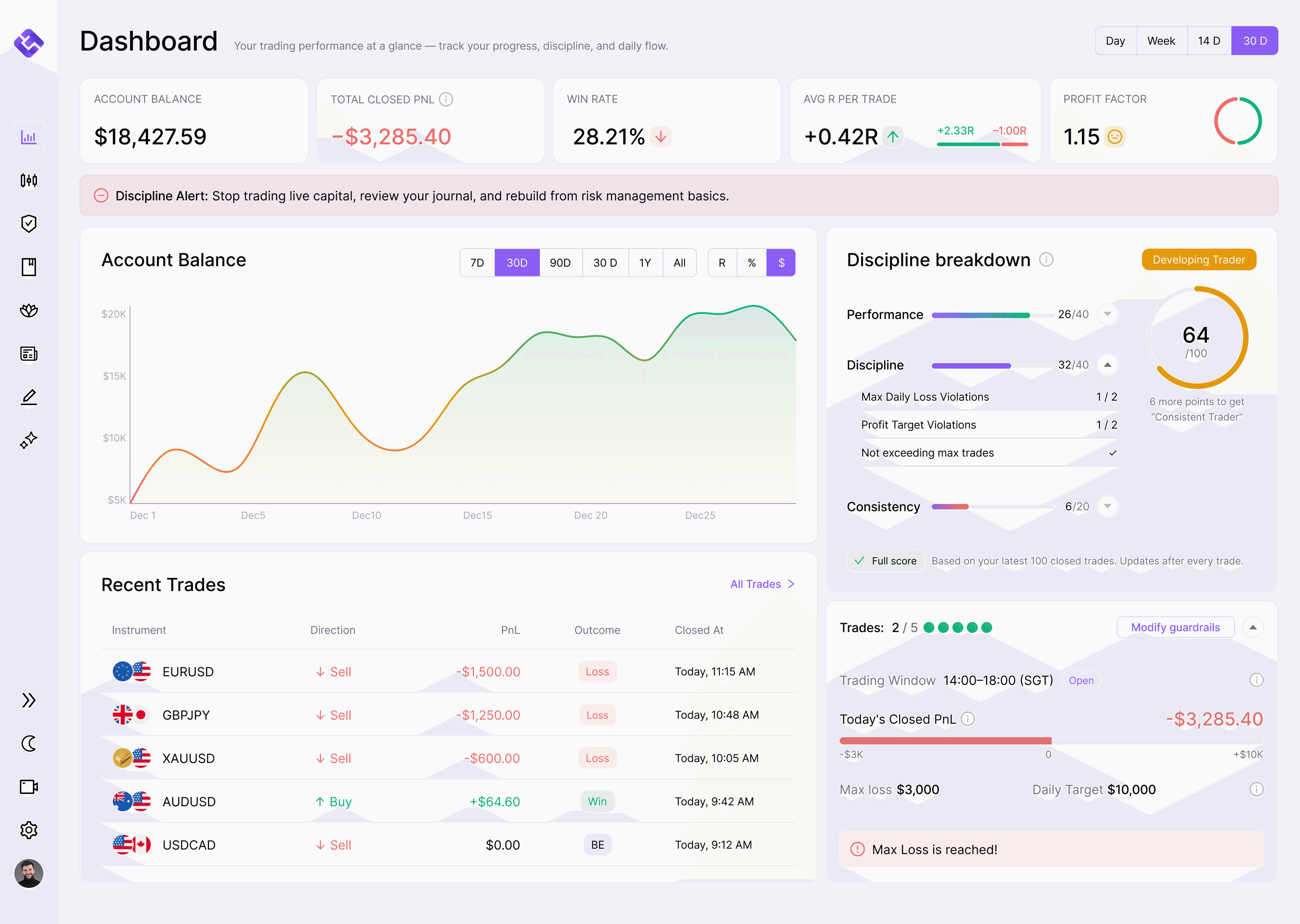
EdgeFlo's guardrails help with the behavioral part. Set a maximum of 3 trades per day. When you hit that limit, EdgeFlo restricts the trade button (you can override if you choose, but you have to make a conscious decision). That forced pause creates space between impulse and action.
The daily loss limit works the same way. If your first two trades of the day were B setups that lost, the guardrail restricts your third trade before you enter a third B setup out of revenge. You have to override, acknowledge the loss, and decide consciously whether the next trade is genuinely A+ or just emotional.
Your trading rules belong in the Edge plan builder, visible during every session. "Only A+ setups" is easy to write and hard to follow. But when the plan is in front of you, the guardrails are active, and your journal tracks every deviation, the system makes discipline structural instead of relying on willpower alone.
The Edge Brief
Receive Insights on trading psychology, discipline, and the behavioral patterns that create consistent traders from our Founder and the EdgeFlo team, delivered to your inbox.
Think different. Trade different.
What makes a trade setup A+ quality?
How many A+ setups should I expect per week?
What is the cost of taking B setups?
How do I stop myself from taking B setups?

Turn discipline on.
Every session.
EdgeFlo is the environment serious traders operate inside.
Start 7-Day Free Trial
Cancel anytime.
No long-term commitment.

Think Different, Trade Different.