

Losing Streak in a Funded Challenge: Stay Alive
Hit 3-4 losses in a row during your funded challenge? Use this de-risk protocol to survive, reset, and climb back to breakeven.
A losing streak during a funded challenge is not a sign that your strategy is broken. It is a sign that probability is doing exactly what probability does.
You started the challenge with a plan. Your backtests showed a 40% to 50% win rate. Your minimum risk to reward was 1:3. The math works over 50 or 100 trades. But right now, staring at three red trades in a row, the math feels distant. The only thing that feels real is the drawdown creeping toward the daily loss limit.
This is the moment that separates traders who pass from traders who blow the account. Not the winning streaks. Not the perfect entries. This moment, right here, when the losses stack up and your finger hovers over a position size that is too large.
Here is what to do instead.
TL;DR
Keep risking 1% per trade for the first two losses, then drop to 0.5% if you hit a third.
At 0.5% risk with a 1:3 reward, two winning trades erase a 3% drawdown.
After 4 consecutive losses, stop trading and take a break before your next entry.
Most funded challenges now offer unlimited time, so there is zero reason to rush recovery.
Journal every loss during the streak to separate plan-based losses from emotional ones.
The First Two Losses: Stay at 1%
Your first loss is routine. You risked 1% on a $100,000 challenge account, lost $1,000, and your balance sits at $99,000. Nothing changes. You take the next setup exactly the same way.
Then the second loss hits. Another 1%, another $1,000. You are now at $98,000, down 2% overall. Still within normal range for any strategy with a 40% to 50% win rate.
Here is the critical distinction most traders miss: not all losses are equal. A loss taken inside your plan (correct pair, correct session, correct setup, correct risk) is a good loss. It is the cost of doing business. A loss taken because you were angry, bored, or chasing a recovery is a bad loss. That is the kind that kills funded accounts.
After two consecutive losses, ask yourself one question. Were both trades inside your plan? If yes, keep trading at 1% risk. Your strategy has not changed. The edge is intact. You are simply on the wrong side of variance for the moment.
If the answer is no, if either trade was impulsive or off-plan, stop immediately. The de-risking protocol starts now, regardless of how many losses you have taken.
Walkthrough: Two Losses at 1% on a $100k Account
You enter a GBP/USD short during London session at 1.2650 with a 30-pip stop loss and a 90-pip take profit. Your risk is 1% of $100,000, which is $1,000. That means your position size is approximately 3.33 standard lots (at $10 per pip per lot, 3.33 lots equals $33.30 per pip; $33.30 times 30 pips equals $999).
Price hits your stop. Account balance: $99,000.
Next day, you take an identical quality setup on EUR/USD. Same structure: 1% risk, 1:3 minimum reward. Price reverses through your stop again. Account balance: $98,000.
Both trades followed your plan. Both were valid setups in the correct session. This is variance, not a broken strategy.
Loss Three and Four: Drop to 0.5%
At $98,000, you have lost 2% of your starting capital. This is the trigger point. Drop your risk from 1% to 0.5% per trade.
Why? Because the next two losses, if they come, will only cost $500 each instead of $1,000. That keeps your total drawdown at 3% instead of 4%, and it gives you far more runway before you approach the maximum drawdown limit that most prop firm challenges enforce.
The math is simple but powerful. At 0.5% risk with a 1:3 reward ratio, each winning trade returns 1.5%. Two wins at 1.5% each recover the full 3% drawdown from four consecutive losses.
Sound too easy? That is the entire point of de-risking. You are not trying to win big. You are trying to stay alive long enough for the edge to show up again.
Walkthrough: The 0.5% Recovery Path
Starting balance: $98,000 (down 2%).
Loss 3: You risk 0.5%, which is $490. Price hits your stop. Balance: $97,510. Down 2.49%.
Loss 4: Another 0.5% risk, now $487.55. Stop hit again. Balance: $97,022. Down 2.98%.
Four losses in a row, and you are still under 3%. Compare that to staying at 1% risk: four losses would put you at $96,000, down 4%, dangerously close to the typical 5% daily loss limit.
Now you win your fifth trade at 0.5% risk with a 1:3 payout. Risk is $485.11. Reward: $1,455.33. Balance: $98,477.
Sixth trade, another win. Risk: $492.39. Reward: $1,477.16. Balance: $99,955.
Two wins erased four losses. You are back to breakeven.
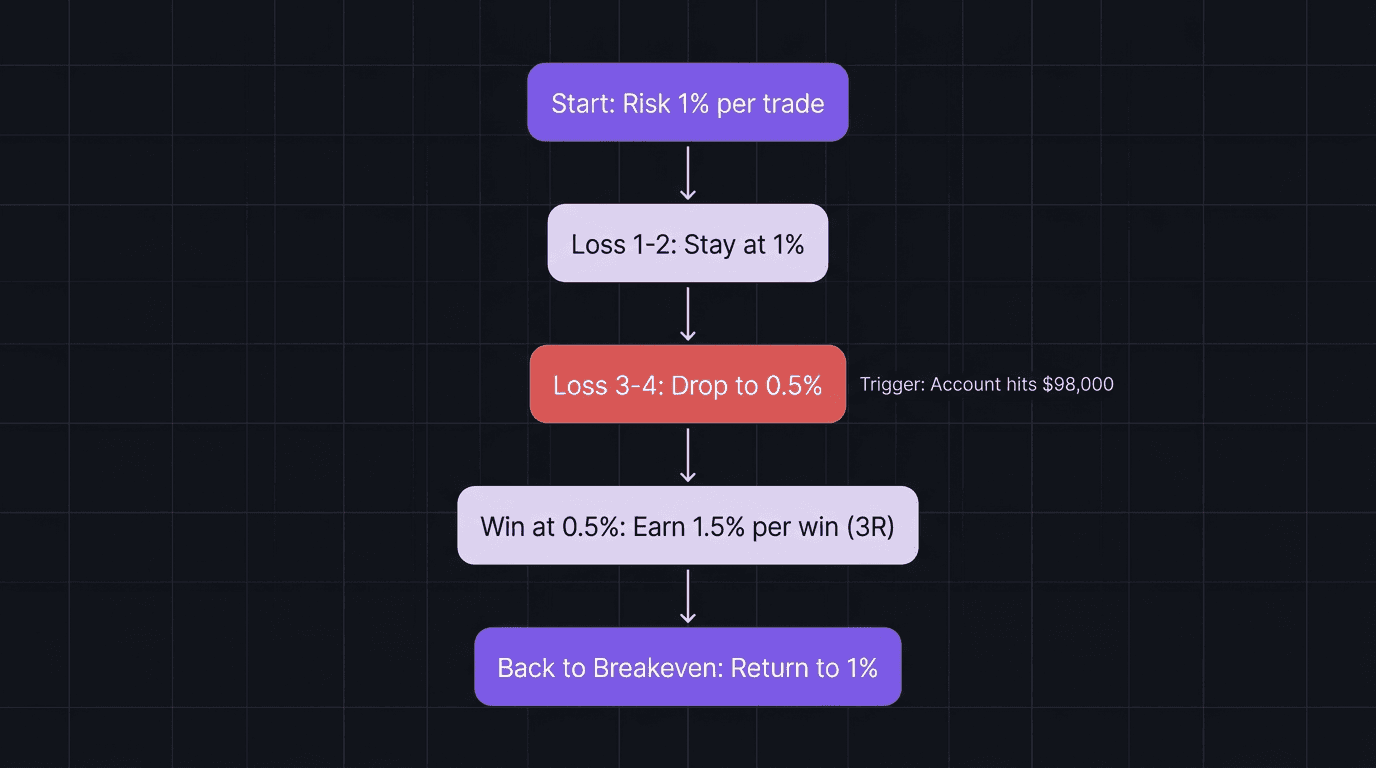
The key to this protocol is the trigger. You do not decide in the moment whether to de-risk. The rule is pre-set: at $98,000 (or 2% down from your starting balance), the risk drops. No negotiation. No "one more trade at full size." The rule fires automatically because you wrote it into your plan before the challenge started.
Once you are back to breakeven, you return to 1% risk. Fresh start.
When to Stop and Take a Break
De-risking is the first defense. The second is knowing when to walk away entirely.
If you hit four consecutive losses, stop trading for the day. This is not optional advice. This is a rule you write into your trading plan before you take the first trade of the challenge.
Why four? Because after four losses, your decision-making quality drops. You are not thinking about the next A+ setup. You are thinking about recovery. About getting back to breakeven. About how this should not be happening. That is exactly the mental state that leads to revenge trading, and revenge trades during a funded challenge can end the account in a single session.
Here is what your break looks like:
Close your trading platform.
Open your trading journal. Review the four trades. Were they all plan-based? Mark each one as a good loss or a bad loss.
If any trade was a bad loss (wrong pair, wrong session, emotional entry, oversized position), write down what triggered it.
Walk away for at least 24 hours. Most challenges offer unlimited time. Use it.
Before your next session, re-read your trading plan from the first line. Not a skim. A full read.
The hardest part of this protocol is believing you have time. If you have been conditioned by older challenge formats that required 10% in 30 days, the idea of pausing for two or three days feels like falling behind. But with unlimited time, there is no behind. There is only in the game or out of the game.
Every day you do not blow the account is a day you can still pass.
The Climb Back to Breakeven
Recovery after a losing streak is not about one big trade. It is about rebuilding confidence through small, controlled wins.
If your drawdown reached 3%, here is the math at 0.5% risk with 1:3 reward:
Win one trade: +1.5%. Drawdown reduces to 1.5%.
Win a second trade: +1.5%. You are back to breakeven.
Two trades. That is all it takes. And because you are risking only 0.5%, a loss during recovery costs half of what it did at full size. The worst case scenario at 0.5% risk is slow. It is never catastrophic.
Once your balance returns to the starting amount ($100,000 in this example), switch back to 1% risk per trade. You earned the right to trade at full size again by proving you can stay disciplined through the drawdown.
Here is what matters during the climb: do not change your strategy. Do not start looking for "safer" setups or switch to a different pair because the one you have been trading "feels unlucky." Your backtested edge works on your plan, your pairs, your session. Changing any of those variables during recovery introduces a new set of unknowns exactly when you need certainty.
What Recovery Actually Looks Like
After four losses, your balance is $97,022 (down roughly 3%). You take a break for two days. You review your journal and confirm all four losses were plan-based. You return to the charts.
Trade 5: EUR/USD long during New York session. 0.5% risk, 1:3 target. You risk $485. Price reaches take profit. You gain $1,455. Balance: $98,477.
Trade 6: GBP/USD short during London open. Same 0.5% risk protocol. You risk $492. Take profit hit. You gain $1,477. Balance: $99,955.
Trade 7: Still at 0.5% because you have not yet reached $100,000. You risk $500. Win. Gain $1,500. Balance: $101,455. You are now above breakeven, and you switch back to 1% risk.
Total time to recover: roughly one week with 1 to 2 trades per day. No panic. No oversized positions. Just the same plan you started with.
Notice something in that scenario? The trader did not try to recover in a single day. One or two trades per day, over five to seven days, brought the account back above starting capital. That is what drawdown recovery looks like when you trust the process.
Good Losses vs. Bad Losses
Not every loss during a streak deserves the same reaction. This distinction changes how you handle the drawdown.
A good loss is a trade that followed your plan completely. Correct pair, correct session, correct entry criteria, correct risk size, correct stop placement. Price simply went the other way. These losses are expected. They are part of the cost structure of any strategy with a sub-100% win rate.
A bad loss is a trade taken outside the plan. Maybe you entered on a C-grade setup because you wanted to "get back in the game." Maybe you doubled your lot size to recover faster. Maybe you traded during the wrong session or on a pair you have not backtested.
Here is the rule: if all four losses in your streak were good losses, your strategy is fine. Continue with the de-risk protocol and keep executing the plan. But if even one loss was a bad loss, the problem is not the market. The problem is your execution. And that requires a longer break and a deeper journal review before returning.
Write this question at the top of your funded account management checklist: "Was this trade inside my plan?" Answer it after every single trade, win or loss.
How EdgeFlo Flags Your Losing Streak
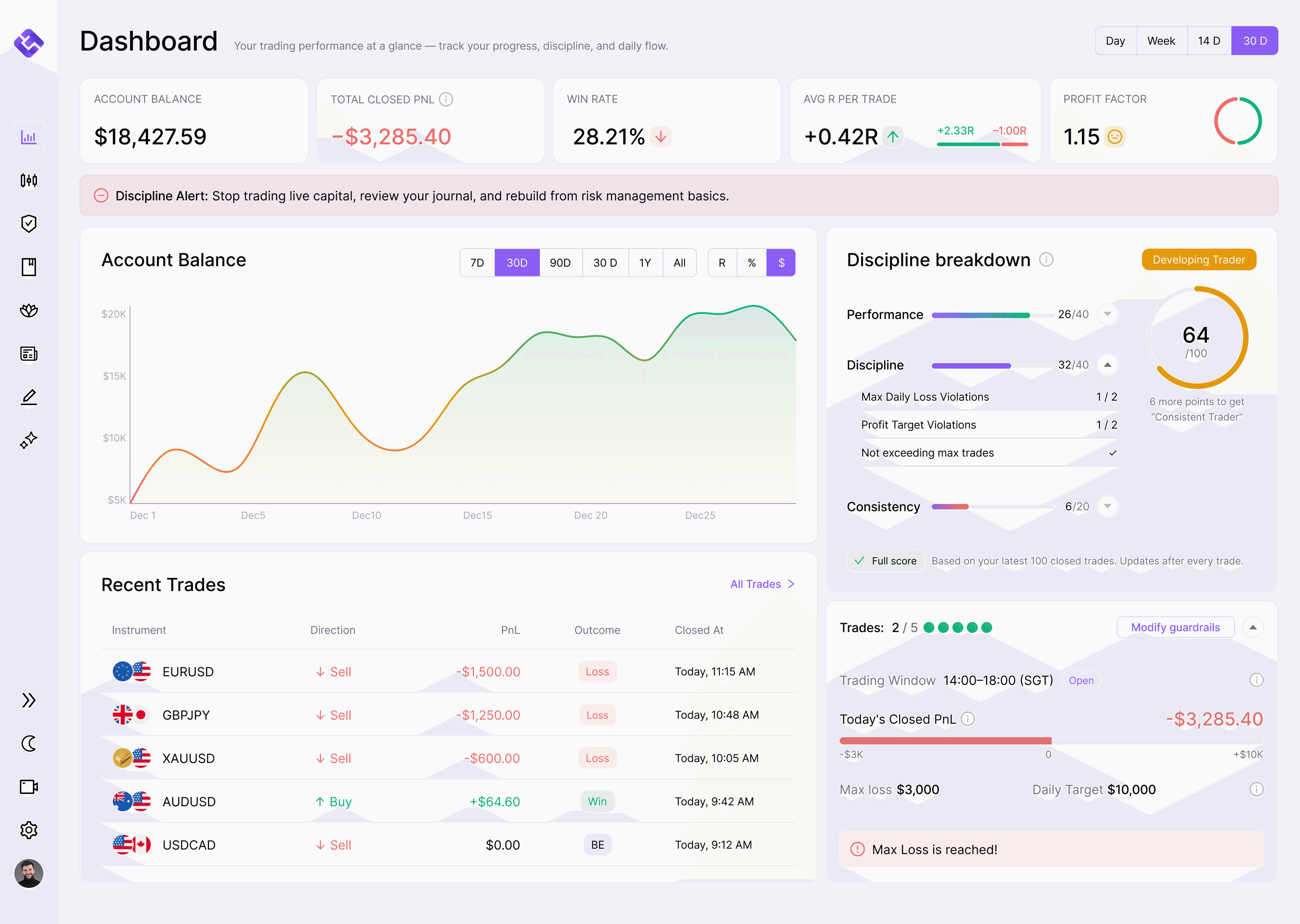
EdgeFlo's trading dashboard tracks consecutive losses automatically. When your loss count starts climbing, the dashboard surfaces that data so you can see the streak building in real time, not just feel it emotionally.
The guardrails layer adds another line of defense. If you set a daily loss limit (say 2% of your challenge account), EdgeFlo warns you when you approach it. You can still override and take another trade, but the system makes you pause and consciously choose to continue. That friction is intentional. It is the difference between spiraling into a revenge trade and walking away for the day.
Combined with journal entries that tag each trade's emotional state, you build a complete picture of what happened during the streak, not just the P&L, but the decisions behind it. When you sit down to review before your next session, the data is already organized.
The Edge Brief
Receive Insights on trading psychology, discipline, and the behavioral patterns that create consistent traders from our Founder and the EdgeFlo team, delivered to your inbox.
Think different. Trade different.
How many losses in a row should I expect during a funded challenge?
Should I stop trading after a losing streak in a funded challenge?
How do I recover from a 3% drawdown in a funded challenge?
Does unlimited time in a funded challenge actually help?

Turn discipline on.
Every session.
EdgeFlo is the environment serious traders operate inside.
Start 7-Day Free Trial
Cancel anytime.
No long-term commitment.

Think Different, Trade Different.