

Liquidity Sweeps and Stop Loss Placement
Learn why good trades get stopped out by liquidity sweeps and how to place your stop loss below the sweep zone to stay in winning trades.
You took the trade. The analysis was clean: higher highs, higher lows, clear demand zone, bullish bias. You placed your stop below the most recent swing low, exactly where the textbook says. Then price dipped below your stop by 8 pips, triggered your exit, and immediately reversed to hit your take profit without you.
That was not bad luck. That was a liquidity sweep, and it happens to every trader who places stops at obvious levels without accounting for how the market hunts those levels before continuing.
TL;DR
Liquidity sweeps are quick price moves below swing lows (or above swing highs) designed to trigger clustered stop losses.
Placing your stop at the obvious swing low makes you a target for sweeps.
Structure-based placement means putting your stop below the liquidity zone, not at it.
Wait for the sweep to happen before trailing your stop to the new structural level.
The transcript confirms: "I only moved my stop loss when price actually stripped the available liquidity and then got pushed up."
Why Good Trades Get Stopped Out
Most traders learn to place stop losses at the most recent swing low (for longs) or swing high (for shorts). This is technically correct. The swing low represents the last point where buyers stepped in, so if price goes below it, the trade idea may be invalid.
The problem is that everyone learns this. When every retail trader places stops at the same swing low, that level becomes a pool of liquidity. And pools of liquidity attract price.
Think of it like this. A swing low at 1.0820 has hundreds of stop orders sitting just below it. Every trader who went long in the 1.0840 to 1.0860 range placed their stop somewhere between 1.0815 and 1.0820. That is a dense cluster of sell orders waiting to be triggered.
When price dips to 1.0818, all those stops fire simultaneously. That creates a burst of selling pressure at that price level, which larger participants can buy into. They get filled at a better price because retail traders just provided the liquidity. Then price reverses and continues higher.
Your trade idea was correct. Your stop placement was predictable.
How Liquidity Sweeps Trigger Stop Losses
The transcript explains the mechanics clearly. In an uptrend, price creates higher highs and higher lows. But sometimes, "it comes down here and sweeps the available liquidity that we have below these lows right here, before going up even further."
Here is what the sequence looks like:
Price makes higher high at 1.0900.
Price pulls back and creates a higher low at 1.0860.
Price rallies again, makes a new higher high at 1.0920.
Price pulls back. Instead of forming a higher low at or above 1.0860, it dips to 1.0855, sweeps the stops below 1.0860, and then immediately reverses up.
Price continues to 1.0950.
If your stop was at 1.0858 (just below the 1.0860 swing low), you got stopped out at step 4. The trade was correct. The trend was intact. But the sweep cleaned you out.
The transcript puts numbers on this: "You maybe make like $500 [from the trailing stop], but if you did not get stopped out, you would have made $2,000. Because you got liquidity swept right there."
That is the real cost. Not just the loss on the single trade, but the missed profit from a trade that would have worked.
Walkthrough: EUR/USD Liquidity Sweep
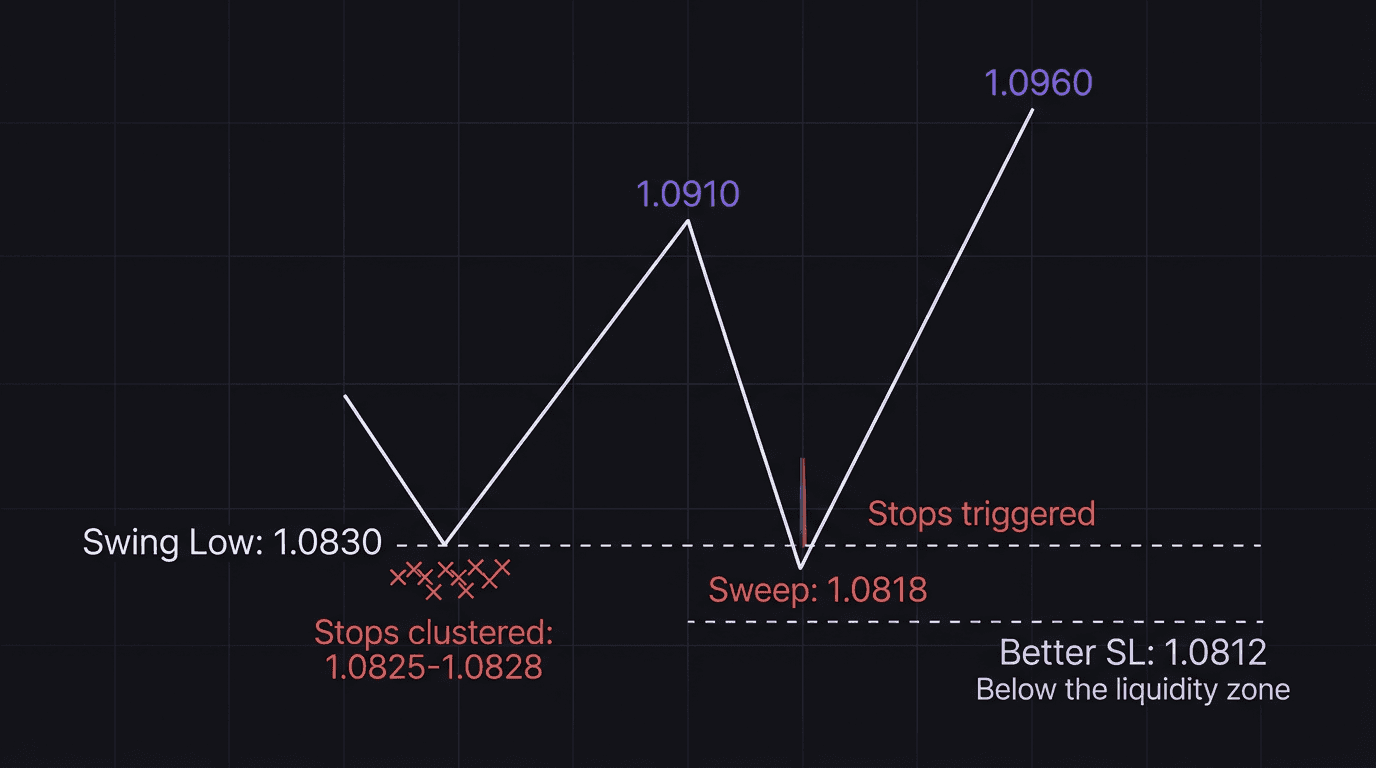
You go long on EUR/USD at 1.0850 from a demand zone on the 1-hour chart. Market structure shows clear higher highs and higher lows. You place your stop at 1.0825, just below the most recent swing low at 1.0830.
Price moves to 1.0890, pulls back to 1.0855, and creates a higher low. You trail your stop from 1.0825 to 1.0828 (just below the new swing low at 1.0830 is your original stop, so you leave it). Price pushes to 1.0910.
Then the sweep comes. Price drops from 1.0910 to 1.0822 in two candles. Your stop at 1.0825 fires. You are out with a 25-pip loss.
Two candles later, price wicks to 1.0818, absorbs all the sell orders, and reverses. By the end of the day, EUR/USD is at 1.0960. The trade offered 110 pips of profit. You got a 25-pip loss.
If your stop had been at 1.0812 (below the liquidity zone rather than at the obvious swing low), you would have survived the sweep and captured the move. The extra 13 pips of risk on your stop would have paid for a much larger reward.
Structure-Based SL Placement
The fix is to place your stop below where the liquidity sits, not at it. This means giving your stop extra room beyond the obvious swing low.
Standard placement: stop at the swing low or 2 to 3 pips below it. This is where every textbook tells you to put it. This is also where your stop gets swept.
Structure-based placement: identify where the liquidity pool likely sits (at the obvious swing low), then place your stop 10 to 15 pips below that zone. Yes, this increases your initial risk. A 30-pip stop becomes a 45-pip stop. But it keeps you in trades that would otherwise sweep you out.
To maintain the same dollar risk with a wider stop, you reduce your position size. If you were risking $300 with a 30-pip stop on EUR/USD (1 standard lot = $10/pip, so 1 lot at 30 pips = $300), a 45-pip stop means you drop to roughly 0.67 lots ($300 / ($10 x 45) = 0.67). Smaller position, same dollar risk, much harder to sweep.
The transcript reinforces this approach. The instructor describes a trade where he specifically waited for the sweep before acting: "I only moved my stop loss when price actually stripped the available liquidity right here and then got pushed up like that." He saw liquidity building below the lows, recognized it as a trap, and waited for it to resolve before adjusting his position.
This is the difference between placing stops based on supply and demand zones (where you think support is) versus placing stops based on where the market is likely to hunt before actually respecting that support.
Wait for the Sweep Before You Trail
The most practical rule from the transcript for intermediate traders: do not trail your stop to a new structural level until the liquidity below that level has been swept.
Here is the sequence:
Price creates higher high.
Price pulls back and forms what looks like a higher low.
Before you trail your stop to that higher low, ask: "Has the liquidity below this low been swept?"
If yes (price already dipped below the low and reversed), trail your stop. The sweep is done; the level is clean.
If no (the low is untouched and obvious), wait. The sweep might still come.
This requires patience and active chart monitoring. You cannot set and forget with this approach. But the payoff is significant: you stay in trades that would otherwise stop you out.
The transcript instructor describes exactly this scenario: "I did not move my stop loss to right here because I know for a fact that this is not really a valid low yet because that is just liquidity building up below these lows right there."
He waited. The sweep happened. He moved his stop after the sweep was done. The trade went on to make $3,800 in profit.
Compare that to moving your stop loss to every visible swing low as it forms. Each move makes your stop tighter and more vulnerable. The tighter stop gives you a false sense of security while increasing the probability of getting swept.
Understanding break of structure concepts helps you distinguish between a genuine reversal (which means your stop should have been hit) and a liquidity sweep (which means the trend is still intact). A genuine break of structure changes the pattern of highs and lows. A sweep dips briefly below and immediately reverses. Learning to tell the difference is one of the most valuable skills in forex execution.
Trading without a stop loss is never the answer. The solution is a better-placed stop, not no stop at all.
How EdgeFlo Helps You Learn From Sweep Patterns
EdgeFlo's journal supports emotion tagging on every trade, which helps you identify whether a premature stop-loss move was driven by fear rather than structure. Over time, reviewing tagged entries reveals whether your early stops correlate with emotional states or genuine structural analysis.
If you keep getting swept, the journal data will show it. Pattern recognition across 20 or 30 tagged trades is far more actionable than guessing after each individual loss.
The Edge Brief
Receive Insights on trading psychology, discipline, and the behavioral patterns that create consistent traders from our Founder and the EdgeFlo team, delivered to your inbox.
Think different. Trade different.
What is a liquidity sweep in trading?
Why does my stop loss keep getting hit before price moves my way?
Where should I place my stop loss to avoid liquidity sweeps?
Should I wait for a liquidity sweep before entering a trade?

Turn discipline on.
Every session.
EdgeFlo is the environment serious traders operate inside.
Start 7-Day Free Trial
Cancel anytime.
No long-term commitment.

Think Different, Trade Different.