

How to Know When Your Trading System Actually Works
Ten trades tell you nothing. A hundred trades reveal your edge. Learn the sample size that separates luck from skill and how your dashboard proves it.
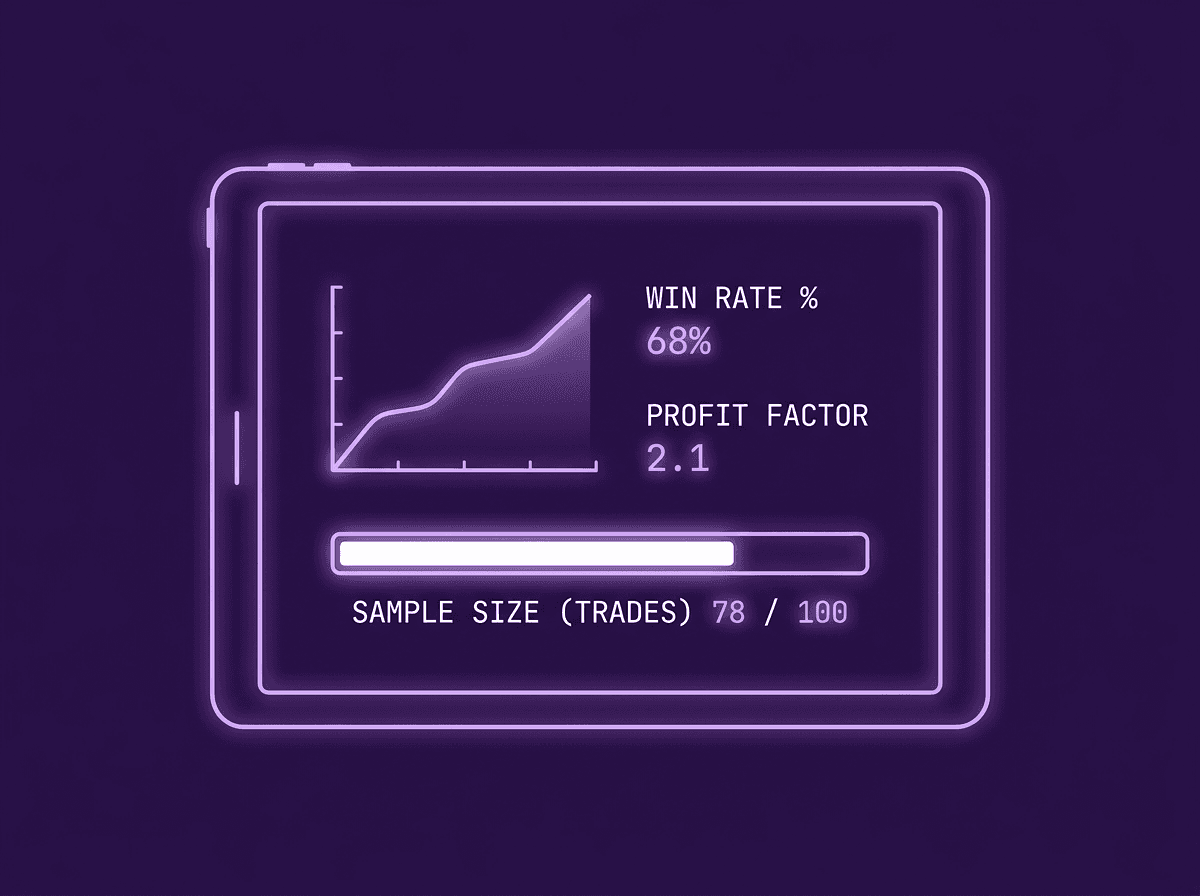
Ten trades tell you nothing. A hot streak of five winners feels like proof that your system works. A cold streak of five losers feels like proof that it does not. Both feelings are wrong. At ten trades, you cannot distinguish skill from luck.
A hundred trades start to separate signal from noise. At that sample size, patterns emerge that are not driven by randomness. Your win rate stabilizes. Your average R per trade converges on a real number. Your expectancy becomes meaningful.
If you want to know whether your trading system actually works, stop guessing after a handful of trades and start measuring after a hundred.
TL;DR
Small sample sizes create false confidence and false despair in equal measure.
A minimum of 100 trades taken with consistent rules is needed before drawing conclusions about your system.
The metrics that matter: expectancy, profit factor, and consistency over time.
Lucky streaks and normal drawdowns both look like "the system works" or "the system is broken" at small sample sizes.
A dashboard that tracks edge over hundreds of trades shows whether your system is real or an illusion.
Why Ten Trades Tell You Nothing
Imagine flipping a fair coin. The expected result over 1,000 flips is close to 50/50. But in any sequence of 10 flips, getting 7 heads or 3 heads is not unusual. At small sample sizes, variance dominates the signal.
Trading works the same way. A system with a true 50% win rate and 2:1 reward-to-risk can easily produce 3 wins out of 10 trades, or 8 wins out of 10. Both outcomes are within normal variance. Neither tells you anything definitive about the system's edge.
This is why traders who evaluate their system after every 10 or 20 trades are constantly whipsawing between confidence and doubt. The data is too thin to support any conclusion, but the emotional impact of recent results is strong enough to feel certain.
The only cure is more data. Not more opinions. Not more indicators. More trades, taken with consistent rules, tracked systematically.
The Sample Size That Separates Luck From Edge
Statisticians use the concept of confidence intervals to determine when a result is meaningful. For trading, the practical threshold is around 100 trades executed with the same rules, on the same instruments, during the same market conditions.
At 100 trades, the variance in your win rate narrows enough that the number means something. If your system shows a 45% win rate over 100 trades, the true win rate is probably somewhere between 35% and 55%. That range is wide, but it tells you something real: you are not a 70% win rate trader, and you are not a 20% one.
At 30 trades, the same 45% observed win rate could mean a true win rate anywhere from 25% to 65%. That range is so wide it is nearly useless for decision-making.
This is why patience with your system is not just a psychological virtue. It is a statistical necessity. You literally cannot evaluate your system until you have enough trades. Trading expectancy calculated from 20 trades is a guess. Expectancy from 100 trades is data.
Walkthrough: The System That Looked Broken
A trader takes 25 trades on a new breakout system. Results: 9 wins, 16 losses. Win rate: 36%. Average winner: 2.3R. Average loser: 1.0R.
The trader's gut reaction: "This system does not work. Time to find something new."
But the numbers tell a different story. Expectancy: (0.36 times 2.3) minus (0.64 times 1.0) = 0.828 minus 0.64 = 0.188R per trade. Positive expectancy. The system is actually working; it just looks bad because 25 trades is not enough for the win rate to stabilize.
The trader sticks with it for 75 more trades (100 total). Final results: 44 wins, 56 losses. Win rate: 44%. Average winner: 2.4R. Average loser: 0.95R. Expectancy: (0.44 times 2.4) minus (0.56 times 0.95) = 1.056 minus 0.532 = 0.524R per trade.
The system was never broken. The sample was too small to see the edge. If the trader had abandoned it at trade 25, they would have walked away from a system producing 0.524R per trade, which is a strong edge.
False Confidence From a Lucky Streak
The opposite problem is equally dangerous. A trader takes 15 trades on a new system and wins 11 of them. Win rate: 73%. "This is the best system I have ever used."
Confidence surges. The trader increases position size. Takes more trades per day. Tells friends about the new strategy. Then the next 30 trades produce 12 wins and 18 losses (40% win rate). The overall record is now 23 wins out of 45 trades (51%).
The initial 73% was variance, not signal. By the time the trader recognized that, they had already oversized and given back half the gains from the lucky streak.
This is why profit factor over small samples is misleading. A profit factor of 4.0 over 15 trades is not a proven system. It is a hot streak that has not yet regressed to the mean.
Walkthrough: The Lucky Streak That Cost More Than It Made
A trader wins 8 out of 10 trades on USD/JPY, averaging 1.8R per winner. Encouraged, the trader doubles their risk from 1% to 2% per trade.
Over the next 20 trades at 2% risk, the system reverts: 9 wins, 11 losses. Win rate: 45%. Average winner: 1.6R.
On the first 10 trades at 1% risk (on a $5,000 account): net gain approximately +$490.
On the first 10 trades at 1% risk: net gain approximately +$620.
On the next 20 trades at 2% risk (on the now approximately $5,620 account):
9 wins at 1.6R with approximately $112 risk = 9 times $179 = $1,613.
11 losses at approximately $112 = $1,234.
Net from those 20 trades: +$379.
The overall result is positive (+$999 across 30 trades), but the increased risk during a period of normal variance added unnecessary drawdown volatility. If the next losing streak had been six trades instead of scattered, the 2% risk could have easily produced a $675 drawdown (6 times $112.40) that would have shaken the trader's confidence and triggered emotional decisions.
The lesson: do not adjust sizing based on small sample results. Wait for 100 trades before drawing conclusions about your system, and never increase risk until the edge is statistically confirmed.
False Despair From a Normal Drawdown
Drawdowns are a normal feature of every profitable trading system. A system with 45% win rate will produce streaks of 5, 6, even 8 consecutive losers during normal operation. That is not the system failing. That is the system behaving exactly as expected.
The problem is that normal drawdowns feel like catastrophic failures when you do not have enough context. After 30 trades, a 7-trade losing streak feels like the end. After 300 trades, you can look at your equity curve and see that you have survived similar drawdowns before and recovered every time.
Context eliminates despair. And context requires data. And data requires volume. There is no shortcut.
How EdgeFlo Dashboard Tracks Your Edge Over Hundreds of Trades
A basic tracking spreadsheet can tell you your win rate and average R. But meaningful system evaluation requires more depth: segmented performance by setup type, session, day of week, and market condition. It requires rolling metrics that show trends over time, not just static snapshots.
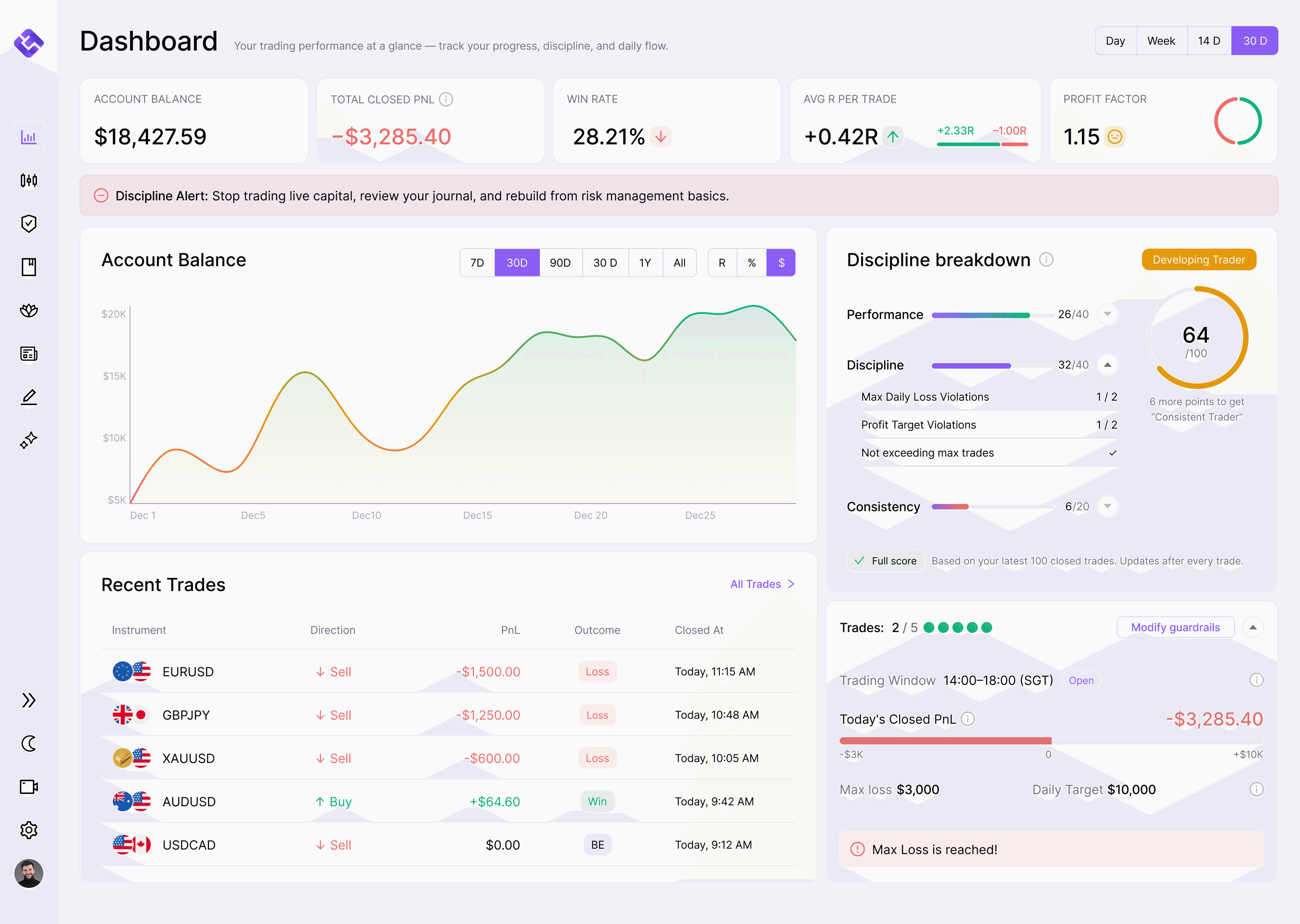
EdgeFlo's dashboard tracks win rate, average R, profit factor, and expectancy across your entire trade history. You can filter by instrument, session, and setup type to see where your edge is strongest and where it fades.
The consistency metrics panel shows how your key numbers evolve over time. A rising expectancy trend confirms the system is working. A declining profit factor flags that something has changed and needs investigation.
After 100 trades, the dashboard tells you with reasonable confidence whether your system has a real edge or whether your results have been driven by luck. After 200 trades, the confidence tightens further. The longer you track, the clearer the picture becomes.
That clarity is the antidote to both false confidence and false despair. When you can open your dashboard and see that your system produces 0.5R per trade over 150 trades, with normal drawdowns of 8 to 12R, a current drawdown of 10R does not trigger panic. It triggers patience. You know the recovery is built into the system.
And that knowledge, backed by data you can actually see and analyze in your journal, is what separates traders who survive from traders who quit right before the edge would have paid off.
The Edge Brief
Receive Insights on trading psychology, discipline, and the behavioral patterns that create consistent traders from our Founder and the EdgeFlo team, delivered to your inbox.
Think different. Trade different.
How many trades do I need to know if my system works?
What metrics prove a trading system has an edge?
Can a 40% win rate system be profitable?
Should I change my system after a losing month?

Turn discipline on.
Every session.
EdgeFlo is the environment serious traders operate inside.
Start 7-Day Free Trial
Cancel anytime.
No long-term commitment.

Think Different, Trade Different.