

How to Protect a Small Trading Account From Yourself
Small accounts amplify bad habits. Learn how fixed risk per trade, daily loss caps, and fewer instruments keep your small account alive long enough to grow.
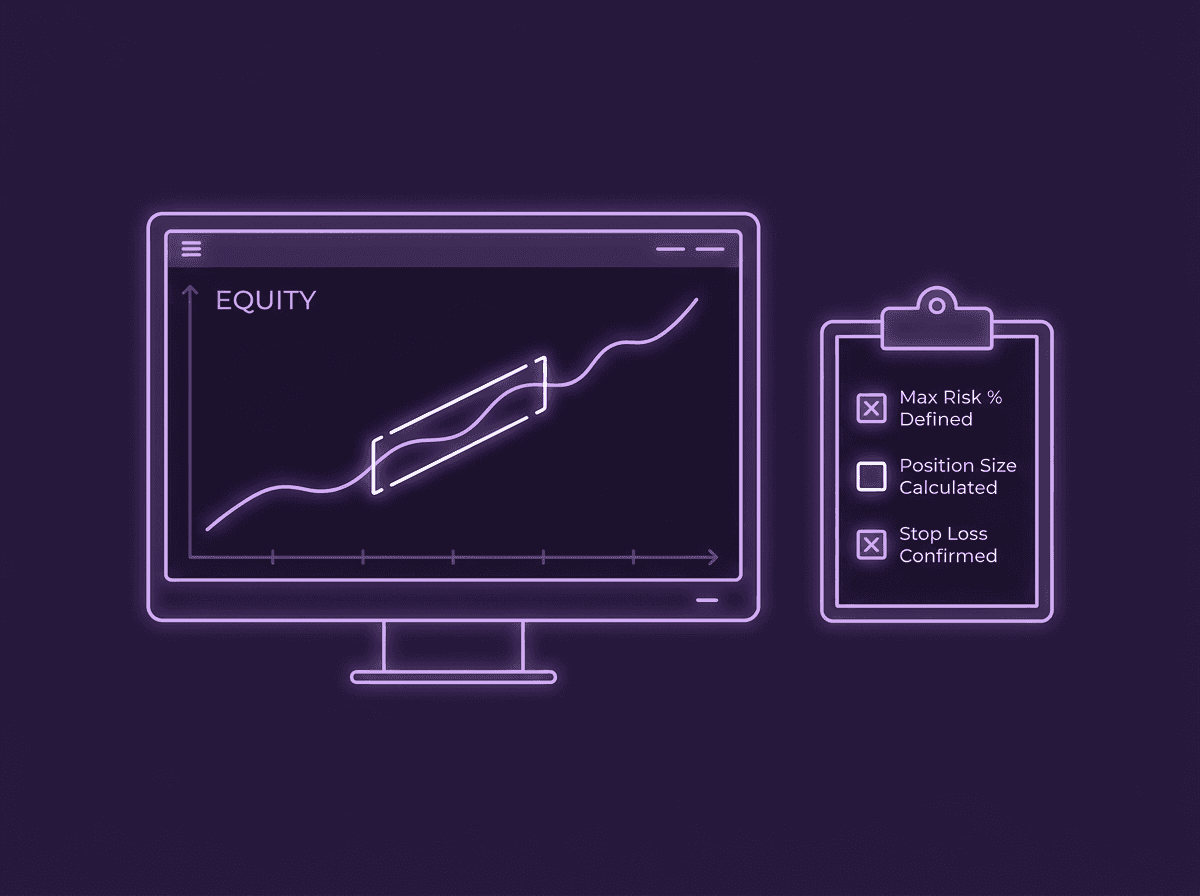
If you cannot protect $100, you will not protect $100,000. That is not a motivational line. It is a mechanical truth about how habits work. The trader who overleverages a $500 account will do the exact same thing when the account grows, except the dollar amounts will hurt more.
Small accounts are not the problem. The habits you build on them are either the foundation for growth or the blueprint for repeated blowups.
TL;DR
Small accounts amplify bad habits because one overleveraged trade can erase weeks of progress.
Fix your risk at 1% per trade, regardless of account size.
Set a daily loss cap (3% is a practical starting point) and stop trading when you hit it.
Trade fewer instruments so you actually understand what you are watching.
The habits you build on a small account follow you to every account size that comes after.
Why Small Accounts Amplify Bad Habits
A $10,000 account can absorb a 5% drawdown and barely feel it in daily life. A $500 account loses $25 on the same percentage move, which might not sound like much, but it represents the same proportional damage.
The real danger is psychological. Small account traders often feel pressure to "grow fast" because the dollar amounts from proper risk management feel tiny. Risking 1% of $500 is $5 per trade. Five dollars feels like nothing, so the temptation is to bump it to 5% or 10% to make the wins "worth it."
That is the trap. Once you start bending risk rules because the dollar amount feels small, you have trained yourself to override your own system. And that override habit does not disappear when the account gets bigger. It scales.
Every blown account starts the same way: a trader who decided the rules did not apply "just this once."
The One Revenge Trade That Wipes 10 Percent
Revenge trading on a large account costs money. Revenge trading on a small account can be terminal.
Walkthrough: How One Bad Hour Costs 12%
You have a $1,000 account. You are risking 2% per trade ($20) on EUR/USD. Your first trade of the day hits the stop loss. Down $20.
Instead of following your plan, you immediately re-enter with double the size because you want to "make it back." Now you are risking 4% ($39.20 on the reduced balance of $980). That trade also loses. You are now down $59.20, or about 6% of your starting balance.
Frustration takes over. You enter a third trade, this time risking 6% because you are convinced the move is coming. It does not. That trade loses $56.45 (6% of $940.80). You are now down $115.65 in one session. That is nearly 11.6% of your starting account, gone in three trades.
With proper 1% risk and a daily loss limit of 3%, the worst case for that session would have been $30. Three losses at $10 each, then you stop. The account survives. You get to trade tomorrow.
Walkthrough: The Same Week, Disciplined Version
Same $1,000 account, same week. You risk 1% ($10) per trade with a 3% daily loss cap.
Monday: two losses and one 2R win. Net: $0. Tuesday: one loss and two 2R wins. Net: +$30. Wednesday: three losses, daily cap hit. Net: down $30. Thursday: two 1.5R wins. Net: +$30. Friday: one loss and one 3R win. Net: +$20.
Weekly net: +$50, or 5% growth. Not exciting. But the account is intact, growing, and building data for your journal. The rules held.
Fixed Risk Per Trade: The Non-Negotiable Rule
The single most important rule for any small account is fixed percentage risk per trade. One percent is the standard.
On a $500 account, that is $5 per trade. On a $1,000 account, $10. On a $5,000 account, $50. The dollar amount changes. The percentage does not.
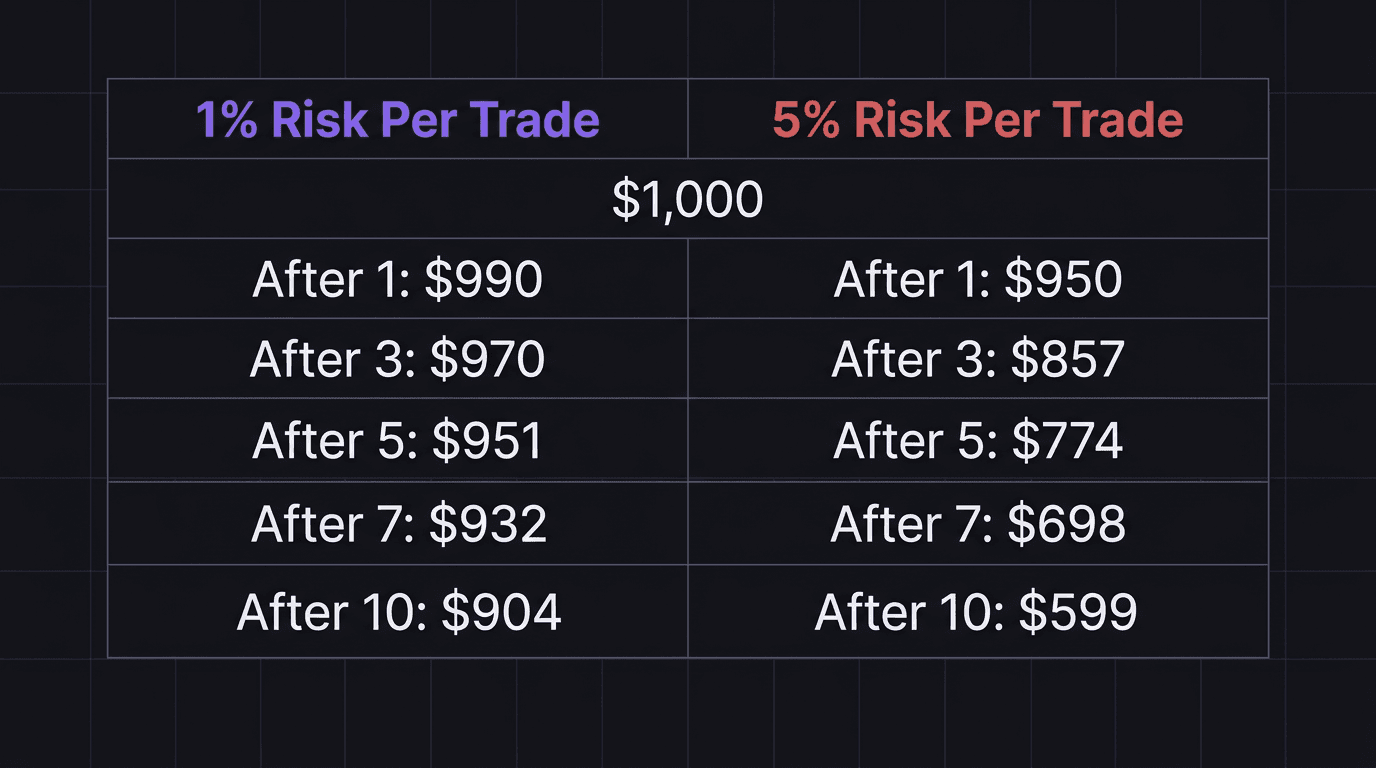
This rule does two things. First, it ensures that a losing streak costs you a manageable drawdown instead of a catastrophic one. Ten consecutive losses at 1% each leaves you with roughly 90% of your account. Ten losses at 5% each leaves you with about 60%.
Second, it trains the habit of disciplined position sizing that will serve you at every account size. The trader who sizes correctly on $500 will size correctly on $50,000 because the muscle memory is already there.
Fewer Instruments, Fewer Mistakes
The other trap for small account traders is watching too many pairs or instruments. Scanning 20 charts feels productive. In reality, it splits your attention and leads to trades on instruments you do not truly understand.
Pick two or three instruments. Learn their behavior during different sessions. Know their average daily range, their typical spread, and how they react to news. Deep familiarity with a few instruments beats surface-level scanning of dozens.
When you know that GBP/USD tends to spike at London open and flatten in the Asian session, you stop taking low-probability trades during quiet hours. When you know that gold has wider spreads and bigger moves, you adjust your stop distance accordingly.
Fewer instruments means fewer decisions, which means fewer opportunities to make emotional mistakes. On a small account, every avoidable mistake costs a disproportionate percentage of your capital. Capital preservation starts with reducing the number of ways you can hurt yourself.
How EdgeFlo Risk Calculator Sizes Every Trade to Your Account
The math behind position sizing is not complicated, but doing it manually before every trade creates friction. Friction leads to shortcuts. Shortcuts on a small account lead to overleveraging.
EdgeFlo's auto risk calculator computes the correct lot size for every trade based on your account balance, your chosen risk percentage, and your stop loss distance. You set your risk rule once (1% per trade, for example) and the calculator does the math in real time.
That removes the most common small-account failure point: the moment where a trader thinks "I will just round up to the next lot size, it is close enough." On a $500 account, rounding up can double your actual risk without you realizing it.
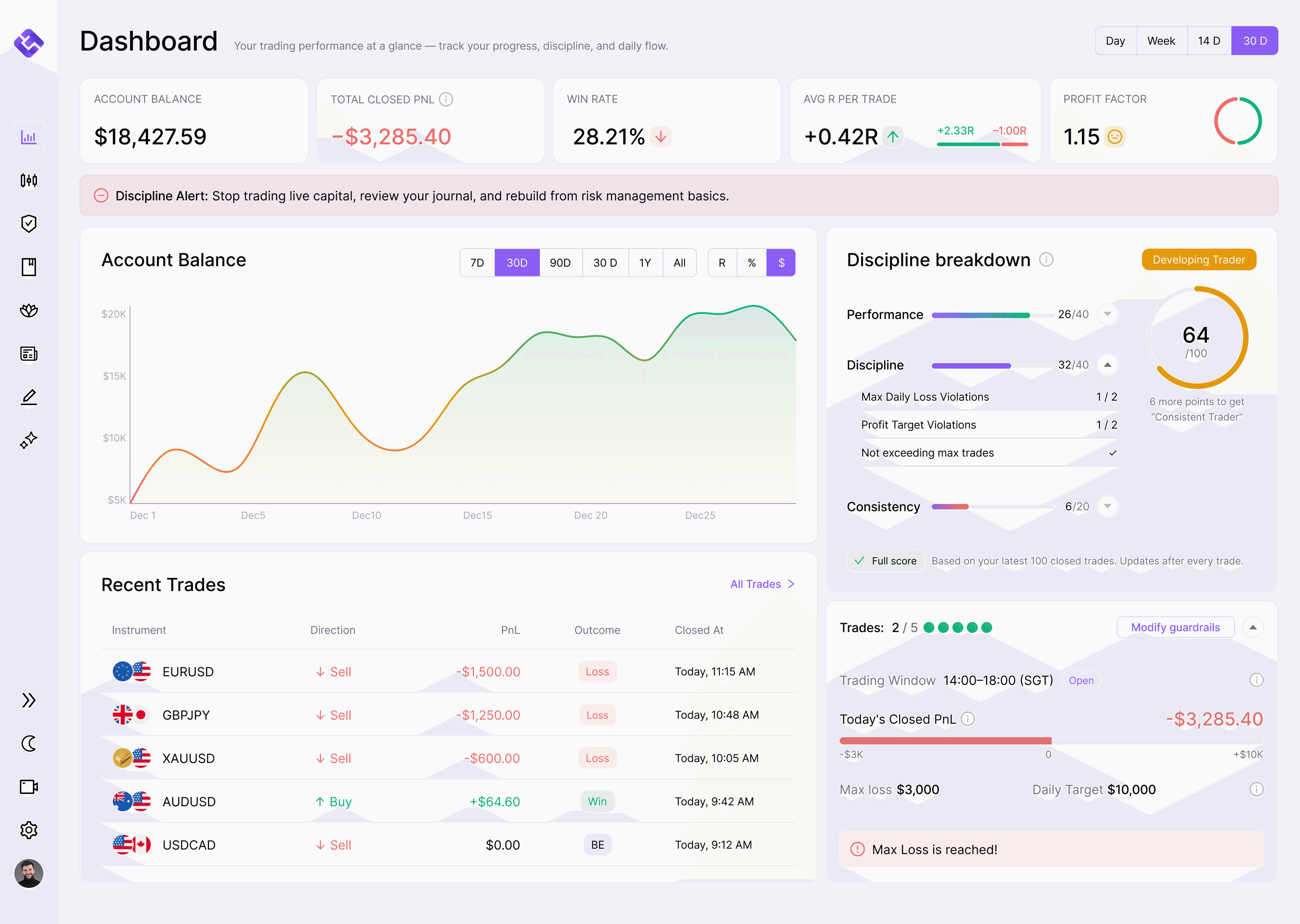
Combined with guardrails that restrict trading when you hit your daily loss limit (you can override them, but you have to choose to), EdgeFlo turns small-account protection from a test of willpower into an environment design problem. The rules are visible, the math is automatic, and breaking them requires a conscious decision instead of an absent-minded click.
The Edge Brief
Receive Insights on trading psychology, discipline, and the behavioral patterns that create consistent traders from our Founder and the EdgeFlo team, delivered to your inbox.
Think different. Trade different.
How much should I risk per trade on a small account?
Can I grow a $500 trading account?
What is the biggest mistake small account traders make?
Should I use a daily loss limit on a small account?

Turn discipline on.
Every session.
EdgeFlo is the environment serious traders operate inside.
Start 7-Day Free Trial
Cancel anytime.
No long-term commitment.

Think Different, Trade Different.