

Internal vs External Structure: How Pullbacks Work Inside Trends
Internal and external market structure serve different purposes. Learn how pullbacks use internal structure, and how a break of that structure signals trend resumption.

You see the trend. You know it is bullish. Price pulls back and you enter the dip. Then it dips further, stops you out, and reverses without you. The trend was right. Your timing was not.
The problem is that you entered during the pullback without understanding the structure inside it. Every pullback has its own internal structure, a mini-trend that moves against the main direction. Until that internal structure breaks, the pullback is not finished. Entering before the break is guessing. Entering after it is reacting to proof.
TL;DR
External (swing) structure defines the main trend: higher highs and higher lows for bullish, lower highs and lower lows for bearish.
Internal structure is the smaller zigzag of highs and lows that forms within a pullback leg.
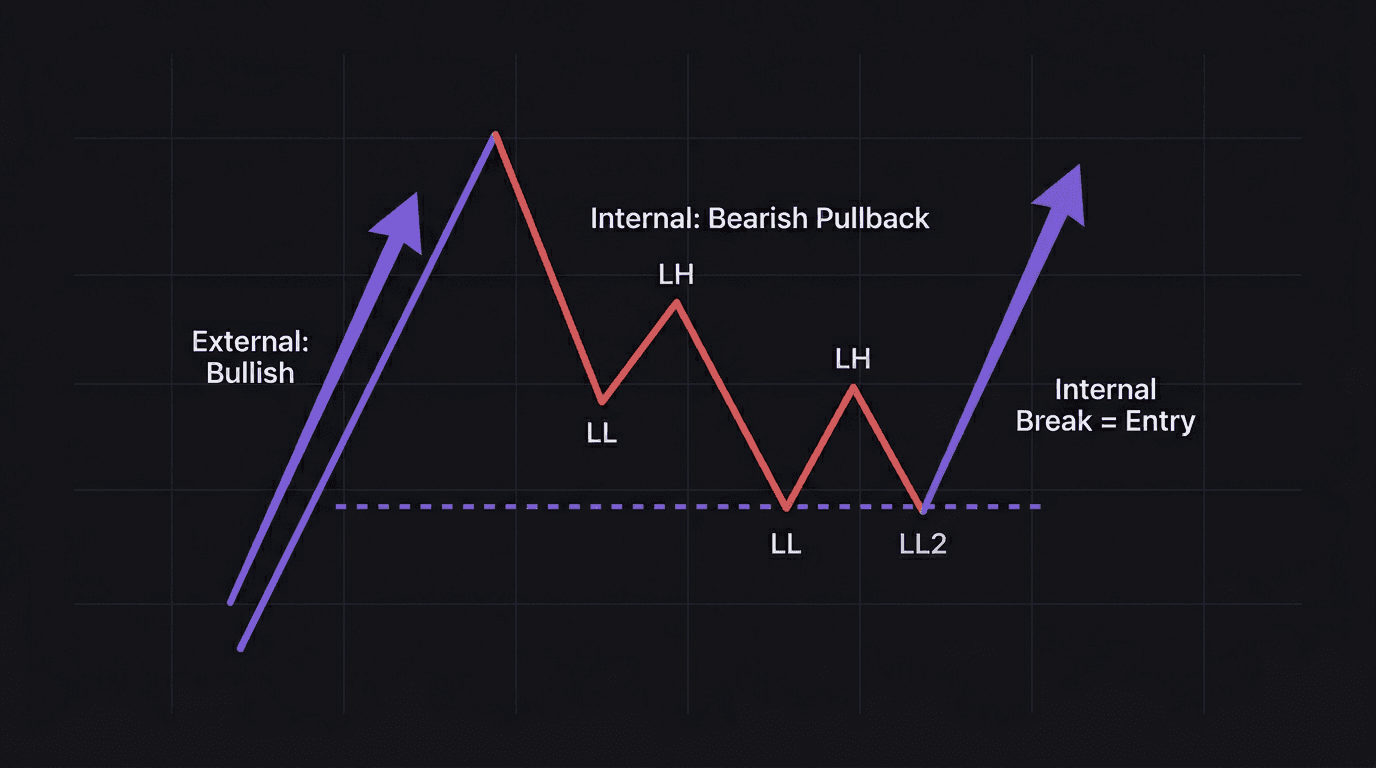
In an uptrend, the pullback creates bearish internal structure (lower highs and lower lows moving against the main trend).
The pullback ends when internal structure breaks in the direction of the external trend.
Waiting for that break filters out premature entries and keeps you aligned with institutional flow.
What Is External (Swing) Structure
External structure is the big picture. It is the series of major swing highs and swing lows that define whether the market is trending up, trending down, or moving sideways.
In a bullish external structure, you see higher highs and higher lows. Each new swing high sits above the previous one. Each pullback low holds above the previous swing low. That pattern tells you buyers are in control at the macro level.
In a bearish external structure, you see lower highs and lower lows. Sellers are in control. Price makes lower highs on each rally and lower lows on each sell-off.
External structure answers one question: who controls the market? Once you know the answer, you only trade in that direction. Trying to counter-trade external structure is fighting the institutions who set the trend. You might win once or twice, but over 50 trades, the trend wins.
What Is Internal Structure
Internal structure is what happens inside a single swing leg. Specifically, it is the series of smaller highs and lows that form during a pullback.
Here is the counterintuitive part: in a bullish market, internal structure during a pullback is bearish. Price creates lower highs and lower lows within the pullback leg, moving against the main trend. This is not a reversal. It is the market's mechanism for facilitating the retracement.
Think of it like breathing. The external trend is the direction you are walking. The internal structure is each exhale. You pause, take a breath (pullback), and then continue walking. The exhale is not a change of direction. It is a natural part of forward movement.
Why This Distinction Matters for Entries
If you enter a long trade during a bullish pullback while internal structure is still making lower lows, you are entering into a mini-downtrend. Price might pull back another 30 or 50 pips before internal structure flips. Your stop gets hit, and then the trend resumes exactly where you expected it to go.
The fix is to wait for internal structure to break. When internal structure shifts from bearish (lower highs, lower lows) to bullish (price breaks above the last internal lower high), that is your signal that the pullback is done and the external trend is about to resume.
How Internal Structure Facilitates Pullbacks
Every trend moves in waves. Price does not go straight up or straight down. It pushes, pulls back, and pushes again. Internal structure is the engine inside each pullback.
In a bullish external trend, here is what the pullback looks like from the inside:
Price makes a new swing high (external higher high).
Sellers step in and price begins to retrace.
The pullback creates a series of internal lower highs and lower lows.
Price reaches a demand zone or liquidity pool from the higher timeframe.
Buyers absorb the selling pressure at that level.
Internal structure shifts: price breaks above the last internal lower high.
The external trend resumes with a new push to higher highs.
Steps 3 through 6 are where most retail traders get trapped. They see the pullback creating lower lows and panic, thinking the trend has reversed. Or they enter too early, before step 6 confirms the pullback is complete.
Walkthrough: Bullish Pullback With Bearish Internal Structure on GBP/USD
GBP/USD is in a bullish external trend on the 1-hour chart. Swing low at 1.2620, swing high at 1.2720. Price begins pulling back from 1.2720. On the 15-minute chart, the pullback creates the following internal structure:
- Internal lower high 1 at 1.2705 - Internal lower low 1 at 1.2678 - Internal lower high 2 at 1.2690 - Internal lower low 2 at 1.2660
At 1.2660, price reaches a demand zone from the 1-hour chart. A V-shaped reaction occurs. Price rallies from 1.2660 to 1.2695, breaking above internal lower high 2 at 1.2690. That break is the signal. Internal structure has shifted from bearish to bullish.
Entry at 1.2695. Stop loss below the pullback low at 1.2655 (40 pips). Target at the previous swing high area near 1.2775 (80 pips).
Without understanding internal structure, a trader might have entered at 1.2690 (internal lower high 2) on the first bounce, gotten stopped out at 1.2660, and then missed the real entry.
The Breakout Signal: Internal Structure Breaks
The internal structure break is the moment the pullback officially ends. It is the confirmation that the counter-trend move inside the pullback has lost steam and the main trend is reasserting itself.
For a bullish external trend, the internal break happens when price closes above the most recent internal lower high. For a bearish external trend, the internal break happens when price closes below the most recent internal higher low.
This signal is powerful because it tells you two things at once: selling pressure (in a bullish trend) has exhausted, and buying pressure is now dominant enough to break short-term structure.
Walkthrough: Missing the Break Costs You the Trade
EUR/USD is in a bearish external trend. Price creates a lower high at 1.0920 and sells off to 1.0850 (new lower low). The pullback begins. Internal structure creates higher lows at 1.0865 and 1.0870, and a higher high at 1.0895. The pullback is bullish internally, which is expected since it is moving against the bearish external trend.
At 1.0910, price reaches a supply zone from the 4-hour chart. A V-shape reaction drops price from 1.0910 to 1.0878. But the last internal higher low was at 1.0870. Price has not broken below it yet. Internal structure is still bullish. A premature short at 1.0878 gets stopped out when price bounces to 1.0905 before finally breaking below 1.0870 at 1.0867.
The correct entry was at 1.0867, after the internal structure break confirmed the pullback was over. Stop above the supply zone at 1.0915 (48 pips). Target at 1.0790 (77 pips).
The premature entry at 1.0878 lost money. The patient entry at 1.0867 had a clean path to target. The only difference was waiting for internal structure to break.
How EdgeFlo Documents Your Structural Rules
EdgeFlo's Edge plan builder lets you write your structural analysis rules directly into your trading plan. You can define exactly what qualifies as an internal structure break for your strategy (body close only, wick included, minimum candle size) and reference that definition before every entry. When you review trades in the journal, you can check whether you followed your documented structural rules or deviated. Over time, that feedback loop tightens your execution and eliminates the premature entries that come from ignoring internal structure.
The Edge Brief
Receive Insights on trading psychology, discipline, and the behavioral patterns that create consistent traders from our Founder and the EdgeFlo team, delivered to your inbox.
Think different. Trade different.
What is external market structure?
What is internal market structure?
How do you know when a pullback is over?
Should you trade internal or external structure?

Turn discipline on.
Every session.
EdgeFlo is the environment serious traders operate inside.
Start 7-Day Free Trial
Cancel anytime.
No long-term commitment.

Think Different, Trade Different.