

Journal Every Funded Trade: Wins and Losses
On a funded account, every trade teaches something worth writing down. Learn how journaling wins and losses on funded accounts prevents repeated mistakes under pressure.
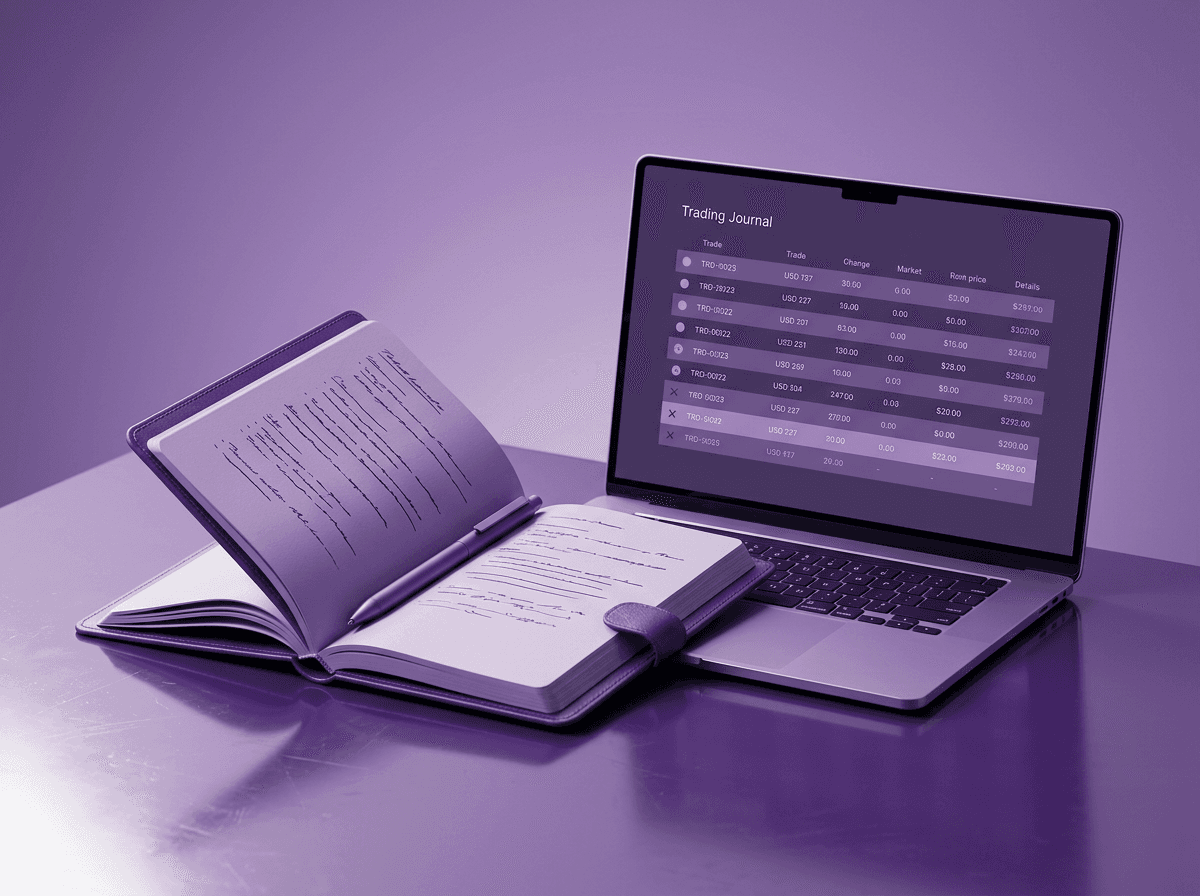
You just closed a trade on your funded account. Was it a win or a loss? You know the answer. But do you know why?
On a funded account, "why" matters more than the result. A winning trade that broke two of your rules is a time bomb. A losing trade that followed your plan perfectly is your strategy working as designed. Without a journal, you cannot tell the difference.
The pressure of a funded challenge makes journaling feel like a chore you do not have time for. You are worried about the 5% daily limit, the 10% drawdown, the fee you paid to get here. Writing things down seems less urgent than finding the next trade.
That instinct is exactly backward. The less room for error you have, the more you need to understand every trade you take.
TL;DR
On a funded account, repeat mistakes cost you more because your drawdown budget is finite.
Journaling wins shows you what to repeat. Journaling losses shows you what to fix.
A five-minute journal entry per trade is enough to capture the data that matters.
Weekly reviews surface patterns that individual trade notes miss.
The traders who keep funded accounts long-term are the ones who know exactly where their edge comes from.
Why Funded Pressure Makes Journaling Non-Optional
On a personal account, you can afford to make the same mistake three times and figure it out eventually. The account absorbs the tuition.
On a funded account, three identical mistakes might be the difference between keeping your account and losing the challenge entirely. If your daily loss limit is 5%, that is $5,000 on a $100,000 account. Three 1% losses from the same mistake type, and you have used 60% of your daily budget on a problem you could have identified after the first occurrence.
Journaling after Trade 1 would have surfaced the pattern. "Entered against 4-hour structure. Took the loss because the 15-minute setup looked clean." After writing that, you would have a flag for Trades 2 and 3: "Wait, I just made this exact mistake. Skip."
Without the journal entry, you rely on memory. And memory under pressure is unreliable. You forget the details of Trade 1 by the time Trade 3 sets up, so you walk into the same trap again.
This is why traders who journal on funded accounts tend to survive longer. Not because writing is magic, but because awareness prevents the repeat errors that compound into blown limits.
What to Journal: The Funded-Specific Fields
You do not need to write a paragraph for every trade. You need specific data points that let you review efficiently. Here is a funded-account journal template that takes under five minutes per trade:
Setup type (which playbook entry this trade follows)
Entry reasoning (what confirmed the setup)
Emotional state (calm, anxious, bored, frustrated)
Result in R multiples (not just dollars)
Plan compliance: did you follow every rule? Yes or no.
If no, which rule did you break?
One-sentence lesson (what did this trade teach you?)
Daily drawdown consumed so far (know where you stand after each trade)
Session count (how many trades have you taken today)
That is it. Six to eight short data points. You can fill them out in the time it takes to wait for your next setup.
The journal template does not need to be complicated. It needs to be consistent. The value comes from doing it every single trade, not from doing it perfectly on some trades and skipping others.
Walkthrough: What the Journal Reveals After a Bad Week
A funded trader finishes a week with 12 trades. Results: 4 wins, 8 losses. The trader feels terrible and considers strategy-hopping.
But the journal tells a different story. The trader reviews all 12 entries:
- 7 of the 12 trades followed the plan. Of those 7: 4 wins, 3 losses. Win rate on plan-compliant trades: 57%. - 5 of the 12 trades broke at least one rule. Of those 5: 0 wins, 5 losses. Win rate on rule-breakers: 0%.
The strategy is not broken. The trader is. Five trades taken outside the plan dragged the entire week into negative territory.
Without the journal, the trader sees "33% win rate, strategy is garbage." With the journal, the trader sees "57% win rate on proper trades, but discipline cost me 5 unnecessary losses."
The fix is not a new strategy. The fix is following the existing plan.
Journal Your Wins (Not Just Losses)
Most traders only journal when something goes wrong. That is half the picture.
Your winning trades contain the blueprint for your edge. When you journal wins, you capture:
Which setups produce the best R multiples
Which sessions (London open, New York overlap) your wins cluster in
What your emotional state was during winning trades
How long you held the trade before it hit target
Over 50 or 100 journaled winners, you will see your "sweet spot," the specific combination of setup type, session time, and emotional state that produces your best results. That pattern is your actual edge, and it only becomes visible if you write it down.
On a funded account, knowing your sweet spot lets you be more selective. You stop trading setups that technically meet your rules but historically underperform. You lean into the exact conditions where your win rate and R multiples are highest.
That selectivity is what keeps funded accounts alive. And it only comes from journaling both sides.
The Weekly Review: Where Patterns Emerge
Individual trade journals capture details. The weekly review captures trends.
Set aside 30 minutes once a week to read through all your trade entries. Look for:
Recurring broken rules. If "entered against higher-timeframe structure" shows up three times this week, you have a pattern worth addressing.
Session quality. Are your Tuesday trades better than your Friday trades? Are London session entries outperforming New York? The data will tell you.
Emotional triggers. If "frustrated" appears in the emotional state field before every losing trade, you know what to work on next.
Drawdown patterns. Did your biggest drawdown days correlate with high trade counts? That suggests overtrading under pressure.
This weekly post-trade review is where funded traders separate from casual traders. The casual trader checks their P&L and moves on. The funded trader reads 12 journal entries, spots a pattern, and writes a rule to fix it before next week.
Building the Habit Under Pressure
The hardest part of journaling on a funded account is doing it when things are going badly. After a losing trade, the last thing you want to do is sit with the loss and write about it. You want to find the next trade and recover.
That urge to skip the journal and "get back to trading" is the exact moment journaling matters most. Because the trade you take right after a loss, without processing the loss, is statistically your worst trade of the day.
Two tactics that help build the journal habit under funded pressure:
1. Set a timer. After every trade close, set a 3-minute timer. You cannot open a new chart or place a new order until the timer finishes. Use those 3 minutes to fill out the journal fields.
2. Make it the exit ticket. Treat the journal entry as the final step of the trade. The trade is not "done" when you close the position. It is done when you write the entry. Until then, the trade is still open in your process.
These small rules create a buffer between trades that prevents impulsive re-entry and builds a journal database that compounds in value over weeks and months.
How EdgeFlo Supports Funded Trade Journaling
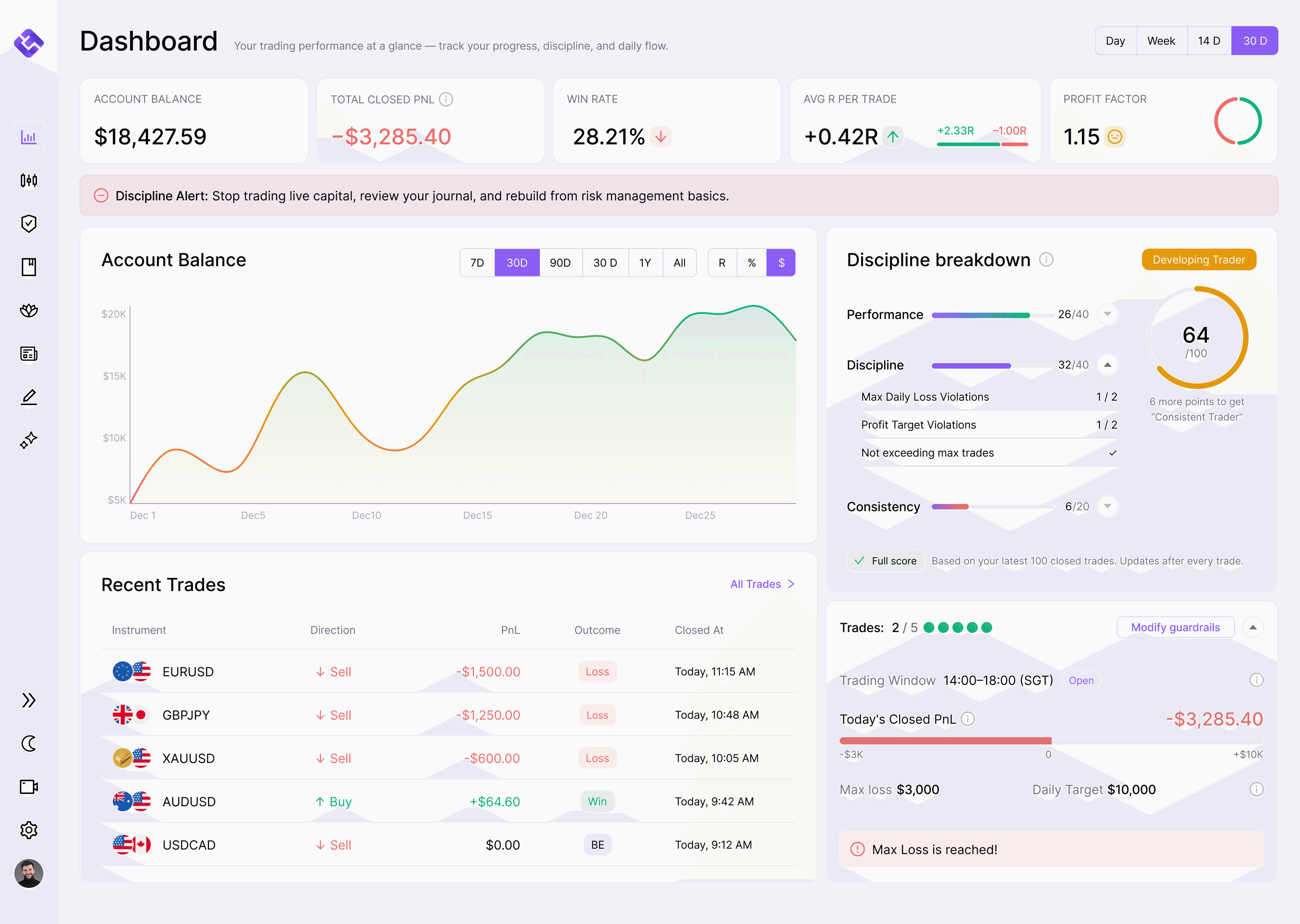
EdgeFlo's journal auto-imports your trade data, which means the numbers are already there. You do not need to manually enter the pair, the entry price, the exit price, or the R multiple. That removes the biggest friction point and leaves you with only the qualitative fields to fill in.
The emotion tagging feature lets you mark your state with a single tap. Over time, those tags create a heat map of which emotional states correlate with your best and worst trades. That correlation is funded-account intelligence you cannot get from P&L alone.
FloAI (available on the Plus plan) surfaces patterns from your journal data. After a few weeks of consistent entries, it can flag recurring behaviors like "your worst trades happen after 2 PM on Fridays" or "your win rate drops when you take more than three trades in a session." Those insights turn raw journal data into specific, actionable adjustments that protect your funded status.
The Edge Brief
Receive Insights on trading psychology, discipline, and the behavioral patterns that create consistent traders from our Founder and the EdgeFlo team, delivered to your inbox.
Think different. Trade different.
Should I journal winning trades on a funded account?
What should I write in my funded trade journal?
How often should I review my funded account journal?
Does journaling actually improve funded account performance?

Turn discipline on.
Every session.
EdgeFlo is the environment serious traders operate inside.
Start 7-Day Free Trial
Cancel anytime.
No long-term commitment.

Think Different, Trade Different.