

Holding Losing Trades: The Ego Trap That Bleeds Accounts
Refusing to cut a loser is not conviction. It is ego. Learn why traders hold bad positions, what it costs, and how to build a mechanical exit habit.
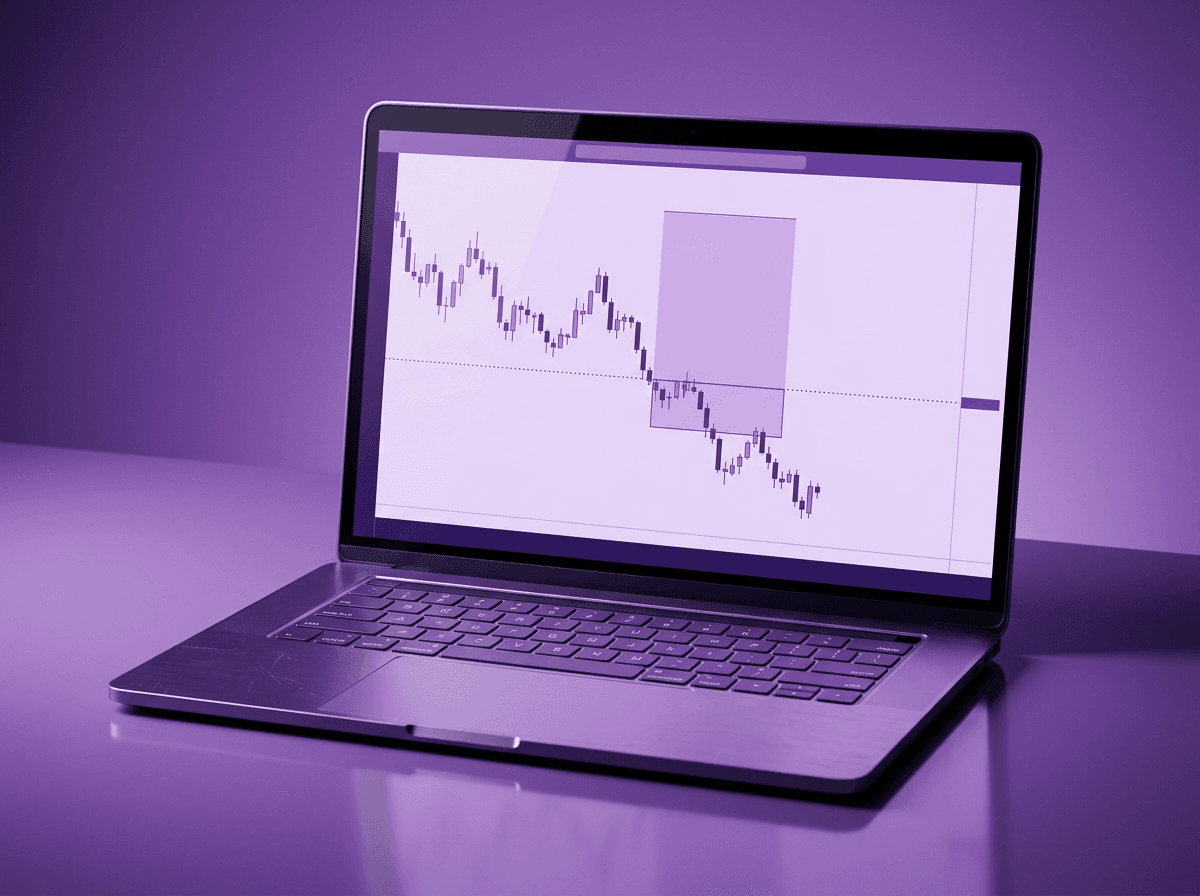
You are in a trade. It moves against you. Your stop loss is 30 pips away. Price drops 15, then 20, then 25. Every pip closer to your stop feels like a personal insult. So you move the stop. Or you remove it entirely. You tell yourself price will come back, because it has to. It does not.
Holding losing trades is not patience. It is not conviction. It is ego dressed up as analysis, and it is one of the most consistent account killers in retail trading.
TL;DR
Holding losers past your invalidation level is not conviction. It is ego refusing to accept a wrong call.
The sunk cost fallacy makes you treat unrealized losses differently than realized ones, even though the math is identical.
Every minute capital sits in a dying trade is a minute it cannot be deployed on the next valid setup.
The fix is mechanical: set the stop at entry and commit to not touching it. Review every override in your journal.
Building a "good loss" identity, where clean exits are a skill, not a failure, rewires how you experience cutting trades.
Why You Hold (And Why It Feels Rational)
When you enter a trade, you are making a statement about the market. "I believe EUR/USD is going up." That statement becomes part of your identity for the duration of the position. Closing at a loss means admitting the statement was wrong. Your ego hates that.
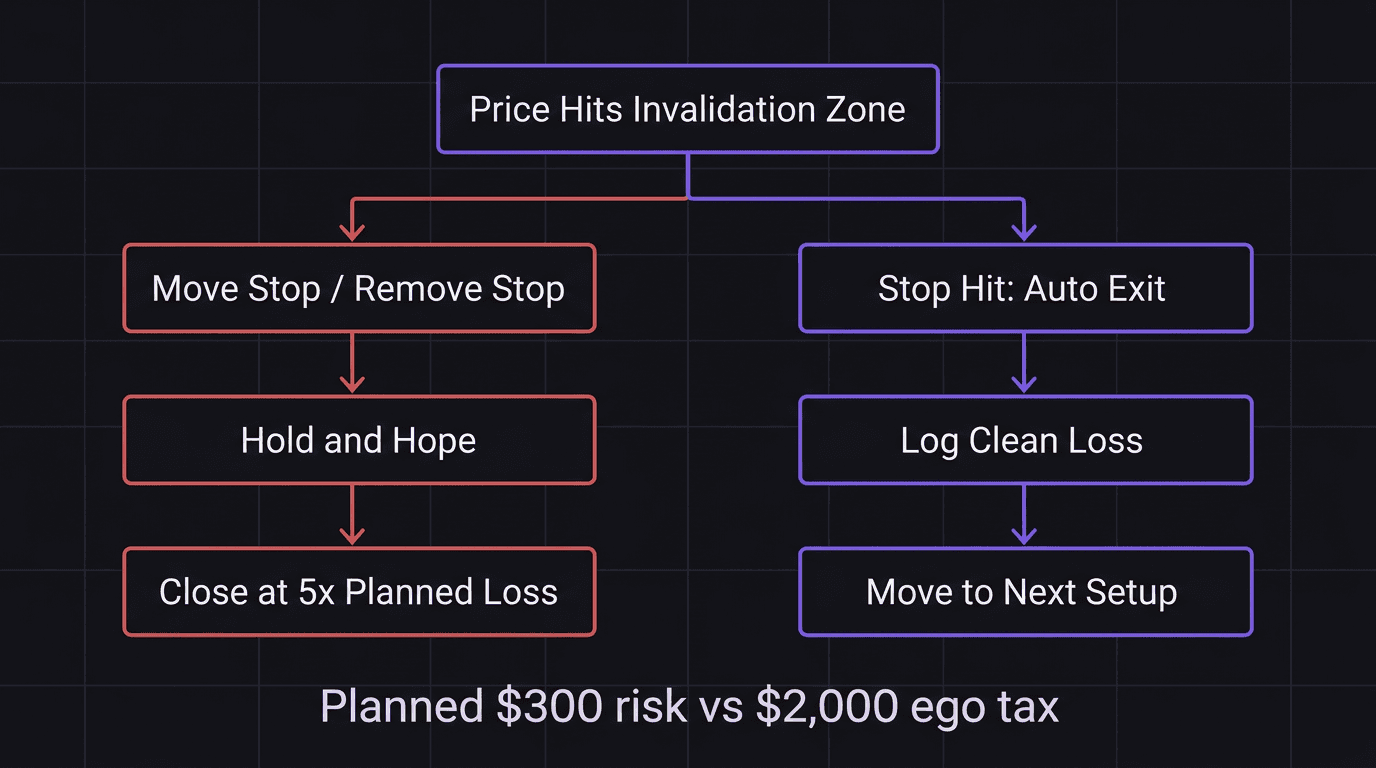
This is not abstract psychology. It plays out in real time at the execution level. Price hits your planned invalidation zone. Your plan says exit. But instead of clicking close, you do one of these:
Move the stop loss further away (buying yourself more room to be "right")
Switch to a higher timeframe and find a reason to stay in
Remove the stop entirely and tell yourself you will "manage it manually"
Average down, adding to the losing position to lower your average entry
Every one of these actions feels like analysis in the moment. "The daily structure is still bullish." "There is support just below." "The risk-to-reward got better because my average entry improved." But none of them were in your original trade plan. You are rewriting the plan to avoid the loss, and that is ego, not trading.
The Sunk Cost Trap
Behavioral economics has a name for this: the sunk cost fallacy. You have already "invested" 2 hours of watching this trade and 20 pips of unrealized drawdown. Closing now feels like wasting that investment. So you hold, hoping to at least break even.
But the market does not know what you have invested. It does not owe you a recovery. The 20 pips you are down are gone whether you close now or hold for another hour. The only question is: given the current chart, would you enter this trade right now? If the answer is no, you are holding a position you would not take, purely because you already have it.
That is the sunk cost trap in one sentence. You are staying in a trade you would not enter because leaving means accepting a loss you have already taken.
Walkthrough: The $2,000 Ego Tax
A trader goes long on EUR/USD at 1.0900 with a stop at 1.0870. He is risking 30 pips on 1 standard lot, which is $300 of planned risk per trade ($10/pip times 30 pips = $300). His target is 1.0980, giving him a 2.67R trade (80 pips reward / 30 pips risk).
Price drops to 1.0875. Five pips from his stop. He moves the stop to 1.0850, adding 20 pips of risk. "There is a demand zone at 1.0855. It will hold." His risk is now 50 pips ($500).
Price drops to 1.0852. He moves the stop again, to 1.0820. His risk is now 80 pips ($800). The 2.67R trade is gone. At this point, he would need price to reach 1.1000 just to get 2R on his new risk, and his original thesis was invalidated 30 pips ago.
Price drops to 1.0830. He removes the stop entirely. "I will close manually if it gets really bad." It gets really bad. Price hits 1.0700 by the end of the week. He finally closes. 200 pips of loss on 1 standard lot.
1 standard lot EUR/USD = $10/pip.
Original planned risk: $10 times 30 pips = $300.
First stop move: $10 times 50 pips = $500.
Second stop move: $10 times 80 pips = $800.
Actual loss (entry 1.0900 to exit 1.0700): 200 pips. $10 times 200 pips = $2,000.
He planned to risk $300. He lost $2,000. The extra $1,700 is the ego tax: the price of refusing to be wrong on a $300 trade. That $1,700 would have funded 5 more properly sized trades, any one of which could have been a winner.
The Opportunity Cost Nobody Counts
Dollar losses are visible. Opportunity cost is not, but it is often larger.
While your capital is locked in a losing trade that you are hoping will recover, the market is generating new setups. Your next A-grade entry might appear while 30% of your capital is tied up in a position you should have closed hours ago.
Worse, the mental load is enormous. You are not calmly watching a held trade. You are staring at it. Refreshing. Hoping. Calculating how much more you can afford to lose. That mental energy is not available for spotting, evaluating, or executing the next valid setup.
A clean $300 loss takes 5 seconds to execute and 2 minutes to journal. You close, you log it, you move on. A held loser consumes hours of attention, disrupts your session, and often leads to revenge trading after it finally closes because you are emotionally wrecked by the time it is over.
The Mechanical Exit Habit
Building a reliable exit habit requires removing the live decision from the exit process, just like removing it from the entry process.
Rule 1: Set the stop at entry. Do not touch it. Your stop loss goes in when the order goes in. It stays where it is. If you move it, you are no longer trading your system. You are trading your feelings. If you struggle with this, trade with a stop loss that you cannot manually override by using a bracket order.
Rule 2: Define "hold" and "ego hold" in your journal. After every trade that hits stop, log it as a "clean exit." After every trade where you moved the stop or held past invalidation, log it as a "held loser." Track both categories separately.
After 20 trades, count the held losers. Calculate the average held-loser loss versus the average clean-exit loss. The gap is your ego tax per month. Putting a dollar figure on the habit makes it concrete. Knowing that moving your stop cost you $4,200 last quarter is more motivating than any psychology book.
Rule 3: Reframe the loss. A loss at your planned stop is not a failure. It is the cost of finding out whether the trade works. You paid $300 to test a hypothesis. The hypothesis was wrong. You still have 97% of your capital. That is a successful risk management event, not a defeat.
Walkthrough: The Clean Exit That Felt Bad
A trader shorts GBP/USD at 1.2700 with a stop at 1.2730 and a target at 1.2620. She is risking 30 pips at 0.5 lots ($5/pip), which is $150 of risk ($5 times 30 pips = $150). Her target gives her a 2.67R trade (80 pips reward / 30 pips risk).
Price moves against her. It hits 1.2730. Her stop triggers automatically. She loses $150. It stings.
Twenty minutes later, price reverses and drops to 1.2640. She watches it and thinks, "If I had just held, I would be in profit." But she also knows that if price had continued to 1.2800 (which happens regularly on GBP/USD), she would be down $500 instead of $150. The stop protected her. The fact that this particular trade would have worked out does not change the math over 100 trades.
0.5 lots GBP/USD = $5/pip.
Risk: $5 times 30 pips = $150.
If held to 1.2800: $5 times 100 pips = $500 loss.
Target at 1.2620: $5 times 80 pips = $400 reward.
R:R: $400 / $150 = 2.67R.
She lost $150. She preserved the other $350 of potential loss. She freed her capital and her attention for the next setup. That is a good loss. Learning to recognize good losses as professional execution rather than personal failure is what separates traders who survive from traders who hold one bad trade into an account-ending event.
How EdgeFlo Enforces the Exit
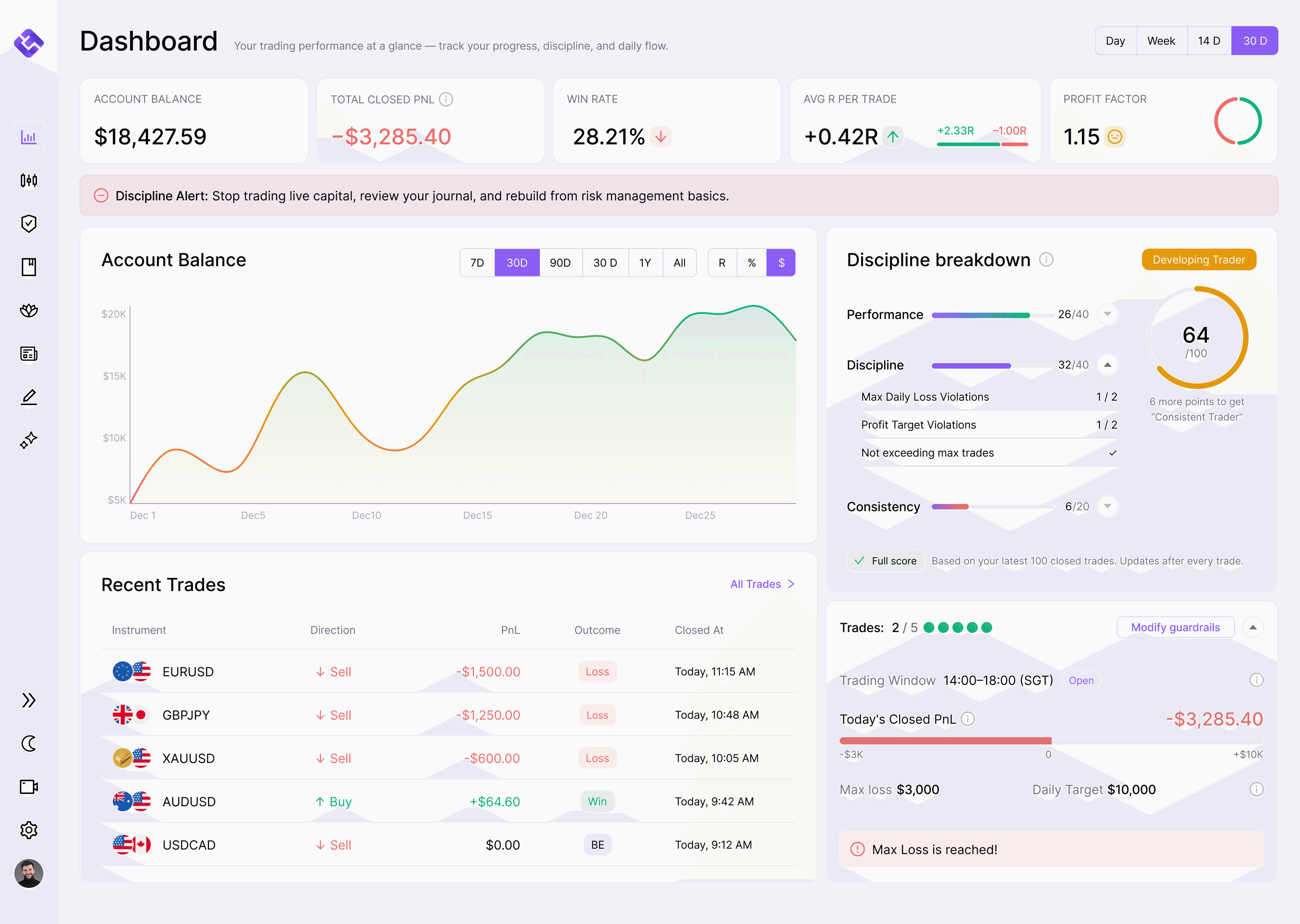
EdgeFlo's guardrail system lets you set hard rules for maximum loss per trade and per day, with override available if you need it. The key word is "conscious." You can still move a stop if you genuinely believe the trade thesis has changed. But the guardrail makes you click through an override prompt first, which breaks the autopilot loop of moving stops under emotional pressure.
The journal tracks every stop modification. Over time, you see exactly how many times you moved a stop and what happened after. That data builds the case for leaving stops alone more effectively than any rule or reminder.
Sanctuary's reset routines are designed for the moment after a loss. Instead of immediately looking for the next trade while still processing the last one, the guided recovery process helps you clear the emotional residue before re-engaging. Losing $300 is a trade cost. Losing $300 and then revenge trading another $600 is the real damage, and a structured reset between the two can stop the cascade.
The Edge Brief
Receive Insights on trading psychology, discipline, and the behavioral patterns that create consistent traders from our Founder and the EdgeFlo team, delivered to your inbox.
Think different. Trade different.
Why do traders hold losing trades instead of cutting them?
Is it ever okay to hold a losing trade?
How much does holding losers actually cost?
How do I build the habit of cutting losses quickly?

Turn discipline on.
Every session.
EdgeFlo is the environment serious traders operate inside.
Start 7-Day Free Trial
Cancel anytime.
No long-term commitment.

Think Different, Trade Different.