

Hope Is Not a Trade Plan: Stop Praying for Reversals
Moving your stop loss and praying for a reversal is not risk management. Learn why hope replaces discipline and how hard stops eliminate the temptation entirely.
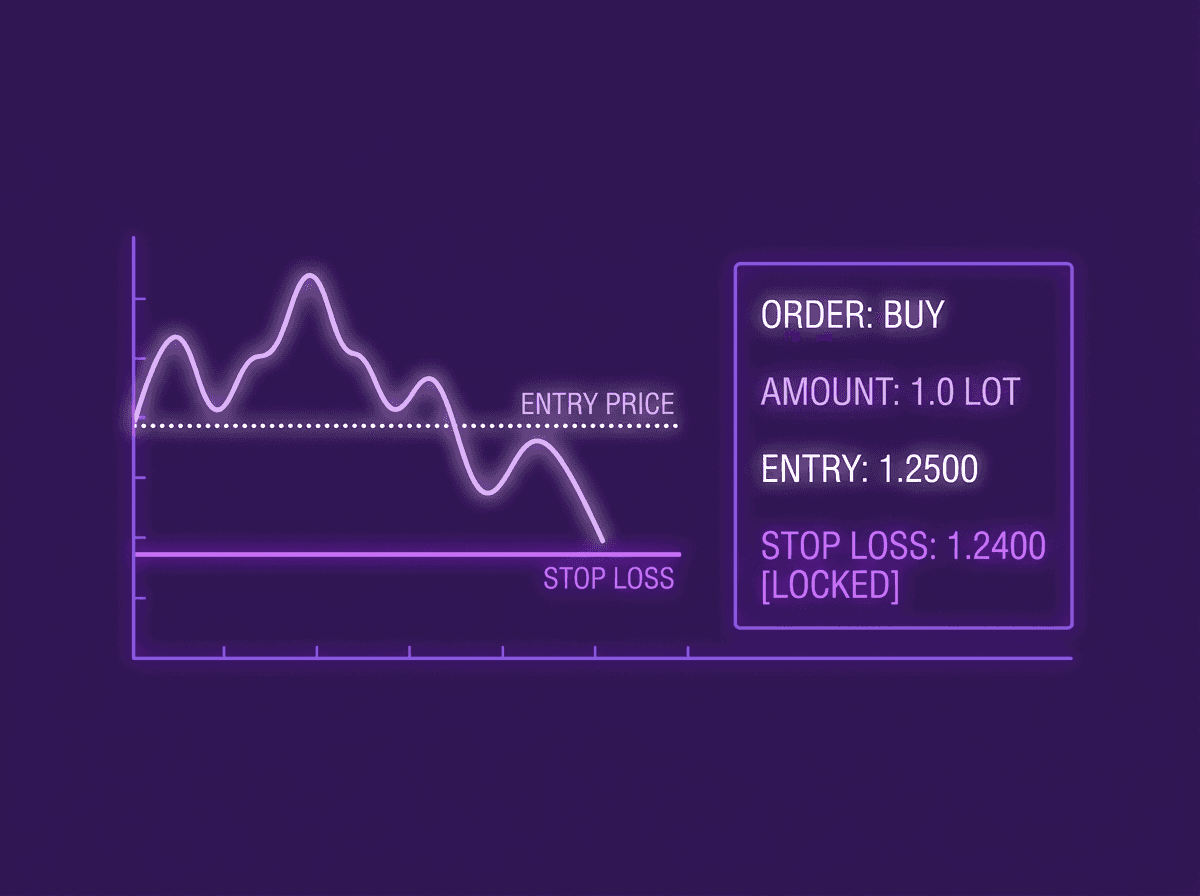
Hope in trading is the act of outsourcing your risk management to luck. Instead of accepting a loss at your predetermined stop, you move the stop further away, close your eyes, and pray that price reverses. It never works consistently, and it turns small, planned losses into account-threatening disasters.
Every trader has done this at least once. You see price creeping toward your stop, and something inside you says, "Just give it a little more room." That feeling is not analysis. It is hope. And hope is the most expensive emotion in your trading account.
TL;DR
Hope in trading means refusing to accept a loss and praying the market reverses in your favor.
Moving your stop loss further away after entry is not a strategy; it is loss avoidance disguised as flexibility.
Every act of hope starts with the same trigger: the pain of accepting you were wrong.
Hard stops eliminate the negotiation entirely because the platform closes the trade before you can intervene.
Conviction from tested data replaces hope; if you trust your edge, individual losses stop mattering.
Why Hope Feels Like the Right Move
Hope does not announce itself as a bad idea. In the moment, it feels like patience. It feels rational. You tell yourself you are "giving the trade room to breathe" when the reality is simpler: you do not want to be wrong.
This is a pain avoidance response. Your brain is wired to delay discomfort, and clicking that close button to take a loss is pure discomfort. So instead of accepting the small, planned loss, you widen the stop or remove it entirely. You start holding losing trades well past the point where your original thesis was invalid.
Sound familiar?
The problem is that hope compounds. Moving the stop once makes it easier to move it again. Each time, the loss gets bigger. Each time, the reversal needs to be larger to save you. And each time, the pain of finally accepting the loss grows. You have turned a $50 planned loss into a $300 unplanned loss, and now you are not just hoping for a reversal. You are desperate for one.
Walkthrough: The Hope Spiral on EUR/USD
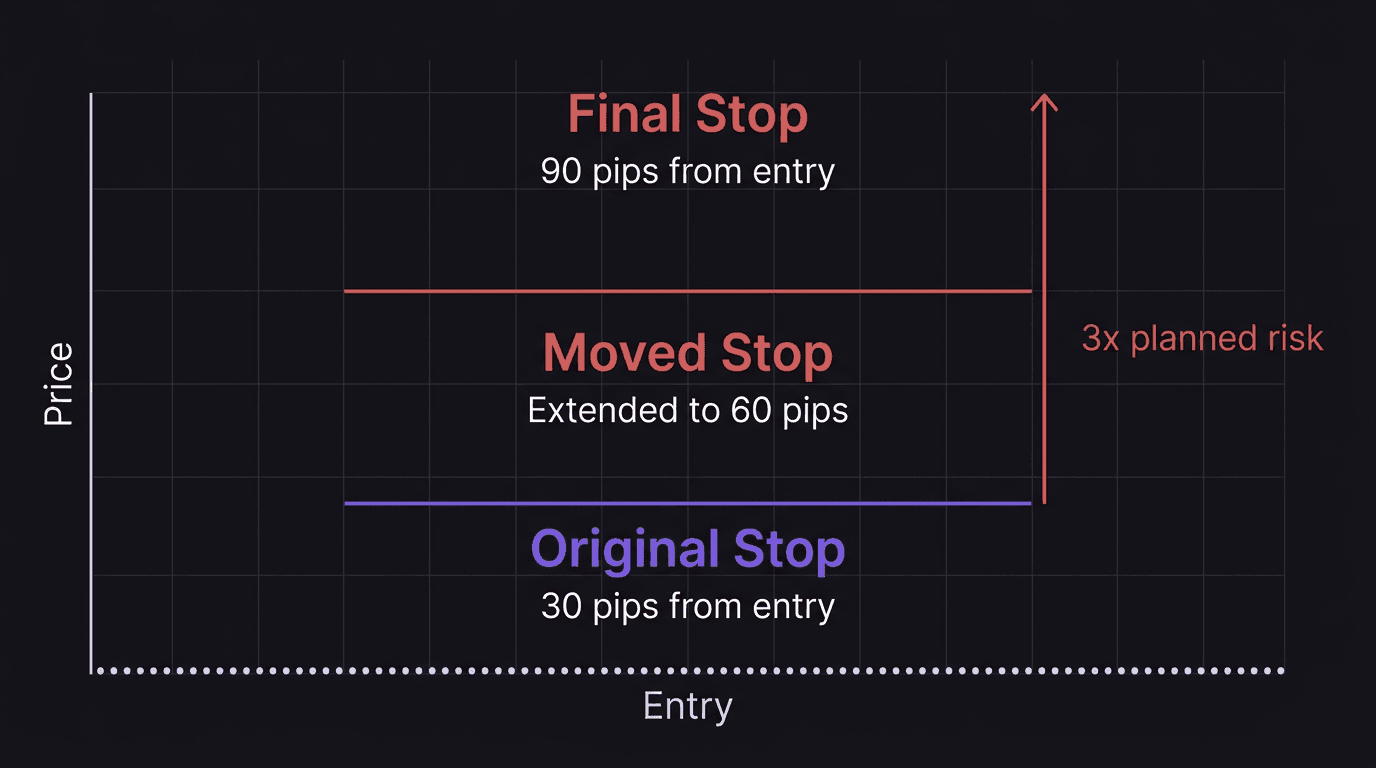
You short EUR/USD at 1.0920 during the London session with a stop at 1.0950 and a target at 1.0850. Your risk is 30 pips.
Price moves against you and hits 1.0945. Five pips from your stop. You feel the tension in your chest. Instead of letting the stop do its job, you move it to 1.0980. "Just a little more room."
Price hits 1.0960. Now you are 40 pips underwater instead of 30. You move the stop again to 1.1010. Price keeps climbing. It reaches 1.0990. You are now 70 pips deep on a trade that was supposed to risk 30.
Finally, price hits 1.1010. You take a 90-pip loss on a trade you planned to risk 30 pips.
That 90-pip loss is three times the risk you agreed to when you entered the trade. If you are trading 0.5 lots on EUR/USD, your planned risk was $150 (0.5 lots = $5/pip, $5 times 30 pips = $150). The actual loss was $450 ($5 times 90 pips = $450). Three trades worth of risk, gone on one moment of hope.
What Hope Actually Costs You
The math behind hope is brutal. When you widen a stop loss, you are not just increasing the loss on one trade. You are destroying the risk-to-reward ratio that makes your strategy profitable.
If your strategy works on a 1:2 risk-to-reward and you triple your risk by moving the stop, you now need a 1:6 move just to hit your original reward target relative to the new risk. That almost never happens.
Here is the real cost. Suppose you risk 1% per trade with a 1:2.5 ratio and a 40% win rate. Over 10 trades, that produces positive expectancy.
10-trade sequence at planned risk: 4 wins at 2.5% each = 10% gained. 6 losses at 1% each = 6% lost. Net: +4%.
Now take that same sequence, but on two of the six losses, you moved the stop and turned a 1% loss into a 3% loss.
10-trade sequence with hope on two trades: 4 wins at 2.5% each = 10% gained. 4 normal losses at 1% each = 4% lost. 2 hope losses at 3% each = 6% lost. Net: 0%.
Two moments of hope erased an entire month of profit. That is what hope costs you. Not one bad trade. An entire edge, wiped out.
The Pain Trigger Behind Hope
Every time you move a stop loss, the same thing happens underneath. You are trying to avoid the pain of being wrong.
Being wrong in the market feels personal. It feels like the market singled you out. But trading fear is not about the market. It is about your relationship with losing. If you view every loss as evidence that you are a bad trader, then of course you will do anything to delay that judgment. Moving the stop feels like buying time.
But losses are not judgments. They are expenses.
Think about any business. A restaurant buys ingredients that expire. A retailer marks down unsold stock. Those are costs of doing business. Nobody calls a restaurant owner a failure because 8% of their ingredients spoiled. Trading losses work the same way. If you took the trade according to your plan, with the correct risk, at a valid setup, and it lost, that is a business expense. Not a character flaw.
When you reframe losses as operational costs, the urge to move the stop shrinks. You already budgeted for this loss when you entered. Taking it changes nothing about your ability or your edge.
Hard Stops: Remove the Negotiation
The simplest way to eliminate hope from your trading is to never give yourself the option. Set a hard stop loss on every trade, and do not touch it.
A hard stop is a stop loss order sitting on the platform that executes automatically when price hits your level. Not a mental stop. Not a "I'll close it if it gets to here" stop. A real, placed, untouchable order.
Why does this work? Because it removes the decision point entirely. You never sit there watching price approach your stop, debating whether to move it. The platform closes it for you. By the time you feel the urge to hope, the trade is already closed.
This is environment design. You are not relying on willpower to cut the loss. You are building a system where the loss gets cut whether you feel like it or not.
Here are the rules that make hard stops work:
Place the stop before or simultaneously with the entry. Not after.
Once placed, the stop only moves in one direction: toward profit (trailing). Never away from it.
If you catch yourself reaching for the stop to widen it, close the entire trade instead.
Review any trade where you felt the urge to move the stop, even if you did not act on it. That urge is diagnostic data.
If you struggle with moving your stop loss after it is placed, this is the single most important habit change you can make. It is more valuable than any new strategy, any new indicator, any new timeframe.
Walkthrough: Hard Stop in Action on GBP/USD
You go long GBP/USD at 1.2650 during the New York session. Your plan says the stop goes at 1.2620 (30 pips) and the target is 1.2740 (90 pips). You place the stop immediately.
Price drops to 1.2635. You feel uncomfortable. The old version of you would move the stop to 1.2600 or remove it entirely. But the stop is placed. You walk away from the screen.
Price hits 1.2620. The stop executes. You lose 30 pips, which is $150 at 0.5 lots ($5/pip times 30 pips).
The next day, you take the same setup. Price reaches 1.2740. You gain 90 pips, which is $450 ($5/pip times 90 pips). One loss and one win. Net result: +$300.
That is a 3R trade. You could not have captured it if you had blown up your account the day before by refusing to take the 30-pip loss.
Conviction vs Hope: Know the Difference
There is a version of "staying in a trade" that is not hope. It is conviction. And the difference matters.
Conviction means your trade thesis is still valid. Price has not hit your invalidation level. The structure that caused you to enter still holds. You are uncomfortable because the trade is taking longer than expected, but nothing about the setup has changed. Staying in is the correct decision because your plan says so.
Hope means your trade thesis is already invalid. Price has moved past the level where your idea made sense. The only reason you are still in is because you do not want to lose. Nothing about your plan supports staying. You are just praying.
Ask yourself one question when you feel the urge to hold: "If I had no position right now, would I enter this trade at this price, with this structure?"
If the answer is no, you are hoping. Close the trade.
If you find yourself trading without a stop loss entirely, you are not even giving yourself a reference point for when hope takes over. Every trade needs a predefined exit, both for profit and for loss, before you click the button.
Build a System That Does Not Need Hope
Hope fills a vacuum. When your trading plan is vague, when your rules are flexible, when your stop placement is a suggestion rather than a commitment, hope rushes in to fill the gaps.
The fix is structure. Specific, written, non-negotiable trading rules that leave no room for interpretation in the heat of the moment.
Your pre-trade checklist should include:
Exact stop level (not "around" a level, the exact price)
Maximum acceptable loss in dollars (calculated before entry)
Invalidation criteria (what would prove your trade idea wrong)
Agreement with yourself: "If price hits my stop, I accept the loss and move on"
When you have done this work before the trade, hope has nowhere to land. You already know what happens if the trade fails. You already accepted it. The only thing left is execution.
And if you have tested your strategy over enough trades, you know that individual losses do not matter. A 40% win rate with a 3R reward means you lose more often than you win, and you are still profitable. Losses are not threats. They are part of the math.
How EdgeFlo Helps You Stop Hoping
EdgeFlo's guardrails warn you and can restrict trading when you hit predefined risk limits (you can override if you choose to). This means the system flags the moment you are approaching dangerous territory, before hope kicks in and before you start negotiating with the market.
Your Edge plan sits next to your chart as a reference document. Before every trade, you can see your stop placement rules, your invalidation criteria, and your risk parameters written out in your own words. When price is moving against you and the urge to move the stop appears, your plan is right there reminding you what you already decided.
After each trade, EdgeFlo's journal lets you tag the emotion you felt. Over a few weeks, you start seeing patterns: which setups trigger hope, which sessions lead to stop-moving, which loss sizes make you negotiate. That awareness is the first step toward eliminating the behavior entirely.
The Edge Brief
Receive Insights on trading psychology, discipline, and the behavioral patterns that create consistent traders from our Founder and the EdgeFlo team, delivered to your inbox.
Think different. Trade different.
Why do traders feel hope instead of cutting losses?
Is it ever okay to move a stop loss further away?
How do hard stops remove hope from trading?
What is the difference between hope and conviction in trading?

Turn discipline on.
Every session.
EdgeFlo is the environment serious traders operate inside.
Start 7-Day Free Trial
Cancel anytime.
No long-term commitment.

Think Different, Trade Different.