

Gambling vs Trading: Where the Line Falls
Trading without an edge is gambling. Learn the exact differences between trading and gambling, why most retail traders are gamblers, and how to cross the line.
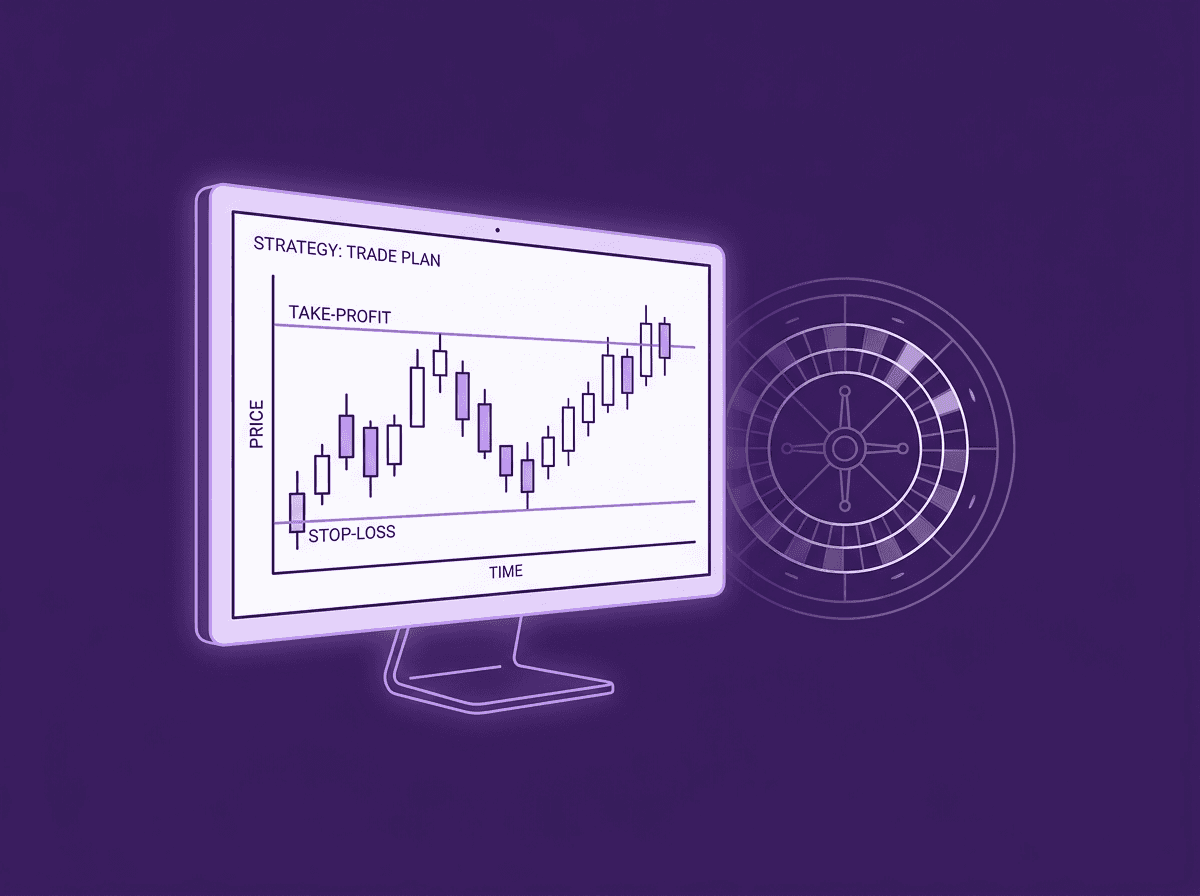
Trading without an edge is gambling. That is the shortest honest answer to "is trading gambling?" and it separates the 90% who blow accounts from the small group who grow them. The difference is not the asset, the timeframe, or the platform. It is whether you have a statistical edge that puts the math on your side over hundreds of trades. If you do, you are running a probability business. If you do not, you are playing roulette with a brokerage account instead of a casino chip.
TL;DR
Trading becomes gambling the moment you remove your statistical edge, your rules, or your risk controls.
Casinos profit not because they win every hand, but because they hold a 5.26% mathematical advantage on every spin of the roulette wheel.
Most retail traders behave exactly like gamblers: no plan, emotional sizing, and a fixation on the next trade instead of the next 100.
The line between gambling and trading is positive expectancy, proven through backtesting and forward testing.
Crossing the line means building rules, trusting probabilities, and managing risk before every single trade.
The Casino Edge: Why the House Always Wins
Casinos made over $60 billion in revenue last year. Not over five years. One year.
They do not win because they are lucky. They win because every game is designed to give the house a small, consistent mathematical advantage over the player.
Take roulette. Most players think betting red or black is a coin flip. It is not. An American roulette wheel has 38 slots: 18 red, 18 black, and 2 green. Those two green slots tilt the entire game.
If you bet on black, your odds of winning are 18 out of 38, which is 47.37%. The casino covers the other 20 slots (18 red plus 2 green), giving the house 52.63%. That gap, 5.26%, is the house edge.
On a single $1 bet, the casino earns about 5 cents. Sounds trivial. But scale it to $1 million in total bets and the house collects $52,600 in expected profit. Scale it to an entire floor of tables running all day, every day, and you see why the industry generates billions.
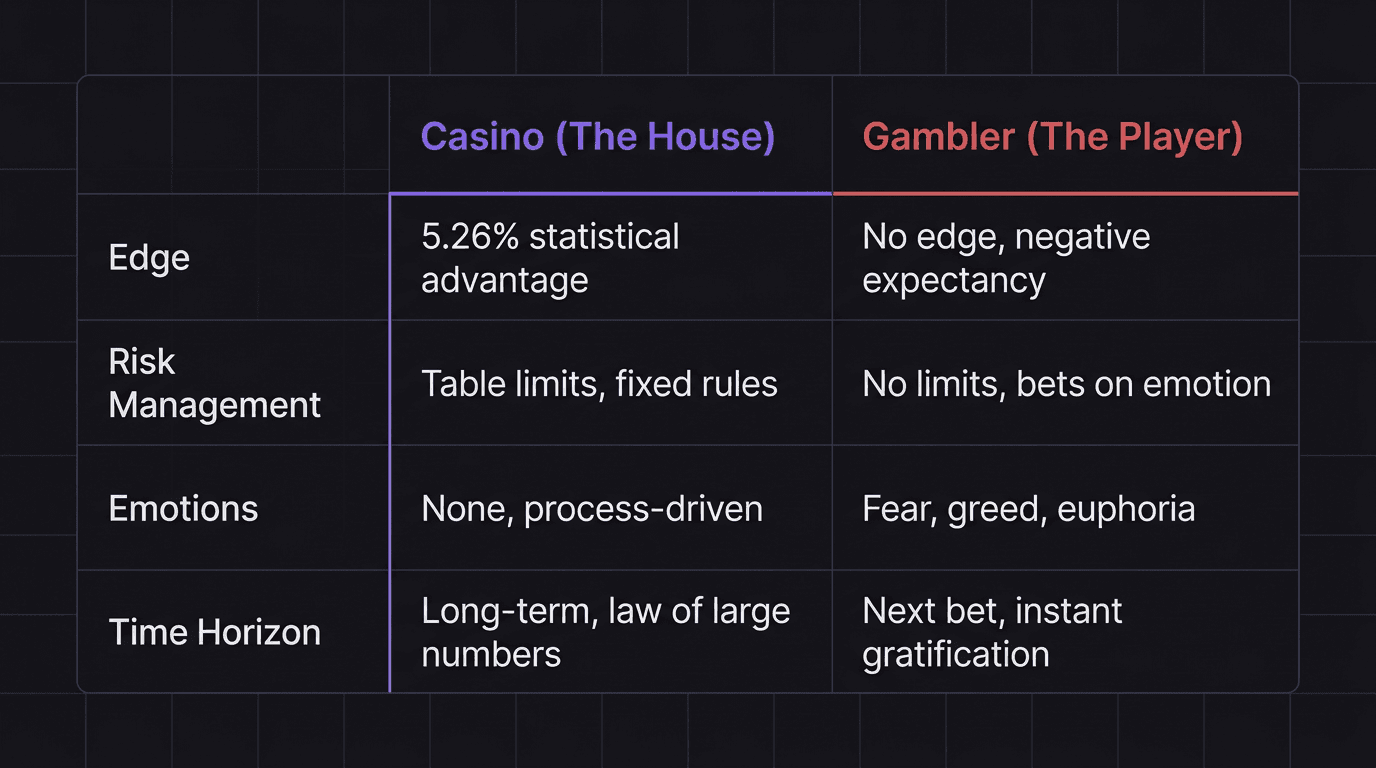
The key point is not the size of the edge. It is what the edge does over volume. This is the law of large numbers at work. Over 1,000 bets at $1,000 each, the players collectively win about $473,700 (47.37% of total wagered). The casino wins about $526,300 (52.63%). Net profit to the house: $52,600. Every time.
The casino does not care about tonight. It cares about this quarter.
The Gambler's Playbook (And Why It Fails)
A gambler walks into a casino with one plan: win money. That is it. No system. No defined risk. No exit strategy. Just hope, instinct, and whatever feeling hits at the table.
Sound familiar?
Here is what the gambler's approach actually looks like:
No edge. The gambler bets on red because it "feels due." There is no repeatable strategy, no tested probability, no reason to expect a positive outcome over 100 spins.
No risk management. After winning $10,000, the gambler comes back the next day and loses $15,000. No stop. No cap. No rule that says "walk away after X losses."
Emotion-driven decisions. Angry after a loss? Bet bigger. Euphoric after a win? Bet bigger. Sad? Keep playing to win it back. The emotional state dictates the bet size.
Short-term fixation. The gambler measures success by tonight's result, not by their track record over 200 sessions.
The gambler's fatal flaw is not bad luck. It is negative expectancy. Every game is tilted against them, and they have no system to tilt it back.
Most Retail Traders Are Gamblers (Here Is the Test)
Replace "casino" with "institutional traders" and "gambler" with "retail trader." The comparison is uncomfortable because it is accurate.
Institutional traders and market makers operate with a statistical edge. They make money over the long term. They manage risk with hard rules. They operate without emotional interference because their systems do not require emotions to function.
Most retail traders, on the other hand, lack a tested edge. They lose money over months and years, then conclude that trading is a scam. They rely on quick wins and luck. They trade based on feelings: fear, greed, revenge, euphoria.
Ask yourself these five questions:
Do you have a written strategy with defined entry and exit rules?
Have you backtested that strategy across at least 100 trades?
Do you risk a fixed percentage on every trade, regardless of how you feel?
Can you lose five trades in a row without changing your plan?
Do you measure success by process adherence, not by your P&L on any single day?
If you answered no to more than two of these, you are closer to the gambler's side of the line than the casino's.
Walkthrough: The Gambler Trader
A trader opens a EUR/USD chart during the New York session. Price has been falling for two hours. The trader thinks, "It has to bounce from here," and buys 1.0 standard lot at 1.0850 with no stop loss.
Price drops another 40 pips to 1.0810. The trader is now down $400 (1.0 lot at $10/pip times 40 pips). Instead of cutting the loss, the trader adds another lot, convinced the bounce is coming. Price drops 20 more pips to 1.0790.
The trader is now holding 2.0 lots down a combined 60 pips on the first position and 20 pips on the second. Total loss: $600 plus $200 = $800. The trader finally closes both positions and opens a revenge trade in the opposite direction, oversized at 2.0 lots.
Math check: 1.0 lot = $10/pip. $10 times 40 pips = $400 loss on first position. 1.0 lot = $10/pip. $10 times 20 pips = $200 loss on second position. $400 + $200 = $800 total loss.
No plan. No stop loss. Sizing based on emotion. This is not trading. This is gambling with a charting platform open.
What Separates Trading from Gambling
The line between gambling vs trading is not blurry. It is a single variable: positive expectancy.
Positive expectancy means that over a large enough sample of trades, your strategy produces a net profit. Not on every trade. Not every week. Over the aggregate.
Here is how expectancy works. Suppose your strategy wins 45% of the time with an average winner of 2R and loses 55% of the time with an average loser of 1R:
Math check: Expectancy = (win rate times average win) minus (loss rate times average loss). Expectancy = (0.45 times 2R) minus (0.55 times 1R). 0.45 times 2R = 0.9R. 0.55 times 1R = 0.55R. 0.9R minus 0.55R = 0.35R.
That is positive expectancy: 0.35R per trade on average. You lose more often than you win, but your winners are large enough to more than cover your losers. Over 200 trades, that 0.35R edge compounds into real returns.
The casino does not win 80% of spins. It wins 52.63%. But that small edge, applied consistently over thousands of spins with fixed rules and no emotional interference, produces billions. Trading works the same way.
Walkthrough: The Casino Trader
A trader uses a GBP/USD breakout strategy tested over 150 historical trades. The strategy has a 42% win rate with a 2.5:1 reward-to-risk ratio. The trader risks 1% of a $10,000 account ($100) per trade.
Over 20 trades this month, the trader wins 8 and loses 12. Each winner averages 50 pips at 0.2 lots ($2/pip). Each loser averages 20 pips at 0.2 lots ($2/pip).
Math check: Win rate: 8 wins divided by 20 trades = 40%. 0.2 lots GBP/USD = $2/pip. Average winner: $2 times 50 pips = $100. Average loser: $2 times 20 pips = $40. Total wins: 8 times $100 = $800. Total losses: 12 times $40 = $480. Net profit: $800 minus $480 = $320. Expectancy: (0.40 times $100) minus (0.60 times $40) = $40 minus $24 = $16 per trade.
The trader lost 60% of trades and still made $320. That is what a statistical edge looks like in practice. No luck required. Just rules, risk management, and patience.
Five Rules That Move You from Gambler to Casino
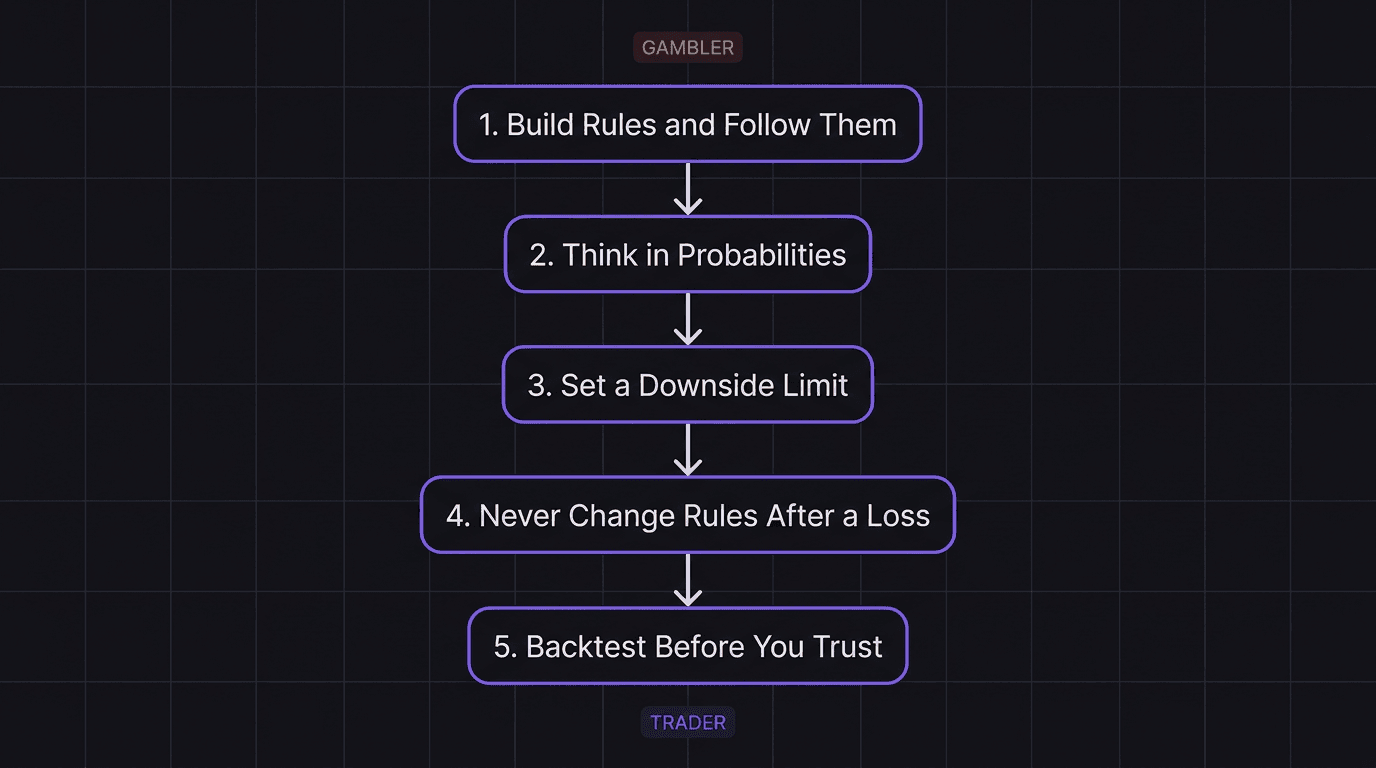
These five principles separate traders who survive from traders who donate their accounts to the market.
1. Build Rules and Follow Them Every Single Time
Your trading plan is your edge. Once you have rules that produce positive expectancy over a backtested sample, your only job is to execute them without deviation. Five losses in a row does not mean the plan is broken. It means variance is doing what variance does.
2. Think in Probabilities, Not Predictions
You do not need to know what the next trade will do. You need to know what 100 trades will do. Thinking in probabilities means trusting the math over your gut, even when your gut screams louder.
3. Set a Downside Limit Before Every Session
Casinos set table limits to control their exposure. You need session limits too. A simple rule: stop trading after three consecutive losses in a single session. This is not about the strategy failing. It is about protecting capital from the emotional spiral that losing streaks create.
4. Never Change the Rules After a Loss
When the casino has a bad night, it does not redesign the roulette wheel. It opens the doors the next morning with the same rules, because it knows the edge plays out over the long term.
Stop changing your strategy every time you hit a losing trade. Refine your plan once per quarter when you review your performance data. Not in the middle of a losing streak. Not at 2 AM after a bad session. This is one of the most common trading mistakes that keeps retail traders on the gambler's side of the line.
5. Backtest Before You Trust
You cannot know whether you have an edge if you have not tested your rules against historical data. A minimum of 100 trades in a backtest gives you enough sample size to separate signal from noise. Until you have that data, you are guessing. And guessing is gambling.
Backtesting your strategy is the single most important step in crossing the line from gambler to trader. Without it, you have conviction based on hope. With it, you have conviction based on evidence.
How EdgeFlo Helps You Trade Like the House
Knowing the difference between gambling and trading is step one. Staying on the right side of the line, day after day, is the hard part. EdgeFlo is built for that second problem.
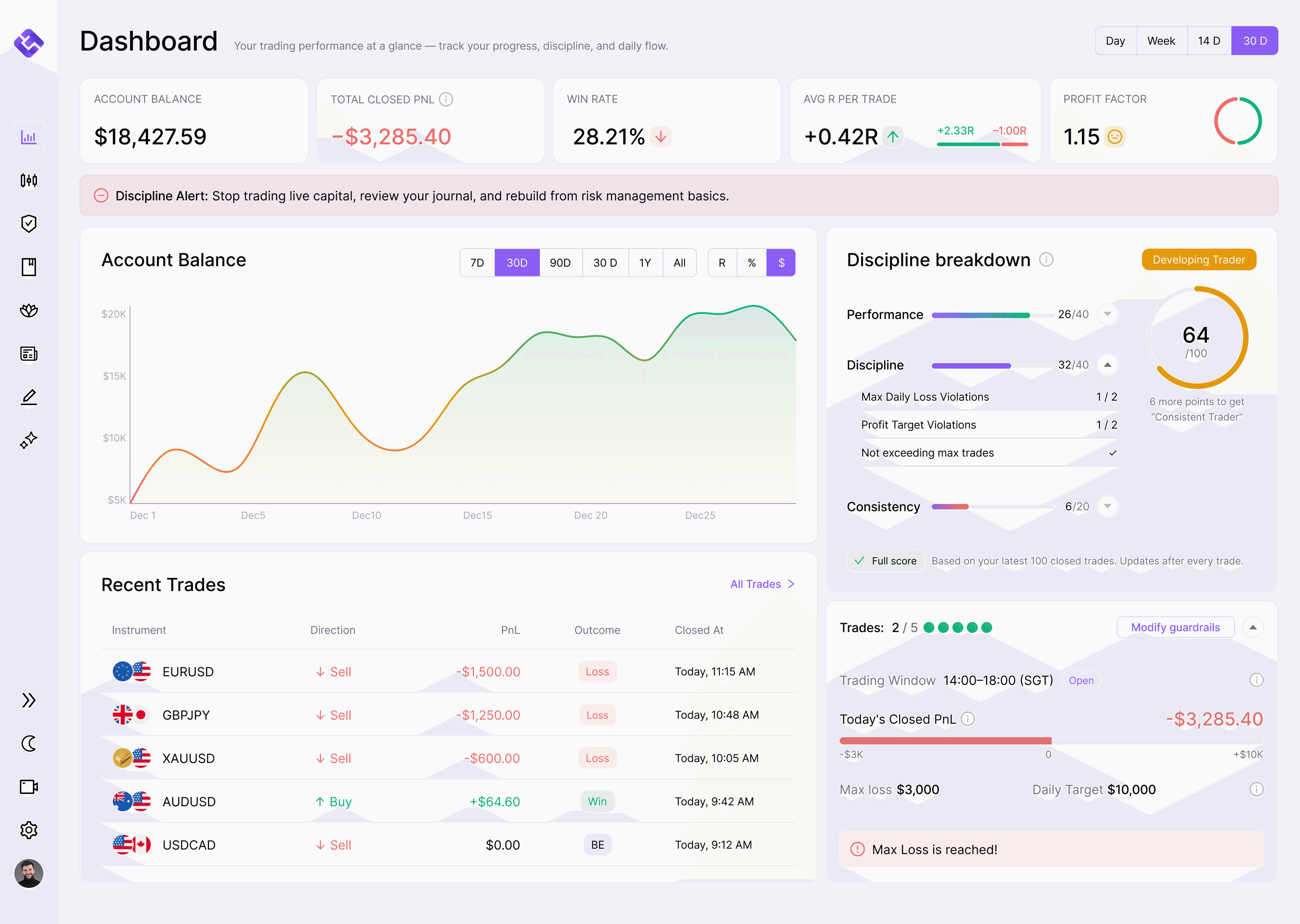
EdgeFlo's Edge feature lets you define your trading plan and keep it visible next to your charts during every session. Your rules do not live in a notebook you forget to open. They sit inside the same platform where you execute. After each trade, you self-report whether you followed the plan, which builds a data trail of your discipline over time.
When you hit your daily loss limit, EdgeFlo's guardrails restrict the trade button. You can override (you always can), but you have to make a conscious choice to break your own rule. That friction is the difference between a gambling mindset and a structured process. It turns "I should probably stop" into an active decision point, not a suggestion you ignore on autopilot.
The Edge Brief
Receive Insights on trading psychology, discipline, and the behavioral patterns that create consistent traders from our Founder and the EdgeFlo team, delivered to your inbox.
Think different. Trade different.
Is trading just gambling?
What is the difference between a trader and a gambler?
How do I know if I am gambling when I trade?
Can you have an edge in trading like a casino?

Turn discipline on.
Every session.
EdgeFlo is the environment serious traders operate inside.
Start 7-Day Free Trial
Cancel anytime.
No long-term commitment.

Think Different, Trade Different.