

Funded Traders Who Survive Play the Long Game
Most funded traders blow their accounts within 90 days by chasing fast payouts. The survivors treat funded capital like their own and accept slow compounding.

Getting funded is not the hard part. Staying funded is. Most traders who pass a prop firm challenge lose their funded account within the first 90 days. Not because they cannot trade, but because the moment real capital is on the line, their behavior changes.
The traders who survive long term do something counterintuitive: they slow down. They treat funded capital with the same care they would use on their own money. They accept that slow, steady compounding beats aggressive swings. And they persist through losing streaks instead of panic-trading their way out of drawdowns.
TL;DR
Most funded traders blow up within 90 days by chasing fast payouts.
The payout chase leads to oversizing, which turns normal drawdowns into account-ending violations.
Treat funded capital like your own. The same risk rules apply.
Persistence through losing streaks (not aggressive recovery) is what separates survivors from the 90-day washouts.
Guardrails and daily loss limits are even more critical on funded accounts, where the rules have hard consequences.
Why Most Funded Traders Blow Up in 90 Days
Prop firms have high failure rates by design. The economics depend on most traders losing their challenge fees or failing their funded accounts. Understanding that is not a reason to avoid prop firms. It is a reason to approach them with the right mindset.
The 90-day blowup pattern looks the same almost every time. A trader passes the challenge, gets funded, and immediately starts trading differently. The conservative approach that passed the evaluation gets replaced by aggressive sizing because "now the money is real" and the trader wants a fast payout.
The first losing streak hits. Instead of following the plan, the trader increases size to recover faster. That leads to a larger drawdown, which triggers more emotional trading, which leads to a rule violation, which ends the account.
The irony is thick. The discipline that passed the challenge was the same discipline needed to keep the account. The trader abandoned it at the exact moment it mattered most.
The Payout Chase That Destroys Funded Accounts
Funded accounts come with profit targets that unlock payouts. Those targets create a perverse incentive: the faster you reach the target, the faster you get paid. That incentive pushes traders toward oversizing.
Walkthrough: The Fast Payout That Ended the Account
A trader receives a $100,000 funded account with a 10% profit target ($10,000) for the first payout and a 5% maximum drawdown ($5,000).
The trader's system produces an average of 4R per month at 1% risk. That is $4,000 per month, which means the payout target takes about 2.5 months to reach.
Impatient, the trader bumps risk to 2.5% per trade to try to reach the target in one month. Two weeks in, two consecutive losses hit (statistically routine). At 2.5% risk, that is $5,000 gone, exactly the maximum drawdown limit.
Account terminated. Challenge fee lost. Back to square one.
At the original 1% risk, five consecutive losses would cost $5,000, exactly the drawdown limit. Tight but survivable if the trader reduces size after the first two losses. At 2.5% risk, the account dies after just two losses. The payout chase did not speed up the timeline. It ended it.
Had the trader stayed at 1% risk and accepted the 2.5-month timeline, the same five-trade losing streak would have cost $4,876 (accounting for the decreasing account balance), leaving a small buffer to continue trading and recover.
Treat Funded Capital Like Your Own Money
The mindset shift that separates survivors from washouts is simple: funded capital is not free money. Treat it exactly the way you would treat your own savings account.
If you would not risk 3% of your personal $10,000 account on a single trade, do not risk 3% of a $100,000 funded account. The dollars are bigger, but the math and psychology are identical.
This means accepting slower growth. It means watching other traders post screenshots of fast payouts while you grind through your conservative plan. It means being okay with funded trader discipline that looks boring from the outside.
The discipline is the same discipline that got you funded. The only change is the account size. If you change your behavior when the account size changes, you are proving that your discipline was conditional, and conditional discipline is not discipline at all.
Persistence Through Losing Streaks Is the Real Edge
Every funded trader will face losing streaks. The question is not whether they happen but how you respond when they do.
The wrong response: increase size to recover. Double down on trades. Take setups that do not meet your criteria because you need to "get back to even." This is how accounts die.
The right response: reduce size during drawdowns. If your normal risk is 1%, drop to 0.5% until you recover a portion of the drawdown. Follow your daily loss limit without exception. Take only the setups that fully match your plan.
Walkthrough: The Funded Trader Who Survived Month Two
A trader with a $50,000 funded account hits a rough stretch in month two. Six consecutive losses. At 1% risk ($500 per trade), the drawdown is $3,000.
Instead of increasing size, the trader reduces to 0.5% risk ($235 per trade based on the reduced balance of $47,000). Over the next 15 trades, the system returns to its normal performance: 45% win rate, 2.5R average winner.
At 0.5% risk on the reduced balance, the next 15 trades at 0.575R expected value per trade produce approximately 8.6R, or about $2,020. The account is recovering steadily, and the drawdown limit was never breached.
The funded trader mindset is not "never lose." It is "when you lose, make it cheap, and keep executing."
How EdgeFlo Guardrails Keep Funded Accounts Alive
Funded accounts have hard rules: maximum drawdown limits, daily loss caps, and sometimes trade frequency restrictions. Breaking any of them ends the account. There is no second chance, no appeal, no "just this once."
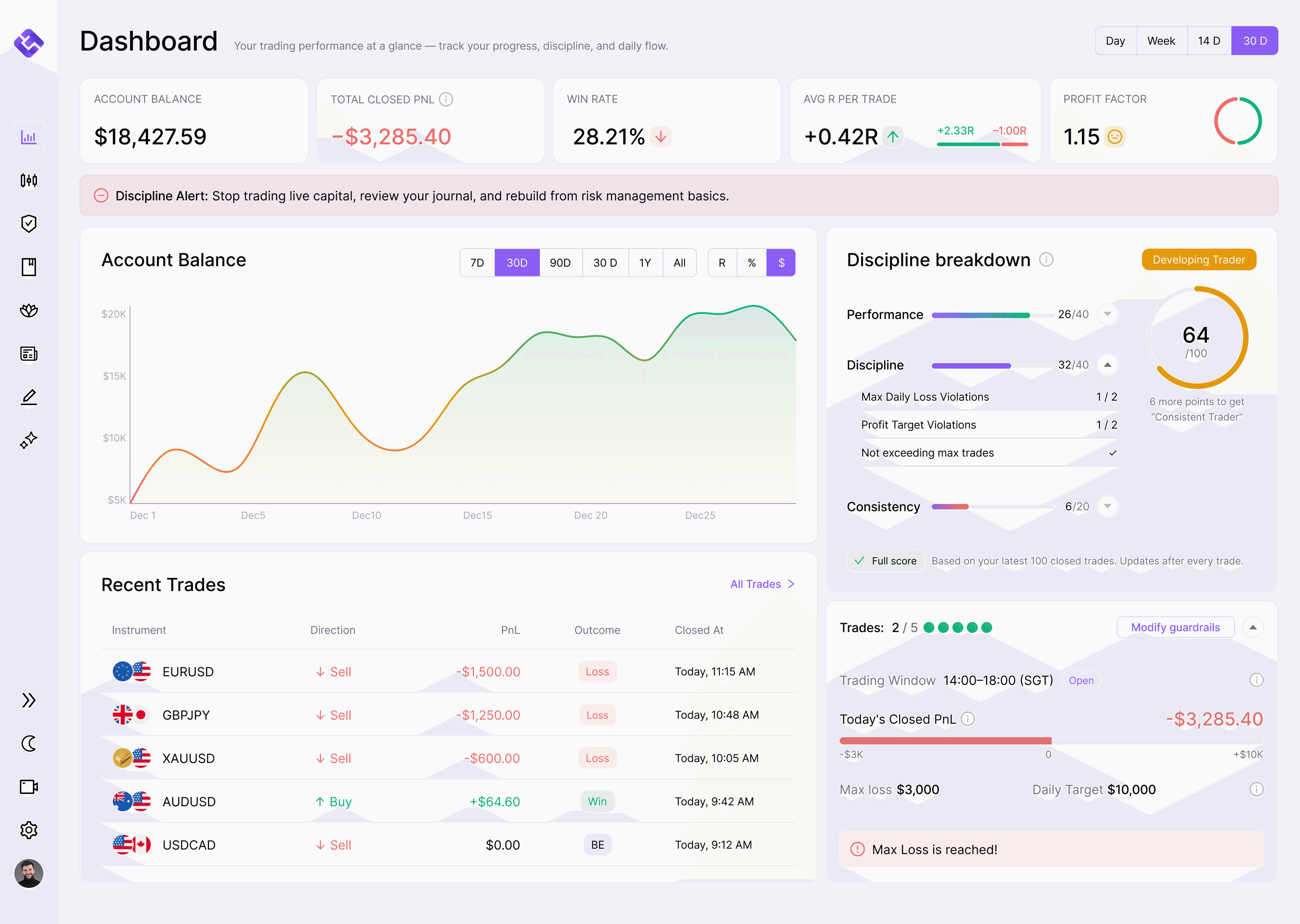
EdgeFlo guardrails map directly to these constraints. Set your daily loss limit to match the prop firm's daily limit. Set your per-trade risk to stay comfortably within the drawdown buffer. When you approach either limit, the guardrail restricts the trade button, making it harder (though not impossible; you can override if you choose to) to breach the rule.
For capital preservation on funded accounts, that friction between the impulse and the action is the difference between keeping your account and losing it. The override exists because EdgeFlo respects your autonomy. But having to consciously choose to override the restriction means you cannot accidentally violate the prop firm's rules in the heat of the moment.
The traders who survive funded accounts are not the ones with the best strategies. They are the ones who protect the account first and chase profits second. The account has to survive today for you to profit tomorrow. That priority never changes, no matter how close the payout target is.
The Edge Brief
Receive Insights on trading psychology, discipline, and the behavioral patterns that create consistent traders from our Founder and the EdgeFlo team, delivered to your inbox.
Think different. Trade different.
Why do most funded traders fail within 90 days?
Should I treat funded capital differently from my own money?
How do funded traders survive losing streaks?
What is the biggest mistake after getting funded?

Turn discipline on.
Every session.
EdgeFlo is the environment serious traders operate inside.
Start 7-Day Free Trial
Cancel anytime.
No long-term commitment.

Think Different, Trade Different.