

Funded Trader Mindset: Shift Your Identity First
The funded trader mindset starts with an identity shift. Until you see yourself as a professional, your habits will keep pulling you backward.

The funded trader mindset is not about positive thinking or affirmations. It is the gap between who you are right now and who you need to become to hold a funded account without self-destructing. Most traders who fail challenges have solid strategies. They lose because their identity, their default behaviors and beliefs, has not shifted to match the account they are trying to manage. Until you close that gap, your old habits will keep pulling you back to your old results. Your personality dictates your personal reality. Change the identity first, and the funded account follows.
TL;DR
Strategy is rarely the reason traders fail funded challenges. The real issue is an unshifted identity that triggers self-sabotage under pressure.
Success amplifies your existing habits. If you have not changed them before getting funded, they scale with your account size.
Confidence comes from data (proof your edge works) and kept promises (proof you can trust yourself).
The top 1% of funded traders focus on consistency, risk management, discipline, and mastering one mechanical system.
Build the professional identity before you need it, not after you pass the challenge.
Why Mindset Beats Strategy in Funded Trading
Ever watched someone flip a small account from $100 to $10,000, then fail a $50,000 funded challenge? Sound familiar?
The strategy did not change. The rules did not change. But the person sitting in front of the screen was still operating with the mindset of someone trading a $100 account. They risked 2% on the first trade, lost it, risked 2% on the second, lost that too, and suddenly they were down 4% on the challenge with their confidence shattered.
What happened next was not a strategy failure. It was a mindset collapse. Once they stopped trusting their edge, they started taking low-quality setups, chasing trades to recover, and eventually hitting the maximum drawdown limit. The challenge was over.
This pattern repeats across every prop firm challenge. The technical ability is there. The emotional capacity to handle the pressure is not. Professional traders are boring and methodical. They wait for the setup that checks every criterion in their plan, and if nothing qualifies, they sit out. That is the funded trader mindset. It is not exciting. It is not a highlight reel. It is the discipline to do nothing when everyone else is chasing.
The Identity Gap: Old Self vs Funded Self
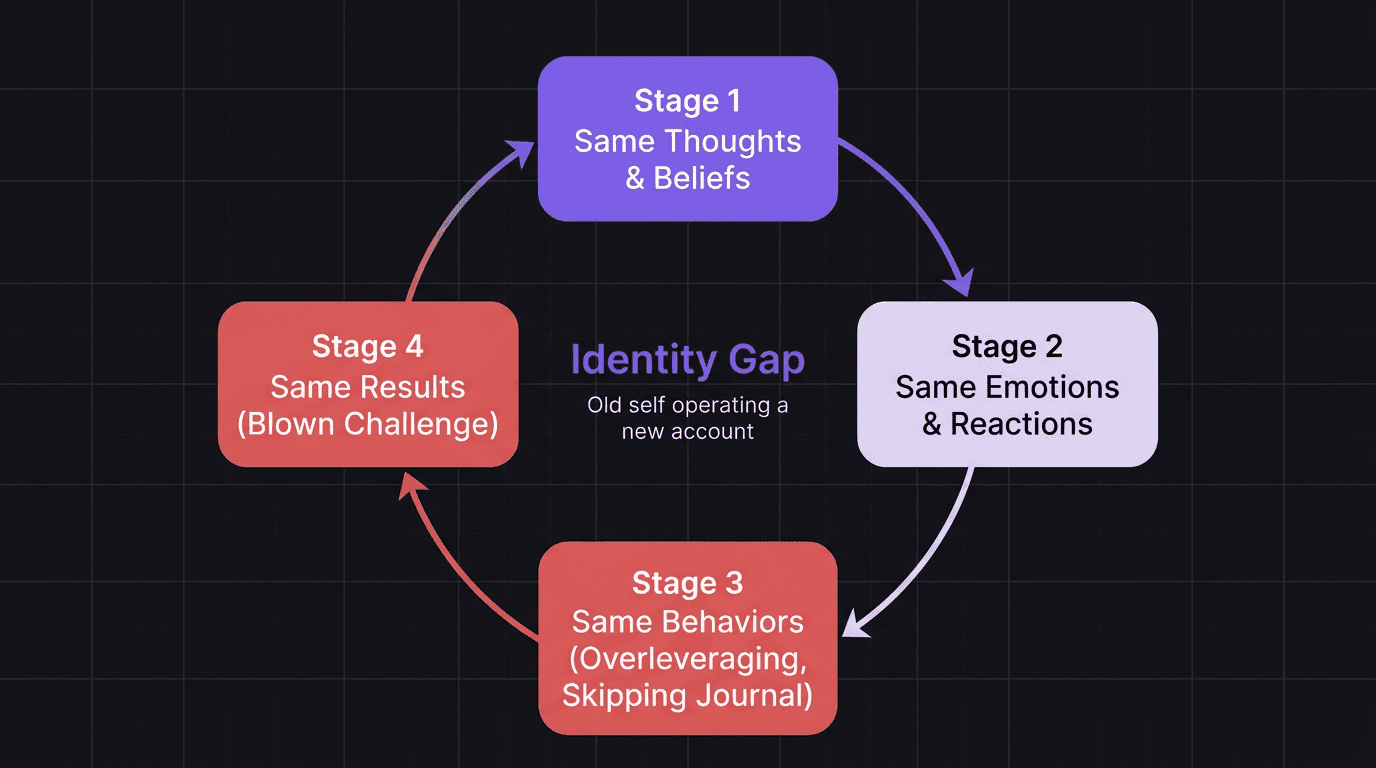
Here is the core problem. You say you want to be a funded trader making $10,000 a month. But your daily habits, your thought patterns, and your emotional reactions are still those of someone who is broke and struggling. That is the identity gap.
Think about lottery winners. Someone goes from $20 in their bank account to a million dollars overnight. Within a few years, a staggering number of them are back to zero. They bought the cars, the watches, the parties. They spent recklessly because their identity never matched their bank balance. Their self-image was still "broke person who got lucky."
The same thing happens in trading. You hit a great run, build up 6% profit in your challenge, and then something shifts. You start taking bigger risks. You skip your pre-market routine. You overtrade because you feel invincible. Within days, those profits are gone. You donated them back to the market.
This is not a willpower problem. Your personality dictates your personal reality. If you think the same thoughts, experience the same emotions, and perform the same behaviors, you get the same results. Success does not fix bad habits. It amplifies them. Whatever you were doing when you were struggling (overleveraging, skipping your journal, revenge trading after losses) will follow you into a funded account unless you make a conscious decision to change.
How Self-Sabotage Shows Up in Challenges
Self-sabotage in funded challenges is sneaky. It does not announce itself. It looks like normal trading decisions in the moment, but the pattern is unmistakable when you zoom out.
Giving profits back. You build up a 5% cushion in phase one. Instead of protecting it, you start swinging for bigger trades. Within three days, you are back to breakeven. You were not comfortable with the profit because your identity does not believe you deserve it.
Increasing lot size after wins. Two winning trades in a row and suddenly you are risking 3% instead of your planned 1%. The dopamine hit from winning felt so good that you wanted more. You were chasing excitement, not following a plan.
Skipping the process after a loss. You take a loss, and instead of journaling it and reviewing what happened, you immediately look for the next trade to "make it back." That is revenge trading dressed up as determination. And it almost always leads to a second loss.
Breaking rules near the profit target. You are at 8% and need 10% to pass. The finish line is right there. So you start forcing trades, ignoring your criteria, trading during sessions you normally avoid. The proximity to the goal makes you abandon the process that got you there.
Every one of these behaviors traces back to the same root cause. Your identity has not shifted. You are still the trader who chases dopamine, who feels unworthy of profits, who does not trust their own edge. Until you address that, no strategy upgrade will save you.
Walkthrough: Two Traders, Same Strategy, Different Results
The Setup
Two traders, Alex and Sam, both use the same breakout strategy on EUR/USD during the London session. They are both in Phase 1 of a $100,000 funded challenge with a 5% daily drawdown limit and a 10% maximum drawdown. Their strategy has a 45% win rate with a 2.5:1 reward-to-risk ratio. Both risk 1% per trade.
Alex: Unshifted Identity
Alex starts strong. Wins three of the first five trades (not all at full 2.5R, some closed early). Account is up 3.5% after week one. Then the losing streak hits. Three losses in a row. Account drops to 0.5%.
Alex panics. Three losses on a proven strategy should not cause panic, but Alex has not built confidence through data. The backtest said 45% win rate, but Alex never truly internalized what that means (55% of trades will lose). So Alex bumps the risk to 2% per trade to "catch up." Takes two off-plan trades during New York overlap because they "looked good." Both lose. Account is now at negative 3.5%.
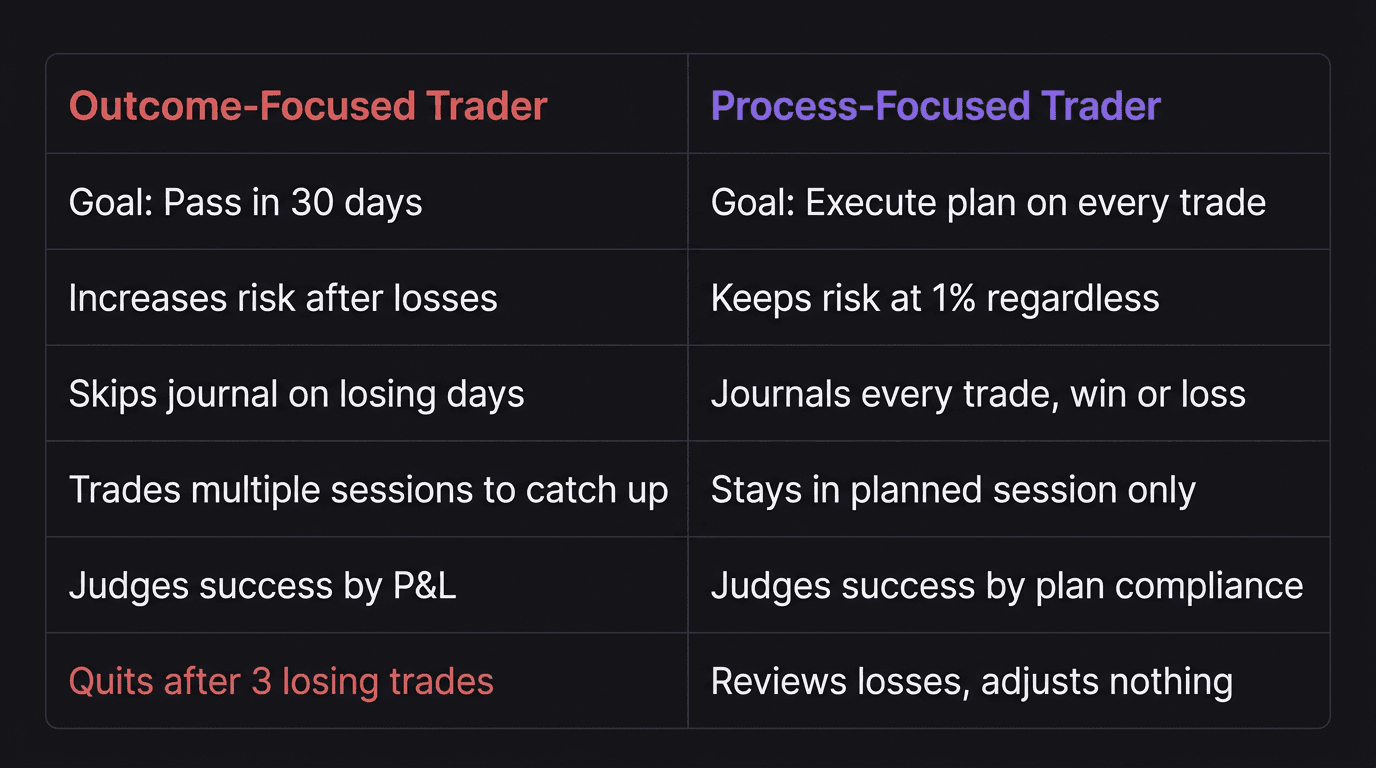
By week three, Alex is down 6.8%. Desperate to avoid failing, Alex starts trading multiple sessions, ignoring the London-only rule. A revenge trade during Asian session hits the daily drawdown limit. The challenge is over.
Sam: Shifted Identity
Sam also wins three of the first five trades. Same 3.5% after week one. Same three-loss streak follows. Account drops to 0.5%.
Sam journals every loss. Reviews each one against the plan. Two were valid setups that simply did not work out (good losses). One had a slightly early entry (bad loss, noted for correction). Sam adjusts nothing about lot size or risk. The plan says 1%, and Sam trusts the data that says this system works over 100+ trades.
By week three, Sam is at 3.2%. Not exciting. Not fast. But the consistency is building. Sam finishes Phase 1 in week six with a 10.4% gain. No rules broken. No variance-driven decisions.
What Separated Them
Same strategy. Same market. Same starting conditions. Alex's identity was still "struggling trader trying to prove something." Sam's identity was "professional executing a tested plan." Alex reacted to emotions. Sam responded with process. That is the funded trader mindset in practice.
Building the Professional Identity
You do not wake up one day with a professional identity. You build it through small, boring actions repeated consistently over time. Here is what actually works.
Trust your data first. Confidence and conviction come from two sources: data that proves your strategy works, and promises you keep to yourself. If you have not backtested your system across at least 100 trades, you do not have data. You have hope. And hope is not a funded trader mindset. Test the edge, record the results, know your numbers cold. When you can say "my system has a 45% win rate and a 2.5:1 R:R over 200 trades," that is real confidence. Not the kind you talk yourself into. The kind that survives a five-trade losing streak.
Keep small promises. Every time you say "I will journal every trade" and then skip Friday's journal, you erode self-trust. Every time you say "I will follow my plan" and then take an off-plan trade, you prove to yourself that your word means nothing. The funded trader mindset starts with keeping the promises you make to yourself. Journal when you said you would. Follow your pre-market routine even when the market looks obvious. Stick to your session even when you see a setup forming in another.
Set process goals, not outcome goals. "Pass the challenge in 30 days" is an outcome goal. It puts pressure on the timeline and leads to rule-breaking. "Execute my plan on every trade this week" is a process goal. It keeps your focus on the behaviors that produce results over time. The top 1% of funded traders do not care about getting funded in 30 days. They care about consistency, risk management, discipline, and mastering one mechanical system.
Accept that professional trading is boring. This is the hardest shift for most traders. You got into trading because it looked exciting. The highlight reels, the six-figure months, the lifestyle content. But the work behind those results is repetitive and unglamorous: backtesting late at night, journaling after losing days, executing the same setup over and over. If you cannot find satisfaction in the process itself, you will keep chasing the dopamine of random wins instead of building sustainable results.
How EdgeFlo Reinforces the Professional Mindset
Building a new identity is easier when your environment supports it. That is the core principle behind EdgeFlo: change the environment, and the behavior follows.
Sanctuary supports mindset reset routines that help you recenter before and after difficult sessions. When you catch yourself spiraling after a loss (the exact moment where ego and old habits try to take over), a structured reset routine interrupts the pattern before it escalates into revenge trading or overleveraging. It is not about feeling better. It is about creating a gap between the emotional trigger and your next action.
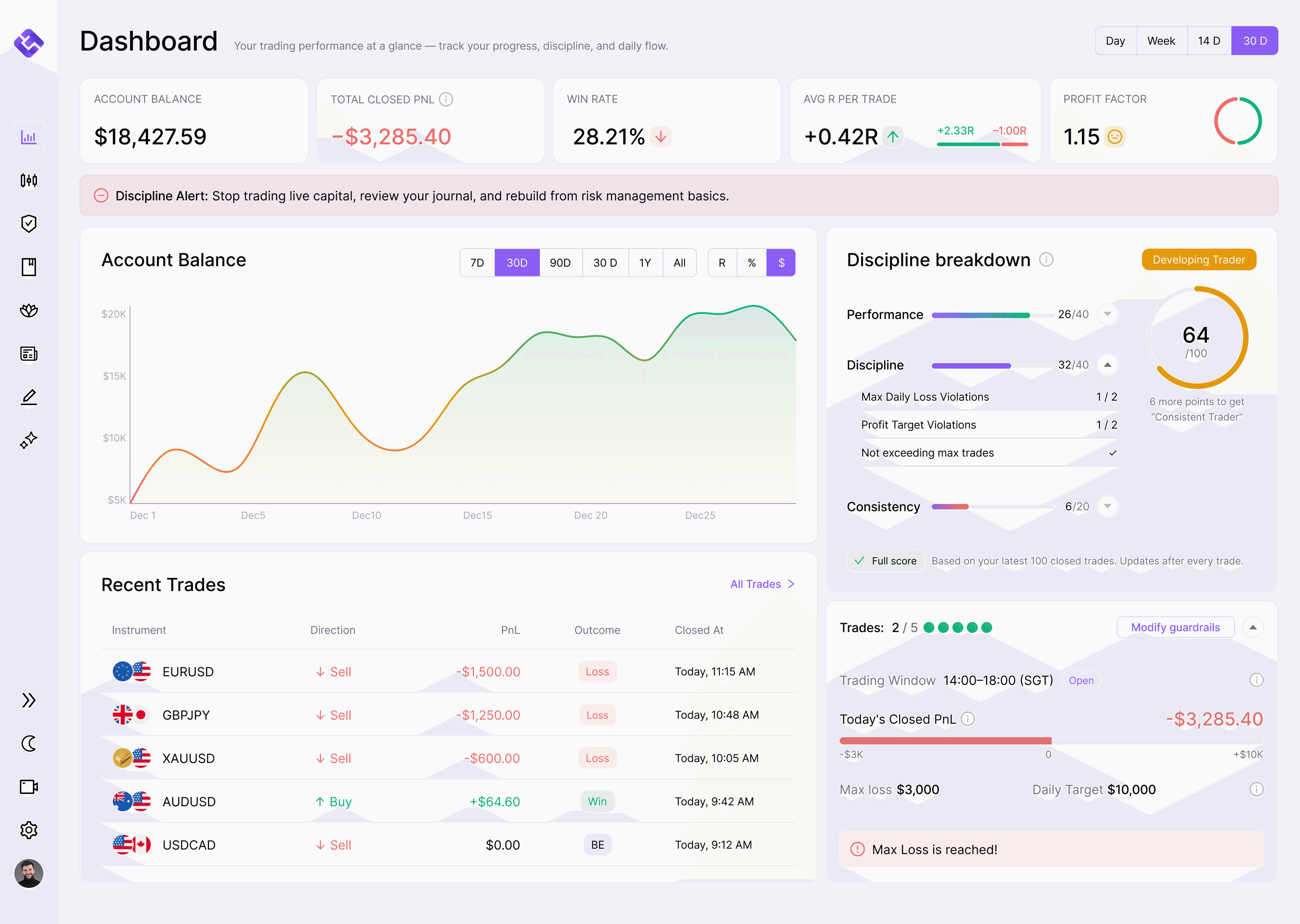
EdgeFlo's journal with emotion tagging builds the self-awareness that most traders skip. When you tag every trade with how you felt during entry and exit, you start seeing patterns you cannot see in real time. Maybe you overtrade every Wednesday after a Tuesday loss. Maybe you increase size when you feel confident, which actually correlates with your worst days. That data turns a vague sense of "I keep messing up" into specific, fixable behaviors. For Plus subscribers, FloAI coaching surfaces these psychology patterns and suggests routines based on your journal history. It is not signals or predictions. It is a mirror that helps you see the identity gap before it costs you another funded account.
The Edge Brief
Receive Insights on trading psychology, discipline, and the behavioral patterns that create consistent traders from our Founder and the EdgeFlo team, delivered to your inbox.
Think different. Trade different.
What is the funded trader mindset?
Why do traders self-sabotage after getting funded?
How do you build confidence for funded trading?
Can you pass a prop firm challenge with the wrong mindset?

Turn discipline on.
Every session.
EdgeFlo is the environment serious traders operate inside.
Start 7-Day Free Trial
Cancel anytime.
No long-term commitment.

Think Different, Trade Different.