

Funded Trader Discipline: What It Looks Like
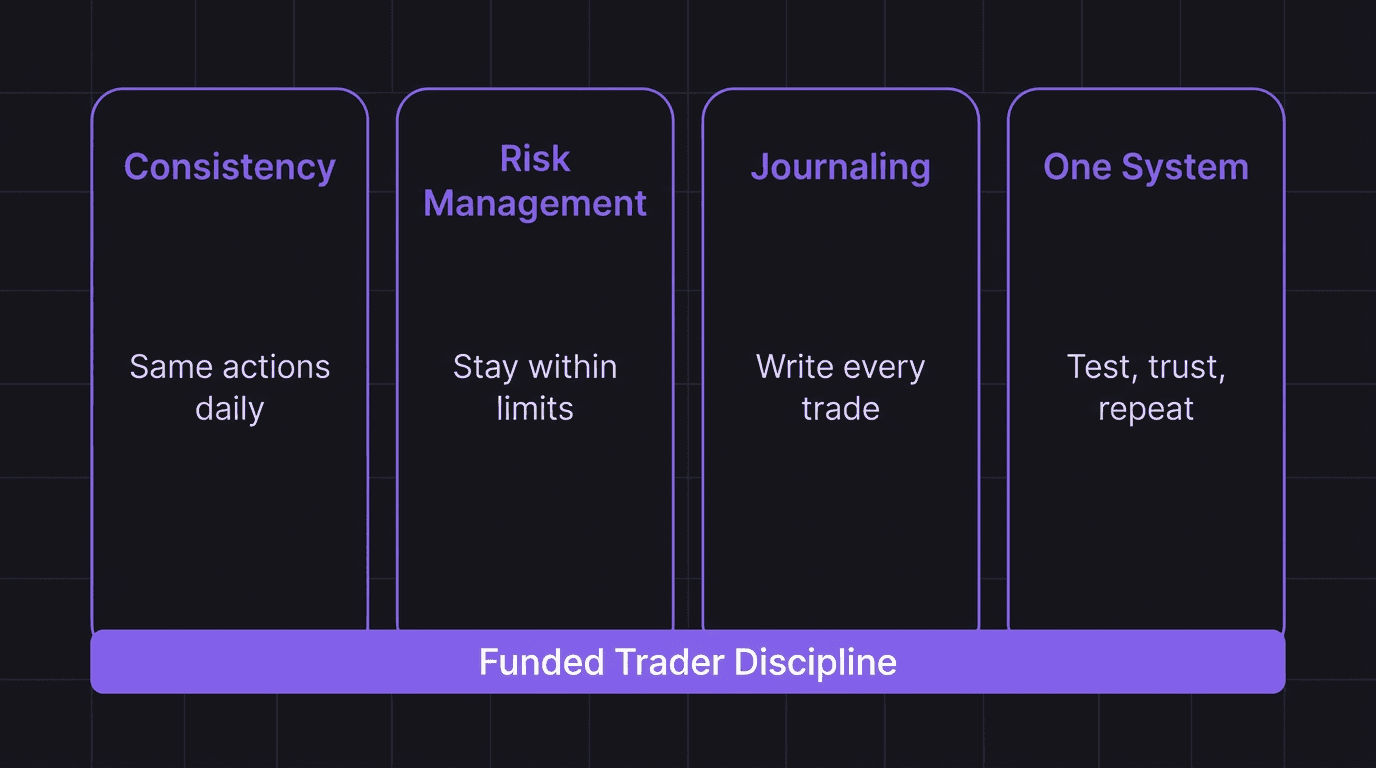
Funded trader discipline is not willpower. It is consistency, risk control, journaling, and mastering one system. Here is what it looks like daily.

Funded trader discipline is not willpower, motivation, or gritting your teeth through a losing streak. It is four things happening every single day: consistent execution, controlled risk, honest journaling, and trading one system you have tested and trust. The traders who pass challenges and keep funded accounts do not have a secret strategy. They have a process they refuse to skip, even on days when nothing feels right. That consistency is what prop firms actually measure. Not your win rate on a hot week. Your ability to show up, follow your plan, and protect the account when the market gives you nothing.
TL;DR
Discipline is not motivation on repeat. It is doing the boring, hard work when you do not feel like it.
The four pillars are consistency, risk management, journaling, and mastering one mechanical system.
A disciplined trading day is structured: pre-market routine, rule check before entry, journal after every trade.
Undisciplined challenge weeks blow up from lot size increases and off-plan trades, not bad strategy.
Build discipline before you need it by practicing on a demo account with real challenge rules.
Discipline Is Not Motivation on Repeat
Here is something most traders get wrong early. They think discipline means being motivated every day. Waking up pumped. Feeling ready. Wanting to trade.
That is not discipline. That is a good mood.
Discipline is what happens when you do not feel like doing any of it. When you lost two trades yesterday and your journal is staring at you, and every part of you wants to skip the review and just take the next setup. Real discipline is sitting down and writing what went wrong anyway.
One trader who failed six funded challenges puts it clearly: the top 1% of funded traders have the ability to "do the hard things, especially when they don't feel like it." They journal their losses. They review their mistakes. They do the post-trade work even after a losing streak, even when every instinct says to stop.
Sound familiar? You have probably had that moment where reviewing felt pointless after a red day. That is exactly the moment discipline either exists or it does not.
Motivation gets you to buy the challenge. Discipline gets you through Phase 2 and into your first payout. They are not the same thing, and confusing them is why most traders cycle through prop firm challenges without ever passing.
The Four Pillars: Consistency, Risk, Journaling, One System
Discipline is not one thing. It is four things working together. Remove any single pillar and the structure collapses.
Consistency
Consistency means your actions do not change based on yesterday's PnL. You follow the same pre-market routine whether you are up 3% on the challenge or down 2%. You check the same criteria before every entry. You size every trade the same way.
The top 1% focus on being "consistent in terms of the actions that they take every single day." Not consistent profits (those come later). Consistent behavior.
Risk Management
Staying within proper risk parameters is non-negotiable. That means knowing your daily loss limit before you open the platform, sizing every position to survive a losing streak, and never cranking up lot size to chase the profit target.
A trader who failed six challenges learned this the hard way: after losing 4% in two trades at 2% risk each, confidence collapsed. The next trades were low-quality setups taken out of desperation, and the account hit max drawdown. The risk was not the problem. The reaction to the risk was.
Journaling
Journaling is not optional for funded traders. It is the mechanism that turns losses into lessons instead of emotional spiraling.
The practice is simple: after every trade, write what you planned, what you did, and whether those two things matched. After a losing day, write what triggered the deviation. This is how you catch patterns before they become habits.
Mastering One System
The fourth pillar is committing to one mechanical system. Not switching strategies after three losses. Not copying someone else's edge without testing it. Building (or selecting) one system that suits your personality, your risk tolerance, and your lifestyle, then trading that system until you have data proving it works.
Without that data, you have no conviction. Without conviction, three losses in a row will send you strategy hopping. And strategy hopping is the opposite of discipline.
What a Disciplined Day Looks Like
Discipline is abstract until you see what it looks like on a Tuesday morning when you do not feel like trading. Here is a practical breakdown.
Before the Session
You open your platform 15 to 30 minutes before your session starts. You check the economic calendar for high-impact news events. You review your trading rules and your plan for the day: which pairs you will watch, which session you will trade, what your maximum risk is for today.
This is not complicated. It takes 15 minutes. But it is the difference between entering the market with a plan and entering the market with a feeling.
During the Session
You wait. That is what most of the session looks like for a disciplined trader. You scan your watchlist. You check whether any setup meets every criterion on your checklist. If nothing lines up, you do nothing.
If a setup does appear, you confirm it against your plan. Entry, stop, target, risk size. You calculate the position size. You enter. Then you walk away or set alerts, because the trade is now in the market's hands.
After the Session
This is where most traders fall off. The session is over. You are tired, or frustrated, or pleased. Either way, you open your journal and log every trade you took (and any setup you skipped that you should not have).
The post-session review takes 10 to 15 minutes. It is the most important 15 minutes of your trading day, because it is the only time you can actually improve. Execution is reactive. Review is where learning happens.
On a No-Trade Day
Disciplined traders have no-trade days regularly. The setup did not appear, so they did not trade. They still log it: "No valid setup. Sat on hands." That entry matters because it proves you can follow your rules even when the rules say do nothing.
Walkthrough: Disciplined vs Undisciplined Challenge Week
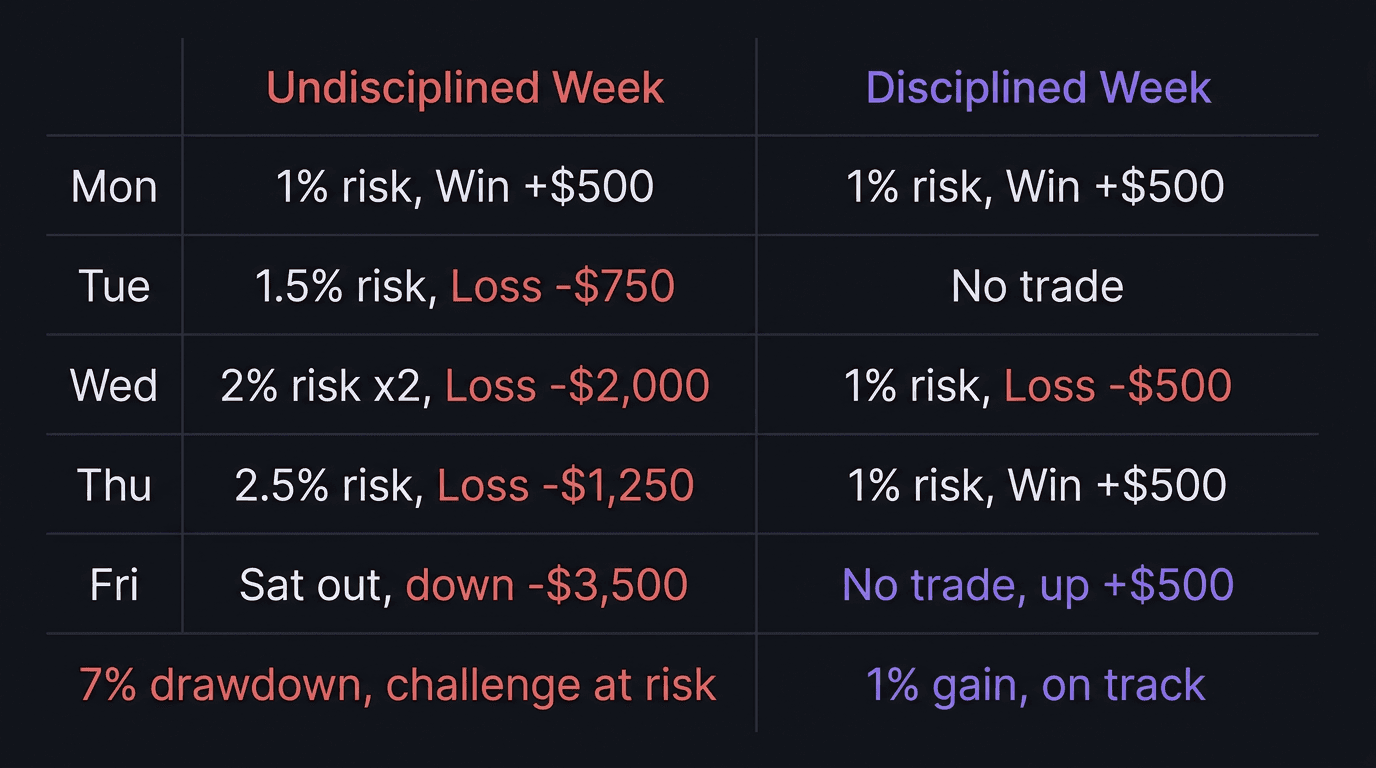
Two traders start a $50,000 funded challenge on the same Monday. Both trade GBP/USD during London session. Both use the same breakout strategy. The difference is entirely in discipline.
Trader A: The Undisciplined Week
Monday: Takes a clean setup, risks 1% ($500). Wins. Feels great. Tuesday: No clean setup, but takes a "close enough" trade anyway. Risks 1.5% ($750) because yesterday was a winner. Loses.
Wednesday: Wants to recover. Bumps risk to 2% ($1,000) on a lower-quality setup. Loses again. Now down $1,250. Confidence is cracking. Takes a revenge trade at 2% before the session ends. Loses. Down $2,250 total.
Thursday: Skips the pre-market routine. Takes the first thing that moves. Risks 2.5% ($1,250). Loses. Down $3,500, which is 7% of the account. One more bad day and the challenge is over.
Friday: Sits out. But the damage is done. The trader passed from confidence to desperation in four days, not because the strategy failed, but because discipline failed.
Trader B: The Disciplined Week
Monday: Same clean setup. Risks 1% ($500). Wins. Logs it. Closes the platform.
Tuesday: No valid setup during the session. Logs "no trade" in the journal. Reviews Monday's trade. Total time at the screen: 2 hours.
Wednesday: One setup meets all criteria. Risks 1% ($500). Loses. Logs entry, reviews the setup against the plan. Everything was correct. The loss was a good loss: planned, sized, and executed.
Thursday: One setup. Risks 1% ($500). Wins. Logs it.
Friday: No setup. Logs "no trade." Reviews the week: 3 trades, 2 wins, 1 loss. Net gain: $500. Account at $50,500. Challenge on track.
The difference between these two weeks is not skill. It is not strategy. It is the willingness to follow rules when following rules feels boring, slow, or painful.
How to Build Discipline Before You Need It
The worst time to build discipline is during a live funded challenge. The stakes are too high and the pressure creates exactly the emotional conditions that break undisciplined traders.
Build it before you get there.
Practice on a Demo with Real Rules
Set up a demo account with the exact rules of the challenge you plan to take. Same profit target. Same daily drawdown limit. Same max drawdown. Trade it for 30 days as if it were real money.
This sounds boring. It is supposed to be. If you cannot follow the rules when nothing is at stake, you absolutely will not follow them when $500 of your own money is on the line.
Journal from Day One
Do not wait until you are funded to start journaling. Start now. Write the plan before the session. Log every trade after. Review the week on Friday.
The habit needs to be automatic before you enter a challenge. If journaling still feels like a chore when you buy the challenge, you will skip it the first time you have a red day.
Set a Personal Daily Loss Limit Below the Challenge Limit
Most challenges allow 5% daily drawdown. Set your personal limit at 2% or 3%. If you hit your limit, close the platform. No exceptions.
This creates a buffer zone that protects the funded account and trains your brain to associate hitting a limit with stopping, not with revenge trading.
Trade One Session Only
Pick London or New York. Trade that session. Close the platform after. This constraint removes the temptation to overtrade during slow hours or chase setups outside your tested conditions.
How EdgeFlo Makes Discipline Structural
The hard part about discipline is that it lives in your head. You have to remember the rules, enforce the limits, and hold yourself accountable with no one watching. EdgeFlo moves discipline out of your head and into your environment.
Guardrails flag when you approach your daily loss limit and restrict the trade button if you cross it. You can override if you choose to, but you have to make a conscious decision to break the rule. That pause is often enough to stop a spiral.
The journal auto-imports your trades so you do not have to log them manually. When the barrier to journaling is zero, skipping it stops being the default. Your Edge plan stores your rules, your criteria, and your risk parameters in one place, visible next to your chart. After each trade, you self-report whether you followed the plan. Over time, the plan stats show you exactly how disciplined you actually are, not how disciplined you think you are.
The Edge Brief
Receive Insights on trading psychology, discipline, and the behavioral patterns that create consistent traders from our Founder and the EdgeFlo team, delivered to your inbox.
Think different. Trade different.
What is funded trader discipline?
How long does it take to build trading discipline?
Can you pass a funded challenge without discipline?
What is the biggest discipline mistake in prop firm challenges?

Turn discipline on.
Every session.
EdgeFlo is the environment serious traders operate inside.
Start 7-Day Free Trial
Cancel anytime.
No long-term commitment.


Think Different, Trade Different.