

News Event Stop Loss: Protect Open Positions
Already in a trade when NFP drops? Tighten your stop, not your grip. Learn the exact protocol for protecting open positions before high-impact news events.
NFP is three minutes away. You have an open short on EUR/USD that is up 40 pips. Your take profit is another 60 pips below. Your stop loss is sitting 25 pips above your entry, right where you placed it this morning.
What do you do?
If the answer is "nothing," you are gambling with your open profit. High-impact news events can move price 80 to 150 pips in seconds, and that move can go in either direction. The traders who survive news volatility with open positions are the ones who have a protocol for this exact moment.
TL;DR
Never sit through a high-impact news event with an unprotected open position.
Tighten your stop loss to the nearest structural level before the release.
If you are in significant profit, consider a partial close to lock in gains.
Check the economic calendar during your pre-session routine so you are never surprised.
The goal is protection, not prediction. You do not need to guess the outcome.
Why News Events Are Different
Normal price action follows structure. Highs get swept, zones get mitigated, order flow shifts in patterns you can read. News events override all of that. A single economic release can inject enough volume to blast through multiple support and resistance levels in one candle.
The whipsaw effect is the real killer. Price spikes 100 pips in one direction, triggers every stop in sight, then reverses and runs 100 pips the other way. If your stop was sitting at its original level, you got taken out during the spike, watched price reverse in your favor, and have nothing to show for a valid analysis.
This is not a reason to remove your stop. It is a reason to manage it before the event, not during it.
The Pre-News Protocol (Step by Step)
Here is the exact sequence to follow when you have an open position and a high-impact news event is approaching:
Step 1: Check the Calendar at Session Open
Before you even look at a chart, check the economic calendar for high-impact events during your session. NFP, CPI, FOMC, ECB rate decisions, GDP. If one of these falls within your trading window, you know in advance that you may need to adjust open positions.
Make this part of your session rules. No surprises.
Step 2: Assess Your Open Position 30 Minutes Before
Thirty minutes before the release, evaluate where your trade stands:
In profit by 2R or more? You have room to tighten aggressively or take a partial close.
In profit by less than 1R? Tighten to breakeven or to the nearest structural level.
At breakeven or in drawdown? Tighten to reduce maximum loss. Accept that the news may stop you out.
The point is not to predict the news outcome. The point is to make sure the news cannot turn a good trade into a disaster.
Step 3: Move Your Stop to Structure
Do not just move your stop to an arbitrary level. Move it to the nearest structural level on your entry timeframe that still gives the trade room to breathe.
For a short position: move your stop to just above the most recent swing high or supply zone on your 15-minute or 5-minute chart.
For a long position: move your stop to just below the most recent swing low or demand zone.
This is different from arbitrarily moving your stop during normal price action. During news, you are not micromanaging. You are reducing exposure to a known volatility event with a specific timeline.
Step 4: Consider a Partial Close
If you are sitting on meaningful unrealized profit, taking 50% off the table before the release is a legitimate move. You lock in gains on half the position and let the remaining half ride with a tightened stop.
This is not the same as closing in fear. It is risk management with a defined trigger: a scheduled, high-impact event that can erase open profit in seconds.
Walkthrough: EUR/USD Short Into NFP
You entered a EUR/USD short at 1.0920 during the London session. Your stop is at 1.0940 (20 pips above entry) and your take profit is at 1.0860 (60 pips below entry). You are trading 0.5 lots. NFP releases at 8:30 AM New York time.
At 8:00 AM, your trade is up 40 pips. Price is at 1.0880.
Step 1: You already knew NFP was today because you checked the calendar this morning.
Step 2: You are in profit by 2R (40 pips gained vs 20 pips risked). You have room to protect aggressively.
Step 3: The most recent 15-minute swing high is at 1.0895. You move your stop from 1.0940 to 1.0898 (3 pips above the swing high for spread buffer).
Step 4: You close half the position (0.25 lots) at 1.0880 for 40 pips of locked profit.
NFP drops. Price spikes 60 pips against you to 1.0940, stops out the remaining 0.25 lots at 1.0898, then reverses and drops 120 pips to 1.0820.
Without the protocol, your original stop at 1.0940 would have been hit on the full 0.5 lots. You would have lost nothing on the trade (breakeven), but you would have given back $200 in open profit and watched price eventually blow past your original target.
With the protocol, you locked in $100 from the partial, lost $45 on the stopped-out remainder, and walked away with $55 net profit. Not the $300 the trade would have paid in a perfect world, but $55 beats $0 when news is involved.
What Not to Do
Do not remove your stop entirely. Some traders pull their stops before news thinking they will "manage it manually." During a 100-pip spike that takes 3 seconds, you cannot click fast enough. Keep a stop in the market at all times.
Do not add to your position. News events are not the time to double down. The outcome is binary and unpredictable. Adding size before news is pure gambling.
Do not widen your stop. If anything, you are tightening. Moving your stop further away before a volatile event increases your maximum loss at the worst possible time.
Do not ignore the calendar. If you trade set-and-forget style, you still need to know when high-impact events are scheduled. Set and forget applies to normal market conditions, not to scheduled volatility bombs.
Building This Into Your Risk Framework
The pre-news protocol is not a separate system. It is a clause within your existing risk rules. Add it to your trading plan:
"If a high-impact news event is scheduled within my session, I will assess all open positions 30 minutes before the release. I will tighten stops to the nearest structural level and consider a partial close if I am in profit by 2R or more."
One sentence in your plan. One habit that protects you from the single most common way traders give back open profit.
How EdgeFlo Helps With News Protection
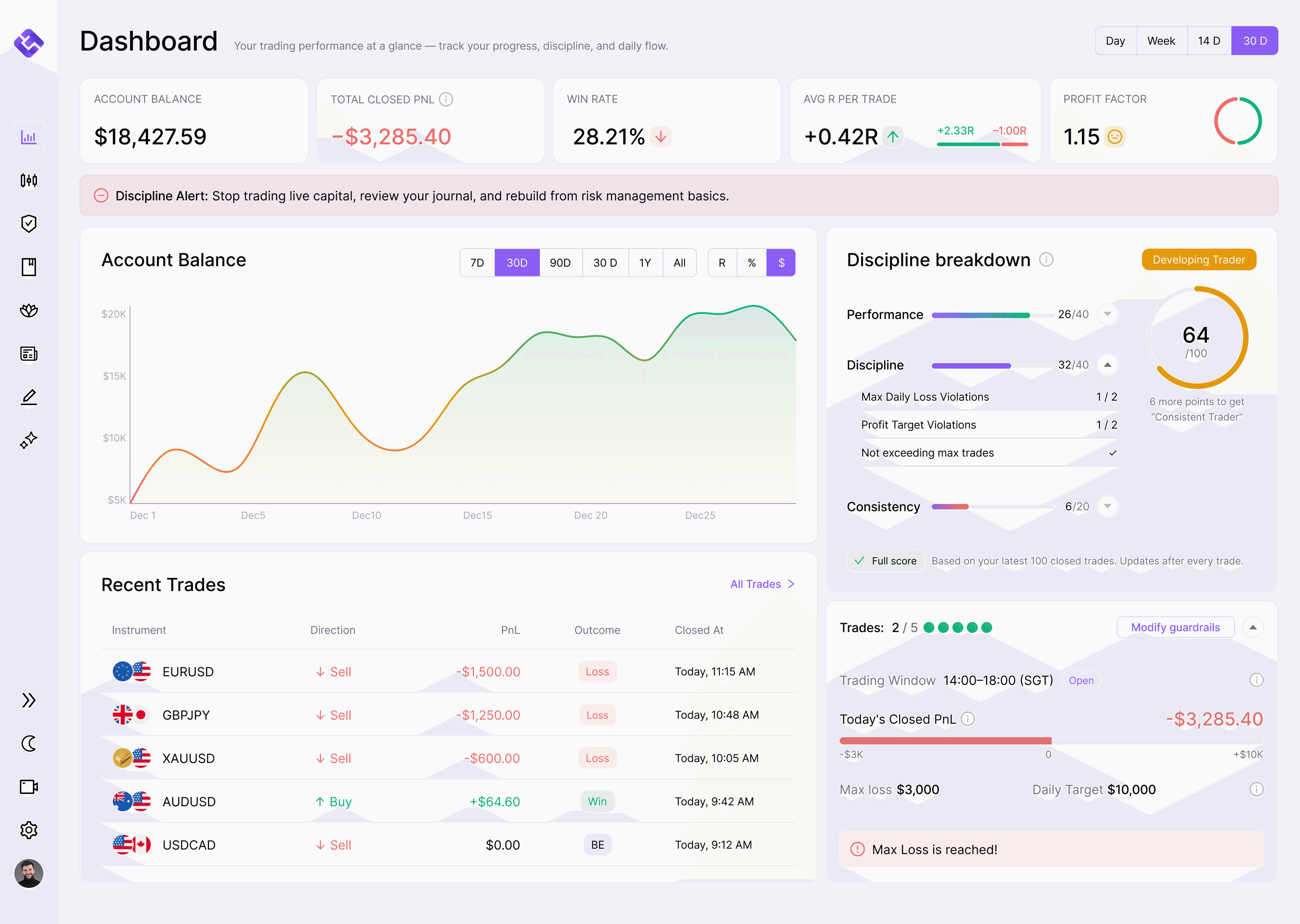
EdgeFlo's economic calendar is watchlist-aware, meaning it highlights events that directly affect the pairs you are currently trading. You see the impact level and timing without needing to check a separate website.
The News Block Guardrail (Plus) restricts new trade entries around high-impact events, helping you avoid the temptation to trade into volatility. For open positions, the calendar alert gives you the 30-minute heads-up you need to run through the protocol above.
The Edge Brief
Receive Insights on trading psychology, discipline, and the behavioral patterns that create consistent traders from our Founder and the EdgeFlo team, delivered to your inbox.
Think different. Trade different.
Should I close my trade before a news event?
How far should I tighten my stop before news?
Does slippage affect stop losses during news?
Can I trade during news events profitably?
Turn discipline on.
Every session.
EdgeFlo is the environment serious traders operate inside.
Start 7-Day Free Trial
Cancel anytime.
No long-term commitment.

Think Different, Trade Different.