

Funded Account Income: $5k to $20k Per Month
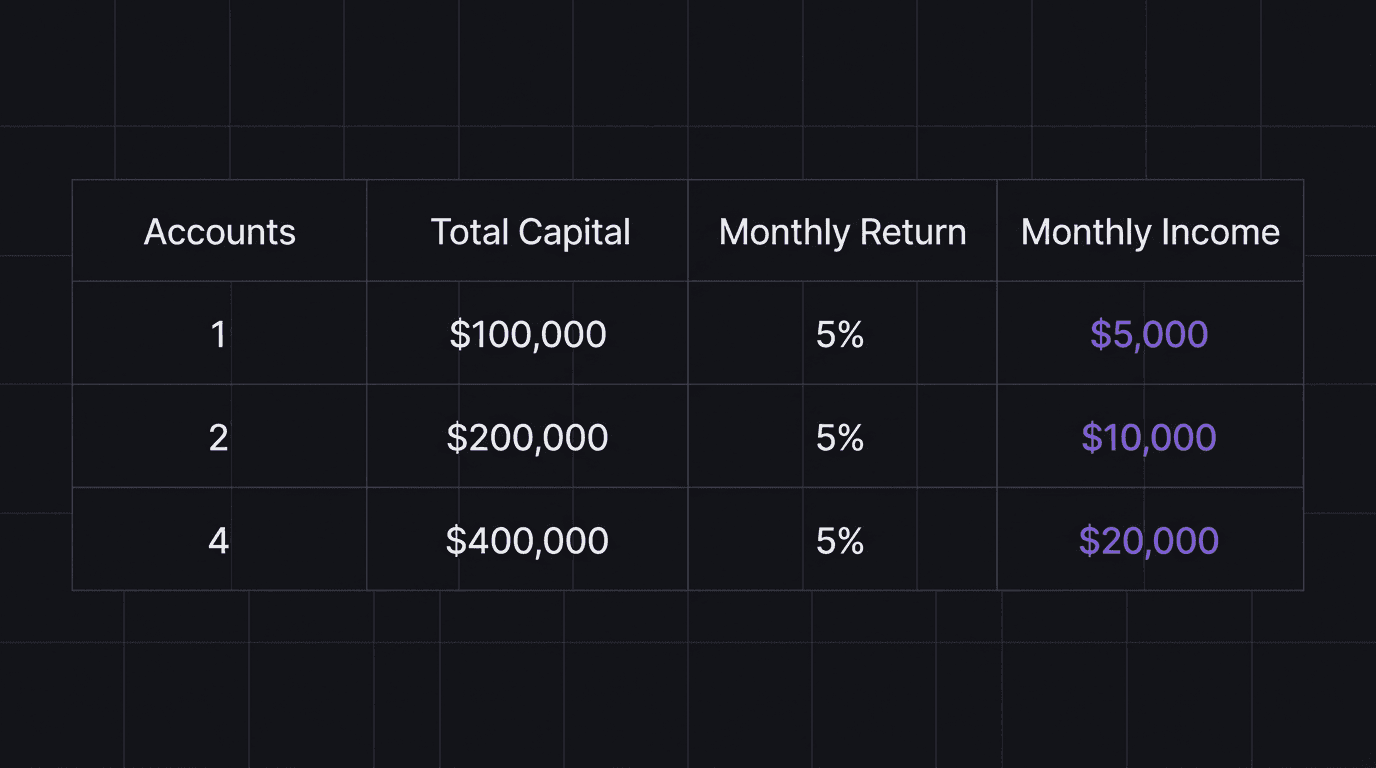
One $100k funded account earns $5,000/mo at 5% monthly. Scale to $200k for $10k/mo and $400k for $20k/mo. Here is the realistic income progression.

A single $100k funded account earning 5% per month pays you $5,000. Two accounts at the same rate pay $10,000. Four accounts pay $20,000. The path from $5k to $20k per month does not require you to take bigger risks or chase higher returns. It requires you to keep doing the same thing on more capital.
Most traders who land their first funded account immediately try to squeeze 10% monthly out of it. That pressure leads to oversizing, overtrading, and eventually losing the account. The traders who actually build real income from prop firms do the opposite. They aim for a modest, repeatable return and add accounts over time.
TL;DR
One $100k funded account at 5% monthly = $5,000/mo income
Scale by adding accounts, not increasing risk per trade
Two accounts ($200k total) = $10,000/mo at the same 5%
Four accounts ($400k total) = $20,000/mo, still risking 1% per trade
Reinvest your payouts from the first account to fund new challenges
One Account: $5,000 Per Month
Your first funded account is the foundation. On a $100k account, 5% monthly equals $5,000 in profit. That is $60,000 per year in additional income on top of whatever you already earn.
Sound underwhelming compared to the "$10k per month" dream? It should not. That $5,000 proves something most traders never prove: you can extract consistent returns from the market without blowing up.
The math behind it is straightforward. Risk 1% per trade ($1,000 on a $100k account), aim for a minimum 1:3 risk-to-reward ratio, and you need roughly two winning trades per month to clear 5%. With a 40% win rate and 3R average winner, the numbers work.
Walkthrough: Month One on a $100k Account
You start your first funded month on EUR/USD. You risk 1% per trade, which is $1,000. Your stop loss is 30 pips, so your position size is 3.33 standard lots (30 pips times $10/pip per lot = $300/lot; $1,000 / $300 = 3.33 lots). Your take profit at 3R is 90 pips.
Over the month, you take 8 trades. Three hit your 3R target. Five hit your stop loss.
3 wins at $3,000 each = $9,000 gained. 5 losses at $1,000 each = $5,000 lost. Net profit = $4,000, which is 4% on the account.
Not quite 5%, but close. One more winning trade next month and you are on track.
The single biggest mistake at this stage is trying to force 10% returns. When you push for 10%, you start taking lower-quality setups, oversizing positions, or moving your stop loss. You are trading from pressure instead of process. That is exactly how traders lose their funded accounts.
Keep your risk at 1% per trade. Accept 5% monthly. Protect the account. That is the entire job.
Two Accounts: $10,000 Per Month
Once you have been consistently profitable on your first account for two to three months, you are ready to scale. But you do not scale by increasing your risk. You scale by adding capital.
Take your payouts from Account 1 and use them to purchase a second $100k funded challenge. Pass the challenge the same way you passed the first one. Same risk rules, same strategy, same 1% per trade.
Now you are managing $200k across two accounts. At 5% monthly on each, here is what changes:
Account 1: 5% of $100k = $5,000
Account 2: 5% of $100k = $5,000
Total monthly income: $10,000
You just doubled your income without touching your risk parameters. Same win rate. Same R multiple. Same strategy. The only variable that changed is total capital.
This is why chasing higher percentage returns is the wrong approach. The problem is never the return. The problem is capital. A trader trying to make $10,000 on a single $100k account needs 10% monthly. A trader with two $100k accounts only needs 5%. Which one do you think stays funded longer?
Walkthrough: What Happens When You Chase 10%
A trader with one $100k account wants $10,000 per month. To get there, they increase their risk to 2% per trade ($2,000). Their stop is still 30 pips on EUR/USD, so their position size jumps to 6.67 lots. They take 10 trades that month with a 40% win rate.
4 wins at $6,000 each = $24,000 gained. 6 losses at $2,000 each = $12,000 lost. Net profit = $12,000, which is 12%.
Sounds great on paper. But what happens when the next month delivers a 30% win rate instead?
3 wins at $6,000 = $18,000. 7 losses at $2,000 = $14,000. Net = $4,000. Still positive, but the drawdown during the month hit $8,000 (four consecutive losses at $2,000 each). That is an 8% drawdown, dangerously close to the typical 10% maximum drawdown limit.
One more bad trade in that losing streak and the account is gone. The trader who risked 1% on two separate accounts would have survived the exact same losing streak with only a 4% drawdown on each account. The income target is the same. The risk of ruin is completely different.
Four Accounts: $20,000 Per Month
The same logic continues. After running two accounts profitably for a few months, reinvest payouts into a third and fourth challenge. Now you are managing $400k total.
At 5% monthly on $400k, your income is $20,000 per month. Over twelve months, that is $240,000. And you achieved it while risking the same 1% per trade you started with.
Four funded accounts at $100k each is not an unrealistic ceiling. Plenty of prop firms allow traders to hold multiple accounts simultaneously. The constraint is not the firm's rules. The constraint is your consistency.
Here is what your annual income looks like at each stage:
1 account ($100k): $5,000/mo = $60,000/yr
2 accounts ($200k): $10,000/mo = $120,000/yr
4 accounts ($400k): $20,000/mo = $240,000/yr
The critical detail: you do not need to manage all four accounts simultaneously from day one. You build up to it. One account for months one through three. Two accounts for months four through six. Three or four accounts once you have proven you can handle the operational load without your trading quality dropping.
The Reinvestment Flywheel
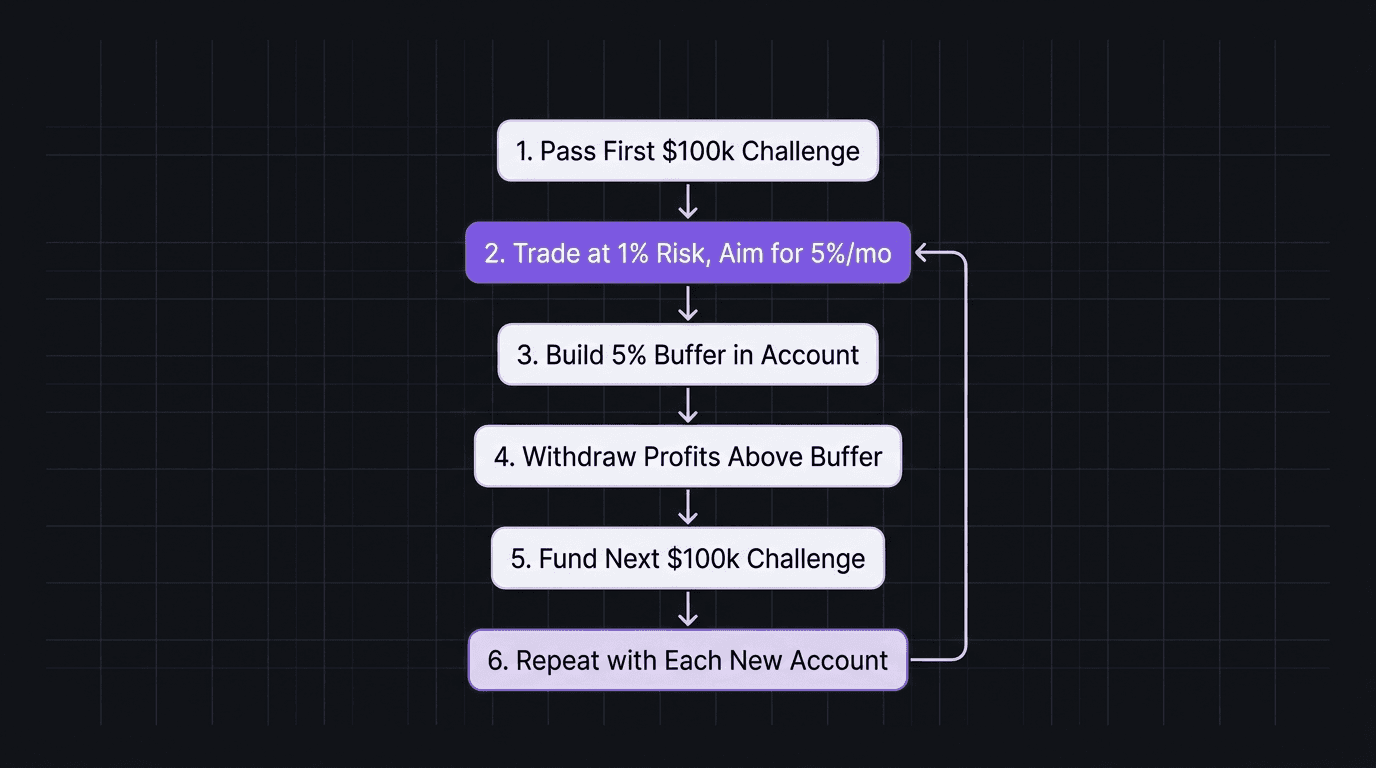
The reinvestment flywheel is what separates traders who stay at $5k per month from traders who reach $20k. It works like this:
Pass your first $100k challenge
Trade conservatively at 1% risk, aiming for 5% monthly
Take payouts after building a 5% buffer in the account
Use those payouts to fund your next challenge
Repeat
The buffer is important. When you earn 8% in a month, do not withdraw all of it. Pull 3% and leave 5% in the account as a cushion against losing streaks. If your account balance stays around $105k, you can absorb four or five consecutive losses at 1% risk without hitting dangerous drawdown territory.
This buffer protects you psychologically too. Trading a funded account with zero cushion feels different from trading one with a 5% buffer. Every trade feels heavier when you are at exactly $100k. Give yourself room to breathe.
Walkthrough: The Flywheel in Action
Month 1: You earn 5% on Account 1. Balance is $105k. You withdraw $3,000 and leave $2,000 as buffer. Account balance: $102k.
Month 2: Another 4% month on Account 1. Balance goes from $102k to approximately $106k. You withdraw $4,000. You now have $7,000 in total payouts saved.
Month 3: You earn 5% again. Balance is roughly $106k. You withdraw $5,000. Total payouts saved: $12,000. A $100k challenge costs between $500 and $600 at most prop firms. You purchase your second challenge.
Month 4: You pass the second challenge using the same strategy. Now you are running two $100k accounts. Income potential just doubled.
The flywheel accelerates because each new account generates its own payouts, which fund the next account even faster. By the time you have two accounts running, you are generating $10,000 per month. Even after keeping a buffer in both accounts, you have more than enough to fund a third challenge within one or two months.
The key discipline: do not skip the buffer. Traders who withdraw everything and start each month at exactly $100k are one bad week away from losing the account. Capital preservation is what keeps the flywheel spinning.
How EdgeFlo Tracks Multi-Account Performance
Managing four funded accounts is an operational challenge. You need to track performance, drawdown, and risk exposure across all of them without mixing data or losing visibility.
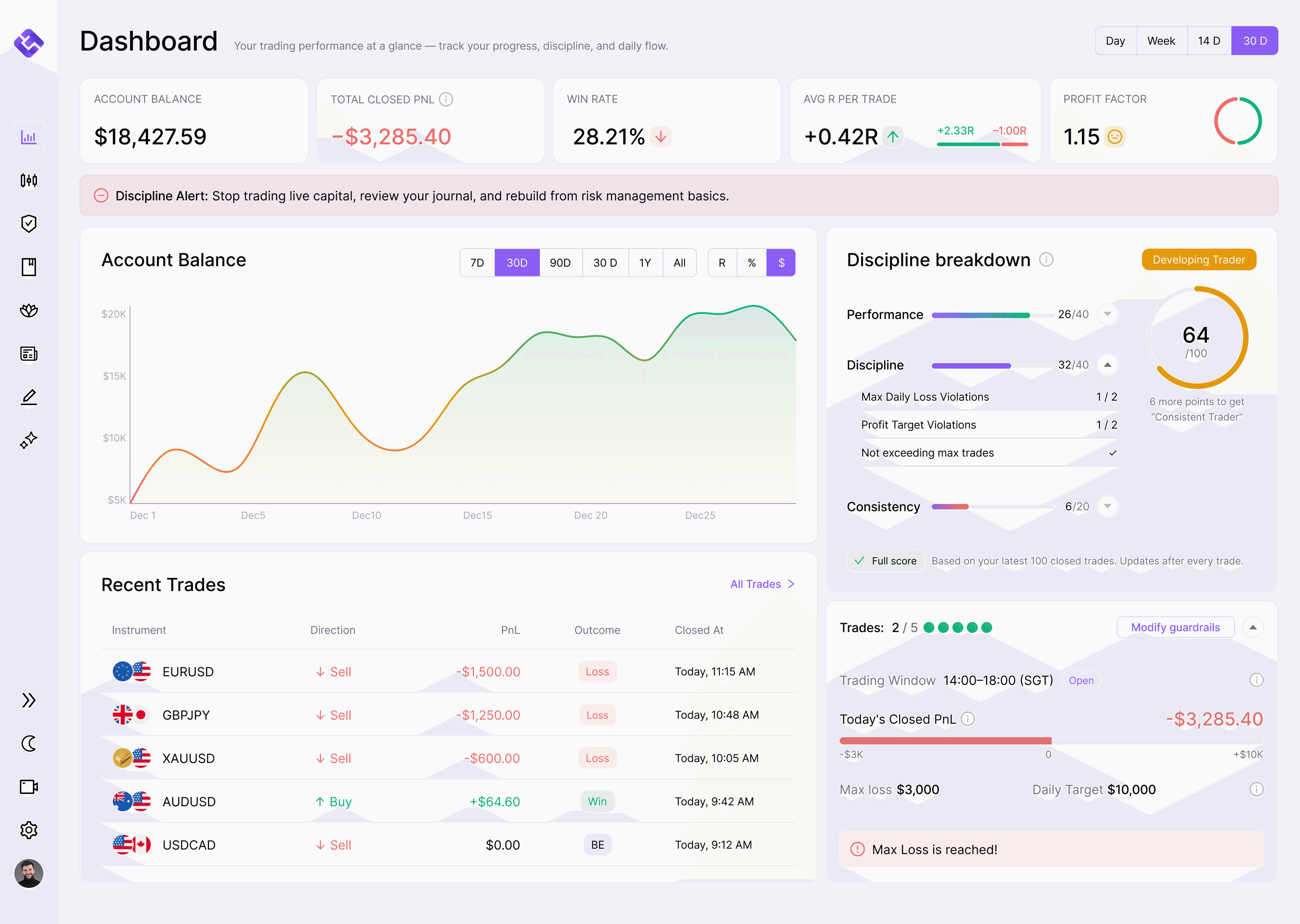
EdgeFlo's trading dashboard supports multiple account tracking. You can see your win rate, average R, and equity curve for each account individually or aggregated across all accounts. When one account is approaching a drawdown limit, the dashboard surfaces that before you take your next trade.
The scaling plan only works if you treat each account with the same discipline as your first. EdgeFlo keeps each account's journal, performance stats, and trade history separate so that a slump on Account 3 does not contaminate your decision-making on Account 4.
The Edge Brief
Receive Insights on trading psychology, discipline, and the behavioral patterns that create consistent traders from our Founder and the EdgeFlo team, delivered to your inbox.
Think different. Trade different.
How much can you earn from one $100k funded account?
Is 5% monthly return realistic for funded traders?
How do you scale funded account income without increasing risk?
When should you attempt a second funded challenge?

Turn discipline on.
Every session.
EdgeFlo is the environment serious traders operate inside.
Start 7-Day Free Trial
Cancel anytime.
No long-term commitment.

Think Different, Trade Different.