

Funded Account Drawdown: Open Positions Count
On a funded account, drawdown includes open positions, not just closed losses. Learn how floating P&L affects your daily loss limit and what to do about it.
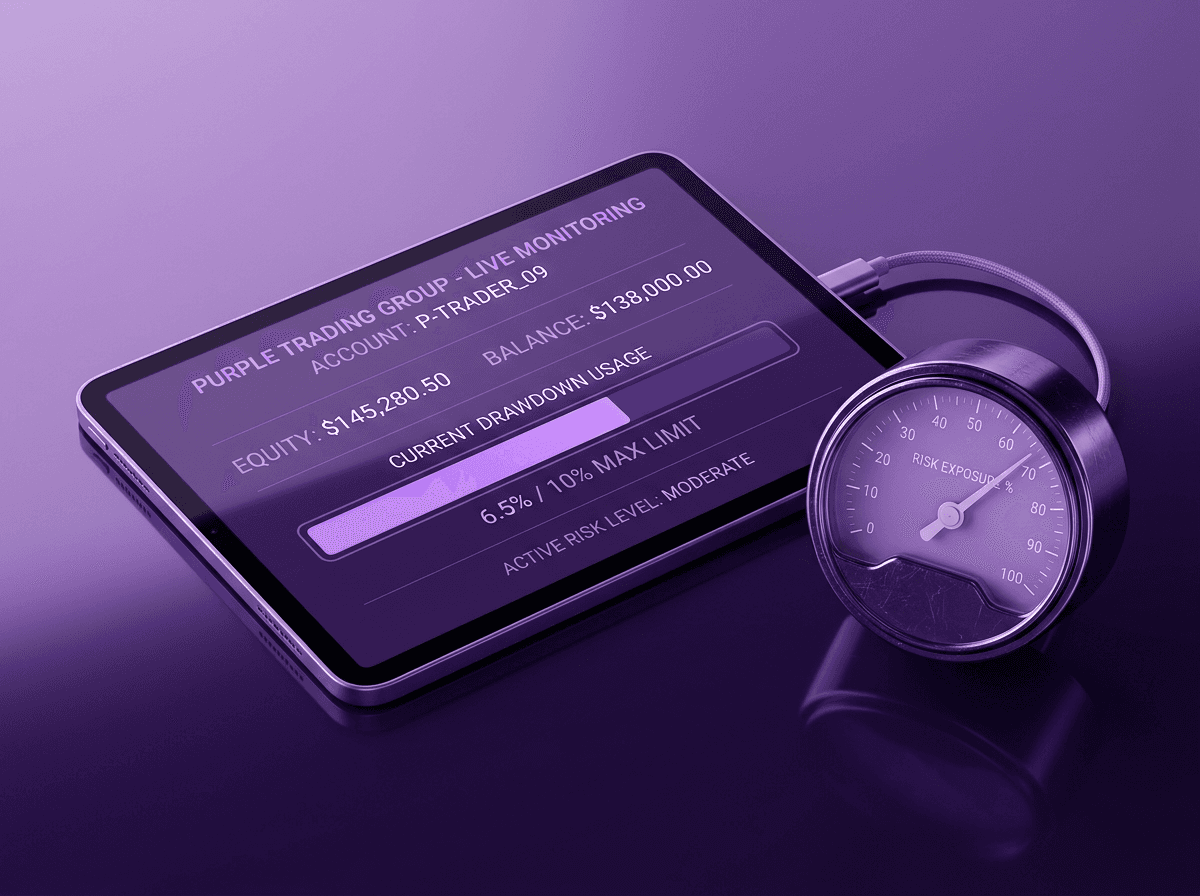
Most traders learn drawdown math on a personal account where the rules are simple: you lose money when you close a losing trade. Floating losses are uncomfortable, but they do not trigger anything.
Funded accounts work differently. Your drawdown includes open positions, not just closed ones. That distinction has ended more funded careers than bad strategies ever have.
If you are trading a prop firm account and you only track closed P&L, you are flying blind. The platform is watching your equity, which moves with every tick on every open position.
TL;DR
Funded account drawdown is calculated on equity, meaning open positions count toward your limit.
A floating loss can breach your daily limit or max drawdown even if you never close the trade.
Static drawdown is measured from your starting balance; trailing drawdown follows your high-water mark.
Always know your real-time equity, not just your closed P&L, before entering another trade.
Size positions with floating risk in mind, not just stop-loss distance.
Closed P&L vs Equity: The Gap That Kills Accounts
On a traditional personal account, your balance changes when you close a trade. Your equity changes in real time as open positions move. The difference between these two numbers is your floating P&L.
On a funded account, the platform's risk engine watches your equity, not your balance.
Here is what that means in practice. You start the day with a $100,000 balance. You take a trade on EUR/USD, risking 1%. The trade goes against you by 20 pips. You have not closed anything. Your balance still reads $100,000. But your equity is lower.
If your funded account has a 5% daily loss limit, that means your equity cannot drop below $95,000 at any point during the day. Not when trades close. At any point.
So if you have one open trade floating at minus $2,000 and another open trade floating at minus $2,500, your equity is $95,500. You are $500 away from breaching the daily limit. One more tick against you and the platform may close everything and flag your account.
You never chose to take a $4,500 loss. But the drawdown engine does not care about your intentions.
Static vs Trailing Drawdown: Know Which One You Have
Not all prop firms measure drawdown the same way. The two most common types are static and trailing, and confusing them can cost you your account.
Static drawdown is measured from your starting balance. If your account starts at $100,000 with a 10% max drawdown, your floor is $90,000. Period. It does not matter if you grow the account to $108,000 first. Your floor stays at $90,000.
Trailing drawdown follows your equity high-water mark. If your account grows to $108,000, your new floor becomes $98,000 (10% below the peak). That means your profits have tightened your allowed drawdown.
With trailing drawdown, a winning streak actually makes you more vulnerable to a breach if your equity drops back. You now have less room between your current equity and the floor.
Before you trade a single lot on a funded account, read the exact rules for your specific platform. Know whether the drawdown is static or trailing. Know whether it resets daily or tracks across the entire account lifetime. This is not fine print. This is survival information.
Walkthrough: How Floating P&L Triggers a Breach
A trader has a $100,000 funded account with a 5% daily loss limit (static, equity-based). Starting equity: $100,000. Daily floor: $95,000.
Trade 1: Buy GBP/USD. The trade goes against the trader by 25 pips. Position size: 1.0 lot. Floating loss: $250.
Trade 2: Buy AUD/USD. Goes against the trader by 40 pips. Position size: 2.0 lots. Floating loss: $800.
Trade 3 (closed): Sold EUR/USD earlier, hit stop loss. Closed loss: $1,500.
Running equity: $100,000 minus $250 minus $800 minus $1,500 = $97,450.
The trader thinks "I only lost $1,500 today, that is 1.5% of my account." But the platform sees equity at $97,450, which means $2,550 of total drawdown used. The trader has $2,450 of room left.
Now GBP/USD drops another 50 pips. Floating loss on Trade 1 goes from $250 to $750. AUD/USD drops another 30 pips. Floating loss on Trade 2 goes from $800 to $1,400.
New equity: $100,000 minus $750 minus $1,400 minus $1,500 = $96,350.
Still safe, but now $3,650 of the $5,000 daily limit is consumed. One more adverse move and the account could breach.
The key lesson: the trader's "closed P&L" only showed a $1,500 loss. But equity-based drawdown was tracking $3,650 of total exposure. That is nearly 73% of the daily limit consumed, and two positions are still open.
How to Monitor Real-Time Drawdown
Knowing the rule exists is not enough. You need a system for tracking it during your session.
Step 1: Know your floor before you trade. Write it down. If your daily loss limit is 5% and your starting equity is $100,000, your floor is $95,000. Put a sticky note on your monitor if you have to.
Step 2: Track equity, not balance. Your platform shows both numbers. Train yourself to look at equity. Balance is yesterday's news. Equity is right now.
Step 3: Calculate available risk before each new trade. Before adding a position, subtract your current floating losses from your daily budget.
If your floor is $95,000, your current equity is $97,000, and you want to risk 1% ($1,000 based on starting balance), ask yourself: if this new trade goes to full stop loss, does my equity stay above $95,000?
$97,000 minus $1,000 = $96,000. Yes, still above $95,000. The trade fits.
But if your equity were already $96,200, that same $1,000 risk would put you at $95,200, only $200 above the floor. One spike of slippage or spread widening could breach you. In that case, either reduce position size or sit out.
Step 4: Set alerts. Some platforms allow you to set equity alerts. Use them. Set one at 50% of your daily limit consumed and another at 75%. Those are your warning levels.
Size for Floating Risk, Not Just Stop Distance
Most position sizing calculators take your risk percentage, your stop loss distance, and your account size to output a lot size. That works perfectly for closed-trade math.
But on a funded account, you need to think about what happens between entry and your stop. Your position can float against you by more than your stop distance if price spikes before settling. Spread widening during news, slippage during volatile sessions, and gap moves can all push your floating loss beyond what you planned.
The practical solution: size slightly smaller than the calculator suggests. If the math says 1.0 lot, consider 0.8 lots. That extra cushion gives you room for floating risk without consuming your daily budget faster than expected.
This is especially important if you hold multiple positions simultaneously. Each open trade adds floating risk. Two trades each floating at minus 15 pips might seem harmless individually, but together they are eating your drawdown budget in real time.
How EdgeFlo Helps You Track Drawdown
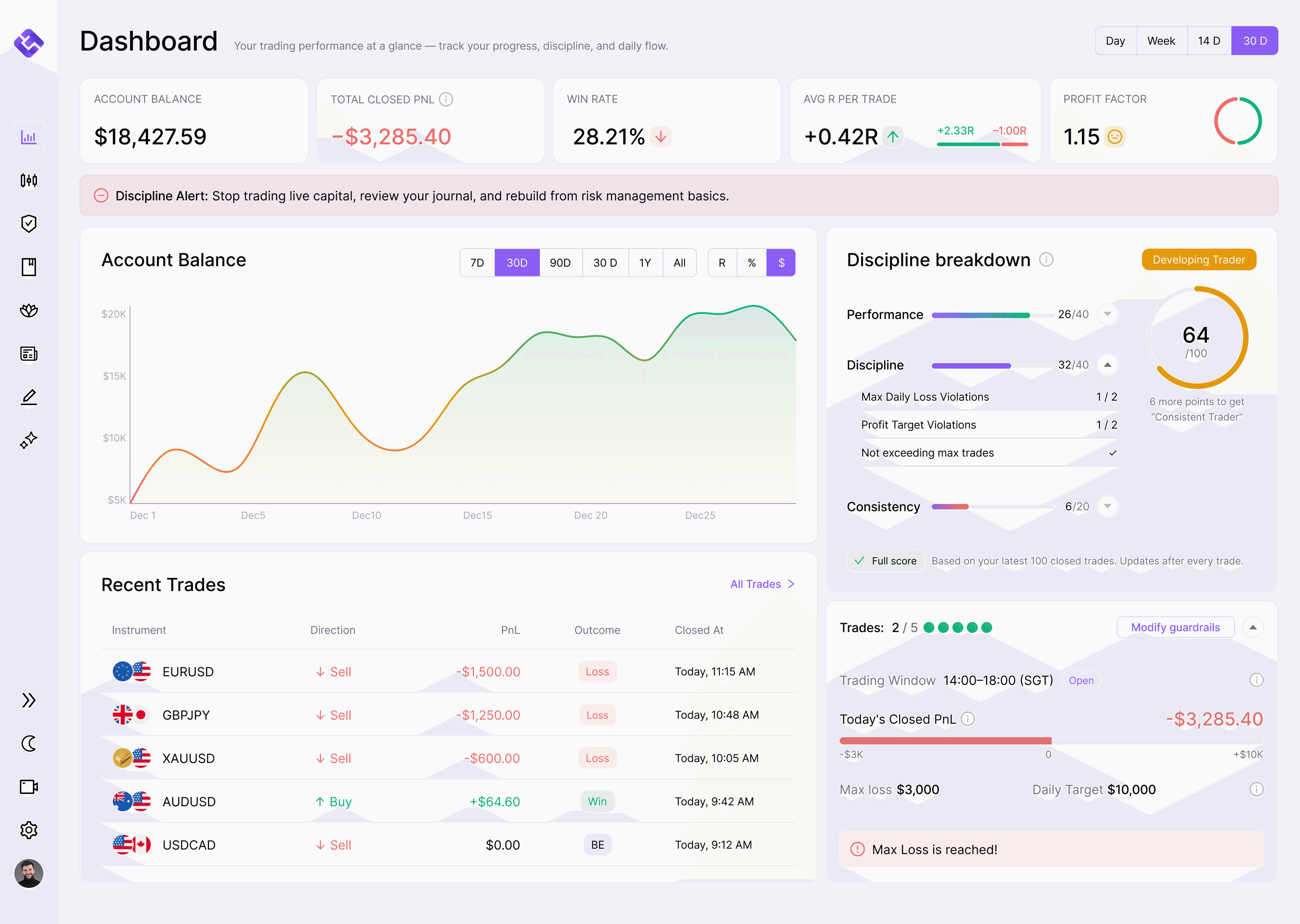
EdgeFlo's dashboard shows your open and closed P&L side by side, so you always see the full picture of your drawdown exposure. You do not need to toggle between screens or do mental math to figure out how much room you have left.
The guardrails feature lets you set a daily loss cap that factors in your funded account rules. When you approach the limit, EdgeFlo restricts new trades (with the option to override). That intervention point comes before the platform's hard cutoff, giving you a buffer zone instead of a sudden stop.
And after each session, your journal captures not just the closed result but the maximum floating drawdown you experienced during the day. Over time, that data shows whether your intraday exposure is tighter or wider than your final P&L suggests.
The Edge Brief
Receive Insights on trading psychology, discipline, and the behavioral patterns that create consistent traders from our Founder and the EdgeFlo team, delivered to your inbox.
Think different. Trade different.
Does drawdown on a funded account include open trades?
What is the difference between static and trailing drawdown?
Can I lose my funded account from an open position I never closed?
How do I monitor drawdown during the trading day?

Turn discipline on.
Every session.
EdgeFlo is the environment serious traders operate inside.
Start 7-Day Free Trial
Cancel anytime.
No long-term commitment.

Think Different, Trade Different.