

Full Time Trading: The Reality Nobody Shows You
Full time trading looks glamorous on social media. The truth: isolation, pressure, and life imbalance. Here is what nobody warns you about.
Full time trading promises freedom, flexible hours, and unlimited income. The reality is different. You get isolation, pressure that never switches off, and a life that slowly collapses into one activity. If you are considering making the jump (or you already have and something feels wrong), this article covers what social media leaves out.
TL;DR
Full time trading removes structure, social contact, and income stability all at once.
Your worst enemy is not the market. It is the identity shift that ties your self-worth to daily P&L.
Screen time expands without external limits, and more hours behind the charts means worse decisions, not better ones.
The traders who last treat it like a business with hard boundaries, not a lifestyle of unlimited freedom.
Building systems for session limits, income buffers, and life outside trading is what separates a career from a burnout spiral.
The Fantasy vs. the First 90 Days
Most traders picture full time trading as waking up late, checking the charts in a nice home office, taking two or three trades, and then spending the afternoon doing whatever they want. That version exists for about a week.
What actually happens in the first 90 days: you sit at the screen longer because there is no boss, no schedule, and no reason to stop. Every session feels important because your rent depends on it. The freedom you wanted turns into the absence of any structure, and your brain starts filling that vacuum with anxiety.
Sound familiar? You are not alone. The transition from part-time to full time trading removes three things simultaneously: predictable income, social interaction, and externally imposed routine. Losing all three at once is disorienting even if you are already profitable.
Walkthrough: The Overexposure Trap
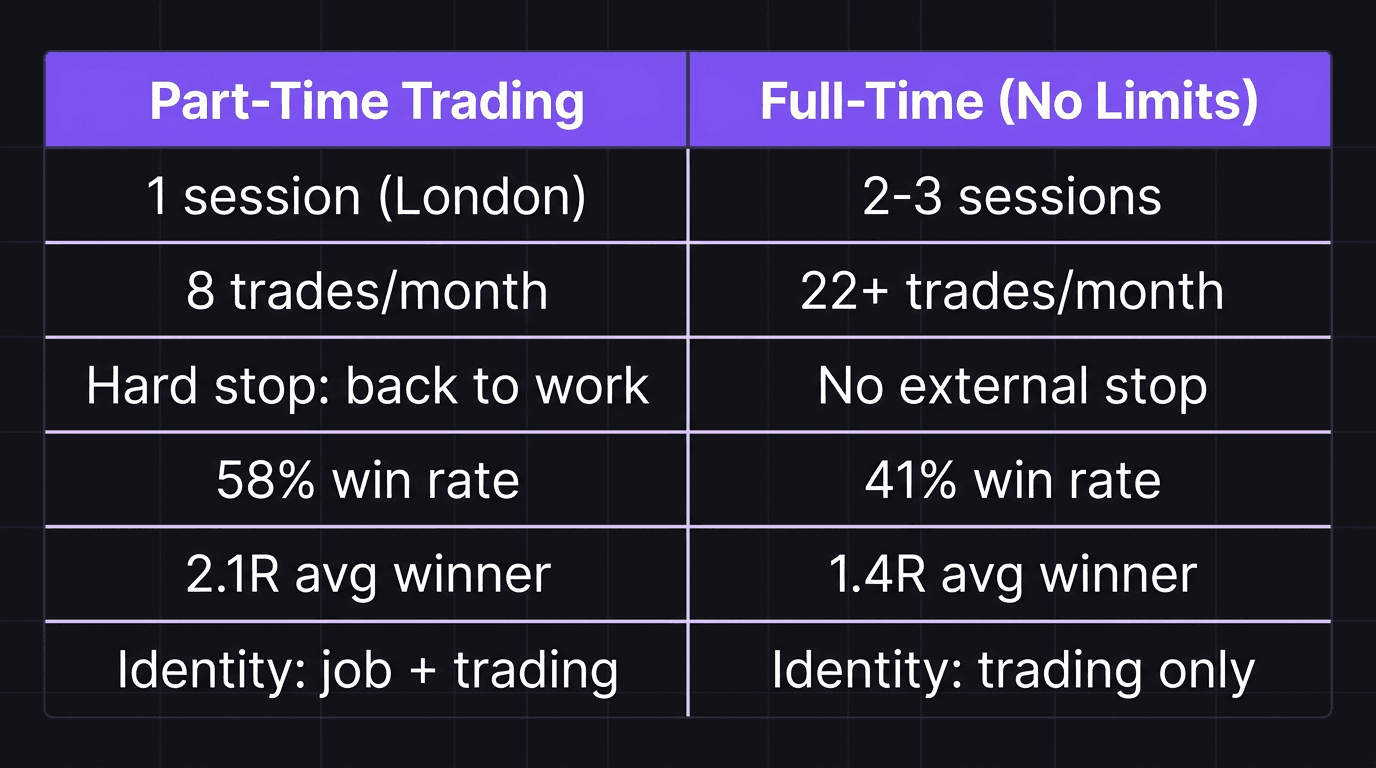
Imagine you have been consistently profitable trading the London session for 14 months while working a day job. Your average month is $4,200 on a $50,000 funded account risking 1% per trade. You quit your job.
Week one feels great. Week three, you start watching the New York session "just to see." By month two, you are trading London, New York, and sometimes Asian session because you are awake and the chart is right there.
Your trade count goes from 8 per month to 22. Your win rate drops from 58% to 41%. Your average R drops because you are taking B and C setups you would have ignored when you had a job to get back to.
The math shifts fast. At 8 trades per month with 58% win rate and 2.1R average winners, your expectancy was strong. At 22 trades per month with 41% win rate and 1.4R average winners, you are grinding for breakeven and working three times harder.
The job was not holding you back. It was holding you together.
The Identity Problem
Here is the part nobody talks about on trading Twitter. When trading is your full time income, it becomes your full time identity. Your mood at dinner depends on your afternoon session. Your confidence at a social event depends on whether the week was green. You start measuring your value as a person by your P&L.
This is not a mindset issue you can fix with affirmations. It is a structural problem. When one activity provides your income, your schedule, your intellectual stimulation, and your sense of achievement, losing in that activity does not feel like a normal business cost. It feels like a personal failure.
Professional traders who last decades separate who they are from what they do. They have interests, relationships, and goals outside trading. That separation acts as a psychological buffer. When you blow it away, a three-loss day can feel like a three-loss life.
Isolation Is Not Freedom
Working from home alone sounds peaceful until month four. There are no colleagues to bounce ideas off. There is no team lunch. There is no natural reason to leave the house before 3 PM.
The traders who survive this do not just accept isolation. They engineer around it. They join structured communities (not Discord pump groups). They schedule calls with other serious traders. They keep a physical routine that forces them out of the house at the same time every day regardless of P&L.
If your trading life consists of screen, journal, sleep, repeat, you are building a burnout machine. The excitement of early wins masks the damage for a while. But isolation compounds. By month six, many full time traders report lower motivation, increased revenge trading, and a vague sense that something is wrong even when the numbers are fine.
The Income Volatility Nobody Budgets For
A salaried job pays the same amount every two weeks. Trading does not. You might make $8,000 in March and lose $2,000 in April. If your living expenses are $4,500 per month, that April loss is not just a bad month. It is a financial emergency.
Most traders who go full time underbudget. They calculate their average monthly income from trading, subtract expenses, and assume the surplus is enough. They forget that averages include the best months and the worst months, and the worst months are when your psychology needs the least financial pressure.
Walkthrough: The Financial Pressure Loop
A trader has $60,000 in a funded account and monthly expenses of $3,800. At 1% risk per trade, each standard position risks $600. He needs roughly 6 to 7 winning trades at 1.5R average to cover expenses after fees.
Month one: 9 wins, 5 losses. Net +$3,300. Tight, but it works.
Month two: 4 wins, 7 losses. Net: negative $2,100. Expenses still due.
Now the math: month two P&L is negative $2,100 and expenses are $3,800, so he needs $5,900 from savings or next month's trading just to stay level. That pressure leaks into month three. He starts forcing setups to make up the deficit. Trade count rises. Quality drops.
This loop destroys more full time traders than bad strategy ever will. The fix is boring: keep 12 months of expenses in a separate savings account that trading cannot touch. Your burnout guardrails matter more when rent depends on your account.
Screen Time Expands to Fill the Day
When you trade part time, your session has a hard stop. The job forces you to close the charts. Full time trading removes that constraint, and most traders do not replace it with a self-imposed one.
The result: you watch charts for 6, 8, sometimes 10 hours. Decision quality degrades after the first 2 to 3 hours. You start seeing setups that are not there. You enter trades you would never take if you had walked away after your one focused session.
Research on decision fatigue is clear. The quality of choices declines as the number of decisions increases. Trading is pure decision-making. Every candle is a micro-decision: do I enter, do I adjust, do I exit? Stretching that across an entire day is like taking an exam that never ends.
The most durable full time traders impose session limits on themselves, and that funded trader discipline is what keeps them in the game. They trade London or New York, not both. They set a hard close time and walk away regardless of what the chart is doing. They treat those limits as non-negotiable, because without external structure, self-imposed structure is the only thing standing between focused trading and aimless screen watching.
What the Survivors Do Differently
Traders who make full time work for 3, 5, 10 years share a few patterns that have nothing to do with strategy:
They keep non-trading structure. A morning routine that is not about the markets. Exercise at a fixed time. A hobby that has nothing to do with screens. These are not nice-to-haves. They are the scaffolding that prevents your entire life from collapsing into one room and one activity.
They separate income accounts. Trading profits go into a business account. A fixed amount transfers to a personal account monthly, like a salary. The rest stays in the trading account or gets invested elsewhere. This removes the emotional link between today's P&L and tonight's grocery budget.
They track mental state, not just trades. The best traders journal energy level, sleep quality, and focus rating alongside their trade data. After 60 days, the pattern is obvious: bad sleep equals bad execution. Forced sessions equal forced trades. The data gives them permission to skip a day when they are not sharp.
They take days off without guilt. Part-time traders already have built-in days off. Full-time traders must create them. The market will be there tomorrow. Your edge does not expire because you skipped a Tuesday.
How EdgeFlo Supports Full Time Traders
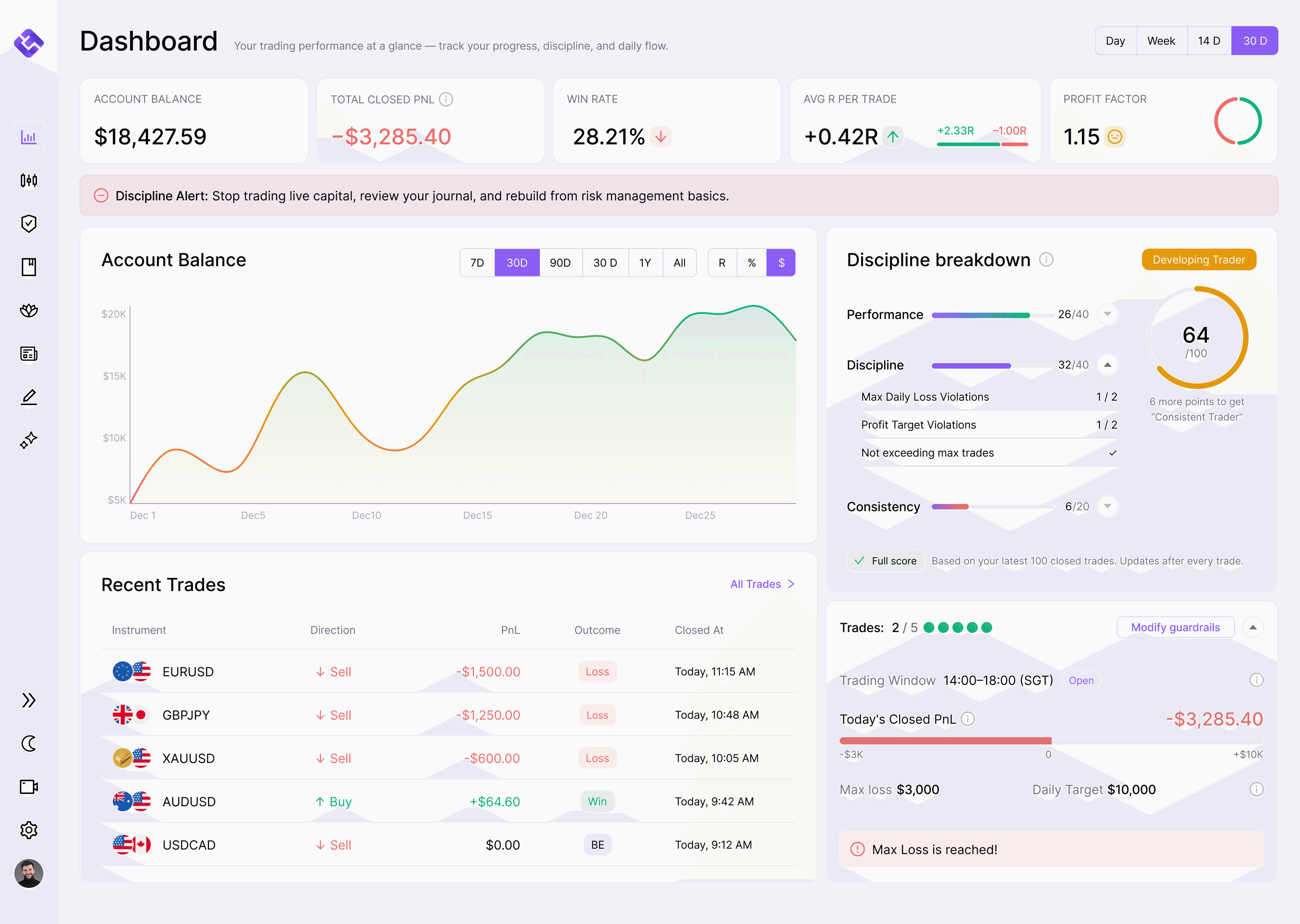
EdgeFlo is built for exactly this transition. The guardrails system lets you set daily loss limits and max trade counts that enforce your own rules, with override available when you genuinely need it. When you are alone at the desk with no boss checking on you, having a system that makes rule-breaking a conscious choice instead of an unconscious drift is the difference between a sustainable career and a six-month burnout.
The journal auto-imports your trades and tracks emotion tags alongside entries and exits. Over time, you build a dataset that shows your actual performance curve against your mental state, not just your P&L against the market.
Sanctuary provides guided reset routines for the days when a loss feels personal. When your identity is wrapped up in your trading, a structured reset between sessions can be the thing that stops one bad trade from becoming a revenge spiral.
The Edge Brief
Receive Insights on trading psychology, discipline, and the behavioral patterns that create consistent traders from our Founder and the EdgeFlo team, delivered to your inbox.
Think different. Trade different.
Can you realistically make a living from full time trading?
What is the biggest downside of trading full time?
How much money do you need to trade full time?
How do full time traders avoid burnout?

Turn discipline on.
Every session.
EdgeFlo is the environment serious traders operate inside.
Start 7-Day Free Trial
Cancel anytime.
No long-term commitment.

Think Different, Trade Different.