

FTMO Rules: Profit Targets, Loss Limits, and What Gets You Kicked
FTMO challenge rules explained: 10% and 5% profit targets, 5% daily loss limit, 10% overall loss limit, minimum trading days, and how the refundable fee works.
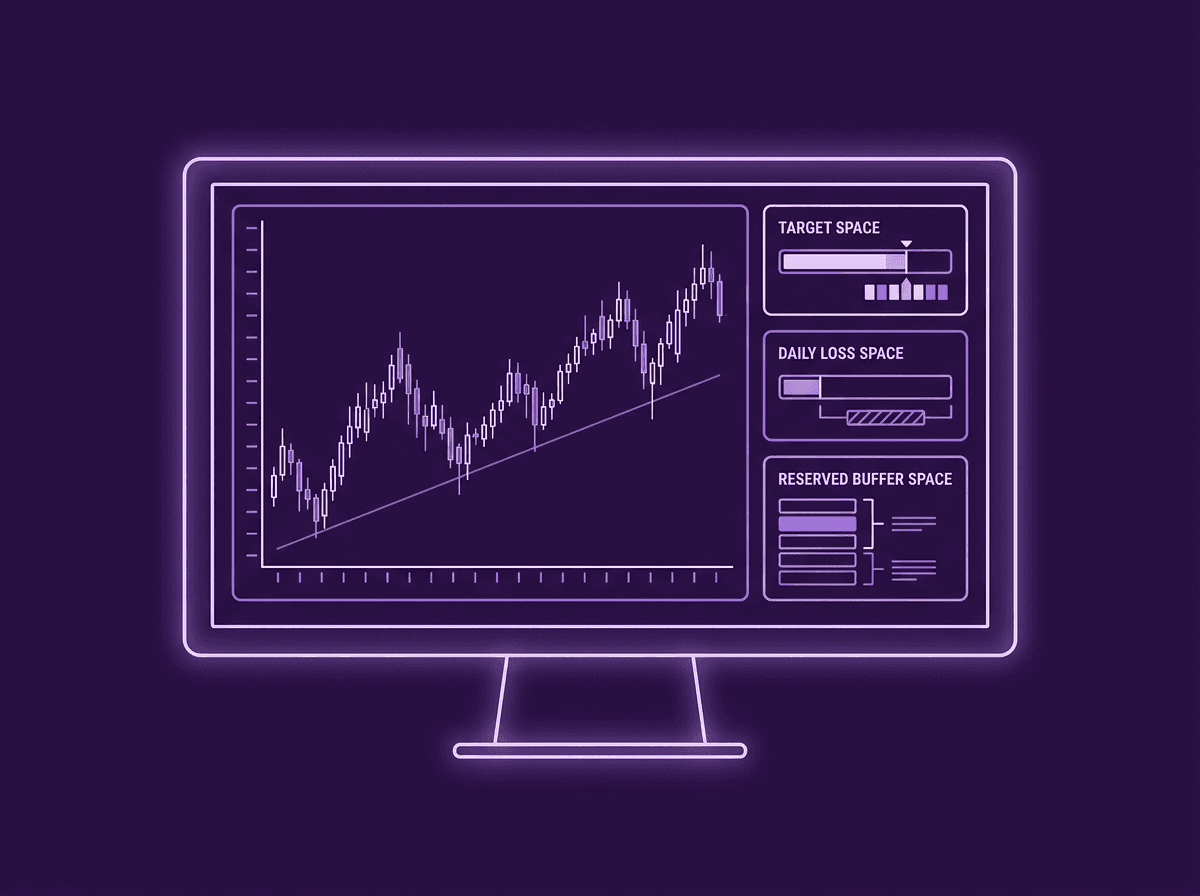
FTMO runs a two-phase challenge. Phase 1 (the FTMO Challenge) requires a 10% profit target. Phase 2 (Verification) requires 5%. Both phases enforce a 5% maximum daily loss and a 10% maximum overall loss. You need a minimum of 4 trading days per phase, and there is no time limit on either one. The registration fee is refundable after you pass both phases and receive your funded account.
FTMO has been operating for over 10 years, making it one of the longest-running prop firms in the industry. The rules are straightforward, but the details matter. A single miscalculation on how daily loss is measured can end your challenge overnight.
TL;DR
Phase 1 profit target: 10%. Phase 2: 5%. Same loss rules on both.
Maximum daily loss: 5%, calculated across closed trades, open positions, commissions, and swaps.
Maximum overall loss: 10%. Your equity can never drop below 90% of the starting balance.
Minimum 4 trading days per phase. No maximum time limit.
Fees range from $89 (10k account) to ~$1,080 (200k account) and are fully refundable after passing.
FTMO Challenge Structure (Two Phases)
The FTMO evaluation has two stages. You must pass both before you trade real capital.
Phase 1: FTMO Challenge. This is the main test. You receive a demo account at your chosen size and need to hit the profit target while respecting loss limits. Think of it as proving you can be profitable under pressure.
Phase 2: Verification. Same rules, lower profit target. This phase confirms that Phase 1 was not a fluke. FTMO wants to see that you can repeat the process consistently.
After passing both phases, you receive access to a funded account with the same balance. Your registration fee is refunded with your first profit payout. The profit split starts at 80/20 in your favor (some scaling plans adjust this higher over time).
The key thing to understand: both phases share the same loss rules. The only difference is the profit target. Do not change your strategy between phases.
Profit Target: 10% Then 5%
Phase 1 requires 10% growth. Phase 2 requires 5%.
On the most popular account sizes:
Account Size | Phase 1 Target (10%) | Phase 2 Target (5%) |
|---|---|---|
$10,000 | $1,000 | $500 |
$25,000 | $2,500 | $1,250 |
$50,000 | $5,000 | $2,500 |
$100,000 | $10,000 | $5,000 |
$200,000 | $20,000 | $10,000 |
These targets are measured by equity, not just closed P&L. Open floating profit counts toward the target. If your equity touches the target level, even briefly, the phase is passed.
How realistic is 10% with proper risk management? At 1% risk per trade with a 3:1 reward ratio, you need roughly 4 winning trades (net of losses) to hit the target on a $100k account. With a 50% win rate and 8 trades, that is about right. It does not require aggressive sizing or a miracle run.
The trap is impatience. Traders who try to hit 10% in a few days inevitably oversize. One bad day at 3% risk per trade and the challenge is over. Slow is fast here.
Maximum Daily Loss (5% Rule)
This is the rule that ends the most challenges. Not the profit target. Not the overall loss. The daily loss limit.
How it works: On any single calendar day, your total losses cannot exceed 5% of your initial account balance. On a $100k account, that is $5,000.
What counts toward the 5%:
Closed losing trades
Open floating losses (unrealized P&L)
Commissions and swap fees
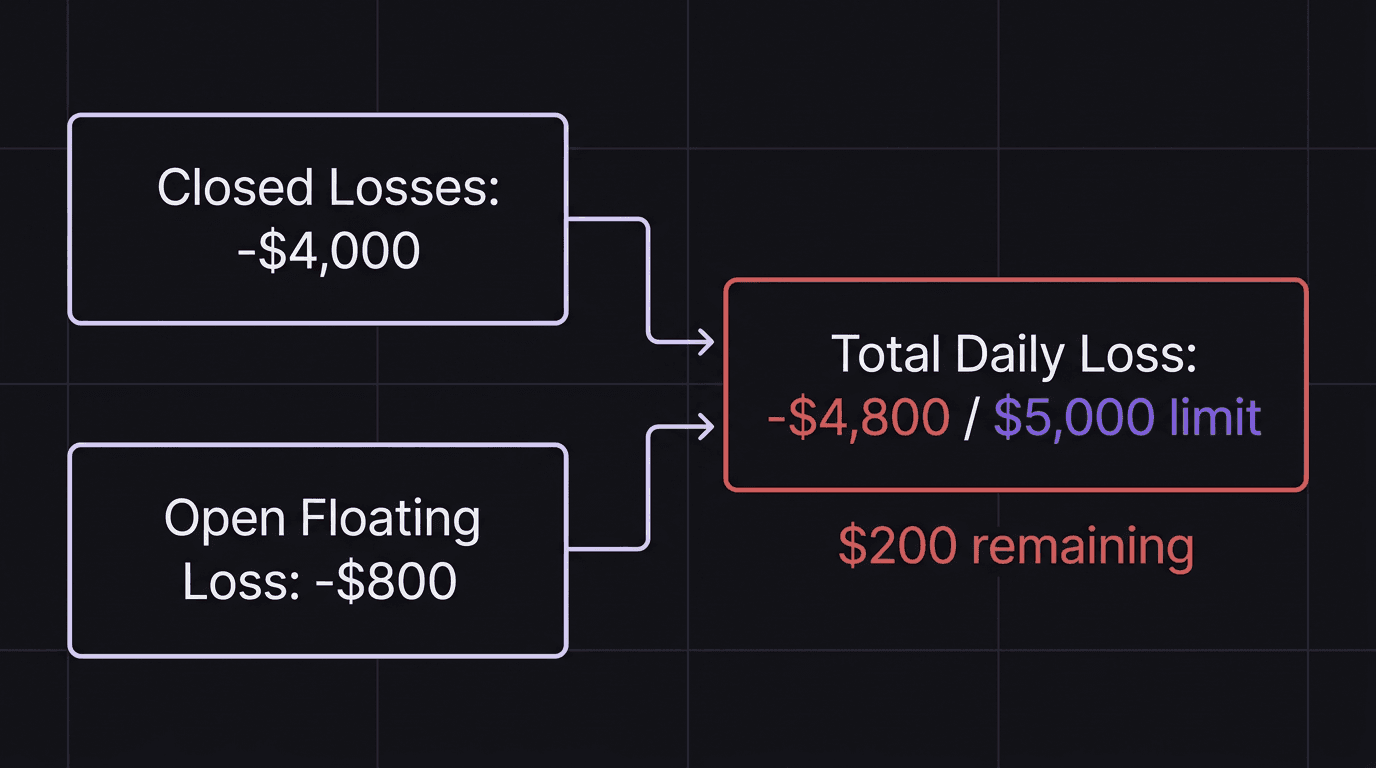
All combined. This is the part most traders get wrong. They think "I only lost $3,000 in closed trades, I am fine." But their open position is floating at negative $2,500. Total: $5,500. Challenge failed.
Walkthrough: How the Daily Loss Catches You
> You are trading a $100,000 FTMO challenge. On Tuesday, you close two losing trades on EUR/USD for a combined loss of $4,000. You still have one open position on GBP/USD that is currently floating at negative $800. > > Your total daily exposure: $4,000 (closed) + $800 (open) = $4,800. You are $200 away from the $5,000 daily limit. > > If GBP/USD drops another 4 pips against you (assuming standard lot sizing), you breach the 5% daily loss. The challenge ends. Not because you took a bad trade, but because you did not track your cumulative daily exposure. > > The fix? After losing $4,000 in closed trades, close the GBP/USD position immediately and stop trading for the day. Period.
There is one nuance that works in your favor. If you profit $5,000 in closed trades on the same day, your effective daily buffer grows. The calculation looks at net daily P&L from the starting point. So a $5,000 profit day means you could technically absorb $10,000 in subsequent losses that same day before breaching the limit.
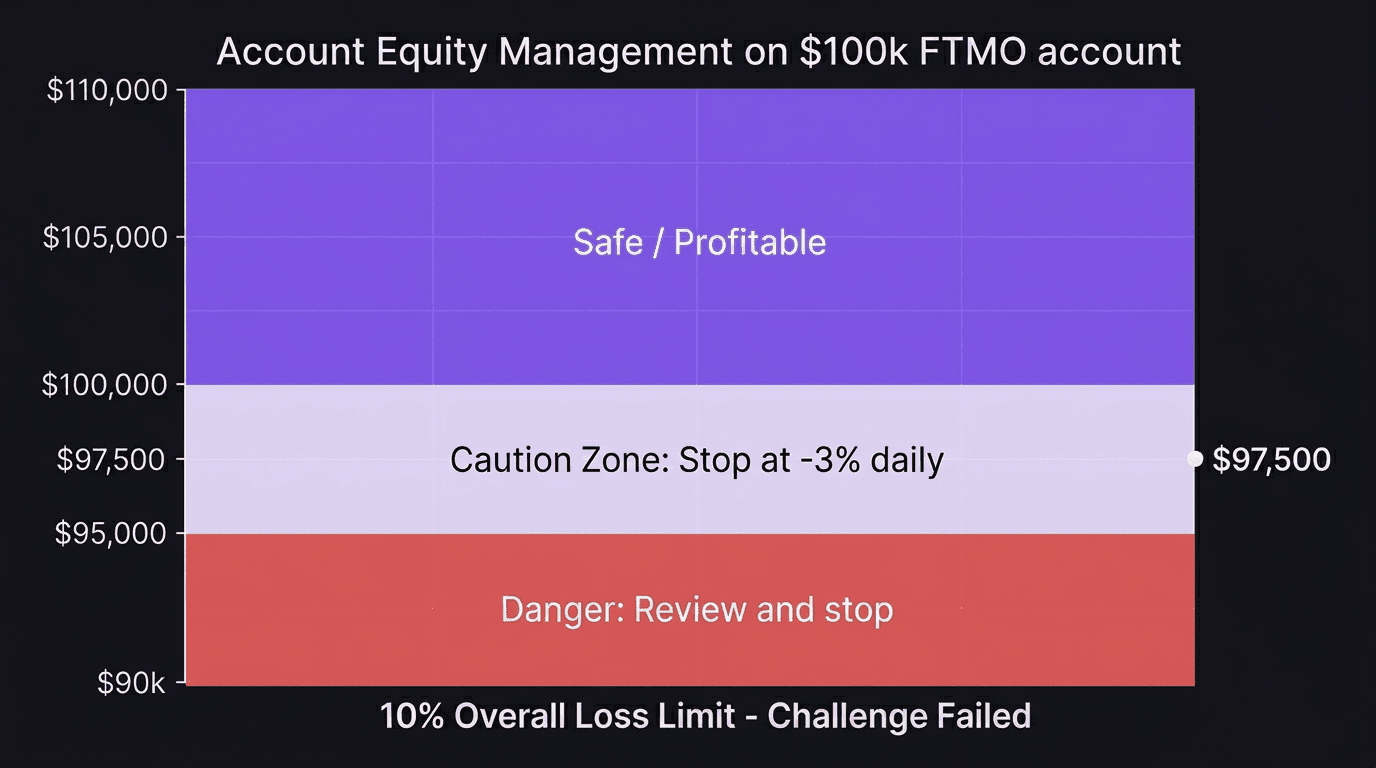
Still, banking on this is risky. The safe rule: if your closed losses exceed 3% for the day, stop. Leave a buffer. The remaining 2% is your emergency margin, not your trading budget.
The daily loss resets at midnight Central European Time (CET). If you trade from the US or Asia, know exactly when midnight CET falls in your timezone. A swing trade held overnight carries its unrealized loss into the next day's calculation.
Maximum Overall Loss (10% Rule)
Your equity cannot drop below 90% of your starting balance at any point during the challenge. On a $100k account, $90,000 is the hard floor.
Unlike the daily loss, this one does not reset. It accumulates across the entire challenge.
The good news: this limit is harder to hit than the daily loss if you are managing risk properly. At 1% risk per trade, you would need 10 consecutive losers to breach it. That is statistically unlikely with any reasonable strategy.
The bad news: traders who breach the daily loss on day one often revenge trade on day two and hit the overall loss by day three. The two limits feed each other when discipline breaks down.
Sound familiar? If you have ever blown an account in a three-day spiral, you know exactly how this works. The antidote is a hard personal rule: if you lose 3% in a day, you are done for that day. No exceptions. Your trading journal should log the stop as a discipline win, not a missed opportunity.
Minimum Trading Days and Time Limits
You need at least 4 trading days in each phase. A trading day counts as any day where you open at least one position.
There is no maximum time limit on either phase. You could take three months if you wanted. This is a deliberate design choice. FTMO wants to see traders who wait for good setups rather than forcing trades to hit a deadline.
What this means practically:
You do not need to trade every day. If Tuesday has no setups, skip Tuesday.
You cannot pass in less than 4 days, even if you hit the profit target in one trade. You still need to trade on 3 more days.
Weekend positions count for the day they were opened, not the day they close.
The minimum trading day rule exists to prevent lucky one-trade passes. FTMO wants proof that you can show up consistently, not that you got lucky on a news spike.
For the position sizing math: if you need 4 trading days minimum and your risk is 1% per trade, you have plenty of room to take 1-2 trades per day without ever threatening the loss limits. There is no urgency to stack trades.
The Fee Structure and Refund Policy
FTMO charges a registration fee based on account size. The fee is fully refundable.
Account Size | Registration Fee |
|---|---|
$10,000 | $89 |
$25,000 | $250 |
$50,000 | $345 |
$100,000 | $540 |
$200,000 | ~$1,080 |
When do you get the refund? After passing both Phase 1 and Phase 2, you receive your funded account. The registration fee is returned with your first profit split payout.
What if you fail? You lose the registration fee for that attempt. You can purchase a new challenge immediately. Some promotional periods offer retry discounts, but this is not guaranteed.
Is the fee worth it? Consider the alternative. To trade a $100,000 account on your own, you would need $100,000 in capital. The FTMO fee is $540. Even if you fail twice ($1,080 total), that is still a fraction of the capital you would need otherwise.
The math gets more obvious at higher levels. A $200,000 funded account for roughly $1,080 in entry cost is a deal that did not exist ten years ago. The risk-to-opportunity ratio favors the trader, as long as you have the skills to pass.
And that brings everything back to discipline. The rules are not complicated. Hit 10%, then 5%. Do not lose more than 5% in a day. Do not lose more than 10% total. Trade at least 4 days. Every one of those rules is a discipline test, not a skill test.
How EdgeFlo Maps to FTMO Rules
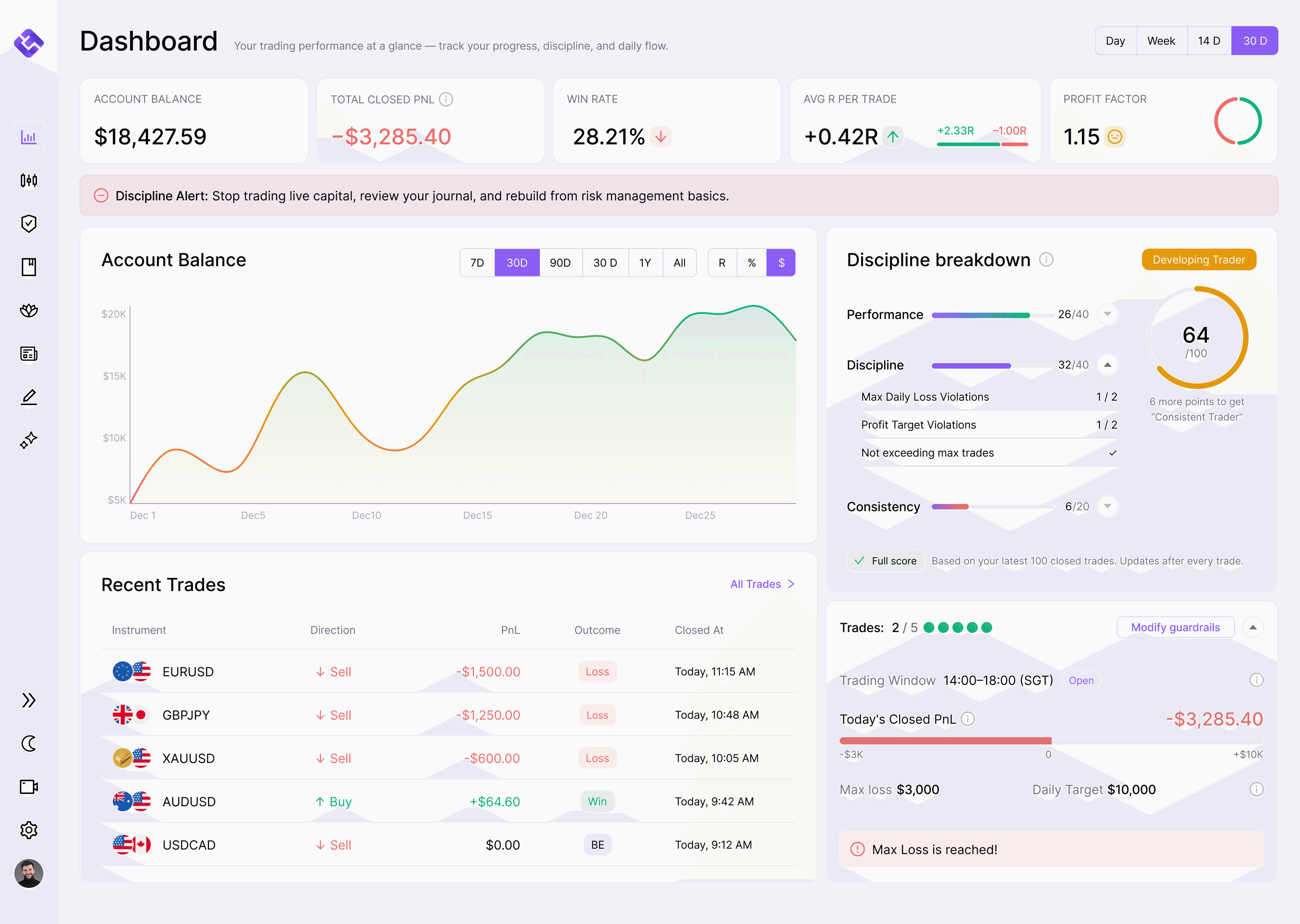
EdgeFlo's guardrails enforce max loss per day and risk per trade limits, with an override available when you need it. These map directly to FTMO's 5% daily loss and 10% overall drawdown rules. Set your personal limits slightly below the hard caps (for example, 4% daily loss instead of 5%) and EdgeFlo flags you before you cross the line.
The lot size calculator auto-calculates position size based on your account balance, risk percentage, and stop loss distance. Combined with the auto-journal that logs every trade, you build the review habit that catches rule violations early, not after the account is terminated.
The Edge Brief
Receive Insights on trading psychology, discipline, and the behavioral patterns that create consistent traders from our Founder and the EdgeFlo team, delivered to your inbox.
Think different. Trade different.
What is the maximum daily loss on FTMO?
What happens if I break an FTMO rule?
Is the FTMO fee refundable?
How many trading days do I need to pass FTMO?

Turn discipline on.
Every session.
EdgeFlo is the environment serious traders operate inside.
Start 7-Day Free Trial
Cancel anytime.
No long-term commitment.

Think Different, Trade Different.