

Fractal Market Shift: What It Actually Confirms
A fractal market shift confirms an internal pullback started. It does not confirm a reversal. Learn what fractal shifts mean and how to use them correctly.

A fractal market shift confirms one thing: an internal pullback has started. That is it. Not a reversal. Not a trend change. Not a reason to flip your bias. A fractal shift is the smallest structural signal you can read, tracked candle by candle, and it fires constantly. In a healthy uptrend, you will see multiple fractal shifts as price pulls back before continuing higher. Treating every fractal shift as a reversal is one of the fastest ways to destroy an account. The shift matters, but only as a first alert in a larger confirmation chain.
TL;DR
A fractal market shift is a break of the previous fractal high or low, requiring only a wick (not a body close).
It confirms an internal pullback has started. Nothing more.
Fractal shifts happen frequently, even in strong trending markets.
Never trade a fractal shift alone. Wait for internal and swing confirmation.
Use fractal shifts as an awareness trigger in your pre-trade checklist.
What Is a Fractal Market Shift
Fractal structure is the most granular level of market structure. It tracks the highs and lows that form candle by candle, capturing every minor push and pullback.
A fractal high is a candle (or group of candles) that forms a local peak. A fractal low is a candle that forms a local trough. These are not the big swing points that define the trend. They are the tiny peaks and valleys that happen inside every move.
A fractal market shift occurs when price breaks a previous fractal level. And here is the key difference from internal and swing structure: fractal breaks only require a wick. The candle does not need to close its body past the level. If the wick touches or pierces the fractal level, the break is valid.
This is what makes fractal shifts the most aggressive and most frequent structural signal. Internal and swing breaks require body closes, which filters out noise. Fractal breaks do not have that filter. A liquidity sweep that wicks past a fractal low counts as a fractal break, even if price immediately reverses.
Because the bar is so low for a fractal break, these shifts happen all the time. In a trending market, you might see 5 to 10 fractal shifts per day on a 15M chart. Most of them lead to nothing. The trend just resumes after a brief dip. That frequency is exactly why you cannot trade them in isolation.
What It Confirms (And What It Doesn't)
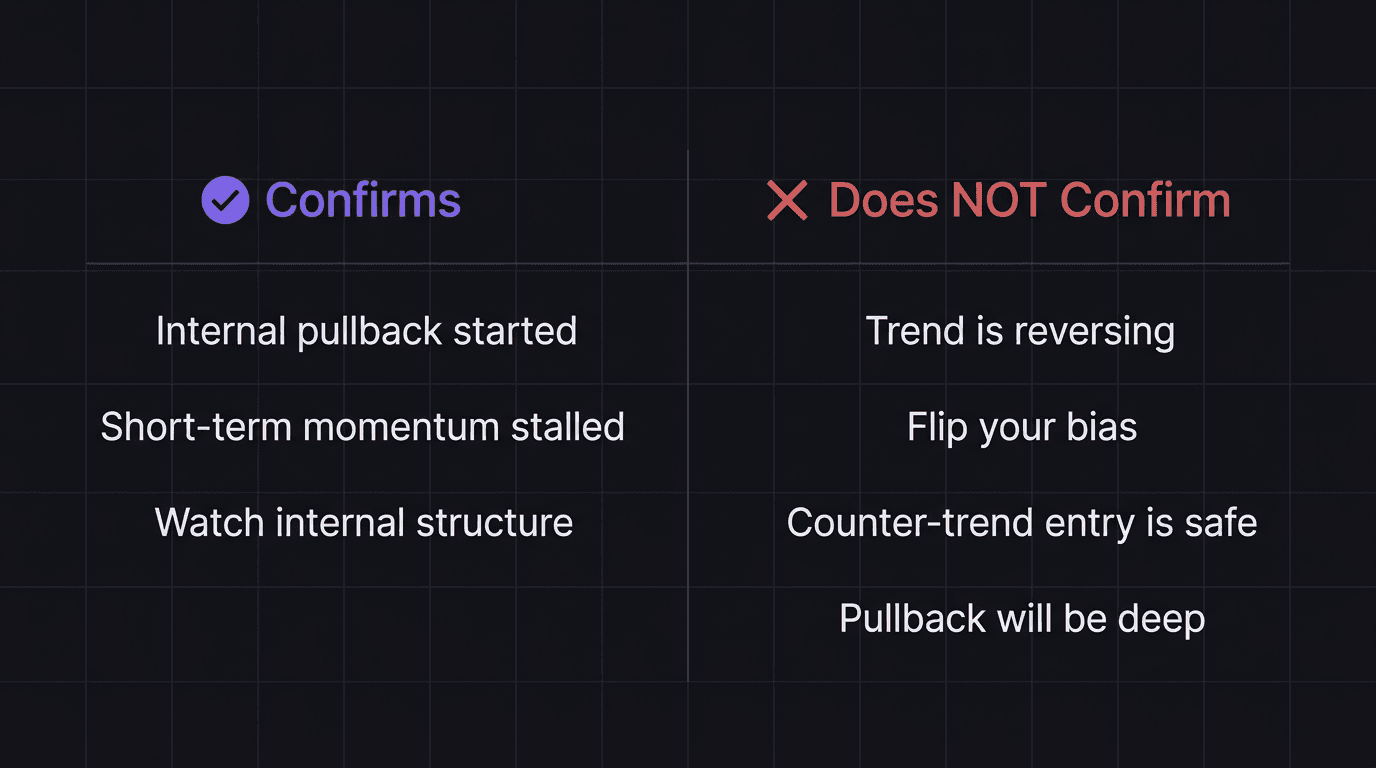
Here is the only thing a fractal market shift confirms: the very short-term momentum has changed, and an internal pullback has likely started.
That is useful information. But it is not actionable on its own.
What It Confirms
When you see a fractal shift against the trend, it tells you:
The current push has stalled at the fractal level.
Short-term buyers (in an uptrend) or sellers (in a downtrend) have temporarily lost control.
You should start watching internal structure for a potential shift.
Think of it as a weather alert. "Clouds are forming" is useful information. But you do not cancel your outdoor plans based on clouds alone. You wait to see if rain actually follows.
What It Does NOT Confirm
A fractal shift does not tell you:
The trend is reversing.
You should flip your bias.
A counter-trend entry is safe.
The pullback will be deep enough to trade.
This is where most traders go wrong. They see a fractal shift, feel the urgency to act, and enter a counter-trend trade before the higher timeframe structures have confirmed anything. The result is predictable: the trend resumes and they get stopped out.
Example: GBP/USD 15M chart, bullish swing structure.
Price is trending higher with clear HH/HL on the swing level. The current push reaches a fractal high at 1.2745. A candle wick dips below the previous fractal low at 1.2738. Fractal market shift confirmed: bearish.
A reactive trader sees this and thinks "reversal starting" and goes short at 1.2736. Price dips to 1.2730, stalls for two candles, then pushes back to 1.2755. The short gets stopped out.
What actually happened? The fractal shift signaled the start of a minor internal pullback. Price pulled back 15 pips, found buyers, and resumed the uptrend. The swing trend was never in danger.
A disciplined trader sees the same fractal shift and does nothing except note: "Pullback may be starting. Watching internal structure for confirmation." Internal structure never shifts bearish (no body close below the internal low). The pullback was too shallow to register on the internal level. The trader stays long and catches the push to 1.2755.
The fractal shift gave the same information to both traders. One misinterpreted it. One read it correctly.
Fractal Shift vs Internal Market Shift
Understanding the difference between these two signals is what separates traders who react from traders who confirm.
Requires only a wick break.
Fires frequently (multiple times per session).
Confirms: internal pullback has started.
Action: awareness. Watch internal structure.
Requires a body close past the internal level.
Fires less frequently.
Confirms: the pullback has enough momentum to create its own structure.
Action: preparation. Stop taking trend-continuation trades. Mark your re-entry zone.
The relationship between them is sequential. The fractal shift always comes first. It is the earliest signal. But the internal shift is the one with teeth. When internal structure shifts, the pullback is real, not just a wick dance.
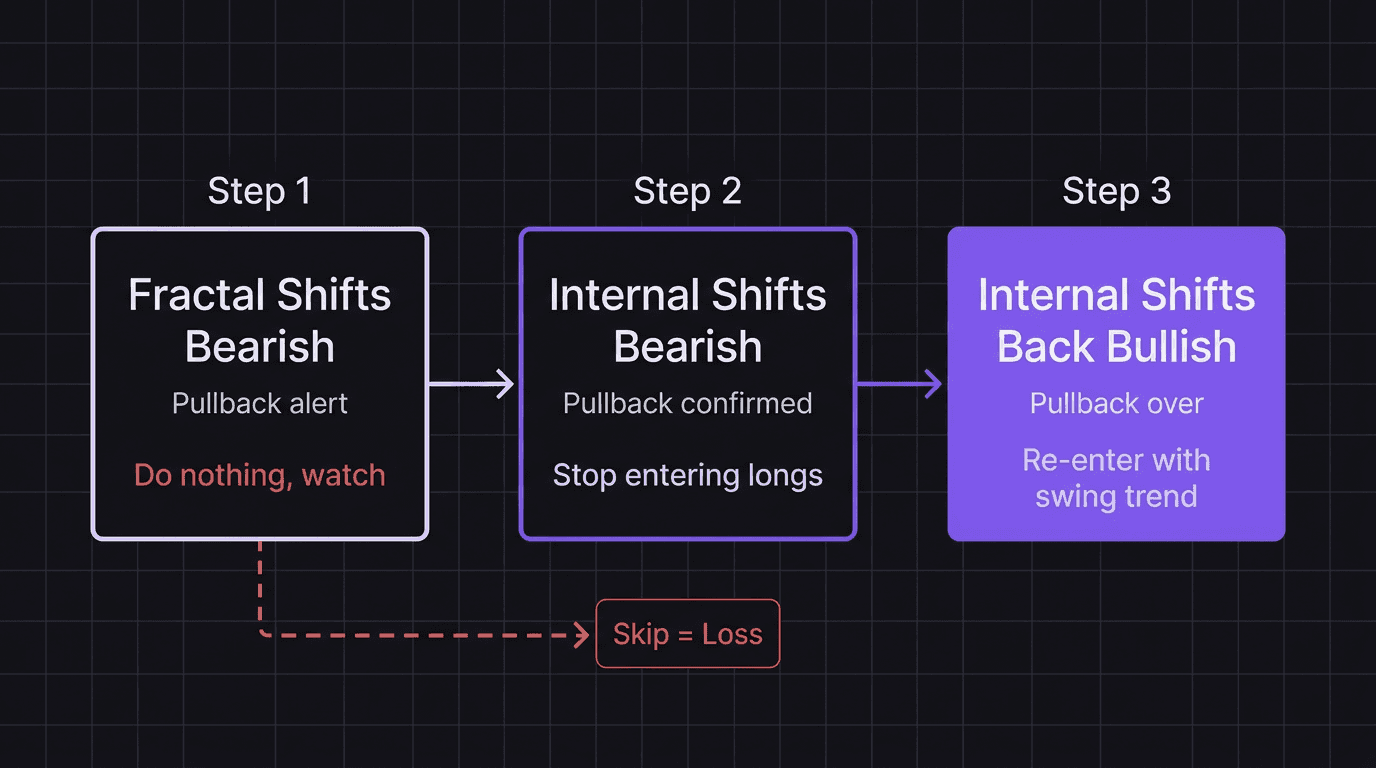
Here is the practical sequence:
Fractal shifts bearish (in an uptrend): Pullback alert. Do nothing except watch.
Internal shifts bearish: Pullback confirmed. Stop entering longs. Wait for internal to shift back bullish.
Internal shifts back bullish: Pullback is over (or pausing). Re-enter with the swing trend.
If you skip from Step 1 directly to trading, you are acting on the weakest signal in the chain. It is like hearing a rumor and betting your account on it before checking the facts.
What NOT to do: EUR/USD 1H chart, bearish swing structure.
Price is in a downtrend. A fractal shift occurs as a wick breaks above the previous fractal high at 1.0845. A trader goes long, expecting a reversal. Price pushes to 1.0852 (7 pips), then rolls over. Internal structure never shifts bullish. No body close above the internal high at 1.0860. Price drops to 1.0810 over the next 6 candles.
The fractal shift was real. A small pullback did start. But it never developed into anything more. The internal level held, the swing trend continued, and the long trade was a loss.
Compare: a trader who saw the fractal shift, waited for internal confirmation at 1.0860, and never got it. No trade taken. No loss. No frustration.
How to Use Fractal Shifts in Your Plan
Fractal shifts belong in your mechanical trading plan as awareness triggers, not trade triggers. Here is how to incorporate them.
Step 1: Add Fractal Shifts to Your Checklist
In your pre-trade checklist, add a line: "Has a fractal shift occurred against the current trend?" If yes, mark the pullback alert as active. If no, the trend is still pushing cleanly.
Step 2: Define What Happens After a Fractal Shift
When a fractal shift fires, your plan should specify your next action:
Stop entering trend-continuation trades until internal structure resolves the pullback.
Mark the internal level that needs to break (body close) for the pullback to be confirmed.
Mark the internal level that needs to break in the trend direction for the pullback to end.
This turns the fractal shift from an emotional trigger into a procedural step. You are not reacting. You are following a checklist.
Step 3: Never Trade the Fractal Shift Alone
Write this as a hard rule. "I do not trade fractal shifts as entry signals." That means no counter-trend trades on a fractal shift. No bias flips. No "it looks like a reversal."
The fractal shift earns you one thing: heightened attention. It does not earn you a position.
Step 4: Track Fractal Shifts in Your Journal
After each session, note how many fractal shifts occurred and how many of them led to actual internal shifts. Over a month of data, you will see the hit rate. Most fractal shifts (roughly 60 to 70% in a trending market) do not lead to internal shifts. They are just noise within the trend.
That data builds your trading edge. When you know from experience that most fractal shifts are false alarms, the urge to trade them fades. The discipline comes from evidence, not willpower.
What About Fractal Shifts at Key Levels?
A fractal shift that occurs at a significant swing level (a strong high or strong low) is more meaningful than one that happens in the middle of a move. But even then, it does not upgrade to a trade signal. It upgrades to a "high-priority watch" for the internal shift.
The rule stays the same: fractal shift = awareness. Internal shift = preparation. Swing shift = action.
How EdgeFlo Supports Fractal Shift Discipline
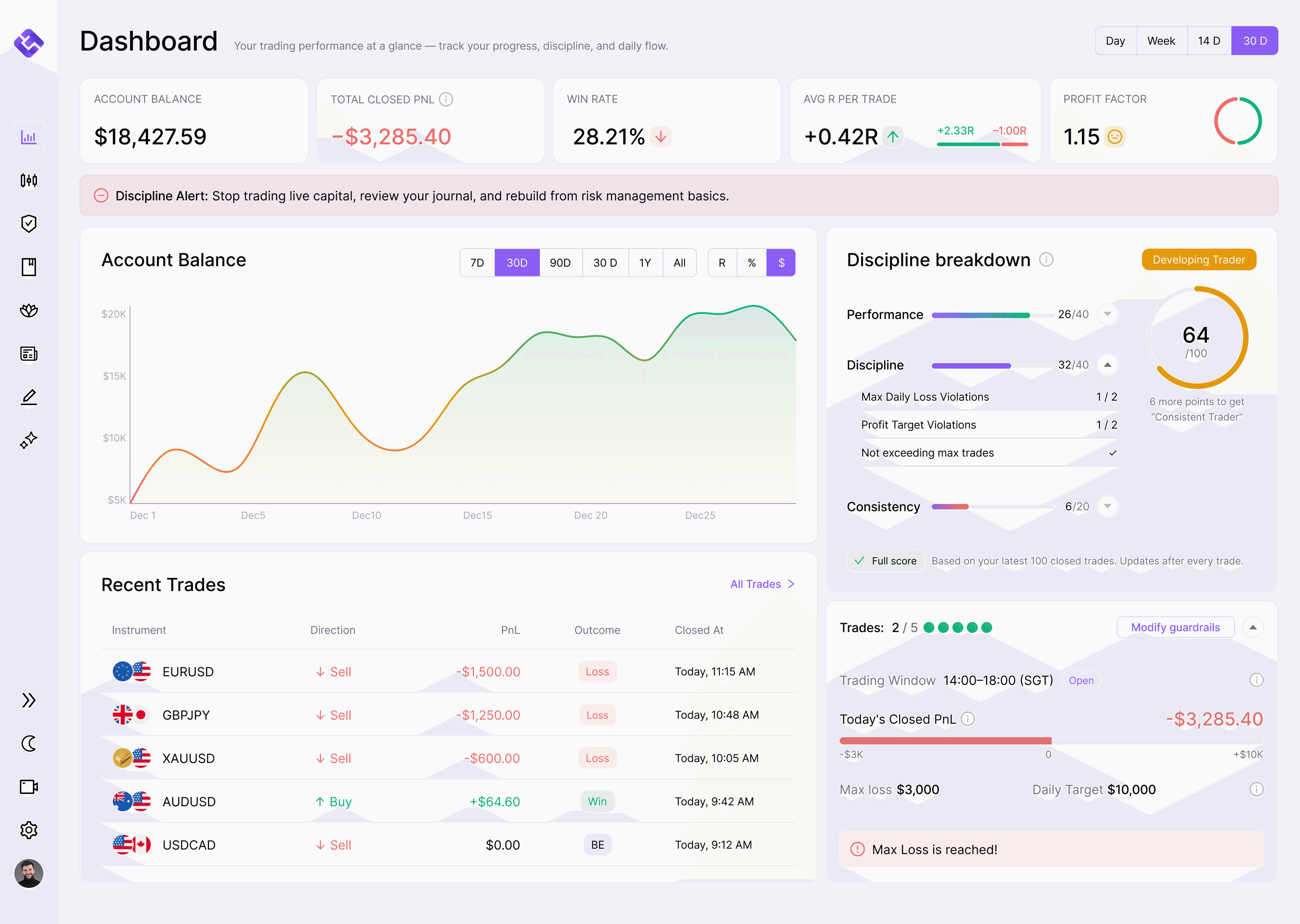
EdgeFlo helps you stay disciplined when fractal shifts fire by keeping your rules visible during live trading. When a fractal shift occurs and the impulse to trade hits, your plan is right there on screen, reminding you that fractal shifts are awareness triggers, not entry signals.
The journal tracks whether you acted on fractal shifts or waited for higher-level confirmation. After a few weeks, you can review the data and see exactly how many times a fractal shift alone would have led to a losing trade. That feedback turns a rule you follow on faith into a rule you follow because your own results prove it works.
EdgeFlo's Sanctuary feature is especially useful here. When a fractal shift creates urgency, Sanctuary walks you through a reset before you can enter an impulsive trade. By the time the reset is done, either the internal shift has confirmed (giving you a real setup) or the fractal shift has faded (saving you from a bad entry).
The Edge Brief
Receive Insights on trading psychology, discipline, and the behavioral patterns that create consistent traders from our Founder and the EdgeFlo team, delivered to your inbox.
Think different. Trade different.
What is a fractal market shift?
Is a fractal market shift a reversal signal?
What is the difference between a fractal shift and an internal shift?
How should you use a fractal market shift in your trading plan?

Turn discipline on.
Every session.
EdgeFlo is the environment serious traders operate inside.
Start 7-Day Free Trial
Cancel anytime.
No long-term commitment.

Think Different, Trade Different.