

From Trader to Investor: How Day Trading Funds Long-Term Wealth
Day trading generates cash flow. Investing compounds it. Learn the pipeline from active trading income to passive long-term wealth.
Day trading is a job. A high-skill, high-reward job, but still a job. You sit at a screen, analyze charts, press buttons, and exchange time for money. The moment you stop trading, the income stops.
That is not wealth. That is cash flow.
Real wealth comes from taking that cash flow and deploying it into assets that grow while you sleep. The traders who build lasting financial freedom are the ones who treat trading as a vehicle, not a destination. They use active income to fund passive investments that compound over years and decades.
TL;DR
Trading is active income. You stop trading, the money stops.
Investing converts trading profits into assets that compound without screen time.
A simple pipeline: trade, set aside 30% to 50% of net profits, deploy into long-term investments.
Start investing as soon as you are consistently profitable, even with small amounts.
The goal is building enough passive income to cover living expenses.
Trading Is a Job, Investing Is the Business
Most traders never make this distinction. They pour everything back into trading accounts, chase bigger lot sizes, and measure success by monthly P&L. But trading, even at its best, requires your presence. You still have to physically analyze charts, execute entries, and manage risk every single day.
That is exchanging time for money. The same fundamental structure as any other job.
Investing is different. When you buy an asset that appreciates or pays dividends, it works for you around the clock. You do not need to watch it. You do not need to manage it daily. The returns compound whether you are at your desk or on a beach.
The smartest funded traders understand this. They do not chase a bigger trading account forever. They use trading profits as fuel for a separate wealth engine.
Walkthrough: The Trader Who Never Invested
A trader earns $8,000 per month from forex trading. Every dollar goes back into the trading account or covers lifestyle expenses. After three years, he has a larger trading account but zero investments, zero passive income, and zero safety net. One extended drawdown wipes months of progress because there is no outside capital cushion.
Compare that to a trader earning the same $8,000 who sets aside $3,000 per month into an index fund averaging 10% annually. After three years, she has roughly $125,000 in investments generating returns independently. If trading hits a rough patch, the portfolio keeps growing. That is the difference between a trader with income and a trader building wealth.
The Cash-Flow Pipeline: Trade, Save, Deploy
The pipeline is simple. It has three steps, and the discipline comes from treating step two as non-negotiable.
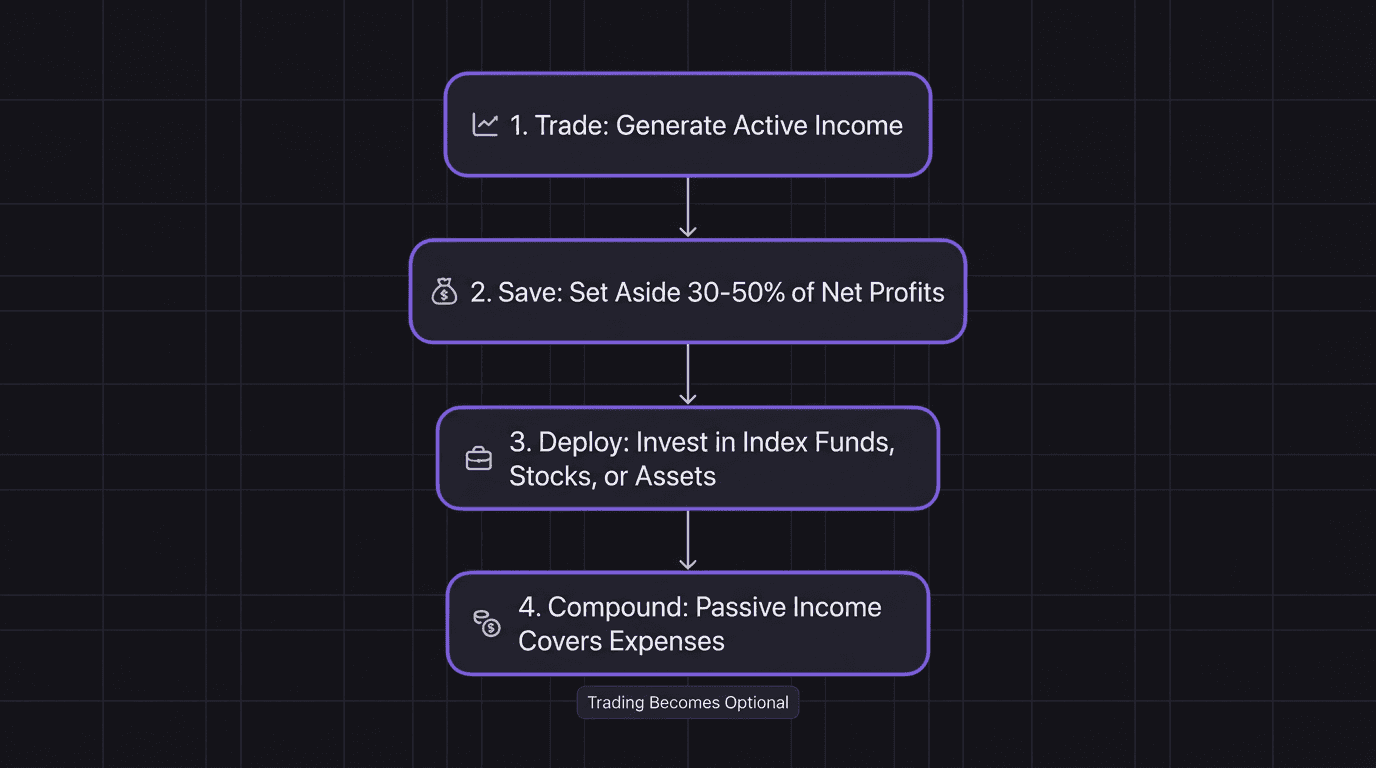
Step 1: Trade. Execute your plan, manage risk, generate monthly profit. This is the engine.
Step 2: Save. Before you touch profits for lifestyle upgrades, set aside a fixed percentage. A starting range of 30% to 50% of net monthly profits works for most traders. This money leaves your trading account and goes into a separate investment account. It does not come back.
Step 3: Deploy. Put that money into assets you understand and believe will appreciate over 5, 10, or 20 years. Do not overthink it. An index fund, a quality stock, or a proven asset class is enough to start.
The key is consistency. Investing $2,000 every month for ten years at 10% annual returns builds over $400,000. Not from trading skill. From discipline and compounding.
Setting clear trading goals that include an investment allocation percentage makes this pipeline automatic rather than aspirational.
Active Income vs Passive Income for Traders
Active income requires your time and attention for every dollar earned. Passive income works independently once the initial investment is made.
Factor | Trading (Active) | Investing (Passive) |
|---|---|---|
Time required | Daily screen time | Minimal after purchase |
Income stops when you stop | Yes | No |
Scales with time invested | Somewhat | Yes, through compounding |
Emotional toll | High | Low |
Income ceiling | Limited by hours and capital | Limited by capital only |
Trading will always be active. Even the best trader in the world cannot trade while sleeping. But investing makes your money work around the clock.
The real passive income comes from two sources: dividends and appreciation. Dividends pay you for holding an asset. Appreciation increases the value of what you own. Together, they create income streams that do not require chart time.
The goal for any serious trader is reaching the point where passive income from investments covers basic living expenses. At that point, trading becomes optional. You trade because you want to, not because you have to pay rent.
What to Invest In With Trading Profits
You do not need a complicated portfolio. Simplicity wins for traders who already spend their mental energy on markets.
Index Funds (S&P 500, total market): The lowest effort, historically proven. You buy the entire market and ride long-term growth. No stock picking required.
Quality Stocks: Buy companies you understand deeply and believe will be worth significantly more in 5 to 10 years. Think about the products and services you actually use and trust. Quality matters more than finding the cheapest price. It is better to buy a great company at a fair price than a fair company at a great price.
Digital Assets: If you understand the space, a small allocation to proven digital assets can diversify your portfolio. Only invest what you can afford to hold through extreme volatility.
Real Estate: Rental properties provide monthly cash flow and appreciation. This requires more capital upfront but creates another income stream independent of trading.
The principle behind all of these is the same. Buy assets you have conviction in. Hold them through temporary downturns. Let compounding do the heavy lifting.
Walkthrough: What Not to Do
A trader makes $5,000 in a good month. He immediately buys a speculative stock someone mentioned on social media. The stock drops 40% in two weeks. He panic sells, locking in a $2,000 loss. That $5,000 of trading income vanished because the investment decision lacked any plan or conviction.
Better approach: the same $5,000 goes into a diversified index fund. Three months later, it is worth $5,200. Nothing exciting. But in five years, the compounded contributions from every profitable month create a portfolio worth tens of thousands. Boring works. Speculation does not.
Capital preservation matters as much on the investing side as it does in your trading account. Do not gamble with the money your trading discipline earned.
How EdgeFlo Tracks Your Monthly Profit for Investment Allocation
Knowing how much to invest each month requires knowing how much you actually made. Not a guess. Not a feeling. The real number, after accounting for losses and commissions.
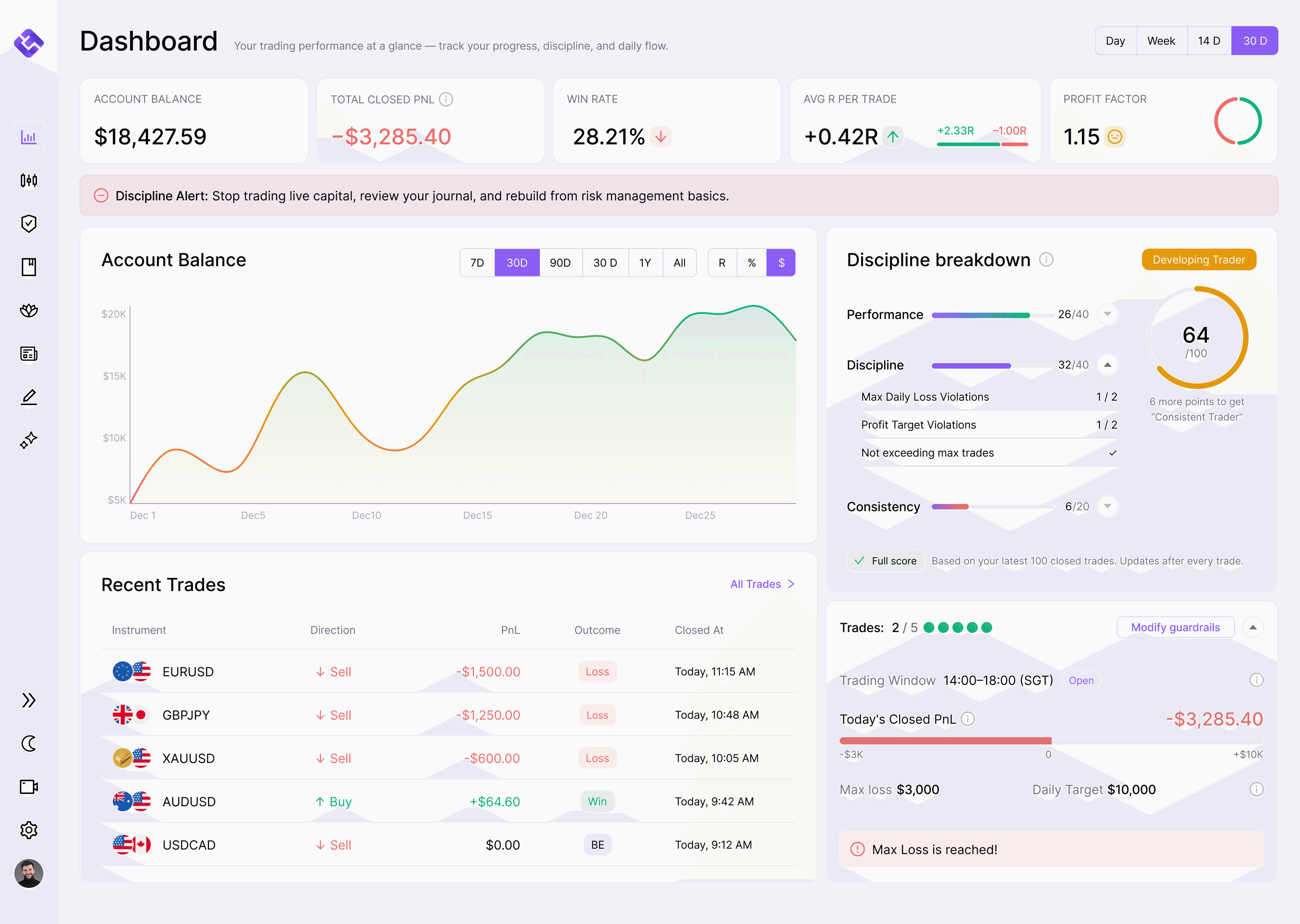
EdgeFlo's dashboard tracks your monthly P&L automatically. Every trade is logged, every win and loss recorded. At the end of each month, you see exactly what your net profit is, which makes calculating your investment allocation straightforward.
When you can see that you made $6,000 net last month, deciding to deploy $2,400 into your investment account is a two-second decision. When your P&L lives in a spreadsheet you update once a week (or never), the pipeline breaks down because the numbers are not clear enough to act on.
Treating your trading profits as a funding source for long-term wealth starts with visibility. You cannot manage what you do not measure.
The Edge Brief
Receive Insights on trading psychology, discipline, and the behavioral patterns that create consistent traders from our Founder and the EdgeFlo team, delivered to your inbox.
Think different. Trade different.
Can day trading profits fund long-term investments?
What percentage of trading profits should go to investing?
Is trading active income or passive income?
When should a trader start investing profits?

Turn discipline on.
Every session.
EdgeFlo is the environment serious traders operate inside.
Start 7-Day Free Trial
Cancel anytime.
No long-term commitment.

Think Different, Trade Different.