

Four Trade Outcome Grades Every Trader Should Use
Every trade falls into one of four grades: plan-win, plan-loss, off-plan-win, or off-plan-loss. Learn why each grade matters and how to track your distribution.
Every trade you take produces one of four outcomes, and only one of them is actually good for your long-term development. Most traders sort their trades into two buckets: wins and losses. That is the wrong framework. It misses the most important variable: whether you followed your plan.
The four trade outcome grades split every result along two axes. Did you follow your plan? Did you make money? The combination of those two answers tells you far more about your trading than P&L alone ever could.
TL;DR
Every trade falls into one of four grades: plan-win, plan-loss, off-plan-loss, or off-plan-win.
Plan-wins are the only outcomes that prove your strategy works and your execution is sound.
Plan-losses are normal, expected costs of doing business. Celebrate them.
Off-plan wins are the most dangerous grade because they reinforce bad habits with profit.
Track your grade distribution across 50 or more trades to see your real execution quality.
The Four Grades Explained
Grade 1: Plan-Win (Followed Plan + Profit)
You took a trade that met every criterion in your plan. You managed it according to your rules. It hit your target.
This is the gold standard. Save these trades. Screenshot them. Review them before every session. These are the setups you want burned into your pattern recognition so you take them without hesitation next time.
A plan-win proves two things at once: your strategy produces edge, and you can execute it under live conditions.
Grade 2: Plan-Loss (Followed Plan + Loss)
You followed every rule. You waited for the right setup. You entered at the right level, placed your stop correctly, and managed the trade exactly as planned. It hit your stop and you lost 1R.
This is a good loss. It is the cost of doing business in a probability game. Any strategy with a 40% or 50% win rate will produce more plan-losses than plan-wins. That does not mean the strategy is broken. It means you are playing the numbers correctly.
The right response to a plan-loss is nothing. Maybe a small nod. You did your job. The market did not cooperate on this one. Move on to the next setup.
Grade 3: Off-Plan-Loss (Broke Rules + Loss)
You entered a trade that did not meet your criteria, or you managed it in a way that violated your rules, and you lost money. Maybe you moved your stop, or entered before confirmation, or sized up because you "felt confident."
This is a bad loss. Not because you lost money (losses happen), but because the loss was avoidable. You broke your trading rules and paid for it.
Off-plan losses are actually valuable if you learn from them. They are clear signals that something in your decision-making broke down. Write down exactly which rule you violated and why. That note is more useful than the P&L.
Grade 4: Off-Plan-Win (Broke Rules + Profit)
You broke your rules, ignored your plan, took a trade that did not meet your criteria. And you made money.
This is the most dangerous grade. More dangerous than any loss. Because profit is a powerful reinforcer. Your brain just learned that breaking rules pays. And it will remember that the next time you are tempted.
Sound familiar? You probably know the feeling. The quick scalp that was not on your plan. The impulse entry that happened to work. The revenge trade that accidentally caught a move. The profit feels great in the moment, but it poisons your process.
Why Plan Wins Are the Only True Success
If you zoom out, only one of the four grades actually moves you forward as a trader. Plan-wins.
Plan-losses are neutral. They are expected variance. Off-plan losses are bad but at least they punish the bad behavior and create a learning opportunity. Off-plan wins are actively harmful because they reward the wrong behavior.
Think of it this way. If you are building a habit of following your plan, every plan-win and plan-loss reinforces that habit. Every off-plan trade (win or loss) erodes it.
Your real measure of progress is not your P&L. It is the percentage of your trades that fall into the plan-win and plan-loss categories combined. If 80% or more of your trades are on-plan, you are executing well regardless of what the equity curve shows this month.
Walkthrough: Why a $500 Off-Plan Win Is Worse Than a $200 Plan-Loss
A trader on a $10,000 account risks 1% per trade ($100). They have a clear plan: trade GBP/USD during London, enter only on confirmed break of structure into a demand zone, target 3R.
On Tuesday, they see EUR/USD moving fast during the New York open. Not their pair. Not their session. No setup criteria met. They enter long on impulse with 2% risk ($200). Price rallies. They close for $500 profit.
On Wednesday, they take a textbook GBP/USD setup during London. Every box checked. The trade hits stop loss for a 1R loss ($100).
Which day was more successful? Wednesday. By a mile.
The Tuesday trade made money but taught the trader that breaking rules works. The Wednesday trade lost money but reinforced the behavior that produces long-term profitability.
If the trader tracked both grades, this would be obvious. Without grading, Tuesday looks like the better day.
Off-Plan Wins Are the Most Dangerous Grade
An off-plan loss hurts and that pain creates a natural deterrent. You broke your rules, you lost money, and your brain files that under "do not repeat."
An off-plan win does the opposite. Your brain files it under "that worked, do it again." This creates a behavioral reinforcement loop that gets stronger every time it happens.
After three off-plan wins, a trader starts thinking they have "market feel" or "intuition." After five, they start trusting their gut over their plan. After ten, they have quietly abandoned their system entirely and are trading discretionary without admitting it.
The danger compounds because off-plan wins are random. They are luck dressed up as skill. But the human brain is terrible at distinguishing the two. Profit is profit, and your reward circuitry does not care whether you earned it through discipline or through dumb luck.
How to Handle an Off-Plan Win
When an off-plan win happens (and it will), do two things:
Grade it honestly in your journal. Tag it as off-plan win. Do not relabel it as "my plan is evolving" or "I was adapting to market conditions." If it did not meet your written criteria, it was off-plan. Period.
Treat the profit as suspect. You can keep the money, but do not count it as evidence that your approach is working. It is not evidence of anything except luck.
If a specific off-plan pattern keeps appearing profitably across 20 or more occurrences, then consider formally adding it to your plan after proper testing. But that is a review process decision, not a live-session decision.
How to Track Your Grade Distribution
Tracking your grade distribution is straightforward. After every trade, assign one of the four grades in your journal. At the end of each week, tally up the grades. At the end of each month, calculate the percentages.
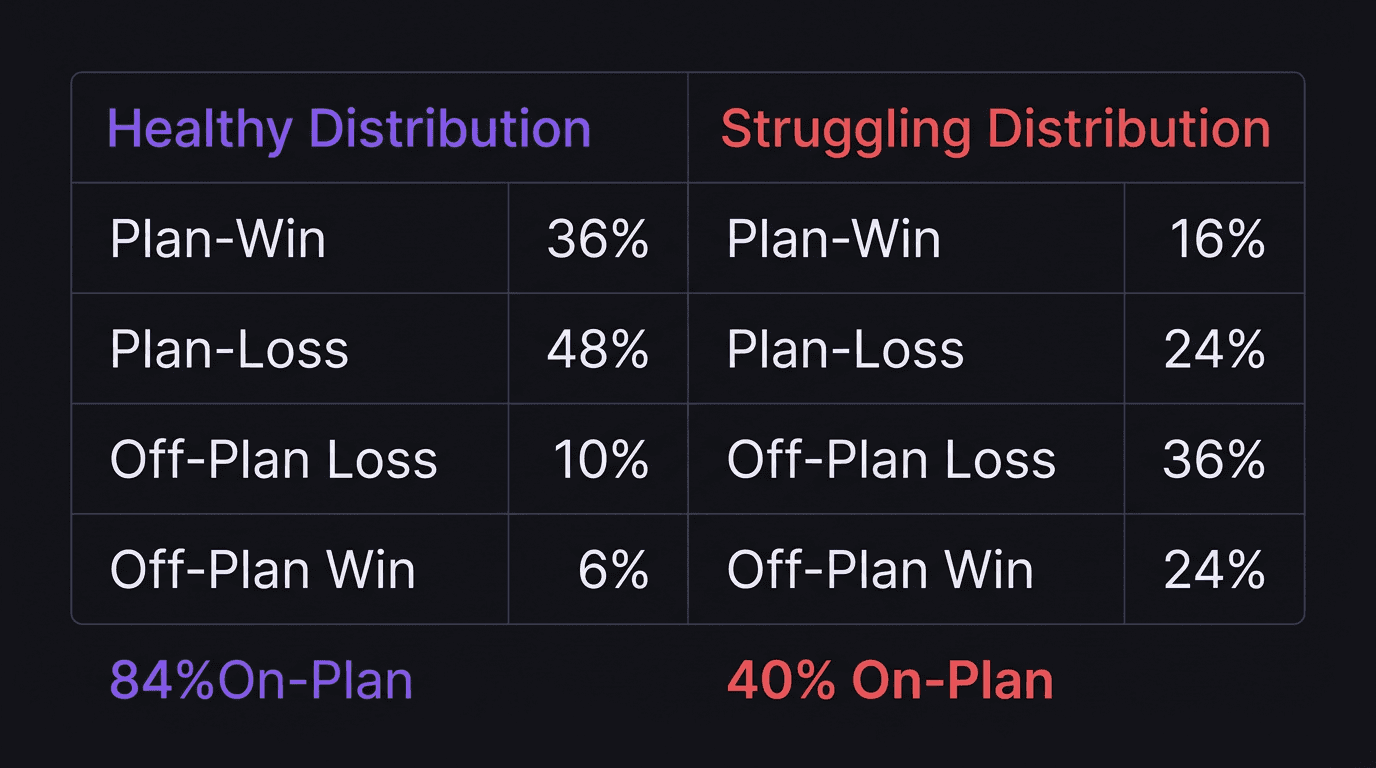
Here is what a healthy distribution looks like after 50 trades:
Grade | Count | Percentage |
|---|---|---|
Plan-Win | 18 | 36% |
Plan-Loss | 24 | 48% |
Off-Plan Loss | 5 | 10% |
Off-Plan Win | 3 | 6% |
In this example, 84% of trades are on-plan (36% + 48%). That is strong execution. The off-plan trades are minimal and the trader is clearly following their system.
A struggling trader's distribution might look more like this:
Grade | Count | Percentage |
|---|---|---|
Plan-Win | 8 | 16% |
Plan-Loss | 12 | 24% |
Off-Plan Loss | 18 | 36% |
Off-Plan Win | 12 | 24% |
Only 40% on-plan. This trader's strategy might be perfectly fine, but they will never know because they do not follow it consistently enough to generate meaningful data.
Track this monthly. If your on-plan percentage is rising, you are becoming a better trader even if your P&L has not caught up yet. If it is dropping, no amount of strategy tweaking will fix the real problem.
How EdgeFlo Helps You Grade and Track
EdgeFlo's post-trade review flow includes a plan adherence field where you mark whether each trade followed your plan. Combined with the automatic P&L tracking, this creates a running grade distribution without manual calculations.
The trading dashboard displays your on-plan percentage alongside win rate and expectancy, so you see execution quality right next to financial performance. The weekly AI report (Plus plan) flags when your off-plan trade count is rising before it becomes a pattern you cannot see on your own.
Grading every trade takes five seconds. The insight it produces over 50 or 100 trades is worth more than any indicator or setup scanner.
The Edge Brief
Receive Insights on trading psychology, discipline, and the behavioral patterns that create consistent traders from our Founder and the EdgeFlo team, delivered to your inbox.
Think different. Trade different.
What are the four trade outcome grades?
Why is an off-plan win considered dangerous?
What grade should I celebrate the most?
How do I track my grade distribution?

Turn discipline on.
Every session.
EdgeFlo is the environment serious traders operate inside.
Start 7-Day Free Trial
Cancel anytime.
No long-term commitment.


Think Different, Trade Different.