

Demo Trading Mistakes That Follow You to Live Markets
Treating demo like a game builds habits that destroy live accounts. Learn the 5 demo trading mistakes that follow you and how to journal your way out.
Demo trading mistakes follow you to live markets because habits do not care whether money is real. Every trade you take on a practice account trains your execution patterns: what setups you enter, how you size positions, whether you follow your plan, and how you react to losses. If you treat demo as a game, you build game habits. Those same habits activate the moment you go live, and they cost real money.
The biggest demo trading mistake is not losing money on paper. It is building unconscious patterns of sloppy execution that feel normal by the time you fund a live account. You skip the lot size calculation. You enter trades outside your plan. You do not journal. Then you go live, and you wonder why nothing works anymore. It works the same. You just never built the habits that matter.
TL;DR
Demo accounts build real execution habits, good or bad. Your brain does not differentiate between practice and live patterns.
The five demo mistakes that transfer to live: skipping lot size math, trading outside your plan, not journaling, oversizing because "it is not real money," and quitting your session after wins instead of losses.
Use demo to practice execution mechanics: pressing buttons, calculating lot size, placing stops correctly.
Journal every demo trade as if it were live. This single habit prevents most of the downstream problems.
The goal of demo is not profit. It is consistent plan execution across 30 to 50 trades.
Why Demo Habits Transfer to Live
Your brain learns through repetition, not context. When you practice a movement (physical or mental), the neural pathway strengthens regardless of whether the stakes are real. This is why athletes train with drills, not just games. The drill builds the pattern. The game tests it.
Trading works the same way. Every time you enter a trade on demo, your brain records the sequence: scan the chart, identify a level, click buy, set a stop, set a target. If you do this 50 times following your plan, the pattern becomes automatic. If you do this 50 times randomly, the random pattern becomes automatic.
The switch to live does not reset your habits. It adds pressure to existing habits. If you built sloppy habits on demo, pressure makes them worse, not better. You will not suddenly become disciplined when real money hits the screen. You will default to whatever pattern you trained.
The 5 Demo Mistakes That Cost Real Money
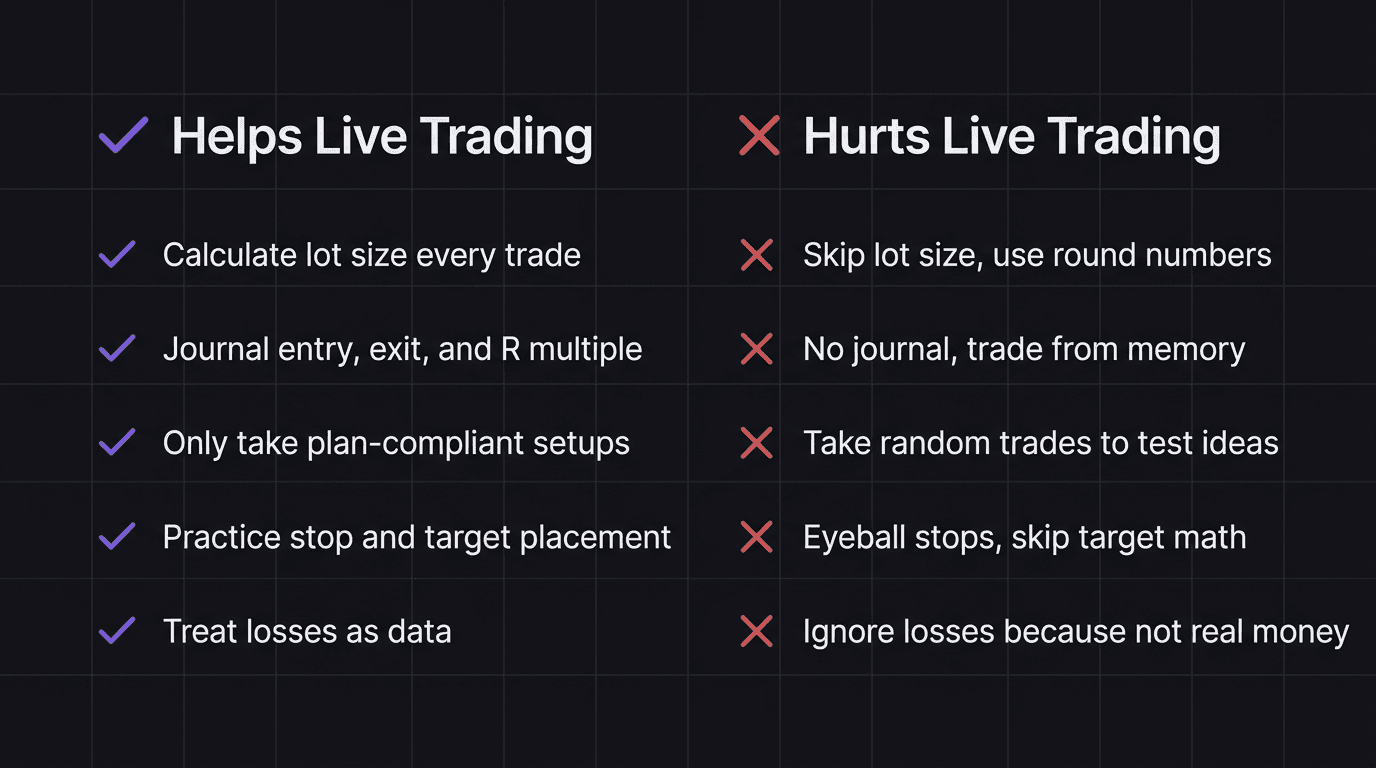
1. Skipping the Lot Size Calculation
On demo, the position size does not matter. You cannot lose real money, so why bother calculating 0.5% risk on a $50,000 demo account?
Because lot size calculation is a skill. It requires you to know your risk percentage, your stop distance in pips, the pip value for the pair you are trading, and the formula that connects them. Skip this on demo 50 times, and when you go live, you will not have the muscle memory. You will guess. Or you will open TradingView, eyeball the stop distance, and pick a round lot number. Both paths lead to oversized positions and common trading mistakes that drain accounts.
The fix: calculate lot size on every single demo trade. Write it down. Treat the number as if your rent depends on it.
2. Taking Trades Outside Your Plan
Demo accounts remove consequence. Without real money at risk, the cost of taking a "just to see what happens" trade is zero. So you do it. Then you do it again. Then it becomes your default behavior.
By the time you go live, you have taken 100 demo trades, and 40 of them were outside your plan. Your brain has learned that off-plan trades are acceptable. When a live setup looks "close enough" but does not meet your criteria, you take it anyway, because that is what you always do.
The fix: define your plan before each demo session. Write it on paper or in your trading journal. Only take trades that meet every criterion. If no setup qualifies, close the charts and walk away. Practice patience on demo, because you will need it on live.
3. Not Journaling Demo Trades
This is the most destructive mistake, and it is also the most common. If you do not journal your demo trades, you have no feedback loop. You cannot see patterns. You cannot identify which setups work and which do not. You cannot prove to yourself (or to a prop firm evaluator) that your strategy has an edge.
Journaling on demo is where you build the trading journal habit that sustains you through live trading. If you cannot maintain a journal when there is no money on the line, you will absolutely not maintain one when emotions are running high after a live loss.
Use the same journal template you plan to use on live. Record entry, exit, lot size, R multiple, plan compliance (did the trade meet all your criteria?), and one sentence about what you learned.
4. Oversizing Because "It Is Not Real Money"
When the account balance is fake, why not trade 5 lots instead of 0.05? You want to see big numbers move. You want the thrill of a $2,000 gain on a demo trade.
The problem is not the demo P&L. The problem is that you trained yourself to associate trading with large, exciting swings. When you go live with proper position sizing, a $15 gain on a 0.05 lot feels boring. That boredom creates restlessness, and restlessness leads to oversizing "just this once" on a live account.
Correct lot sizing on demo teaches you to be comfortable with small, proportional returns. That comfort is what keeps you from blowing your real account when the temptation to go bigger kicks in.
5. Quitting After Wins Instead of Losses
On demo, many traders stop their session after a few winning trades. They feel good. They got the dopamine hit. Why risk a loss and ruining the mood?
On live, they do the opposite: they stop after losses because the pain is real. The inconsistency creates a skewed dataset. Demo results look great (only winning sessions logged). Live results look terrible (full exposure to losing days).
The fix: set a session rule and follow it on demo. Trade the London session, take every valid setup until the session ends, and journal all of them. Do not cherry-pick when to start or stop. Practice enduring losses on demo so that enduring them on live does not feel foreign.
What Demo Trading Is Actually For
Demo is not for making fake money. It is for building three things:
Mechanical execution. Pressing the right buttons in the right order under time pressure. This includes calculating lot size, setting stop loss and take profit levels, and managing the trade through its lifecycle.
Plan compliance. Proving that you can follow your rules 30 to 50 times in a row. Not 5. Not 10. A statistically meaningful sample. If you cannot follow your plan for 50 demo trades, you are not ready for live.
Confidence through competence. Real trading confidence comes from evidence, not motivation. Demo gives you a safe place to collect that evidence: "I followed my plan for 50 trades, my win rate was 33%, my average R was 4.1, and my expectancy was positive. I am ready."
Walkthrough: The Demo-to-Live Transition Done Right
You are forward testing your strategy on a $10,000 demo account. You set your risk at 0.5% per trade ($50). Your trading plan says: only take long entries off H1 demand zones during London session, with a minimum 1:3 R:R.
2 wins: +3.2R and +4.1R
3 losses: negative 1R each
Net: +4.3R
Plan compliance: 5/5 (100%)
1 win: +5.6R
3 losses: negative 1R each
Net: +2.6R
Plan compliance: 4/4 (100%)
2 wins: +3.8R and +4.5R
4 losses: negative 1R each
Net: +4.3R
Plan compliance: 5/6 (one trade taken outside the plan, journaled as off-plan, lost 1R)
After three weeks, you have 15 trades. Your overall win rate is 33.3% (5 wins out of 15). Your average R per win is 4.24R. Your plan compliance is 14/15 (93.3%). Your net is +11.2R.
You journal all 15 trades. You review the one off-plan trade and note the trigger (boredom during a slow session). You set a rule: if no setup forms within the first 90 minutes of London, close the charts.
After 50 trades at this standard, you have a credible dataset. You know your win rate, your average R, your expectancy, and your plan compliance percentage. You transition to live with evidence, not hope.
The Journal Is the Bridge
Every demo mistake listed above has the same root cause: lack of accountability. Without a journal, you have no record, no feedback, and no self-correction mechanism. With a journal, every trade gets reviewed, every deviation gets flagged, and every pattern gets visible.
Start journaling on demo the way you want to journal on live. Use the same format. Ask the same questions after every trade. Did this trade meet all criteria? What was the R multiple? Was the lot size calculated or guessed? What would I do differently?
The journal turns demo from "practice" into "training." Practice is unstructured and casual. Training is deliberate, measured, and builds toward a specific performance standard. Your demo period should be training.
How EdgeFlo Bridges Demo to Live
EdgeFlo's journal auto-imports trades from your connected broker, including demo accounts. The same journal template, emotion tags, and post-trade review prompts apply whether the account is demo or live. This means your journaling workflow is identical before and after the transition.
The habit tracker shows your plan compliance rate across time. If you maintained 95% compliance on demo for 50 trades, and it drops to 70% in your first 20 live trades, you can see exactly when and where the deviation started. Usually it is the same triggers: boredom entries, oversized positions after a win, or skipped journals after losses.
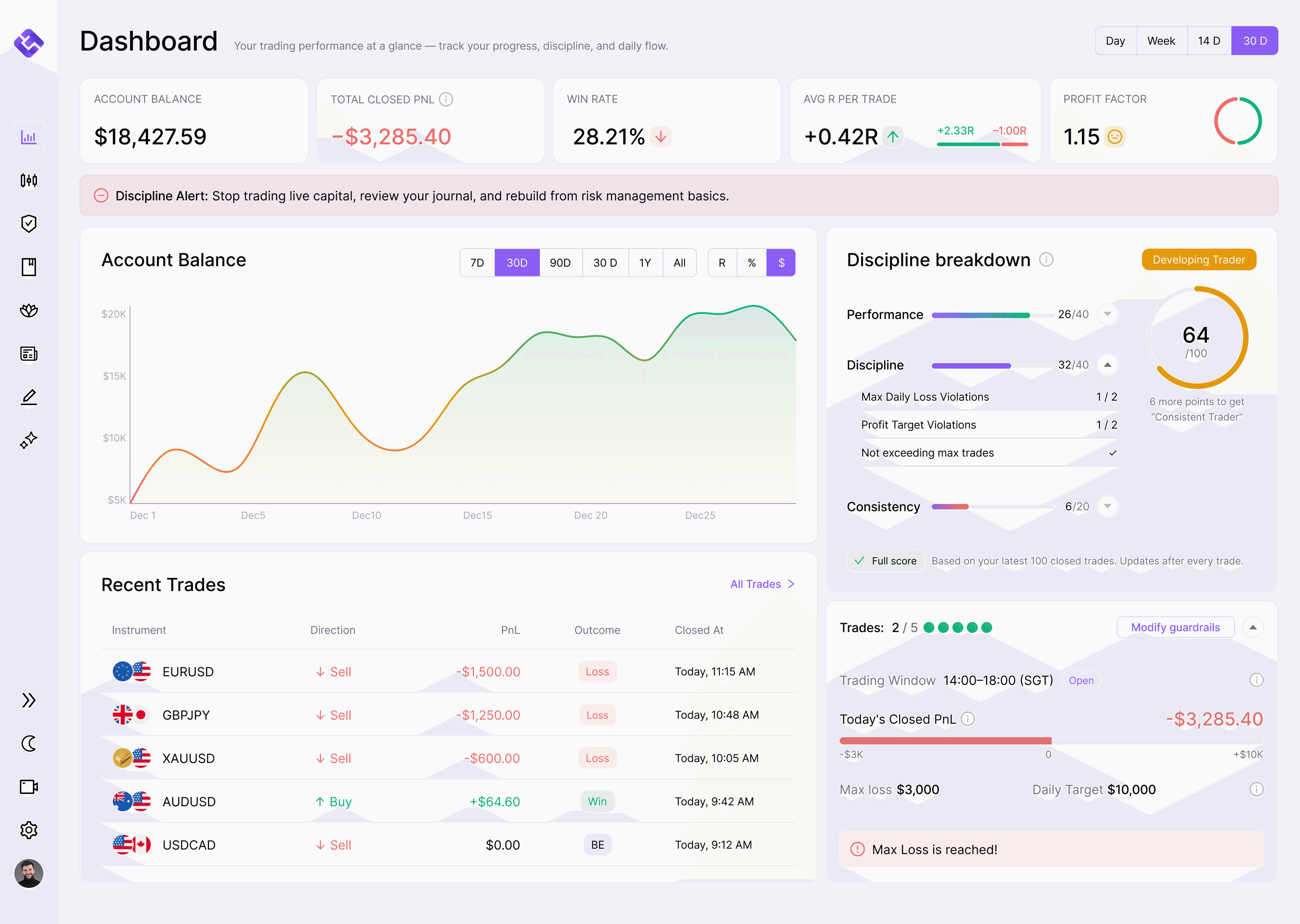
EdgeFlo does not distinguish between demo and live for tracking purposes. Your dashboard shows your metrics. Your weekly report analyzes your patterns. The data does not care whether the P&L was real. It cares whether the process was consistent. That is exactly how you should think about demo trading: the money is fake, but the process is real.
The Edge Brief
Receive Insights on trading psychology, discipline, and the behavioral patterns that create consistent traders from our Founder and the EdgeFlo team, delivered to your inbox.
Think different. Trade different.
Should I take demo trading seriously?
How long should you demo trade before going live?
Why am I profitable on demo but not live?
Can demo trading hurt your real trading?

Turn discipline on.
Every session.
EdgeFlo is the environment serious traders operate inside.
Start 7-Day Free Trial
Cancel anytime.
No long-term commitment.

Think Different, Trade Different.