

Forex Leverage for Beginners: Why It Barely Matters
Forex leverage multiplies your buying power but doesn't control your risk. Learn how lot sizes, pip values, and position sizing work on small accounts.
Forex leverage is borrowed capital from your broker that multiplies your buying power. A $100 account with 1:100 leverage can control $10,000 worth of currency. But here is the part most beginners miss: leverage does not determine how much you risk. Your lot size does. A trader using 1:100 leverage who sizes correctly at 0.01 lots risks roughly the same amount per pip as a trader on 1:20 leverage using the same lot size. The difference is that the high-leverage trader could open a dangerously large position. Whether they actually do is a position sizing decision, not a leverage decision.
TL;DR
Leverage multiplies buying power, not risk. A $1,000 account at 1:100 can control $100,000 in currency.
Lot size determines your actual dollar risk per pip: micro lot (0.01) = ~$0.10/pip, mini lot (0.1) = ~$1/pip, standard lot (1.0) = ~$10/pip.
A $100 account trading a mini lot blows up in 100 pips. Trading a micro lot, that same move costs $10.
Leverage barely matters if you size your trades based on risk percentage and stop loss distance.
Let a calculator handle lot size math so you never accidentally oversize a trade.
What Leverage Actually Does
Think of leverage like a credit limit on a card. Your broker says: "You have $1,000, but I'll let you control up to $100,000." That does not mean you should spend $100,000. It means you can.
Leverage is the ratio between your account balance and your maximum buying power. Here is how it scales:
1:20 leverage on a $1,000 account = $20,000 buying power
1:50 leverage on a $1,000 account = $50,000 buying power
1:100 leverage on a $1,000 account = $100,000 buying power
1:500 leverage on a $1,000 account = $500,000 buying power
The math is simple: account balance times leverage ratio equals buying power. A $1,000 account at 1:100 means $1,000 x 100 = $100,000 in buying power.
What changes with more buying power? The maximum lot size you're allowed to open. Without leverage, a $1,000 account can only trade 0.01 lots (a micro lot). With 1:100 leverage, that same account can open up to 1.0 standard lot.
And that is exactly where the danger starts. More buying power means you can trade bigger. But "can" and "should" are two very different words.
Leverage is a double-edged sword. If EUR/USD moves 50 pips in your favor and you're holding 1.0 lot, you make $500. If it moves 50 pips against you, you lose $500. On a $1,000 account, that is half your balance gone from a move that takes maybe an hour during London session.
The practical rule: cap your leverage at 1:100. Some unregulated brokers offer 1:500 or 1:1000. Avoid those unless you have iron discipline and a strict risk-per-trade rule in place. Even at 1:100, you can destroy a small account in minutes if you max out your lot size.
Lot Sizes and Buying Power at Each Leverage Level
This is where most leverage explanations stop too early. They tell you what leverage is but skip what it lets you do with specific lot sizes. So here is the full picture.
Three lot sizes exist in forex:
Standard lot (1.0) = 100,000 units of base currency = ~$10 per pip on major pairs
Mini lot (0.1) = 10,000 units = ~$1 per pip
Micro lot (0.01) = 1,000 units = ~$0.10 per pip
Your leverage determines which of these you can access. Here is a breakdown on a $100 account:
Leverage | Buying Power | Max Lot Size | Pip Value at Max |
|---|---|---|---|
1:20 | $2,000 | 0.01 (micro) | $0.10/pip |
1:50 | $5,000 | 0.01 (micro) | $0.10/pip |
1:100 | $10,000 | 0.1 (mini) | $1/pip |
1:1000 | $100,000 | 1.0 (standard) | $10/pip |
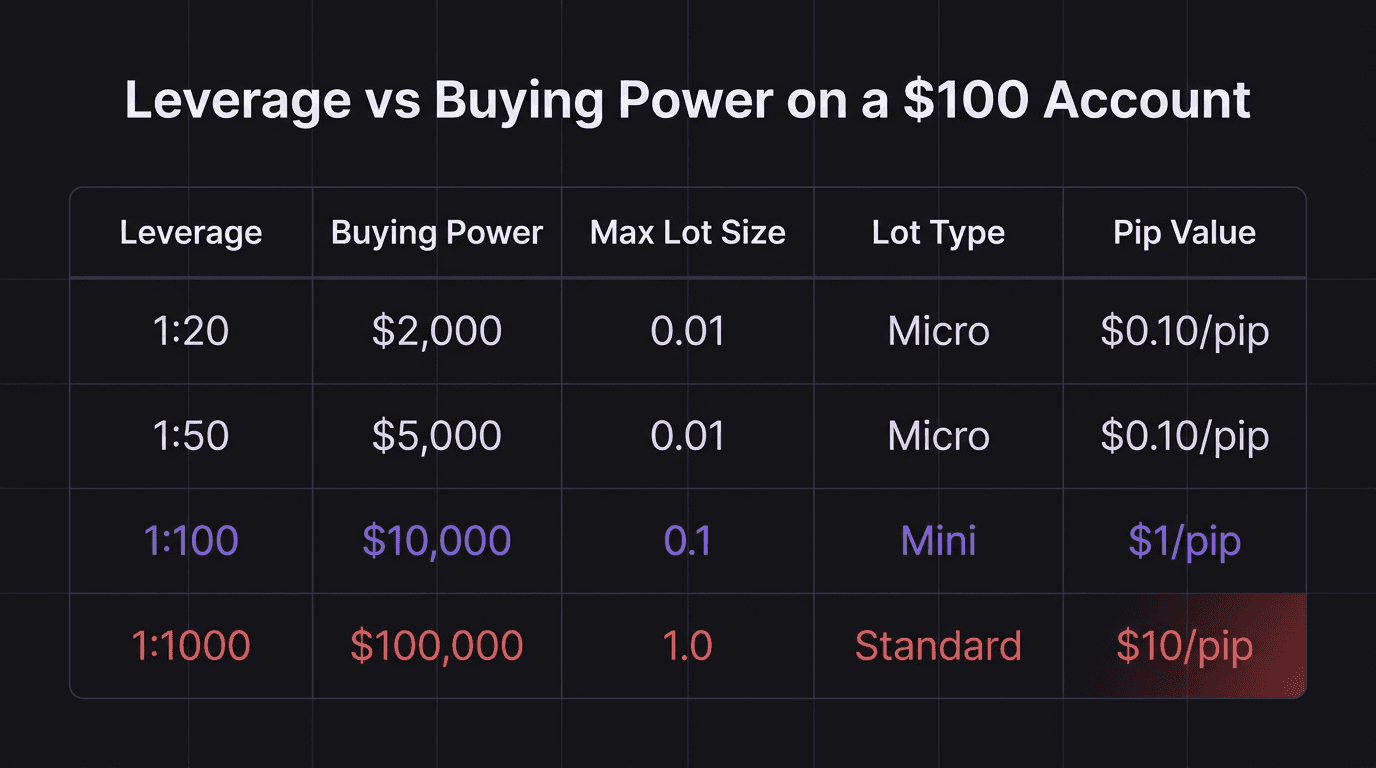
Look at that table carefully. At 1:20 and 1:50, you can only trade micro lots on a $100 account. Your pip value tops out at $0.10. At 1:100, you unlock mini lots and $1 per pip. At 1:1000, you can trade a full standard lot with $10 per pip exposure on a hundred-dollar account.
Same $100. Same market. The only difference is how big of a hole leverage lets you dig.
Now do the same exercise on a $1,000 account:
Leverage | Buying Power | Max Lot Size | Pip Value at Max |
|---|---|---|---|
1:20 | $20,000 | 0.1 (mini) | $1/pip |
1:100 | $100,000 | 1.0 (standard) | $10/pip |
At 1:100 on a $1,000 account, you could open a standard lot. That means every pip of movement is $10. A 100-pip drawdown wipes you out entirely. Sound extreme? GBP/USD regularly moves 100 pips in a single session.
The $100 Account Blow-Up Example
This is where leverage gets real. Not in theory. In your account balance.
The reckless trade
You deposit $100. Your broker gives you 1:100 leverage, so your buying power is $10,000. You open EUR/USD with a mini lot (0.1). Every pip is now worth $1.
Price drops 50 pips against you. That is $50 gone. Half your account, vanished in what might be a 2-hour move.
Price drops 100 pips against you. That is $100. Your entire account. Blown. And 100 pips on EUR/USD? That is a completely normal daily range. You did not need a black swan event or a flash crash. Just an average Tuesday.
The same account, sized correctly
Same $100 account. Same 1:100 leverage. But this time you trade a micro lot (0.01). Every pip is $0.10.
Price drops 100 pips against you. That costs $10. Uncomfortable, sure. But you still have $90 in the account. You can take nine more trades at the same size before your account hits zero.
The leverage did not change between these two scenarios. The buying power was identical. What changed was the lot size. One trader used every bit of available margin. The other sized the trade to survive normal market movement.
What about the $1,000 account?
Same pattern, bigger numbers. A $1,000 account at 1:100 leverage can open 1.0 standard lot on EUR/USD. Every pip = $10.
Walkthrough: The $1,000 account mistake. You open 1.0 lot on GBP/USD during London session. Price moves against you by 55 pips over 90 minutes. That is 55 x $10 = $550 in losses. More than half your account from a single trade. You had no stop loss because you "were sure it would come back." It did not come back. Traders who skip stop losses learn this math the hard way.
Now compare that to a properly sized trade on the same $1,000 account. You risk 1% per trade ($10) with a 50-pip stop loss. The lot size calculation: $10 risk / 50 pips / $10 per pip per standard lot = 0.02 lots. Pip value: 0.02 x $10 = $0.20 per pip. If your stop hits at 50 pips, you lose exactly $10. That is 1% of your account. You have 99 more "bullets" before you are wiped out.
Same account. Same leverage. Wildly different outcomes.
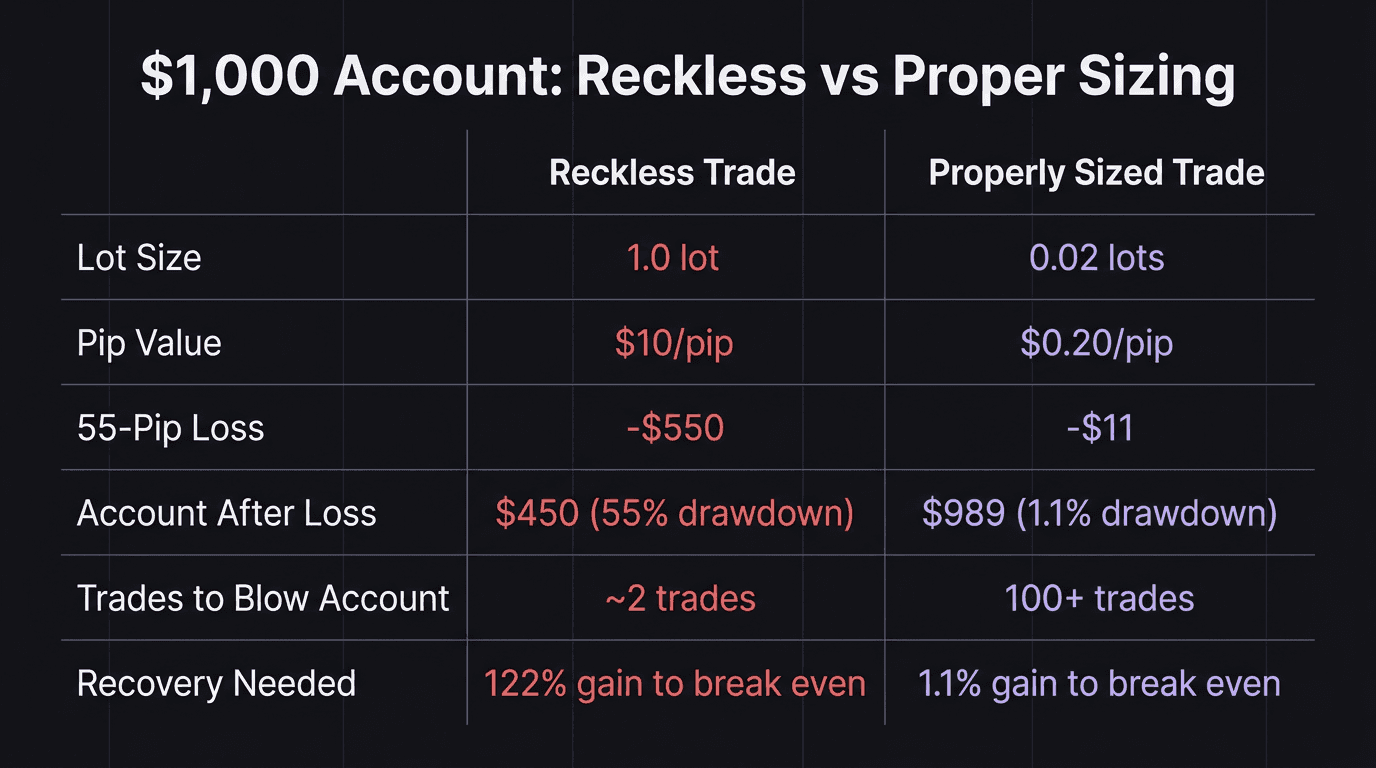
That last row is the one that stings most. Lose 55% and you need a 122% gain just to get back to where you started. Lose 1.1% and you need a 1.1% gain. Drawdown recovery math is brutally asymmetric, and oversized positions make it worse.
Why Leverage Barely Matters If You Size Correctly
This is the part that most leverage articles completely miss. And it is the most important insight you will read today.
If you follow proper position sizing rules, your leverage ratio is almost irrelevant.
Here is why. Say you have a $1,000 account and you risk 1% per trade. That means your maximum loss per trade is $10. Your stop loss is 50 pips. The lot size formula spits out 0.02 lots. You need roughly $20 in margin to hold that position at 1:100 leverage, and about $100 in margin at 1:20 leverage.
Both cases produce the same trade. Same lot size. Same pip value. Same $10 risk if your stop gets hit. The only difference is how much margin your broker locks up. At lower leverage, you might not have enough free margin for multiple positions. But on a single properly sized trade, the outcome is identical.
Walkthrough: Two traders, same risk, different leverage. Trader A has a $1,000 account at 1:100 leverage. Trader B has a $1,000 account at 1:20 leverage. Both risk 1% ($10) on EUR/USD with a 50-pip stop. Both calculate 0.02 lots. Both enter at 1.0850. Price drops to their stop at 1.0800. Both lose exactly $10. Trader A has more free margin left for additional trades. Trader B is more margin-constrained. But the risk on this trade? Identical.
The real variable is not leverage. It is lot size selection. And lot size is driven by three inputs:
Account balance (how much you have)
Risk percentage (how much you are willing to lose per trade, usually 0.5% to 1%)
Stop loss distance (how many pips to your invalidation point)
The formula: (Account Balance x Risk %) / (Stop Loss Pips x Pip Value per Lot) = Lot Size
On that $1,000 account at 1% risk with a 50-pip stop: ($1,000 x 0.01) / (50 x $10) = 0.02 lots.
Leverage just determines whether your broker will allow you to open that position. At 1:100, you have plenty of headroom. At 1:10, you might get a margin rejection on larger lot sizes. But if your calculated lot size is small enough (which it should be on a small account), even low leverage works fine.
This is why professionals say leverage does not matter. Because they never trade based on how much leverage they have. They trade based on how much they can afford to lose. Those are two completely different starting points.
Set a daily loss limit of 2-3% alongside your per-trade risk rule, and leverage becomes nothing more than a number on your broker's settings page.
How EdgeFlo Calculates Your Lot Size Automatically
The lot size formula is simple, but doing it manually before every trade is where mistakes creep in. You punch in the wrong pip value. You forget to adjust for a JPY pair. You round up "just this once" because the position feels small. One rounding error on a volatile pair and your 1% risk becomes 3%.
EdgeFlo's auto risk calculator handles this inside the Trade Execution pillar. You set your risk percentage (say 0.5% or 1%), enter your stop loss distance, and the calculator returns the exact lot size for that trade. No spreadsheet. No mental math. No "close enough."
The point is not to remove your decision-making. You still choose your risk percentage, your stop loss placement, and whether the trade is worth taking. The calculator just removes the arithmetic step where most beginners make sizing mistakes. That way, your leverage setting stays irrelevant because your lot size is always matched to your actual risk tolerance.
The Edge Brief
Receive Insights on trading psychology, discipline, and the behavioral patterns that create consistent traders from our Founder and the EdgeFlo team, delivered to your inbox.
Think different. Trade different.
What leverage should a beginner forex trader use?
Can you lose more than your deposit with leverage?
Does higher leverage mean higher risk?
What is a good lot size for a $100 forex account?

Turn discipline on.
Every session.
EdgeFlo is the environment serious traders operate inside.
Start 7-Day Free Trial
Cancel anytime.
No long-term commitment.

Think Different, Trade Different.