

Why Your First Year of Trading Losses Are Tuition
Early trading losses are the cost of learning, not proof you cannot trade. Treat every loss as data, journal daily, and build the habits that turn tuition into profit.
Your first year of trading will probably cost you money. That is not a prediction meant to discourage you. It is a reality that nearly every consistently profitable trader has lived through. The losses you take early on are not proof that you cannot trade. They are the price of learning how the market actually works, how you respond under pressure, and which habits you need to build before real consistency becomes possible.
TL;DR
Early losses are tuition, not a verdict on your ability.
The real secret to consistency is showing up daily, journaling every trade, and managing risk on every position.
Trading growth is exponential, not linear; most progress arrives after long periods of feeling stuck.
Habits formed on a small account follow you to larger accounts, for better or worse.
The only guaranteed way to fail is to quit before the learning compounds.
The Timeline Nobody Tells You About
Most trading content shows the highlight reel. Big wins, funded accounts, screenshots of five-figure days. What you rarely see is the years of blown accounts, emotional breakdowns, and incremental improvement that came first.
Consistently profitable traders often describe the same arc. The first one to three years are painful. Accounts get blown. Strategies get abandoned. Confidence swings wildly between overconfidence after a win streak and despair after a drawdown. Sound familiar?
Here is what changes the story: the traders who eventually break through do not have a secret indicator. They have a process. They show up every single day, journal every trade, manage risk on every position, and review what went wrong before moving on.
The painful early years are not wasted years. They are the tuition the market charges before it lets you keep the profits.
Losses Are Data, Not Failure
The biggest psychological trap for new traders is attaching self-worth to the P&L. A red day feels like a personal indictment. A losing week triggers thoughts like "maybe everyone was right and I should quit."
That emotional reaction is natural, but it is also the thing that keeps you stuck.
Every loss contains information. Did you follow your plan? Was your stop placed at a logical level? Did you size the position correctly? If the answer to all three is yes, then the loss is just a cost of doing business. A welcome part of the process rather than evidence of incompetence.
The traders who survive the learning curve are the ones who stop classifying losses as "bad" and start classifying them as data. A loss you journal and learn from is tuition. A loss you ignore or repeat is wasted money.
Walkthrough: The Revenge Trade That Doubled the Damage
Picture this. You are trading EUR/USD on the 1H chart. You enter a long position at 1.0850 with a 30-pip stop at 1.0820, risking 1% of your $5,000 account.
The trade hits your stop. You lose $50. That stings, but it is well within your plan.
Then the emotional reaction kicks in. You jump back in immediately, this time risking 2% to "make it back." You enter at 1.0830 with a 20-pip stop, and the market drops again. Now you are down $150 on two trades instead of $50 on one.
The first loss was tuition. The second loss was the fee you pay for skipping the lesson. The difference between the two is a journal entry and a five-minute pause.
What Actually Changes When It Finally Clicks
The breakthrough does not come from finding a better strategy. It comes from an internal shift.
You stop trying to flip your account overnight. You stop chasing signals from strangers on the internet. You stop measuring your worth by this week's P&L. Instead, you start focusing on execution quality, on following your plan, on taking only the setups that meet your criteria.
That shift sounds simple. It takes most traders years to internalize it because the emotional pull of quick profits is powerful. But once you make the switch, results change quickly. Not because the market becomes easier, but because you stop beating yourself.
The traders who make it describe a similar pattern: invisible progress for months or years, then a sudden acceleration. Trading skills compound like interest. You do not notice the growth happening until the curve bends upward.
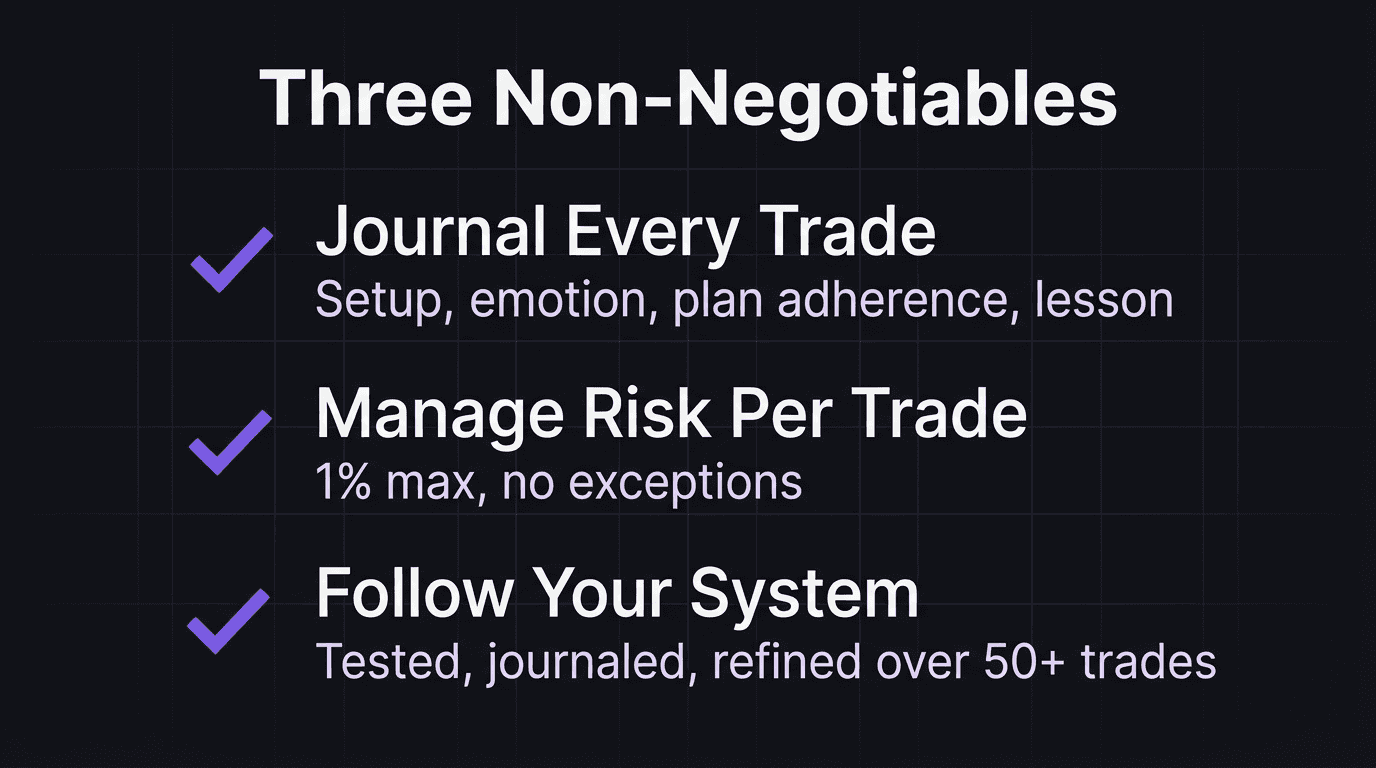
The Three Non-Negotiables: Journal, Risk, System
If early losses are tuition, then these three habits are the coursework that turns that tuition into a degree.
1. Journal every trade. Not just the P&L. Record the setup, your emotional state, whether you followed your plan, and what you would do differently. The journal is where invisible patterns become visible. Without it, you repeat the same mistakes for years without realizing it.
2. Manage risk on every single position. Set a fixed percentage per trade (1% is the standard starting point for most retail traders) and do not deviate. Proper risk per trade is the difference between a drawdown that teaches you something and a blown account that sends you back to zero.
3. Follow a system. Not someone else's system copied from a YouTube video. A system you have tested, journaled, reviewed, and refined over dozens of trades. A system simple enough to execute under pressure and mechanical enough that emotions cannot override it.
Walkthrough: What 50 Trades of Data Actually Reveal
A trader takes 50 trades over two months on GBP/USD, risking 1% per trade. After reviewing the journal, here is what the data shows:
22 wins, 28 losses (44% win rate).
Average winner: 2.1R. Average loser: 1.0R.
London session trades: 60% win rate. New York session trades: 31% win rate.
Trades taken after a loss (within 30 minutes): 25% win rate.
The raw P&L might look mediocre. But the data tells a clear story. London session setups work. New York session setups do not. And trades taken right after a loss are almost guaranteed losers.
Without a journal, this trader would keep bleeding money in New York and revenge trading after losses. With a journal, the fix is obvious: trade London, skip New York, and take a mandatory break after any loss.
That is what turns tuition into trading confidence. Not a hot streak, but proof from your own data that you know what works.
How EdgeFlo Shortens the Learning Curve
The tuition phase is unavoidable, but the duration is not fixed. The faster you build the journal, risk, and system habits, the sooner the curve bends upward.
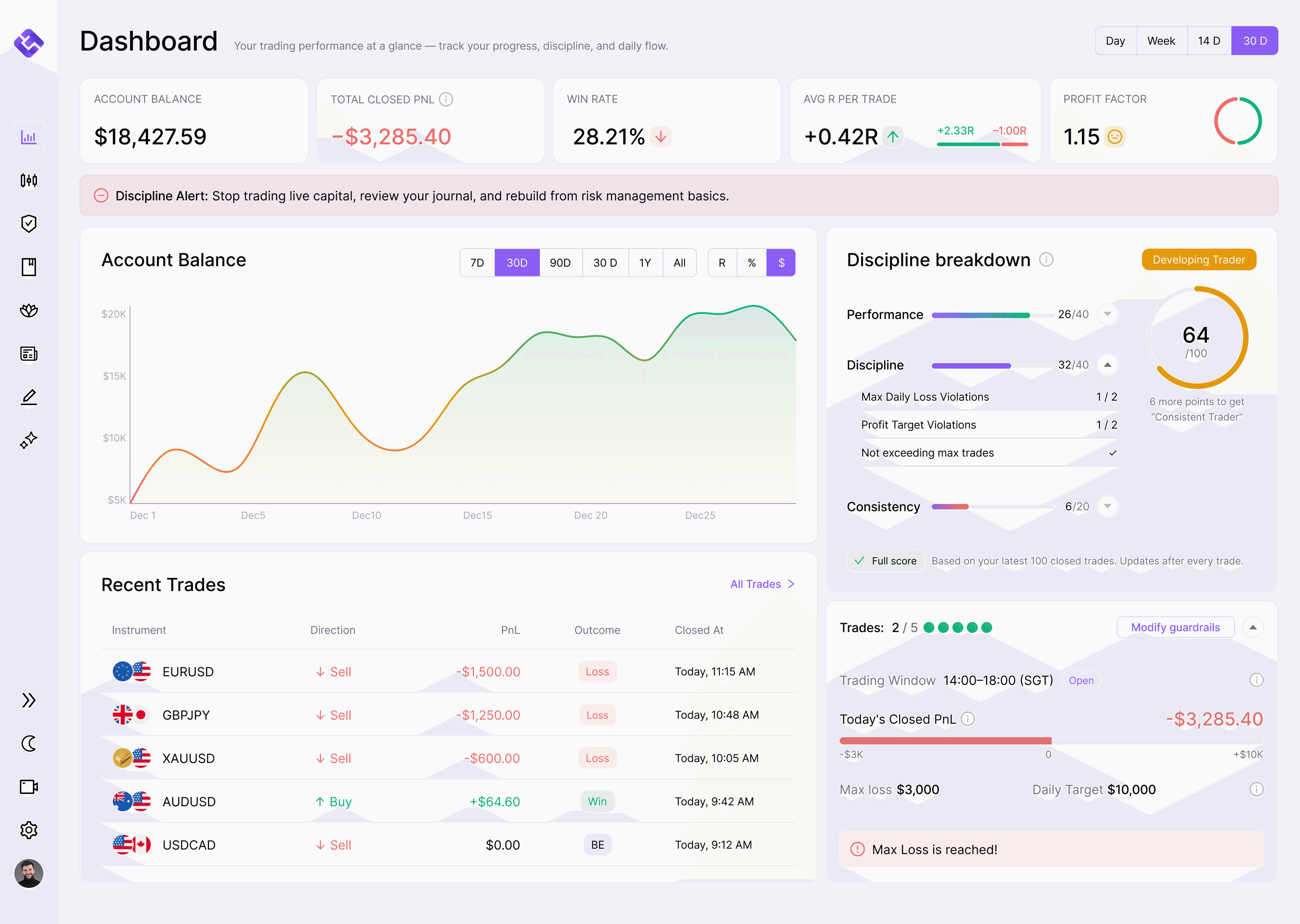
EdgeFlo's AI-powered trading journal auto-imports your trades so you never skip a journal entry out of laziness or frustration. Emotion tagging lets you flag your mental state on each trade, which is exactly the data you need to spot patterns like "I revenge trade every time I feel frustrated after a loss."
The weekly AI report (Plus) surfaces patterns you might miss on your own: which sessions produce your best results, which setups you keep forcing, and where your execution drifts from your plan. That feedback loop turns months of scattered introspection into focused, data-driven improvement.
Your first year will cost you money. The question is whether those losses become tuition or just expenses. A structured feedback loop makes sure you get the lesson every time you pay the price.
The Edge Brief
Receive Insights on trading psychology, discipline, and the behavioral patterns that create consistent traders from our Founder and the EdgeFlo team, delivered to your inbox.
Think different. Trade different.
Is it normal to lose money in your first year of trading?
How much should a beginner risk per trade?
When do most traders become consistently profitable?
How do I stop feeling bad about trading losses?

Turn discipline on.
Every session.
EdgeFlo is the environment serious traders operate inside.
Start 7-Day Free Trial
Cancel anytime.
No long-term commitment.

Think Different, Trade Different.