

Trading Longevity: Outlast Everyone to Win
Most traders quit within a year. The ones who profit are the ones who survive. Learn the long-game framework that professional traders follow.

The traders who make real money are not the ones who find the perfect setup or the secret indicator. They are the ones who are still trading five years from now. Most retail traders disappear within their first year. Some blow their accounts. Some burn out. Some just quietly stop logging in. The market does not reward the fastest learner or the cleverest analyst. It rewards the person who refuses to leave the table. Trading longevity is your single biggest competitive advantage, and almost nobody treats it that way.
TL;DR
Most retail traders quit within 12 months due to blown accounts, burnout, or unrealistic expectations.
The market rewards patience and consistency over speed and cleverness.
Capital preservation through proper risk per trade is the foundation of longevity.
Treat losing months as tuition, not evidence that trading does not work.
The traders who win long term are the ones who kept showing up when everyone else quit.
The Dropout Problem
The statistic gets thrown around a lot: roughly 90% of retail traders lose money. But here is the part people miss. Many of those losses are not caused by bad strategy. They are caused by quitting too early.
A trader finds a strategy, backtests it, sees a 52% win rate with a 2:1 reward-to-risk ratio. On paper, that is a profitable edge. But after two weeks of live trading, they hit a streak of four losses in a row. Doubt creeps in. They tweak the strategy. Then they switch to a different one. Then another. Within three months, they have tried five strategies and committed to none of them.
Sound familiar?
The problem is not the strategy. The problem is the timeline. A 52% win rate needs hundreds of trades to express its edge statistically. Four losses in a row is mathematically normal for that win rate. But the trader expected profits this week, not this year.
The Long Game Framework
Trading longevity is not about grinding through pain. It is about building a structure that keeps you in the market through inevitable rough patches. Here is the framework:
1. Size for survival, not for speed. Your risk per trade determines how long you can survive a losing streak. At 0.5% risk, you can take 40 consecutive losses before your account drops 20%. At 2% risk, that same 20% drawdown arrives after just 10 losses. Size for the worst case, not the average case.
2. Measure in quarters, not weeks. A single week or even a single month tells you almost nothing about your edge. Commit to reviewing performance in 90-day windows. One bad month inside a profitable quarter is noise, not signal.
3. Track process, not just profit. During losing streaks, P&L is a discouraging metric. Switch your focus to process metrics: plan adherence rate, discipline score, setups skipped versus taken. If the process is clean, the results will follow. If the process is broken, fixing it is your actual job.
4. Budget for learning. Treat your first 12 months of live trading as an education expense, not a money-making venture. The traders who survive this phase come out the other side with trading confidence built on real data, not hope.
Walkthrough: The Five-Year Trader
Consider two traders starting in January 2024 with $10,000 accounts trading EUR/USD.
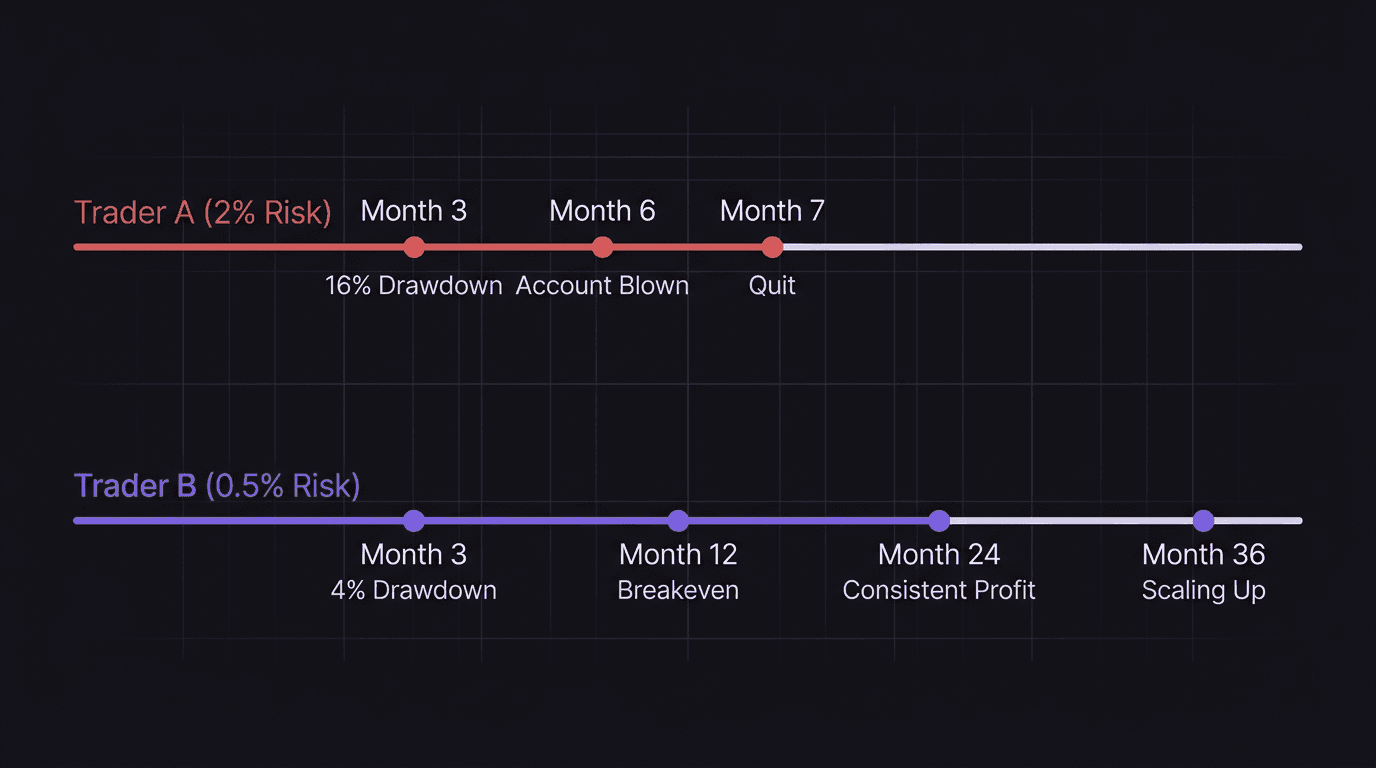
Trader A risks 2% per trade ($200), expects to double the account in six months. Hits a drawdown of eight losses in a row in month three. Account drops from $10,000 to roughly $8,400.
That is a 16% drawdown. Trader A panics, switches strategies, starts risking 3% to "recover faster," blows the account to $5,200 by month six, and quits.
Trader B risks 0.5% per trade ($50), expects to learn for 12 months before judging results. Hits the same eight-loss streak. Account drops from $10,000 to $9,600.
That is a 4% drawdown. Barely noticeable. Trader B sticks with the plan, makes small adjustments from journal data, and after 12 months is breakeven. After 24 months, they are consistently profitable at small size. After 36 months, they start scaling up with proof.
Trader A is gone. Trader B is compounding.
The Three Account Killers
Most traders who fail do not fail because of the market. They fail because of one of these three patterns:
Burnout. Staring at charts for 8 to 10 hours per day, every day, while riding the emotional roller coaster of wins and losses. This is unsustainable. The traders who last treat trading like a job with defined hours, not a lifestyle consumed by screen time.
Revenge cycles. A loss triggers an emotional response. The emotional response triggers a bad trade. The bad trade triggers a bigger loss. This spiral can wipe out weeks of progress in a single afternoon. Knowing when to walk away is a survival skill, not weakness.
Get-rich-quick expectations. Expecting to turn $5,000 into $50,000 in six months leads to oversized positions, excessive risk, and inevitable blowups. The traders who survive set realistic goals: a few percent per month, compounded over years. Boring? Yes. Effective? Absolutely.
If you recognize yourself in any of these patterns, the fix is not a better strategy. The fix is a better framework for staying in the game. Drawdown recovery plans, session limits, and realistic timelines are the scaffolding that keeps you trading through the hard phases.
Capital Preservation Is Not Conservative
Some traders hear "preserve capital" and think it means being timid. That is wrong. Capital preservation means you will still have money to trade with when your next high-probability setup appears.
Every dollar you lose recklessly today is a dollar you cannot compound tomorrow. A 50% drawdown requires a 100% gain just to get back to breakeven. A 20% drawdown only requires 25% to recover. The math is brutal and asymmetric. Protect the capital and the profits will come. Treat the capital recklessly and even the best strategy cannot save you.
The tortoise wins this race. It always has. The traders who survive are not the ones chasing the biggest gains. They are the ones who keep losses small, show up every day, and trust the process over years, not weeks.
How EdgeFlo Supports Trading Longevity
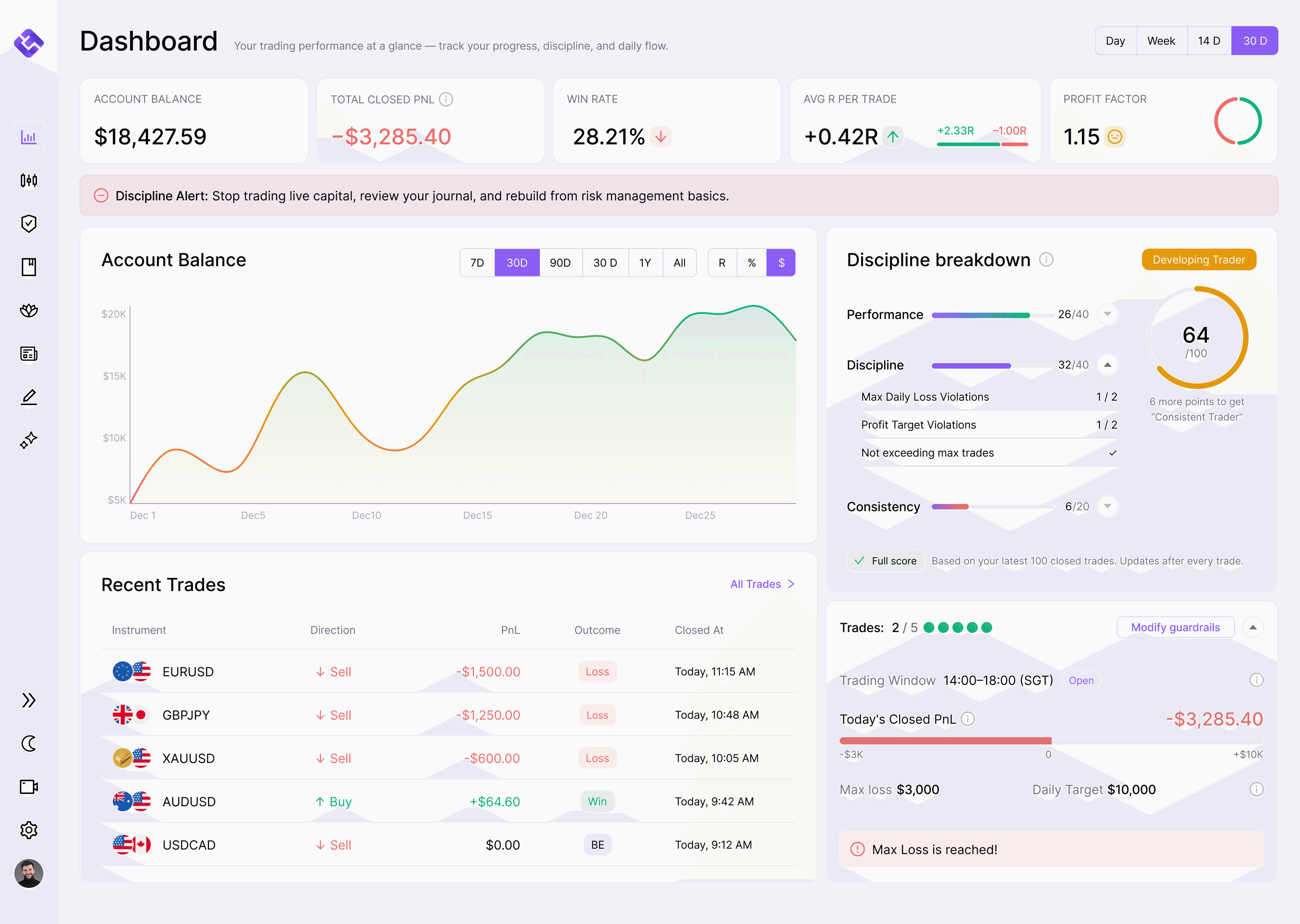
EdgeFlo's risk management tools calculate position size automatically based on your account balance and risk percentage, taking the guesswork out of sizing for survival. Guardrails can cap daily losses and maximum trades per day, creating hard stops that prevent revenge spirals from compounding. You can override them, but the friction is deliberate.
The trading journal tracks your discipline rate and plan adherence over time, so during rough patches you can see whether the process is still intact even when P&L is negative. The weekly AI report (Plus) flags drift patterns before they become account-threatening habits, giving you early warning that something needs to change.
The Edge Brief
Receive Insights on trading psychology, discipline, and the behavioral patterns that create consistent traders from our Founder and the EdgeFlo team, delivered to your inbox.
Think different. Trade different.
Why do most traders quit within a year?
What is trading longevity?
How do I survive a long losing streak?
Is trading longevity more important than skill?

Turn discipline on.
Every session.
EdgeFlo is the environment serious traders operate inside.
Start 7-Day Free Trial
Cancel anytime.
No long-term commitment.

Think Different, Trade Different.