

Equilibrium Level: Why 50% Changes Your Entry Quality
The 50% equilibrium splits premium from discount pricing. Buy below it, sell above it, and watch your entry quality transform. Setup guide included.
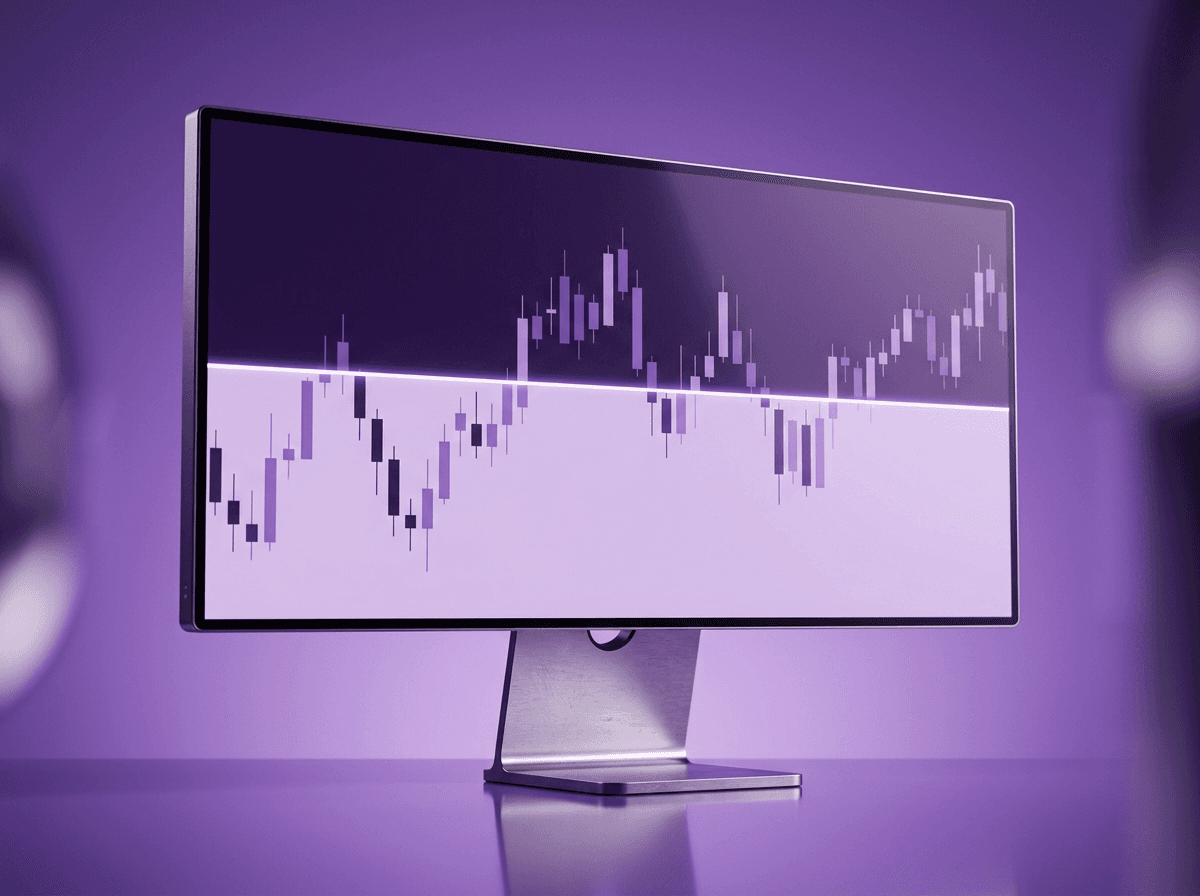
You found a demand zone. The trend is bullish. You feel good about the trade. But the zone sits above the 50% mark of your swing range, and you do not realize that you are about to buy at a premium price with a mediocre risk-to-reward ratio.
The equilibrium level is a single horizontal line that tells you whether you are getting a good deal or a bad one. It splits your swing range in half and creates a filter that most traders ignore until they wonder why their winners barely cover their losers.
TL;DR
The equilibrium level is the 50% midpoint of your swing range.
Above 50% is premium pricing (ideal for sells). Below 50% is discount pricing (ideal for buys).
Demand zones in discount carry higher probability because they sit closer to the structural defense level.
This single filter eliminates entries with poor risk-to-reward before you even analyze candles.
Set it up with a Fibonacci retracement from swing low to swing high on TradingView.
What the Equilibrium Level Means
Take your swing range and find the exact middle. That is the equilibrium. In a range from 1.0870 to 1.0990, the equilibrium sits at 1.0930.
Above 1.0930, price is considered expensive relative to the current range. Buyers who enter here are paying premium prices. Their stop loss (below the swing low at 1.0870) is far away, and their target (the swing high at 1.0990) is close. The math does not favor them.
Below 1.0930, price is considered cheap. Buyers entering here have a tight stop loss and a wide target. The math works.
This is not a magic level where price bounces. It is a filter that tells you whether the location you are considering is statistically favorable or not. Two traders can enter the same trend with the same direction bias, and one makes 3R while the other barely breaks even. The difference is almost always where they entered relative to equilibrium.
Premium vs Discount Pricing
Think about buying anything in the real world. You want to pay less than something is worth. A shirt on sale at 40% off is a better deal than the same shirt at full price. The shirt is identical. Your outcome changes based on the price you paid.
Charts work the same way. When price pulls back into a bullish swing range, it retraces from the swing high. The deeper the pullback, the cheaper the entry. The 50% equilibrium separates "full price" from "discounted."
Premium (above 50%): Overbought territory. Sellers are more likely to step in. If you buy here, your stop is wide and your target is tight.
Discount (below 50%): Oversold territory. Buyers are more likely to step in. If you buy here, your stop is tight and your target is wide.
For bearish setups, flip it. Sell in premium, not in discount.
Walkthrough: The Difference Between Premium and Discount Entries
EUR/USD swing range: 1.0870 (swing low) to 1.0990 (swing high). Equilibrium at 1.0930.
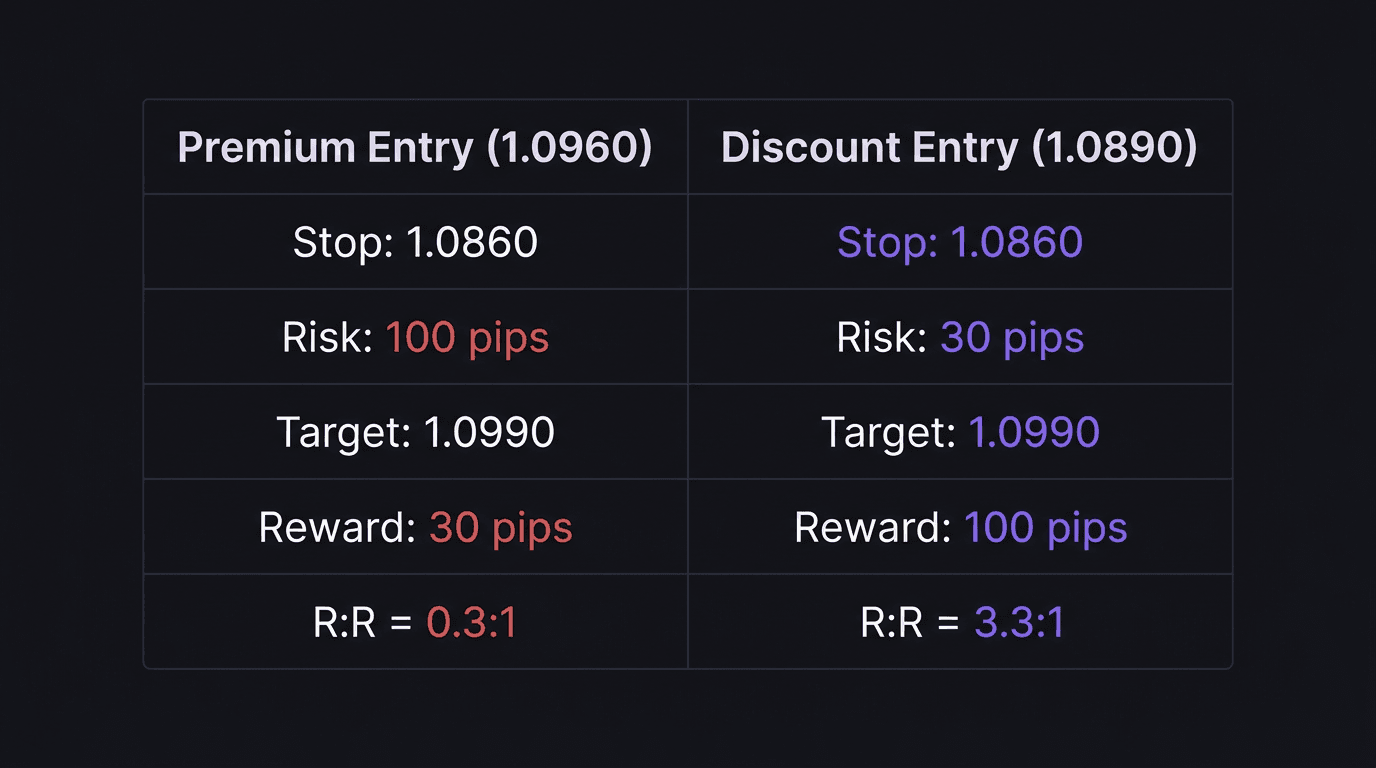
Trader A enters at 1.0960 (premium). Stop below the swing low at 1.0860. Risk: 100 pips. Target at swing high re-test: 30 pips. That is a 0.3:1 risk-to-reward ratio. You need to win 77% of the time just to break even. Good luck.
Trader B waits for discount and enters at 1.0890. Stop below the swing low at 1.0860. Risk: 30 pips. Target at swing high: 100 pips. That is 3.3:1. You only need to win 24% of the time to break even.
Same pair. Same trend. Same week. Trader A is grinding for scraps. Trader B is stacking R.
Why Demand Zones in Discount Win More
Not all demand zones are equal. A demand zone sitting at 1.0950 (premium) and a demand zone sitting at 1.0880 (discount) exist in completely different contexts even though both are valid points of interest.
The discount zone wins more often because it sits closer to the structural pivot. In a bullish range, the swing low is the last line of defense. Demand zones near that swing low are where the most aggressive institutional buying happened, the orders that launched the entire impulsive move upward.
When price pulls back deep into discount and taps that extreme zone, you are trading alongside the strongest order flow. Your stop is just below the swing low (tight), and your upside is the entire range above you (wide).
This is why patience pays. Waiting for price to reach a discount zone instead of grabbing the first zone you see in premium is the single biggest improvement most intermediate traders can make.
How to Set Up the Premium-Discount Tool
On TradingView, the setup takes 30 seconds.
Select the Fibonacci retracement tool from the left toolbar.
In a bullish swing range, click and drag from the swing low to the swing high.
Go into the tool settings. Make the 0.5 level visible and bold. This is your equilibrium line.
The 0 level sits at the swing high. The 1 level sits at the swing low. Everything between 0.5 and 0 is premium. Everything between 0.5 and 1 is discount.
You can color-code the zones. Some traders shade premium in red and discount in green. Others keep it minimal with just the 50% line visible. Whatever helps you see at a glance whether price is cheap or expensive.
The key rule: do not enter a buy above the 50% line. Do not enter a sell below it. This single filter, applied consistently, removes half of your bad trades before entry timing even comes into play.
How EdgeFlo Helps You Track Entry Quality
Knowing about the equilibrium level is step one. The real challenge is tracking whether you actually follow it, trade after trade, week after week.
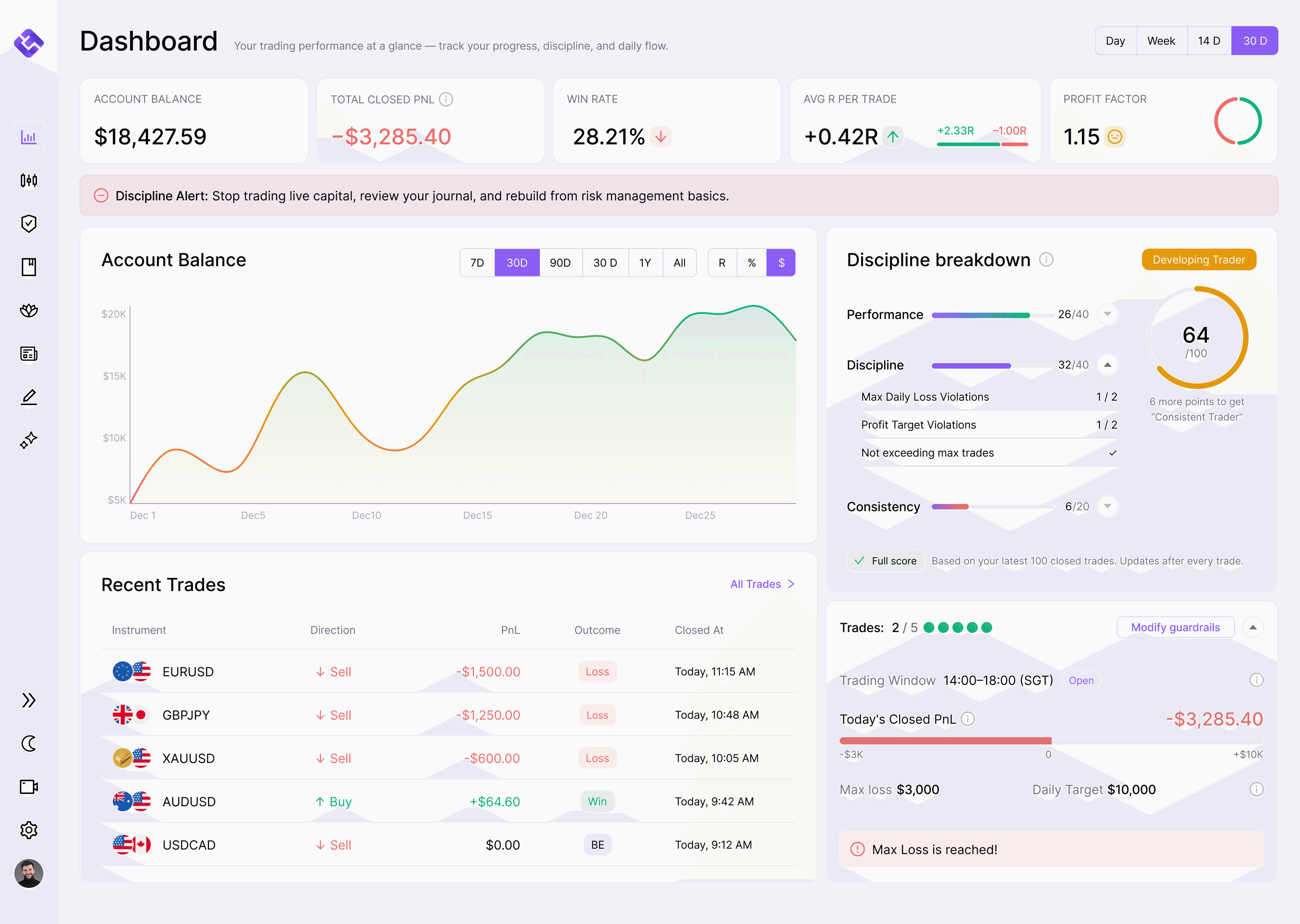
EdgeFlo's dashboard tracks metrics like average R and win rate across all your trades. When you combine that with journal entries tagged by entry location (premium vs discount), patterns emerge fast. You might see that your discount entries average 2.4R while your premium entries average 0.7R. That data makes the rule feel less like theory and more like survival.
The weekly AI report (Plus) can surface this pattern for you, highlighting weeks where premium entries dragged down your overall performance. It is one thing to know the rule. It is another to see your own numbers proving it.
The Edge Brief
Receive Insights on trading psychology, discipline, and the behavioral patterns that create consistent traders from our Founder and the EdgeFlo team, delivered to your inbox.
Think different. Trade different.
What is the equilibrium level in forex trading?
Should I always buy below the equilibrium?
How do I set up the premium-discount tool on TradingView?
Does the equilibrium level work on all timeframes?

Turn discipline on.
Every session.
EdgeFlo is the environment serious traders operate inside.
Start 7-Day Free Trial
Cancel anytime.
No long-term commitment.

Think Different, Trade Different.