

Boring Trading: Why the Best Traders Are Bored
If trading feels exciting, you are probably doing it wrong. Learn why professional traders are bored and how boredom signals a working system.
If trading feels exciting every day, something is wrong. The adrenaline rush of clicking buy, the thrill of watching a candle spike in your favor, the dopamine hit of closing a winner: those feelings are not signs of a profitable trader. They are signs of a gambler. The best traders in the world are bored most of the time. They wait, they execute, they walk away. Boredom is not a side effect of good trading. It is a diagnostic signal that your system is working.
TL;DR
Excitement during trading usually signals overtrading, emotional attachment, or system drift.
Professional traders often take fewer than five trades per week, waiting only for A+ setups.
Boredom means your mechanical plan is running correctly and you are not interfering with it.
The sniper approach (fewer, higher-quality trades) consistently beats the machine-gun approach (high volume, low selectivity).
Measure your "boring score" by tracking how many setups you skipped versus how many you took.
The Machine Gun vs. the Sniper
Think about the difference between spraying 50 rounds at a target from 300 meters and taking one carefully aimed shot. The spray approach feels like effort. It feels productive. You are doing something. But when you check the results, maybe two rounds out of 50 actually hit.
That is what most retail traders do. They scan every pair, enter every session, and take every setup that looks "pretty good." By Friday, they have 30 trades on the books and no idea which ones followed the plan and which ones were impulse clicks.
Now picture the sniper. One round. One target. Full preparation, clean execution, walk away. That single shot has a higher hit rate than all 50 sprayed rounds combined.
Professional traders think like snipers. Some of the most profitable traders take fewer than 20 trades in an entire quarter. They are not in the market for entertainment. They wait for the setup that matches their criteria exactly, execute with full confidence, and then close the platform.
Walkthrough: Machine Gun Month
A trader takes 47 trades in January on EUR/USD and GBP/USD. Win rate: 38%. Average winner: 1.2R. Average loser: 1R.
Do the math. 47 trades at 38% win rate means roughly 18 wins and 29 losses. 18 wins at 1.2R each equals 21.6R. 29 losses at 1R each equals 29R lost. Gross result: negative 7.4R. That is a losing month disguised by the feeling of being busy.
In February, the same trader commits to only A+ setups: weekly structure aligned with daily bias, entry at a confirmed demand zone, minimum 2R target. Total trades: 9. Win rate: 56% (5 wins, 4 losses). Average winner: 2.4R. Average loser: 1R.
5 wins at 2.4R equals 12R. 4 losses at 1R equals 4R. Net: positive 8R. From 9 trades. Fewer trades, better results, lower commissions, and a lot less screen time.
Why Excitement Is a Red Flag
When you feel a rush before entering a trade, ask yourself: is this excitement because the setup is clean, or because the uncertainty itself is thrilling?
If it is the uncertainty, you are gambling. A proper trading edge produces almost mechanical entries. You see the setup, it matches your checklist, you enter, you set your stop and target, you walk away. There is nothing exciting about it. That is the point.
Excitement often masks three problems:
Overtrading: You are bored sitting on your hands, so you manufacture setups that do not exist.
Outcome attachment: You care too much about whether this specific trade wins, instead of thinking in terms of 100 trades.
System drift: You are deviating from your plan, and the novelty of an unplanned trade creates a dopamine spike.
If your trading feels like watching paint dry on most days, congratulations. That probably means you have a system and you are following it.
One Session, Full Focus
Part of the boring trading approach is limiting your exposure to the market. Watching charts from market open to market close does not make you more profitable. It makes you more likely to force bad setups, second-guess good ones, and burn out your decision-making capacity.
Pick one session. London or New York. Show up prepared, execute your best trades during your highest-energy window, and then close the platform.
The more hours you stare at the screen, the worse your decisions become. It is counterproductive. Your best execution comes from focused, limited engagement with the market, not marathon screen time.
Walkthrough: The One-Session Switch
A trader used to monitor charts from 8 AM to 4 PM (London through late New York overlap). They averaged six trades per day. Win rate: 41%. Most of the losses came in the afternoon when energy and focus dropped.
They switched to London only: 8 AM to 11 AM. Three hours. They limited themselves to two trades maximum. First month results: trade count dropped from roughly 120 to 38. Win rate jumped to 55% because every trade had full attention and full energy behind it.
Assuming a 1.5R average winner and 1R average loser in both periods: the old approach netted about 2.5R per month from 120 trades. The new approach netted about 14.5R per month from 38 trades. Less work. More profit. More boring.
The "Boring Score" Metric
Here is a practical way to measure this. At the end of each week, count two numbers:
Setups you saw that sort of looked tradeable
Setups you actually took that matched your full criteria
Divide number two by number one. If the ratio is above 50%, you are probably not selective enough. Professional traders are often below 20%. They pass on the majority of what the market shows them.
Track this ratio alongside your weekly P&L. Over time, you will notice that your best weeks correlate with the lowest ratios. The weeks where you were the most "boring" (passing on nearly everything, taking only one or two trades) tend to be your most profitable.

Boredom Is the Goal
If you find yourself bored during a trading session, do not fight it. Do not open another pair. Do not drop to a lower timeframe to "find something." Sit with the boredom. It means your system is working and you are respecting it.
The traders who survive for years are not the ones with the flashiest setups or the most screen time. They are the ones who mastered the discipline of doing nothing when nothing meets their criteria. Trading is about precision, not screen time. The boring path is almost always the profitable one.
How EdgeFlo Supports Boring Trading
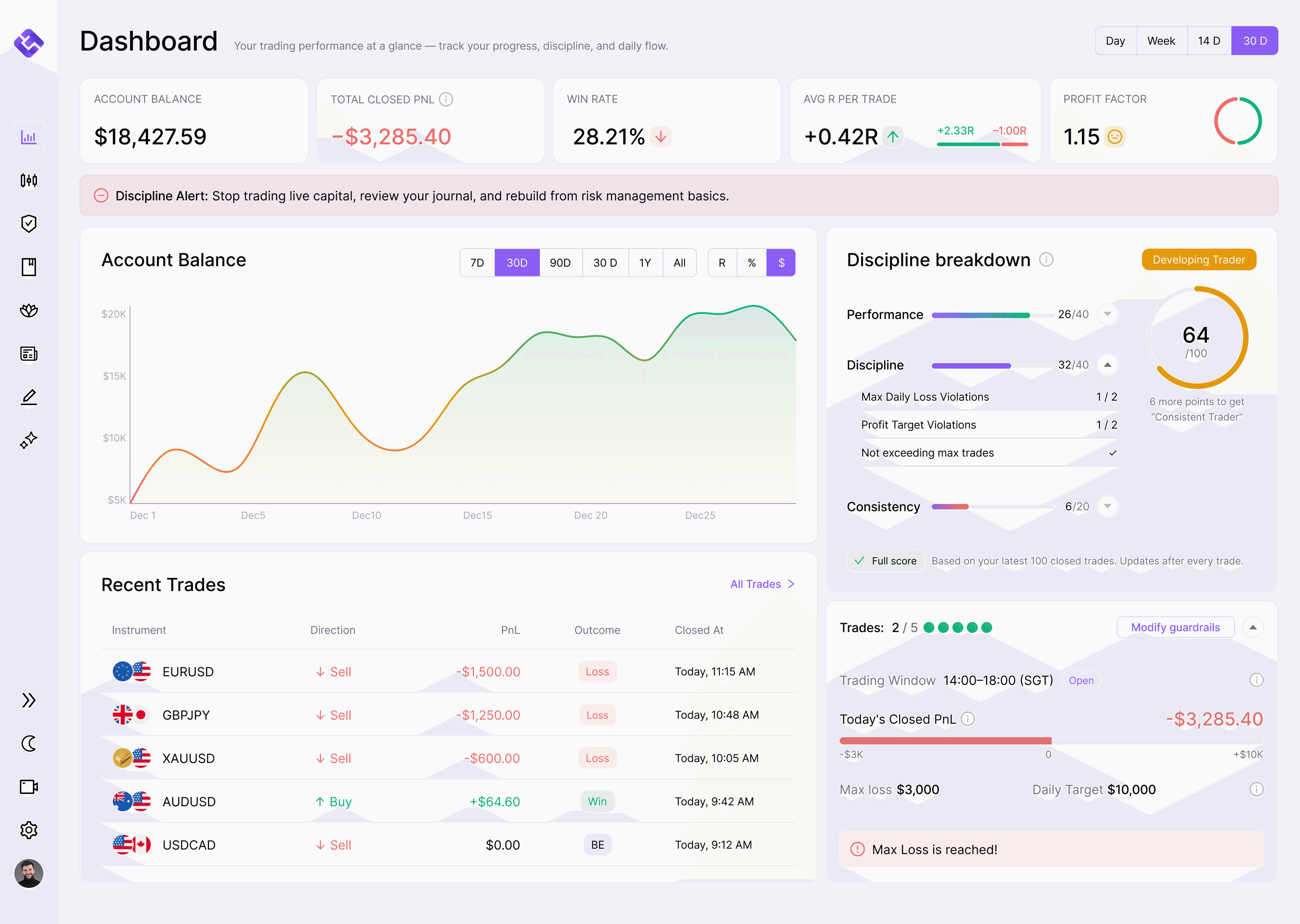
EdgeFlo's trade plan builder (Edge) keeps your A+ criteria visible next to your charts, so you do not have to rely on memory when deciding whether a setup qualifies. The post-trade self-reporting feature lets you tag whether each trade matched your plan, building a discipline score over time.
Guardrails can set a maximum trade count per day, making the "do nothing" decision easier when your quota is reached. You can override them if needed, but the friction is intentional. It turns overtrading from an unconscious habit into a conscious choice you have to actively make.
The Edge Brief
Receive Insights on trading psychology, discipline, and the behavioral patterns that create consistent traders from our Founder and the EdgeFlo team, delivered to your inbox.
Think different. Trade different.
Why is boring trading more profitable?
How many trades per week do professional traders take?
Is it bad if trading feels exciting?
How do I make my trading more boring?

Turn discipline on.
Every session.
EdgeFlo is the environment serious traders operate inside.
Start 7-Day Free Trial
Cancel anytime.
No long-term commitment.

Think Different, Trade Different.