

Less Is More: Eliminate Distractions to Find Your Trading Edge
Multiple indicators, 20 Telegram groups, and five mentors create noise. The subtraction strategy removes everything that does not contribute to your edge.
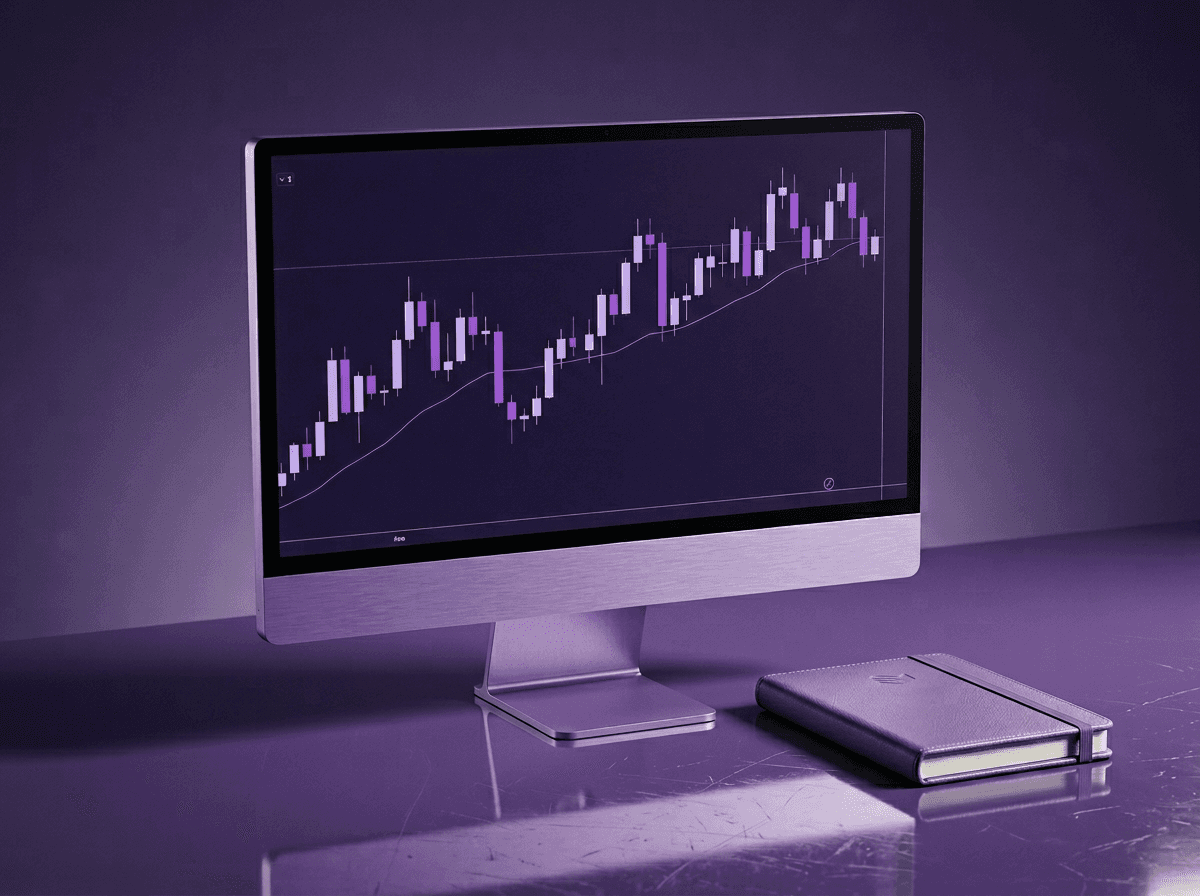
Complexity kills. That is not a bumper sticker. It is a measurable phenomenon in trading. Every indicator you add, every Telegram group you join, every new mentor you follow creates another input that competes for your attention during the moments when focus matters most.
The traders who survive funded accounts and build long-term consistency are almost always the ones who operate with ruthless simplicity. One strategy. A few instruments. Minimal indicators. A written plan. And the discipline to ignore everything else.
TL;DR
Information overload is not a knowledge problem. It is an action problem.
Every tool, indicator, or information source that does not directly contribute to your edge is a distraction.
The subtraction strategy: remove inputs until only your edge remains.
Adding more feels like progress but usually produces worse results.
A clean trading environment means fewer decisions, which means fewer errors.
The Noise That Masquerades as Research
Scrolling through trading Twitter feels productive. Watching three different analysis videos before the market opens feels like preparation. Checking five Telegram signal groups for confirmation feels like due diligence.
None of it is. It is noise dressed up as research.
Real research is reviewing your own trades, testing your own setups, and refining your own system based on your own data. Everything else is someone else's opinion about what the market might do, filtered through their strategy, their risk tolerance, and their biases.
When you consume five different opinions before placing a trade, you are not making a more informed decision. You are making a more confused one. The inputs contradict each other, you hesitate, and you either take no trade (missing your setup) or take a consensus trade (that fits nobody's actual system).
The funded traders who survive do not consume more information. They consume less. They know what their edge is, and they ignore everything that is not directly relevant to executing it.
Why Adding Tools Feels Like Progress but Is Not
There is a specific psychological trap here. When you are losing money, the instinct is to fix the problem by adding something. A new indicator. A new timeframe. A new technique from a YouTube video. A new mentor.
Each addition feels like a step forward. "Now I have more information. Now I can make better decisions." But each addition also increases the cognitive load of every trading decision. With one indicator and one timeframe, the decision is binary: does the setup match your criteria or not? With four indicators across three timeframes, the decision becomes an exercise in contradictions. RSI says overbought. MACD says bullish. Stochastic says neutral. Volume says nothing. What do you do?
You freeze. Or you cherry-pick the indicator that confirms what you already wanted to do (confirmation bias). Neither outcome improves your trading.
The solution is not more information. It is more structure. A mechanical trading plan with clear criteria eliminates the need for additional inputs because the plan already tells you exactly what to look for and what to do when you find it.
Walkthrough: The Trader With 12 Indicators
A trader loads EUR/USD with RSI, MACD, Bollinger Bands, moving averages (20, 50, 200), volume profile, Fibonacci retracement, ichimoku cloud, stochastic, ATR, VWAP, and order flow. Twelve tools on one chart.
A potential long setup forms. RSI: 55 (neutral). MACD: bullish cross. Bollinger: price at upper band (suggests overextension). 20 MA: below price (bullish). 50 MA: above price (bearish). Ichimoku: conflicting cloud signals.
Result: the trader hesitates for 20 minutes, misses the entry, and watches the trade hit what would have been a 3R target. The complexity did not prevent a bad trade. It prevented a good one.
A second trader watches the same pair with one setup: a break of structure above a liquidity sweep on the 1H chart. The criteria are met. Entry taken. 3R winner.
Same market. Same opportunity. Radically different outcomes. The only difference is the signal-to-noise ratio.
The Subtraction Strategy: Remove Until Only Edge Remains
Instead of asking "what can I add to my trading?" ask "what can I remove?"
Start with your chart. Which indicators do you actually use in your entry decisions? If you have not based a trade decision on Ichimoku in the last 30 trades, remove it. It is clutter.
Move to your information sources. Which Telegram groups have provided trade ideas that you actually executed profitably? If the answer is none, leave them. They are distractions.
Examine your watchlist. Which instruments have you actually traded in the last month? If you have 20 pairs on your watchlist but only trade three, delete the other 17. They are attention leaks.
The goal is to reduce your trading environment to only the elements that directly contribute to identifying and executing your edge. Nothing more.
This is the same principle that separates funded traders who maintain discipline from the ones who blow up. The funded survivors do not have more tools. They have fewer distractions.
Walkthrough: The Subtraction Audit
A trader conducts a subtraction audit over one weekend:
Removed: Four Telegram signal groups (never followed any signal that produced a win). Three indicators (RSI, Bollinger, Stochastic: never used in actual entry decisions). Eight watchlist pairs (no trades taken on any of them in 60 days). Two YouTube channels followed for "daily analysis" (conflicting with own system).
Kept: One strategy (1H break of structure). Three instruments (EUR/USD, GBP/USD, gold). One indicator (EMA 50 for trend confirmation). One information source (economic calendar for scheduled events).
The following month, the trader's playbook adherence improved from 72% to 91%. Average R per trade increased from 0.4R to 0.7R. The trader did not get smarter. They got quieter.
What a Clean Trading Environment Looks Like
Clean does not mean empty. It means intentional. Every element in your workspace exists because it serves a purpose in your trading process.
Chart: One to two indicators maximum. Clean candlesticks. Key levels marked. No visual clutter.
Watchlist: Three instruments or fewer. Each one has a documented reason for inclusion in your plan.
Information intake: Zero social media during trading hours. Economic calendar checked once before the session. No Telegram, Discord, or Twitter until the session is over.
Phone: In another room during live trading. Not on your desk. Not on silent. In. Another. Room. Notifications from boredom-driven trades are the most expensive notifications you will ever receive.
Plan: Written, visible, and referenced before every trade. Not memorized, not approximated, but physically present. If you have to think about what your criteria are, you do not have a plan. You have a vague idea.
How EdgeFlo Replaces Five Tools With One Focused System
The distraction problem has a structural cause: most traders use five to seven separate tools (platform, journal, risk calculator, news feed, psychology tracker, dashboard) that do not talk to each other. Switching between them creates cognitive overhead and leaves gaps where information falls through.
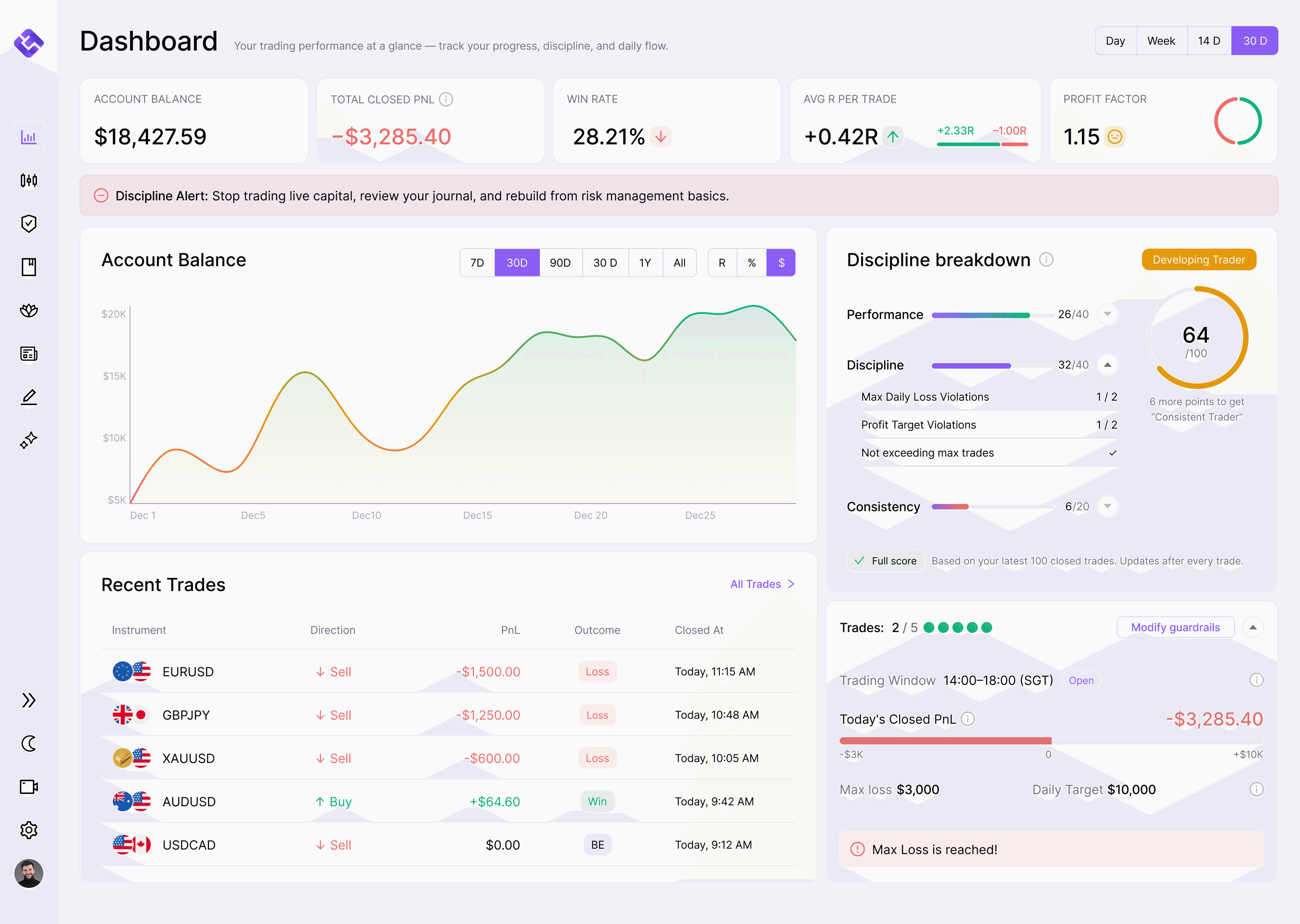
EdgeFlo consolidates execution, journaling, risk management, news, and analytics into one platform. Your trading plan lives next to your chart. Your risk calculator is built into the order entry. Your journal auto-imports trades. Your dashboard tracks consistency metrics. Your economic calendar filters for your watchlist.
That consolidation is not about convenience. It is about reducing the number of context switches in your trading workflow. Every context switch (tab, app, browser) is a moment where focus breaks and distraction can slip in. Fewer switches means cleaner execution.
For funded traders, this matters even more. The prop firm challenge requires the same precise execution, day after day, with zero room for the kind of errors that scattered tools create. A single, focused system removes the structural noise that causes those errors.
Your edge is not hiding in the next indicator or the next signal group. It is already in your data, waiting for you to remove the noise and see it clearly.
The Edge Brief
Receive Insights on trading psychology, discipline, and the behavioral patterns that create consistent traders from our Founder and the EdgeFlo team, delivered to your inbox.
Think different. Trade different.
How do I know if something is a distraction in my trading?
Should I follow multiple trading mentors?
Why does adding more indicators feel like progress?
What does a clean trading environment look like?

Turn discipline on.
Every session.
EdgeFlo is the environment serious traders operate inside.
Start 7-Day Free Trial
Cancel anytime.
No long-term commitment.

Think Different, Trade Different.