

Desensitize to Money in Trading: Think in R, Not Dollars
Big dollar numbers freeze your execution. Learn how to desensitize to money in trading by switching to R-based thinking and gradual exposure.
How to Desensitize to Money So Dollar Signs Stop Ruining Your Trades
You know exactly what to do on a demo account. The setups are clear, the entries are clean, and you let winners run without flinching. Then you switch to live, and a $200 floating loss makes you close a perfectly good trade. The problem is not your strategy. The problem is that dollar signs hijack your execution.
Learning to desensitize to money in trading is the bridge between "I know how to trade" and "I can actually trade."
TL;DR
Dollar fixation causes traders to exit early, skip setups, and break rules at higher lot sizes.
R-based thinking replaces emotional dollar amounts with neutral system metrics.
The demo-to-live gap exists because real money activates loss aversion that demo never triggers.
Gradual exposure (small lot increases over 30-trade blocks) builds tolerance naturally.
Every trade should feel like one of a thousand, not a life-or-death event.
Why Big Numbers Freeze You
On a $500 demo account, a 30-pip loss on 0.1 lots is $30. Your brain processes it as a number in a game. No emotional charge.
On a $50,000 funded account, a 30-pip loss on 2 lots is $600. Your brain no longer sees a game. It sees rent money, car payments, or weeks of work at a previous job disappearing in real time. The rational part of your brain knows that $600 is 1.2% of the account and perfectly within the plan. The emotional part does not care about percentages. It cares about the dollar figure.
This is loss aversion at work. Research in behavioral economics shows that humans feel the pain of losing roughly twice as intensely as the pleasure of gaining the same amount. A $600 loss stings harder than a $600 win feels good. So when the numbers get big enough to trigger that response, you start making decisions to avoid the pain rather than follow the plan.
The result: you close winners too early to "lock in" whatever is there. You skip valid entries because the potential loss feels too large. You tighten your stop loss to reduce the dollar risk, which gets you stopped out by normal price movement. Every one of these actions damages your edge.
The Demo-to-Live Number Shock
The jump from demo to live is where most traders first encounter this problem. On demo, there is zero consequence to losing. Your brain treats it like a strategy game. Setups are taken without hesitation, losers are accepted without reaction, and the equity curve reflects your actual system performance.
The moment real money enters the equation, everything changes. A demo-to-live transition reveals your true relationship with money, and for most traders, that relationship is unhealthy.
Walkthrough: Demo vs Live, Same Trader
A trader backtests and forward tests a pullback strategy on EUR/USD. Demo results over 60 trades: 38% win rate, average winner 3.5R, average loser 1R. Expectancy: (0.38 times 3.5R) minus (0.62 times 1R) = 1.33R minus 0.62R = 0.71R per trade. Positive edge confirmed.
She moves to a $10,000 live account at 0.5% risk ($50 per trade). First 10 trades: 4 wins, 6 losses. Planned outcome at 0.71R expectancy over 10 trades: roughly 7.1R total, or $355.
Actual outcome: She closed 2 of the 4 winners early (at 1.5R instead of 3.5R) because the floating profit was "enough." She skipped 3 valid setups because the $50 risk "felt like a lot today." She took 7 trades instead of 10.
Revised results: Wins averaged 2.2R (not 3.5R). She took fewer trades. Total result: roughly 2.1R instead of 7.1R. The system performed. She did not.
The difference between $355 and $105 is not the market. It is what $50 means to her emotionally.
Gradual Exposure Strategies
You cannot think your way out of money sensitivity. You have to experience your way out of it, gradually, in controlled increments.
Strategy 1: Think in R, Not Dollars
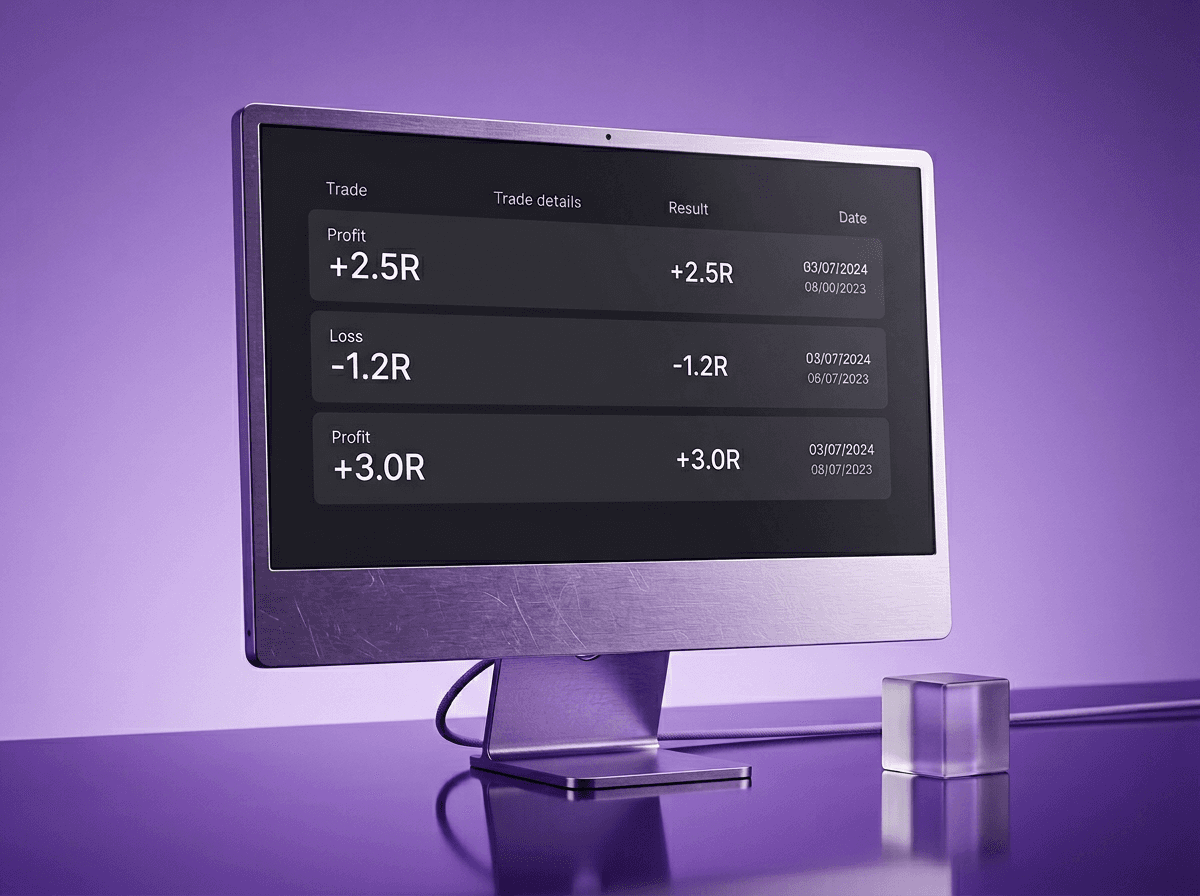
R-based thinking is the most powerful desensitization tool available. Instead of seeing a $500 loss, you see a 1R loss. Instead of celebrating a $1,500 win, you log a 3R win.
The language matters. "I lost $500 today" triggers an emotional response tied to what $500 means in your life. "I lost 1R today" triggers a system response tied to what 1R means in your edge. One is personal. The other is data.
Set up your journal to track R values, not dollar values. When you review your week, look at total R gained or lost. When you evaluate your system, calculate expectancy in R. After a few weeks, you will notice that R feels neutral while dollars feel heavy. That is the point.
Strategy 2: Start With Micro Lots
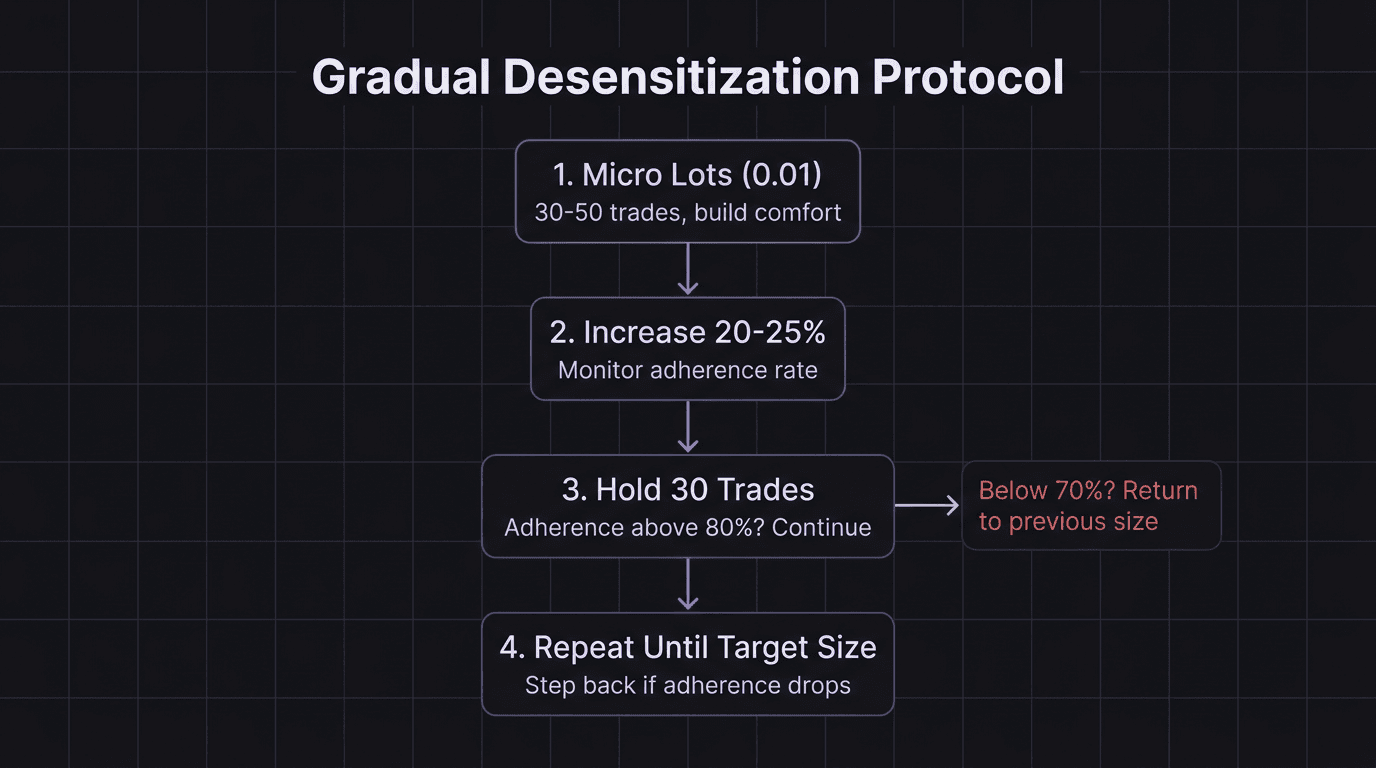
If the jump from demo to live is too jarring, start with micro lots (0.01 lots on a standard account). At $0.10/pip on EUR/USD, a 30-pip loss is $3. Your system still runs on real capital with real consequences, but the dollar figures are too small to trigger emotional responses.
After 30 to 50 trades at micro size, increase to 0.02 lots. Then 0.03. Each step should be small enough that you do not notice it emotionally. If you start hesitating or closing early, the increase was too large. Step back.
Strategy 3: Remove Dollar Displays
Some platforms let you hide the dollar P&L column and show only pips or R values. If yours does, use that setting during live trading. Check the dollar P&L only during your weekly review, when you are calm and analytical. During the session, dollars are noise. Pips or R values are signal.
Strategy 4: Pre-Accept the Loss
Before every trade, say the risk amount out loud. "I am risking $250 on this trade. If it hits my stop, I lose $250. I accept that outcome before I click buy." This pre-commitment reduces the shock when the loss actually happens. You already processed it. It is not new information.
Trading fear is always worst when the loss is unexpected. When you accept the loss before the trade, the emotional charge drops significantly.
Treating Every Trade as One of a Thousand
The ultimate desensitization happens when you genuinely believe that any single trade is irrelevant.
Your edge plays out over 100, 500, 1,000 trades. This specific trade is one data point. It will either add to your R total or subtract from it, and neither outcome changes the system's viability.
Probabilistic thinking is what gets you there. A 40% win rate means 6 out of your next 10 trades will lose. That is not a problem. That is the plan. The $500 you lose on trade 4 is a cost of running the business, identical in function to the $500 loss on trade 72 or trade 318.
When you reach this mindset, dollar amounts become administrative details. You check them for position sizing calculations and monthly accounting. You do not check them during the trade. The only number that matters in the moment is R.
Walkthrough: The Desensitized Trader
A trader manages a $100,000 funded account. Risk: 0.5% per trade ($500). She has traded 200 live trades at this size over 4 months, graduating from $10,000 to $50,000 to $100,000 through gradual scaling.
She enters a buy on EUR/USD at 1.0850. Stop loss at 1.0820 (30 pips). Target at 1.0940 (90 pips). Lot size: 1.67 lots. 1.67 lots = $16.70/pip. $16.70 times 30 pips = $501 risk. $16.70 times 90 pips = $1,503 target.
Price drops 20 pips. She is down $334. She checks her position, confirms the setup is still valid, and goes for a walk. No adjustment. No early exit.
Price reverses, runs to target. Profit: $1,503, or 3R. She logs "+3R" in her journal. Not "$1,503."
The next day, the same setup fires. She enters. It hits her stop. Loss: $501, or 1R. She logs "-1R" and opens her review template. No anger. No revenge entry. Just the next trade in a series of a thousand.
That calm did not come from willpower. It came from 200 trades of gradual exposure where each increment was small enough to process emotionally before the next one arrived.
How EdgeFlo Helps You Think in R, Not Dollars
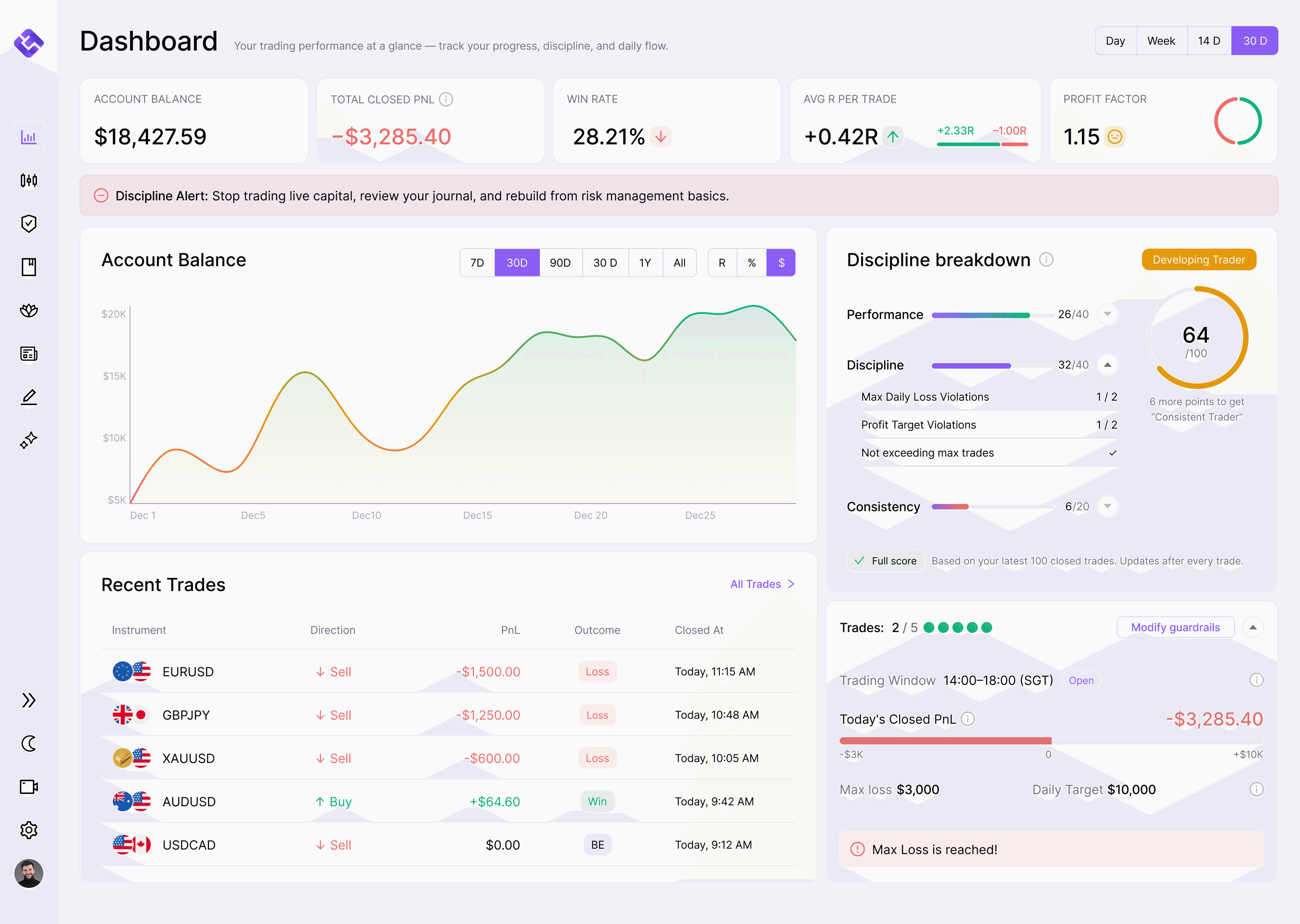
EdgeFlo's trading dashboard and journal display your results in R multiples alongside dollar values, making it natural to think in system terms instead of emotional ones. The auto risk calculator removes the mental math that makes large lot sizes feel intimidating. You enter your risk percentage and stop distance, and the correct position size appears.
The weekly AI report tracks your execution quality across lot size changes. If your plan adherence drops after a size increase, the report flags it before the damage compounds. Guardrails scale automatically with your account, keeping the same percentage protection whether you are trading micro lots or full lots.
The goal is not to ignore money. It is to put money in its proper place: a measurement tool for your system, not an emotional trigger that overrides it.
The Edge Brief
Receive Insights on trading psychology, discipline, and the behavioral patterns that create consistent traders from our Founder and the EdgeFlo team, delivered to your inbox.
Think different. Trade different.
How do I stop being emotional about money in trading?
What does thinking in R mean?
Why does going from demo to live feel so different?
How long does it take to desensitize to bigger lot sizes?

Turn discipline on.
Every session.
EdgeFlo is the environment serious traders operate inside.
Start 7-Day Free Trial
Cancel anytime.
No long-term commitment.

Think Different, Trade Different.