

Demo to Live: Why Your Results Drop
Profitable on demo, broke on live. The emotional gap between simulated and real money trading explains why results drop and how to bridge the transition.
You spend three months on demo. You follow your plan. You hit your targets. Your equity curve looks good. You think: I am ready for live trading.
Two weeks into your live account, you are down 8%. Same strategy. Same pairs. Same timeframes. The only thing that changed is that the money is real.
The gap between demo and live is not a strategy gap. It is an emotional gap. Your brain processes simulated risk and real risk in fundamentally different ways, and that difference rewires your execution from the moment you fund your account.
TL;DR
Demo and live trading use the same strategy, but your brain treats them as completely different activities.
Real money activates your threat detection system (amygdala), which causes fear-driven decisions that did not exist on demo.
The transition fails when traders jump from $0 at risk to full position sizes overnight.
Gradual exposure through micro lots, small accounts, and forward testing bridges the gap.
The emotional skill of executing under pressure takes months of live experience to develop.
Same Strategy, Different Brain
On demo, nothing is at stake. Your amygdala (the part of your brain that detects threats) stays quiet because there is no real consequence to a losing trade. You follow your plan easily because there is no fear attached to the outcome.
The moment you deposit your own money, your brain registers every trade as a potential loss of something you worked hard to earn. That activates the fight-or-flight response. Suddenly, a 20-pip pullback that you held calmly on demo sends your pulse racing on live. A losing streak that was "normal variance" on demo feels like evidence that you are a terrible trader when it happens with real money.
The strategy did not change. Your emotional state did. And emotional state drives execution quality more than any chart pattern ever will.
The Five Ways Live Trading Breaks Your Demo Habits
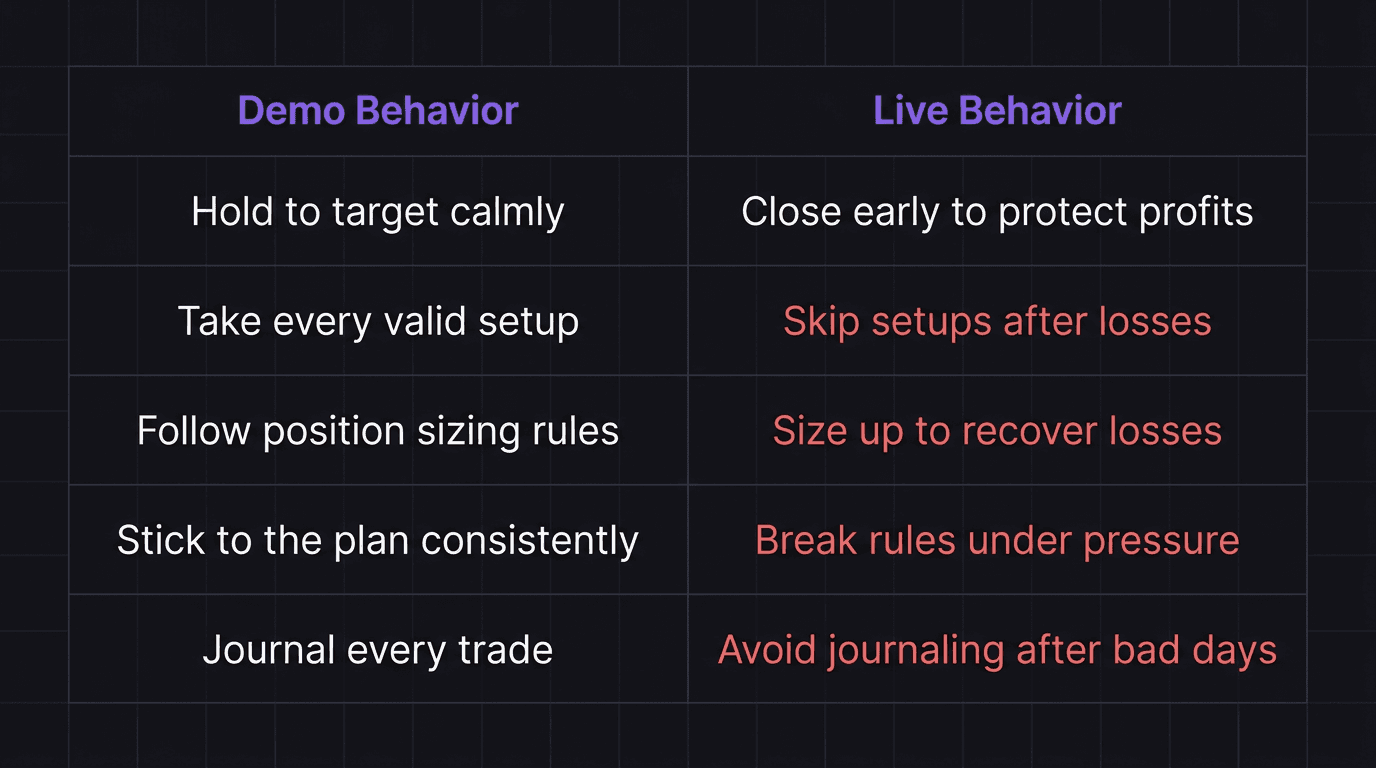
1. You Close Winners Early
On demo, you held trades to target because the outcome did not matter emotionally. On live, unrealized profit feels like something you can lose. A +30-pip winner that has not hit target becomes something to protect. You close it at +15 because the fear of giving back gains overwhelms your plan.
2. You Skip Valid Setups
After two live losses, your confidence drops. The next setup aligns with your plan perfectly. On demo, you would take it without hesitation. On live, you freeze. What if this one loses too? You sit on your hands. The trade works. Now you feel worse.
3. You Increase Size Too Fast
Demo accounts often have inflated balances ($50,000 or $100,000). You get comfortable trading 1.0 lots. When you open a live account with $2,000, you trade 0.5 lots because "it is just half of what I traded on demo." But 0.5 lots on a $2,000 account means a 30-pip stop costs you $150, or 7.5% of your account. That is not a risk management plan. That is a coin flip on survival.
4. You Break Your Rules Under Pressure
On demo, following rules feels easy because breaking them has no consequence worth worrying about. On live, the pressure to recover from a loss or protect a gain creates an overwhelming urge to deviate. You move your stop. You add to a loser. You take a trade that is not on your checklist.
5. You Journal Less (or Stop Entirely)
Demo journals are often clean and consistent because there is no emotional pain to process. On live, traders avoid their journal because reviewing losses forces them to confront feelings they would rather ignore. The journal dies first, and with it goes the feedback loop that would help them improve.
The Bridge: Gradual Exposure to Real Risk
The mistake most traders make is treating the demo-to-live transition as a binary switch. One day you are trading fake money, the next day you are risking your savings. Your nervous system cannot handle that jump.
The bridge is a gradient, not a cliff.
Step 1: Forward Test With Micro Lots
After your demo results are consistent (at minimum 50 trades with positive expectancy), move to a live account with micro lots (0.01). The dollar risk per trade is tiny, maybe $1 to $3, but the psychological shift is real. You are now trading real money. Your brain knows it.
Stay at this level until you can execute your plan for at least 30 trades without deviating. This is forward testing under live conditions. The data matters, but the emotional training matters more.
Step 2: Scale in Stages
Once you can execute cleanly at 0.01 lots, move to 0.03. Then 0.05. Then 0.10. Each increase introduces more financial risk, and each increase gives your amygdala a slightly bigger stimulus to process.
The rule: do not scale up until you have proven you can follow your plan at the current size. If you start breaking rules at 0.10 lots, drop back to 0.05 until the discipline returns.
Step 3: Treat Every Stage as a Test
The demo phase tests your strategy. The micro-lot phase tests your execution under real conditions. The scaling phase tests your psychological limits.
If you are preparing for a prop firm challenge, this staged approach is even more important. Funded challenges introduce a second layer of pressure (pass the evaluation or lose the fee) on top of the base layer of live trading stress.
Walkthrough: The Gradual Transition
A trader finishes 3 months on demo with 80 trades logged. Win rate: 42%. Average winner: 65 pips. Average loser: 30 pips. Expectancy is positive.
She opens a live account with $500 and trades 0.02 lots on EUR/USD. Risk per trade: 30 pips at $0.20/pip = $6. That is 1.2% of her account.
She trades this way for 6 weeks, taking 35 trades. She notices she closes 4 trades early (something she never did on demo). She journals these, noting the emotional state each time. By trade 25, the early closes stop because her nervous system has adapted to seeing real P&L fluctuations.
She scales to 0.05 lots. Risk per trade: 30 pips at $0.50/pip = $15, or 3% of her account. She notices mild anxiety on the first few trades but holds to plan. After another 30 trades, she scales to 0.10 lots.
Building Confidence Through Proof, Not Feelings
The real fix for the demo-to-live gap is not "believe in yourself." That is empty advice that crumbles under pressure.
Real trading confidence comes from proof: a track record of live trades where you followed your plan and the math worked out over a sample. Fifty trades is a start. One hundred trades gives you something to trust.
When you have 100 live trades that show positive expectancy, your brain has a reference point. The next drawdown is not evidence that you are failing. It is part of a dataset you have already survived. Your amygdala calms down because the threat has been encountered before and did not result in catastrophe.
This is why the staged approach works. Each level of risk builds a layer of proof. And that proof is what your nervous system needs to let your rational mind stay in control. Developing a funded trader mindset follows the same principle: discipline built through repetition under real conditions, not theory absorbed during comfortable demo sessions.
How EdgeFlo Helps You Bridge the Gap
EdgeFlo makes the transition from demo to live less chaotic by keeping your structure visible. Your trading plan (Edge) stays next to your chart, so the rules you wrote during calm preparation are right there when pressure hits. Post-trade self-reporting lets you flag whether you followed the plan or deviated, building the self-awareness data that demo trading never produces.
Guardrails restrict your trading when you hit daily loss limits or max trade counts. You can override them, but the override forces a conscious decision. During the fragile early weeks of live trading, that pause between impulse and action is the difference between a controlled session and a blown account.
The goal is not to make live trading feel like demo. It never will. The goal is to build an environment where the emotional pressure of real risk gets contained by structure instead of being amplified by chaos.
The Edge Brief
Receive Insights on trading psychology, discipline, and the behavioral patterns that create consistent traders from our Founder and the EdgeFlo team, delivered to your inbox.
Think different. Trade different.
Why am I profitable on demo but losing on live?
How long should I trade demo before going live?
Does demo trading build bad habits?
Should I start live trading with a small account?

Turn discipline on.
Every session.
EdgeFlo is the environment serious traders operate inside.
Start 7-Day Free Trial
Cancel anytime.
No long-term commitment.


Think Different, Trade Different.