

Conviction Investing: How Traders Can Build a Long-Term Portfolio
Conviction investing means buying what you deeply understand and holding through volatility. Learn how trading skills transfer to long-term portfolio building.

Trading is a job. A high-skill, high-stress job that pays well when you do it right, but still a job. You sit at a screen, analyze charts, execute trades, and exchange your time for money. Every dollar you earn requires your presence.
Investing is what turns that income into wealth that works without you.
Conviction investing means buying assets you deeply understand, at prices you believe are fair, and holding them through volatility because you trust the long-term trajectory. For traders, this is the missing piece: the pipeline that converts active trading income into passive, compounding wealth.
TL;DR
Trading is active income. Investing is the vehicle that turns trading profits into passive wealth.
Conviction investing means buying quality assets you understand and holding through drawdowns.
Quality over value: buy great assets at fair prices, not mediocre assets at cheap prices.
Your trading skills (analysis, risk assessment, emotional control) transfer directly to investment decisions.
Allocate a fixed percentage of monthly trading profits to long-term investments.
What Is Conviction Investing
Conviction investing is simple in concept and brutal in execution. You identify assets you believe will appreciate significantly over 5 to 10 years. You buy them. Then you hold them through every dip, crash, and period of sideways chop without selling.
The "conviction" part is critical. This is not casual speculation or buying a stock because someone on social media said it would go up. Conviction comes from understanding what you own. You know the business model, the competitive advantage, the market trends that support growth. When the price drops 30%, you do not panic, because your analysis has not changed.
Think of it this way: if a stock drops from $430 to $300, most people panic. A conviction investor asks, "Has anything fundamental changed?" If the answer is no, the drop is a buying opportunity, not a reason to sell.
This philosophy follows the principle famously attributed to Charlie Munger: buy great companies at fair prices rather than fair companies at great prices. You pay for quality because quality compounds. A cheap stock with no competitive advantage stays cheap. A quality asset at a fair price can multiply over a decade.
Quality vs Value: The Munger Approach
Most new investors make the same mistake: they look for bargains. They screen for low price-to-earnings ratios, beaten-down sectors, and "undervalued" names. Sometimes this works. Often, things are cheap for a reason.
The quality approach flips this. Instead of asking "What is cheap right now?" you ask "What is worth owning for the next 10 years?"
Quality assets share three characteristics:
Durable competitive advantage. The company does something difficult to replicate. A network effect, a technology moat, a brand that commands pricing power.
Secular growth trend. The industry is growing structurally, not cyclically. Technology adoption, energy transition, digital infrastructure. These trends do not reverse in a recession. They slow down, but they do not stop.
Competent leadership. Management that sets ambitious goals and consistently executes. Not perfect execution, but a pattern of delivering on stated objectives.
When you find an asset that checks all three boxes, the price you pay matters less than you think. Overpaying by 10% on something that grows 500% in a decade is irrelevant in hindsight.
Walkthrough: The Wrong Kind of Value
A trader sees a retail stock trading at $8, down from $45 two years ago. The price-to-earnings ratio is 4. "It is cheap," they think. They buy 500 shares at $8, investing $4,000.
Over the next year, the company closes 200 stores, reports declining revenue, and the stock drops to $3. The trader is down $2,500 on a $4,000 investment.
Now compare: another trader buys 20 shares of a quality tech company at $200. It drops to $170 during a market correction. The trader holds. Within 18 months, it recovers to $320.
Same initial investment. The "cheap" stock lost 63%. The quality stock gained 60%. The difference was not timing. It was conviction in quality versus chasing value.
How Trading Skills Transfer to Investing
If you can trade profitably, you already have skills that most investors lack. The transfer is more direct than you think.
Analysis discipline. You know how to read charts, assess trend direction, and identify when an asset is at a structural support or resistance level. This same skill helps you time your investment entries. You will never buy the exact bottom, but you can avoid buying the exact top.
Risk assessment. Traders understand drawdowns. You know that a 20% drop in a portfolio is normal, not catastrophic. Most investors panic during corrections because they have never experienced a 20% drawdown on a daily basis. You have. Your risk tolerance is calibrated by experience.
Emotional control. Trading teaches you to separate emotion from decision-making. When your investment portfolio drops 15%, the same mental framework applies: does your thesis still hold? If yes, hold. If no, exit. No drama.
Data-driven decisions. You use equity curves, expectancy calculations, and win-rate analysis to evaluate your trading. Apply the same rigor to your investments. Track returns quarterly. Evaluate whether each position is performing relative to your thesis.
The one thing that does not transfer is impatience. Trading rewards quick decision-making. Investing punishes it. You need to build the muscle of doing nothing for months while your investments compound.
Building a Portfolio That Compounds Without Screen Time
The goal is straightforward: build a portfolio that grows while you are not watching it. Here is how to structure it.
Step 1: Set your allocation percentage. Decide what percentage of your monthly net trading profits goes to investments. A starting point is 20% to 30%. If you net $5,000 from trading in a month, $1,000 to $1,500 goes into your investment account.
Step 2: Pick 3 to 5 conviction positions. Do not over-diversify. Diversification is a hedge against ignorance, as Munger put it. If you have done deep research and you understand what you own, 3 to 5 positions is enough. Spread across uncorrelated sectors or asset classes.
Step 3: Deploy quarterly. Rather than buying impulsively every time you have cash, accumulate your trading profits monthly and deploy them quarterly. This forces discipline and lets you buy at better prices during pullbacks.
Step 4: Do not touch it. This is the hard part. Your trading brain wants to optimize, manage, and adjust. Your investment portfolio should be boring. Set your positions. Review quarterly. Rebalance annually if needed. The compound growth comes from time, not from intervention.
Step 5: Reinvest dividends. If your positions pay dividends, reinvest them. Dividend reinvestment is the quiet engine of long-term compounding. It feels insignificant at first. Over 10 years, it adds up dramatically.
This is how trading profits fund long-term wealth. The active income from trading, including prop firm payouts, fuels the passive growth of your portfolio. Any funded trader with consistent monthly payouts has the raw material to build real wealth outside the charts.
How EdgeFlo Tracks Trading Profits for Investment Allocation
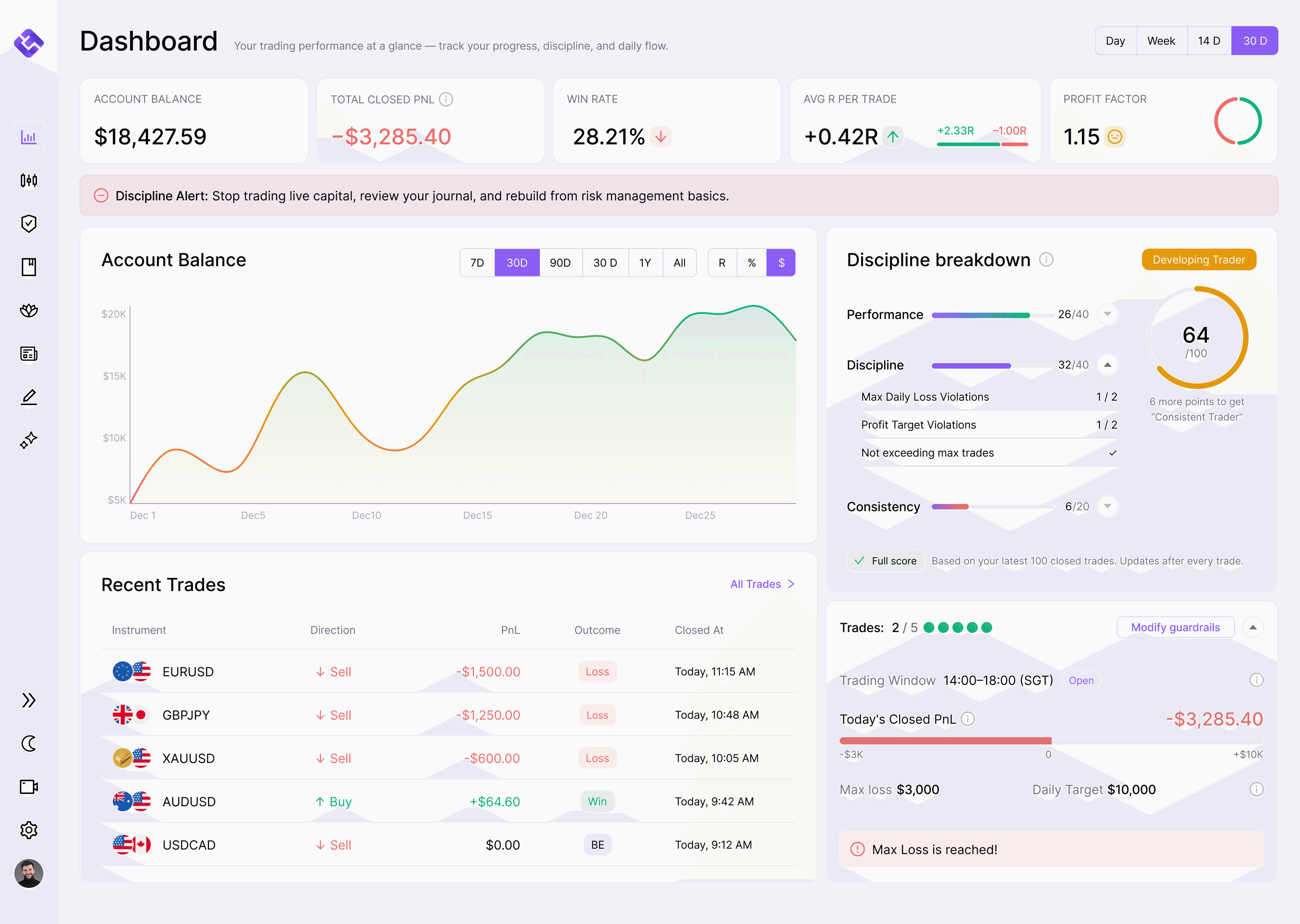
EdgeFlo tracks your cumulative monthly P&L through the dashboard. You can see exactly how much you netted after each month, broken down by pair, session, and strategy. This gives you a clear number to work with when calculating your investment allocation.
Instead of guessing how much you can move to investments, you work from clean data. If your trading goals include building a long-term portfolio, the dashboard becomes your starting point for knowing exactly how much capital your trading generates each month.
The compounding math works in your favor. Trade consistently, invest the surplus, and let time do the rest. The portfolio you build today with your trading profits could be the thing that lets you step away from the screen in 10 years.
The Edge Brief
Receive Insights on trading psychology, discipline, and the behavioral patterns that create consistent traders from our Founder and the EdgeFlo team, delivered to your inbox.
Think different. Trade different.
What is conviction investing for traders?
How is conviction investing different from value investing?
What percentage of trading profits should go to investing?
Can day traders really build long-term wealth?

Turn discipline on.
Every session.
EdgeFlo is the environment serious traders operate inside.
Start 7-Day Free Trial
Cancel anytime.
No long-term commitment.

Think Different, Trade Different.