

The Consolidation Trap: Why First Breakouts Fail
Consolidation ranges build liquidity on both sides. The first breakout sweeps stops before the real move fires the opposite direction. Learn entry rules for post-sweep breakouts.
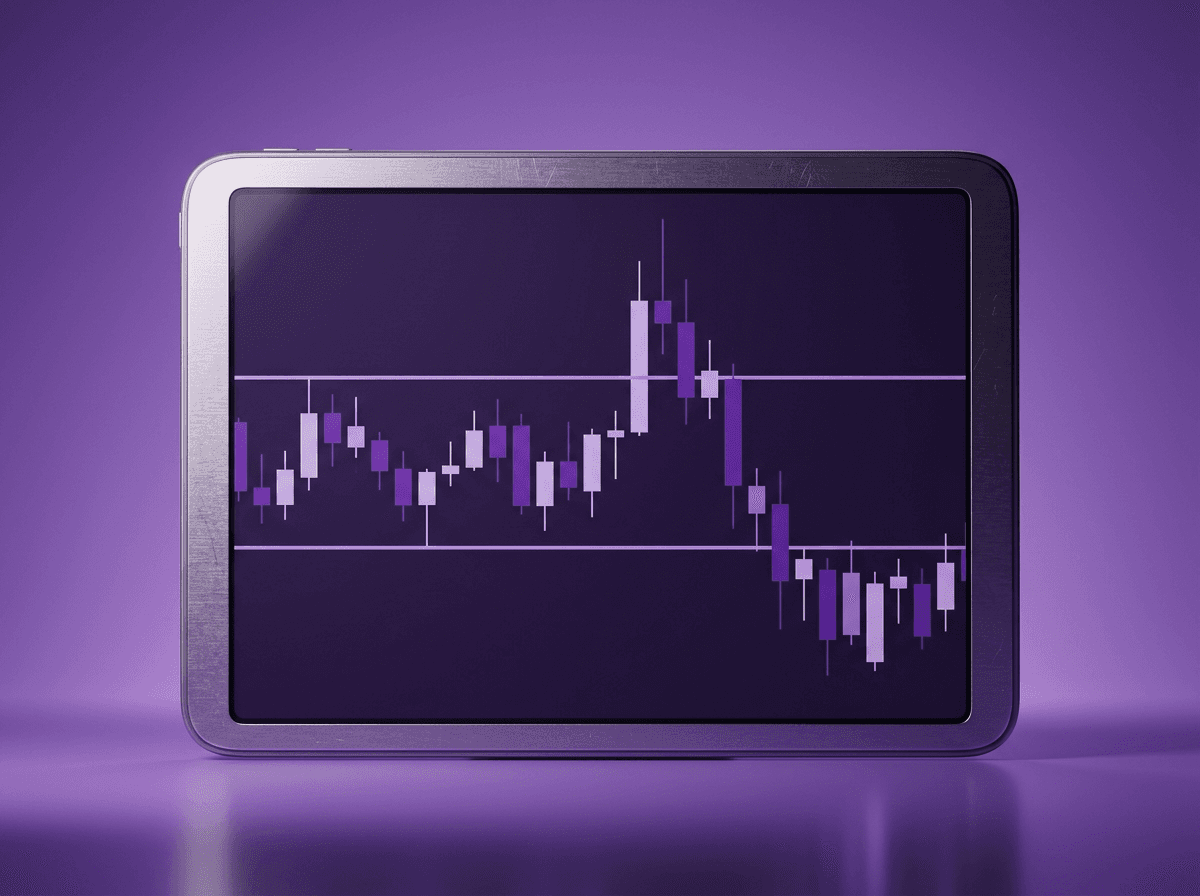
You watched the range for hours. Price bounced between the same two levels like a ping-pong ball. Then it broke out above resistance, and you bought the breakout. Within minutes, price reversed, crashed back into the range, and blew through the other side.
That was not a failed breakout. That was the plan all along.
Consolidation ranges are not pauses in the market. They are liquidity factories. And the first breakout is almost never the real move. It is the trap that funds the real move.
TL;DR
Consolidation ranges stack stop losses above resistance and below support.
The first breakout is designed to sweep one side and collect liquidity.
After the sweep, price returns to the range and breaks the opposite side for the real move.
Trading the first breakout puts you on the wrong side of the institutional trade.
Wait for the sweep, then position for the second breakout.
Why Consolidation Builds Liquidity on Both Sides
Every time price bounces off the top of a range, range traders sell and place stops above resistance. Every time price bounces off the bottom, they buy and place stops below support. The longer the consolidation lasts, the more orders pile up.
From a retail perspective, the range is an opportunity to sell high and buy low. From an institutional perspective, the range is a loading zone. Every bounce creates more predictable stop orders. Those stops are liquidity pools waiting to be harvested.
Think about it practically. If a range lasts three days on the 1-hour chart, how many traders placed a buy at support with a stop below? How many sold resistance with a stop above? Each of those traders represents a pending order at a predictable level. After three days, the liquidity sitting above and below the range is substantial.
Institutions cannot enter a large position at the current price without moving the market. But they can enter after a stop sweep triggers thousands of opposing orders at exactly the price they want.
The Fake Breakout: How the First Move Traps Traders
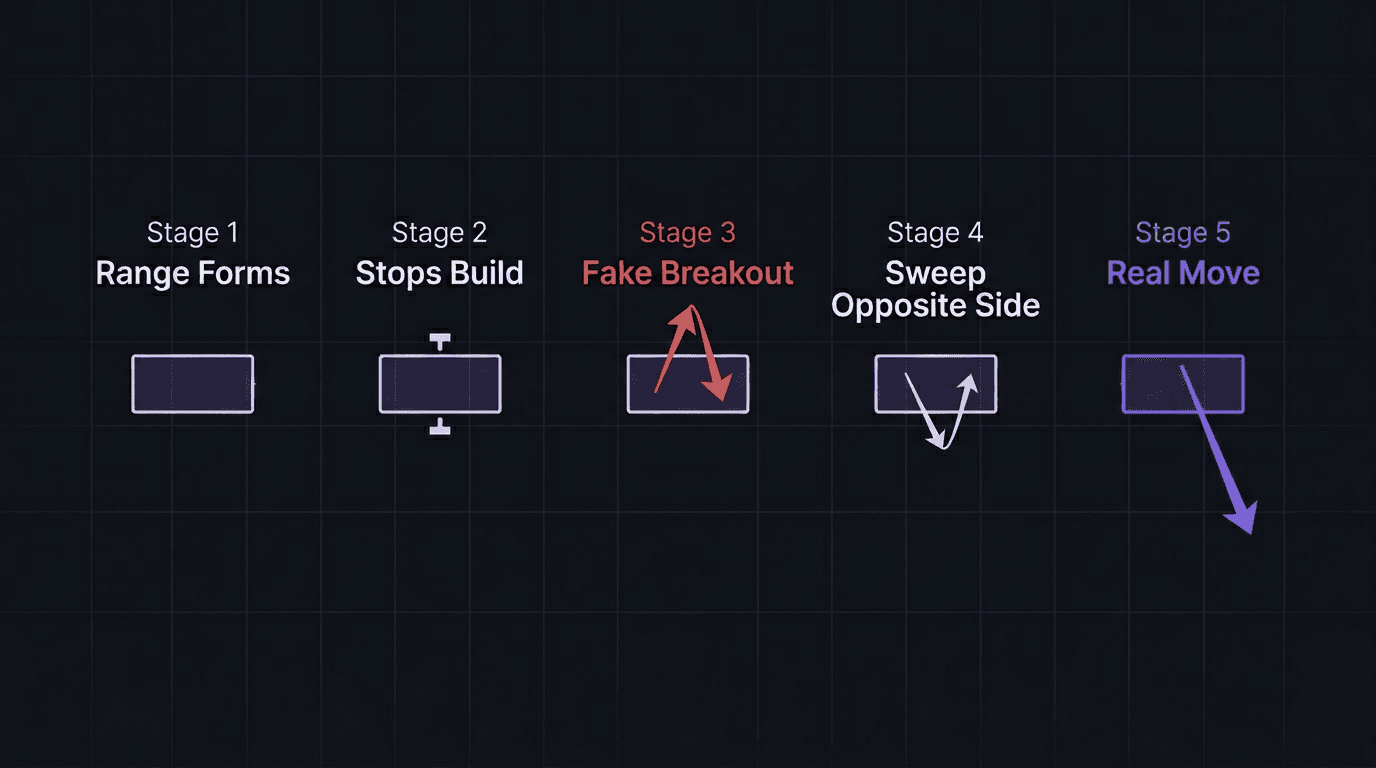
The mechanics of the consolidation trap follow a predictable script:
Price consolidates in a range, building stops on both sides.
Price breaks out above resistance. Breakout traders buy. Their stops go below the breakout candle or below the range support.
The breakout stalls. Price returns inside the range.
Now both the range-trader stops above resistance AND the breakout-trader stops below support are live.
Price drops through support, sweeping all the accumulated stop losses and triggering the real move.
The first breakout creates a double layer of liquidity. Range traders who sold resistance get stopped out above (filling institutional longs if the intent is bullish, or adding sell-side fuel if the real move is bearish). Then the failed breakout traders who bought the break get stopped out below support, providing even more liquidity for the real directional move.
This is why fake breakouts are so common at the edges of consolidation. They are not random. They are functional.
Walkthrough: The Consolidation Trap on GBP/USD
GBP/USD consolidates between 1.2700 (support) and 1.2740 (resistance) for 8 hours on the 15-minute chart. At London open, price spikes to 1.2755, breaking resistance. A breakout trader buys at 1.2748 with a stop at 1.2695. The candle that broke resistance closes at 1.2735, back inside the range. Within 45 minutes, price drops to 1.2690, sweeping both the range-trader stops below support and the breakout-trader stops. The sweep low is 1.2688. Price then reverses and rallies to 1.2800.
A trader who recognized the consolidation trap waits for the sweep. After price drops to 1.2688 and prints a bullish reversal candle, they enter long at 1.2700 with a stop at 1.2680 (20-pip risk). At $10/pip per standard lot, risk is $200. Price reaches 1.2800, a 100-pip move, for $1,000 reward. That is 5.0R.
The breakout trader lost $530. The patient trader made $1,000 on a 5R setup. Same range, same session, opposite outcomes.
Reading the Sweep and Positioning for the Real Move
Once you understand that the first breakout is the trap, reading the setup becomes straightforward. Here is what to look for:
Before the breakout: Identify the consolidation range and mark both boundaries. Note that liquidity is building on both sides. Do nothing inside the range.
During the first breakout: Watch, do not trade. Mark the direction of the first breakout. If it goes up, expect the real move to be down (and vice versa). Look for the candle close. If the breakout candle closes back inside the range, the trap is likely sprung.
After price returns to the range: This is where you get ready. Price is now moving toward the opposite boundary. When it sweeps the stop losses on the other side, you have your signal.
The entry trigger: After the sweep of the opposite side, look for a structural confirmation on a lower timeframe. A break of the most recent swing high (for a bullish setup) or swing low (for a bearish setup) on the 5-minute chart confirms that the real move is starting.
Entry Rules for Post-Sweep Breakouts
Rules make this mechanical. Here are the five rules for consolidation breakout setups:
Rule 1: Identify the range early. Mark both boundaries as soon as you see three or more touches on each side. The cleaner the range, the more liquidity is building.
Rule 2: Do not trade inside the range. Range trading against institutional liquidity building is a losing strategy. Sit on your hands until the range resolves.
Rule 3: Label the first breakout as "fake" by default. Until proven otherwise, treat the first breakout as the sweep move. If the breakout candle closes back inside the range, your default assumption is confirmed.
Rule 4: Wait for the second move. After the first breakout fails and price returns to the range, wait for the sweep of the opposite side. Then look for structural confirmation on a lower timeframe.
Rule 5: Place your stop beyond the sweep low or high. Your stop goes below the deepest point of the second sweep (for longs) or above the highest point (for shorts). This ensures that if price sweeps even deeper, you are protected.
The discipline here is in not trading the first move. That is the hard part. The setup itself is simple.
How EdgeFlo Alerts You to Consolidation Setups
Consolidation traps reward patience and punish impulsiveness. EdgeFlo is built for exactly that dynamic.
FloAI (Plus plan) can surface observations when a range pattern is forming, giving you a heads-up before the breakout bait appears. Instead of staring at the chart and feeling the itch to trade the first break, you have a structured note reminding you that the range is still in play.
The guardrail system also helps. If you set a rule in your trade plan that says "no entries during the first breakout of a consolidation," EdgeFlo's Edge plan builder keeps that rule visible during execution. You can override it (the override is always available), but you have to actively choose to break your rule. That friction is the difference between a reactive trade and a planned one.
After the session, tag your consolidation trades in the journal. Over a month, review how many first breakouts you traded versus how many second moves you caught. Most traders find the numbers tell a clear story.
The Edge Brief
Receive Insights on trading psychology, discipline, and the behavioral patterns that create consistent traders from our Founder and the EdgeFlo team, delivered to your inbox.
Think different. Trade different.
Why do first breakouts from consolidation usually fail?
How does consolidation build liquidity?
Should I ever trade a breakout from consolidation?
How long does a consolidation need to last before the trap pattern appears?

Turn discipline on.
Every session.
EdgeFlo is the environment serious traders operate inside.
Start 7-Day Free Trial
Cancel anytime.
No long-term commitment.

Think Different, Trade Different.