

The Comfort Trap: When Zero Pain Means Maximum Risk
When trading feels effortless and pain-free, you are at peak danger. Learn why comfort signals dropped standards and how to break the complacency cycle.
There is a moment in every trader's journey that feels like arrival. The wins are stacking up. The system is working. You are not stressed, not worried, not second-guessing. Everything just clicks.
That moment is not mastery. It is the comfort trap, and it is the most dangerous psychological state in trading. When pain drops to zero and everything feels effortless, you are at maximum risk for the kind of drawdown that erases months of work.
TL;DR
Zero emotional pain in trading signals dropped vigilance, not achieved mastery.
Complacency creeps in when you stop feeling any discomfort about your process.
The comfort zone is where discipline dies quietly, because nothing feels wrong.
Healthy trading involves persistent low-level discomfort (checking your work, questioning your assumptions).
Scheduled check-ins with hard data break the spell before the account pays for it.
Why Comfort Feels Like Mastery but Is Not
When you are winning consistently, your emotional baseline shifts. The anxiety that used to accompany every trade fades. The pre-session nervousness disappears. The fear of loss evaporates.
This feels like growth. You think: "I used to be nervous about trading, and now I'm calm. That means I've improved."
But there is a critical difference between earned calm and dangerous comfort. Earned calm comes from confidence in your process: you have a plan, you follow it, you trust the math. You still check your work. You still prepare before each session. You still feel a low-level awareness that the market can always surprise you.
The comfort trap is different. In the comfort trap, you stop checking your work. You stop preparing. You stop feeling any tension at all. The absence of pain becomes the absence of effort.
Think of it like driving. A confident driver stays alert, checks mirrors, maintains safe following distance. A complacent driver stops paying attention because nothing bad has happened in a while. One pothole, one surprise brake light, and the complacent driver is in trouble.
Trading works the same way. The market does not care how comfortable you feel.
The Emotional Sequence from Comfort to Catastrophe
The path from comfort to catastrophe follows a specific emotional sequence, and recognizing where you are in it is the key to intervention.
Phase 1: Pride (pain level 3/10). You are doing the right things. Following the plan. Winning trades. You feel a healthy sense of accomplishment. This is the good zone. You are still working, still vigilant.
Phase 2: Comfort (pain level 0/10). You have hit your goal or exceeded it. The urgency is gone. There is nothing pushing you forward. This phase feels like a reward, but it is actually a trap door.
Phase 3: Corner-cutting. Without emotional discomfort to fuel discipline, you start making small compromises. Skip the pre-market routine. Take a trade without checking the plan. Increase size because "the account can handle it."
Phase 4: Exposure. The compromises accumulate. Your risk profile has changed, but you have not noticed because everything still feels fine.
Phase 5: The hit. A normal losing trade (or two, or three) arrives. But because your exposure has silently increased, the damage is outsized. Suddenly, the comfort is gone, replaced by shock.
Phase 6: The spiral. Now you are behind, overleveraged, and emotionally destabilized. This is where emotion chains take over: one bad feeling triggers a bad trade, which triggers a worse feeling, which triggers a worse trade.
Walkthrough: Comfort to Catastrophe in Real Time
A trader on EUR/USD has a $15,000 account and has been on a 3-week winning run. His plan says: risk 1% per trade ($150), max 3 trades per day, journal every trade.
Week 1 of comfort: He skips the journal 2 out of 5 days. Still winning. Does not notice.
Week 2 of comfort: He bumps his lot size from 0.15 to 0.25 lots on "high-conviction" setups. With a 100-pip stop on EUR/USD:
Math check: 0.15 lots = $1.50/pip. $1.50 times 100 pips = $150 = 1% of $15,000. Correct (original plan). Math check: 0.25 lots = $2.50/pip. $2.50 times 100 pips = $250 = 1.67% of $15,000. He has increased his risk by 67% without updating his plan.
Week 3: He takes 5 trades in a single session because "the setups are everywhere today." Three of them lose.
Math check: 3 losses at $250 each = $750 = 5% of the account in one session.
One day's complacency-fueled trading wiped out 5%. Two more days like that and the entire 3-week winning streak is erased.
The trap is that during phases 1 through 4, nothing feels wrong. The damage is invisible until it is not.
What Healthy Discomfort Looks Like in Trading
If zero pain is dangerous, does that mean trading should feel terrible all the time? No. But consistent, low-level discomfort is actually a sign you are doing it right.
Healthy discomfort looks like:
Slight tension before each trade. Not fear, not anxiety, just awareness that real money is on the line and you need to be right about your process, even if you might be wrong about the outcome.
Mild annoyance at journaling. You do it anyway, because you know it matters, but it never becomes so easy that you forget to do it.
Questioning your setups. Before every entry, asking: "Does this actually match my criteria, or am I stretching?" If you never ask that question, you are not thinking critically enough.
Awareness of your ego. A small voice that says "You are not as good as you think" is protective. The voice that says "You have figured it all out" is the one trying to destroy your account.
The trader who never feels discomfort has stopped growing. The trader who feels persistent, manageable discomfort is the one still doing the work.
Scheduled Check-Ins That Break the Comfort Spell
You cannot rely on feelings to catch the comfort trap, because the whole point of the trap is that it feels good. You need structural interventions that force a reality check regardless of your emotional state.
Daily: 2-minute post-session scan. Before you close your charts, answer three questions in writing: (1) Did I follow my plan on every trade? (2) Did I take any trade I would not take again? (3) Is my lot size unchanged from yesterday?
Weekly: 15-minute data review. Pull your week's numbers. Look at: trade count (is it creeping up?), average lot size (is it creeping up?), win rate (is it stable?), and plan compliance (how many trades matched your criteria?). If any number has drifted more than 10% from your baseline, that is a flag.
Walkthrough: A Weekly Review Catches the Drift
A trader reviews her GBP/USD trades for the week. She took 18 trades (her plan allows 3 per day = 15 per week max). Average lot size: 0.22 (plan says 0.2). Journal entries: 12 out of 18 (missing 6).
The numbers tell the story even though she feels great. Trade count is 20% above plan. Lot size has crept up 10%. Journal compliance is only 67%. She is in Phase 3 (corner-cutting) and did not know it until she looked at the data.
She resets: back to 0.2 lots, hard stop at 15 trades per week, journal every single trade before placing the next one.
Monthly: full performance review. Compare this month's ceiling and floor to last month's. Is the range narrowing? Is the floor rising? If neither is happening, something in your process needs attention.
The key is doing these reviews on schedule, not waiting until something feels wrong. By the time it feels wrong, you are already in the hole.
How EdgeFlo Flags When You Stop Challenging Yourself
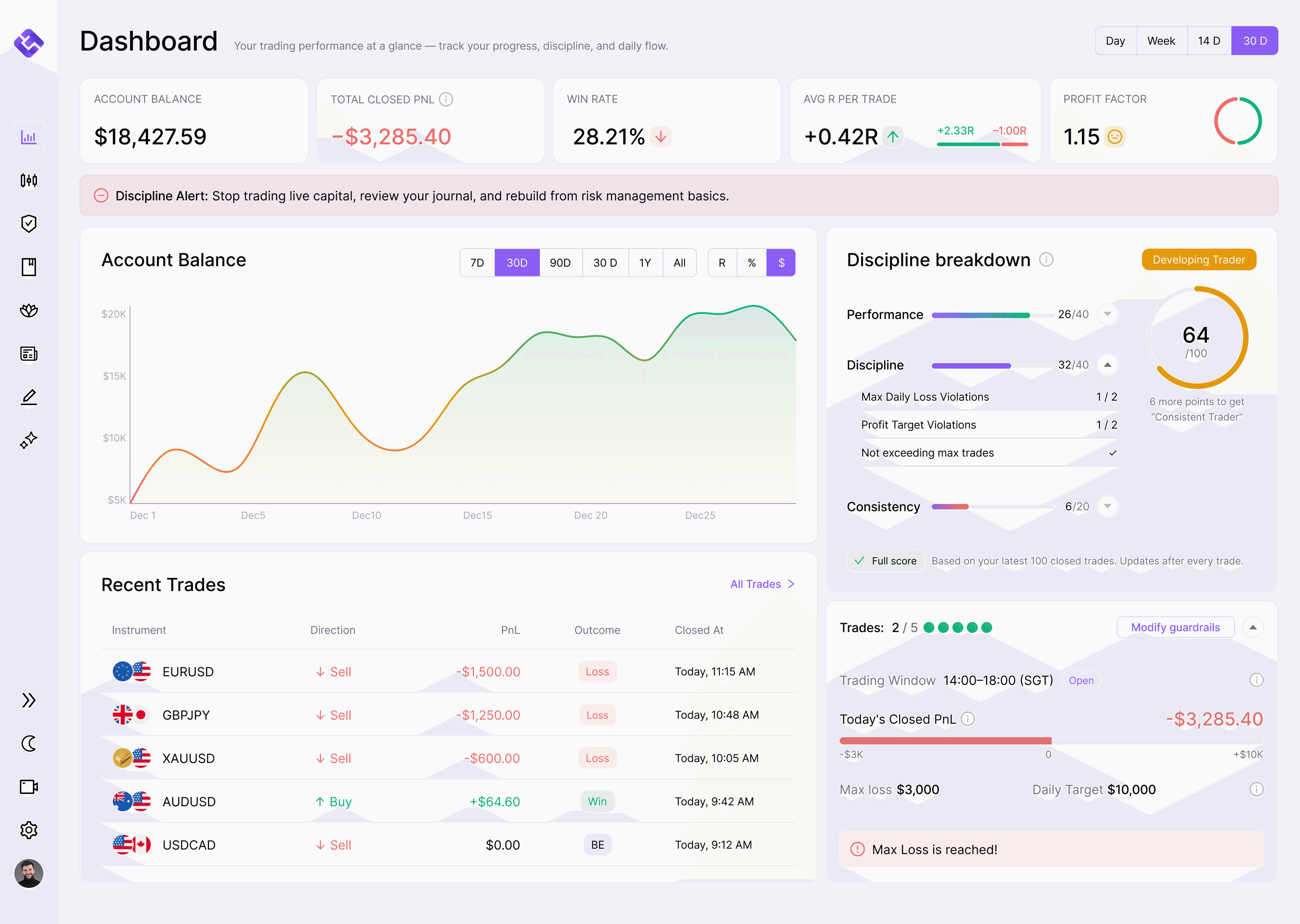
EdgeFlo's pre-market checklist prompts you to confirm your plan, your risk settings, and your emotional state before the session begins. It does not prevent you from trading without completing it, but it surfaces the question: "Are you prepared, or are you coasting?"
The AI-powered trading journal with emotion tagging creates a record of your internal state alongside your trade data. Over weeks and months, you can see the pattern: the sessions where you tagged "confident" or "relaxed" and correlate them with what happened to your performance metrics afterward.
When comfort starts showing up as a consistent tag and your metrics start drifting, the data makes it visible. You cannot argue with numbers. And that visibility is what breaks the spell before the comfort trap collapses into a drawdown.
The Edge Brief
Receive Insights on trading psychology, discipline, and the behavioral patterns that create consistent traders from our Founder and the EdgeFlo team, delivered to your inbox.
Think different. Trade different.
Why is comfort dangerous in trading?
How can I tell if I am in the comfort trap?
Is all comfort in trading bad?
What breaks the comfort spell before it causes damage?

Turn discipline on.
Every session.
EdgeFlo is the environment serious traders operate inside.
Start 7-Day Free Trial
Cancel anytime.
No long-term commitment.

Think Different, Trade Different.