

Choppy Market Strategy: Stop Trading the Noise
Choppy markets chew through accounts when you force trades. Learn to spot consolidation early, reduce size, and protect capital until direction returns.
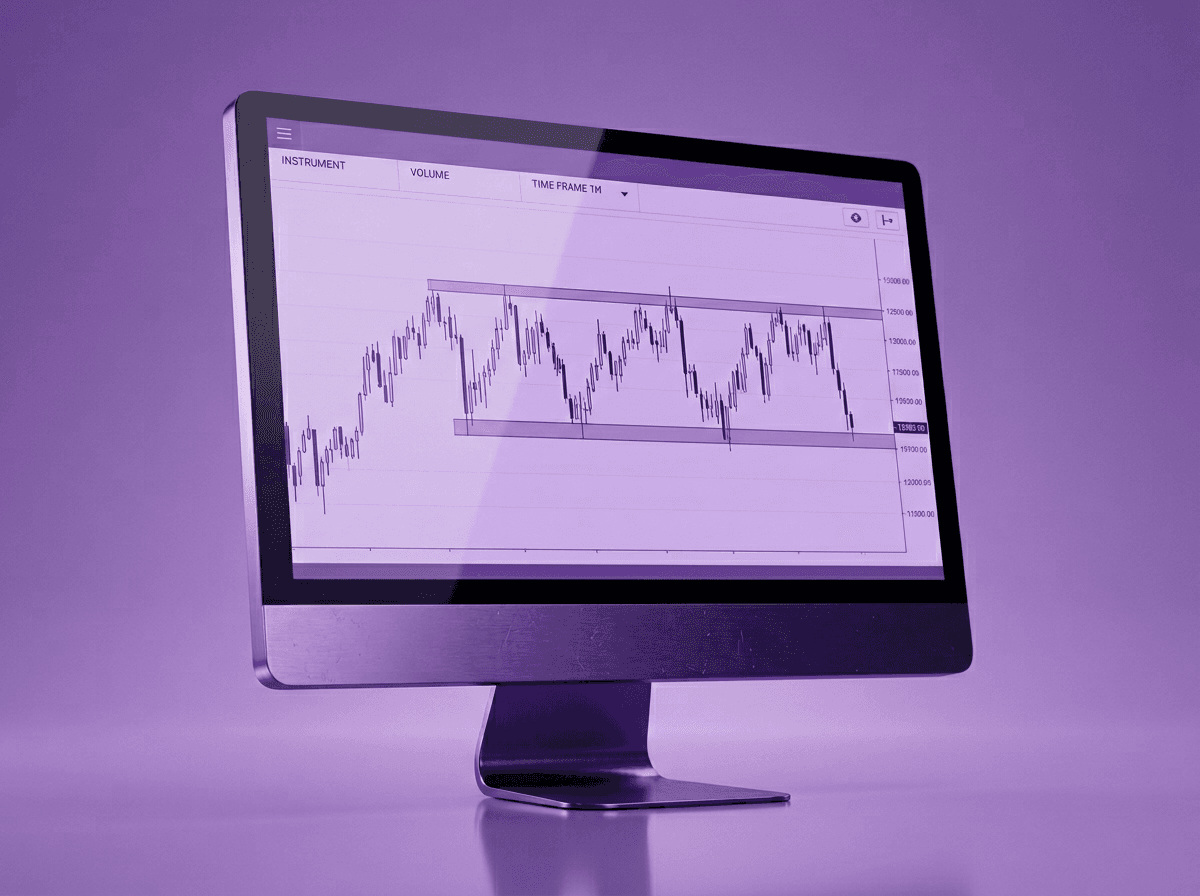
Choppy markets are where good traders turn into frustrated traders. Price moves sideways, every breakout fakes out, and setups that worked perfectly last week now chop you to pieces.
The problem is not your strategy. The problem is applying a trending strategy to a ranging environment. When price has no directional momentum, break-of-structure entries become traps, supply and demand zones get mitigated without continuation, and internal order flow flips so fast that confirmations become meaningless.
The answer is not a new indicator or a special "chop filter." The answer is recognizing when price is stuck in a range, adjusting your risk, and waiting for directional flow to resume before sizing back up.
TL;DR
Choppy markets happen when price fails to break past swing highs or swing lows, trapping traders in a range.
The biggest account damage in chop comes from maintaining normal position size on low-probability setups.
Cut your risk by at least 50% the moment you recognize consolidation.
Do not re-scale until price breaks a swing high or swing low with a clean candle close.
Three consecutive failed break-of-structure signals is your mechanical trigger to reduce size.
What a Choppy Market Actually Looks Like
On a chart, chop does not announce itself. It sneaks up on you after a trending phase ends and price starts doing something that looks almost like a pullback but never completes.
Here are the structural signs:
Price fails to take out the weak swing low (in a bearish trend) or the weak swing high (in a bullish trend).
Internal structure flips rapidly. Bullish to bearish to bullish again, all within a narrow range.
Supply and demand zones get tapped and produce short reactions, but no continuation.
Candles overlap heavily. No clean impulse legs.
The key phrase: "failed to take out the weak low." In a healthy bearish trend, the internal order flow shifts bearish, price targets the weak low, and it breaks. In chop, that final break never happens. Price bounces off a demand zone, shifts bullish again, and you are stuck watching the same range play out.
Ever been in a trade where structure confirmed your entry, the supply zone was clean, and price just... stopped? Then reversed for no obvious reason? That is chop.
Why Chop Destroys Accounts
The damage from a choppy market is not one big loss. It is death by ten small ones.
You take a setup. It looks right. It fails. You take another, slightly less clean. It fails. You start forcing entries because you have been waiting all session and need to "make something back."
This is the overtrading spiral, and chop is the environment that triggers it most often.
Here is the math. Say you normally risk 1% per trade, and you take 5 trades during a choppy session. If 4 out of 5 fail (which is common in chop because setups that need momentum have no fuel), you are down 4% for the day. That one win at 1.5R gives you back 1.5%, so your net is negative 2.5%.
Math check: 4 losses at 1% each = 4%. 1 win at 1% risk and 1.5R = 1.5%. Net: 4% minus 1.5% = negative 2.5%. Correct.
Now stack three days of that. You are down 7.5% in a week with nothing to show for it. If you had cut your risk to 0.5% per trade the moment you noticed chop, those same 5 trades would cost you half: net negative 1.25% per day instead of 2.5%.
That is the entire point. You cannot control whether the market trends. You can control how much you lose when it does not.
The 3-Strike Recognition Rule
You need a mechanical trigger for recognizing chop. Without one, you will always convince yourself that "this one is different."
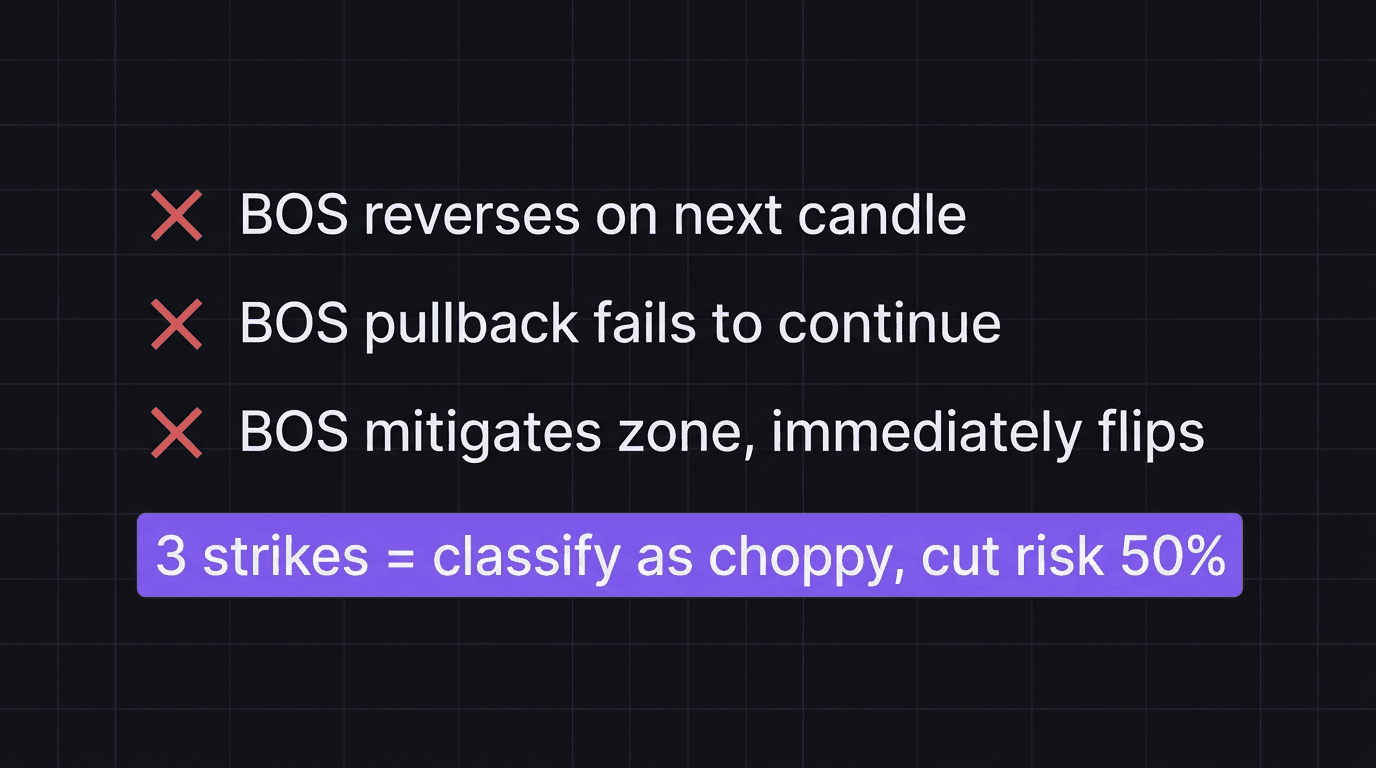
The rule: if 3 consecutive break-of-structure signals fail to produce continuation, classify the market as choppy and cut risk immediately.
What counts as a failed BOS signal:
Price breaks structure, but the very next candle reverses back inside the range.
Price breaks structure, pulls back, then fails to continue in the breakout direction.
Price breaks structure, mitigates a zone, and immediately shifts the internal order flow back to the other direction.
Three of these in a row? The market is not trending. It is consolidating. Stop treating it like a trending market.
Write this into your trading rules document so it is not a discretionary judgment in the moment. When the trigger hits, the action is automatic: reduce risk.
Walkthrough: Missing the Chop Signal on GBP/USD
A trader is watching GBP/USD on the 1-hour chart during London session. The swing trend has been bearish, and they are looking for continuation shorts.
Trade 1: Internal order flow shifts bearish. Trader enters short at a supply range with a 25-pip stop and a 1:2 target. Price reverses immediately and stops them out. Loss: $125 on 0.5 lots (0.5 lots times $10 per pip times 25 pips = $125).
Trade 2: Another bearish BOS forms. Trader enters short again with the same parameters. Price fakes out, sweeps above the supply range, and stops them out. Loss: $125.
Trade 3: A third bearish BOS. Trader enters short with a tighter 20-pip stop this time, trying to reduce damage. Price bounces off a demand zone and takes the stop. Loss: $100 (0.5 lots times $10 per pip times 20 pips = $100).
Total damage: $350 in three trades, all with valid structure, all failed.
If the trader had a 3-strike rule, they would have stopped after Trade 3 and classified the session as choppy. Instead, most traders take a 4th and 5th trade, sometimes doubling size to "make back" the day. That is where the real damage happens.
The Risk Adjustment Protocol
Once you classify the market as choppy, here is the exact protocol:
Step 1: Cut position size by 50%. If you normally trade 0.5 lots, drop to 0.25 lots. If you normally risk 1% per trade, drop to 0.5%. This is non-negotiable. The risk per trade adjustment is the most important thing you do.
Step 2: Tighten your setup filter. Only take setups with multi-timeframe alignment (both swing and internal order flow pointing the same direction). In a choppy market, only the extremes of the range produce anything worth trading. Everything in the middle is noise.
Step 3: Target range boundaries, not trend continuations. If the range high is 1.2700 and the range low is 1.2600, your targets are those levels, not some trend extension beyond them. Expect the range to hold until it breaks.
Step 4: Set a hard daily loss limit. If you do not already have one, this is when you set it. In chop, your normal stop-and-take-profit math does not work because the market has no fuel. A daily loss limit keeps the damage contained.
Step 5: Do not re-scale until direction confirms. You return to normal risk only after price breaks a swing high or swing low with a clean candle close and the next impulse leg follows through. One candle close beyond the range is not enough. You want to see the break plus the first pullback that holds structure.
Walkthrough: What a Correct Chop Response Looks Like
Same GBP/USD scenario. The trader recognizes chop after three failed BOS entries. They cut risk from 0.5 lots to 0.25 lots.
Trade 4: Price reaches the extreme top of the range at a supply zone that aligns with the swing supply range. Both swing and internal structure are bearish from the extreme. Trader enters short with 0.25 lots, a 30-pip stop, and a 50-pip target (targeting the range low).
Risk: 0.25 lots times $10 per pip times 30 pips = $75.
Target: 0.25 lots times $10 per pip times 50 pips = $125.
Reward-to-risk: $125 / $75 = 1.67R.
Price reaches the range low and the trader exits. Net for the session after accounting for the first three losses ($350) plus this win ($125): negative $225.
Not great, but compare that to a trader who kept full size and took five losing trades: negative $500 or worse. The chop adjustment cut the damage nearly in half.
When Chop Turns Into a Breakout
The hardest part of a choppy market is the transition. At some point, one side wins. Price breaks out of the range and establishes directional order flow again.
The trap: entering the breakout too early. Many breakouts in a choppy environment are false. Price sweeps above the range high (grabbing liquidity from traders who set stops above) and then drops back inside.
The better approach: wait for the breakout plus the first pullback that holds structure. If price breaks above the range high, pulls back, and the pullback respects the broken range high as a demand zone, the breakout is likely real. If the pullback drops back below the range high, it was a liquidity sweep, not a breakout.
Do not be the trader who buys the first wick above the range. That is paying for other people's stop losses.
Building Chop Into Your Position Sizing Rules
The chop adjustment should not be a judgment call. Build it into your position sizing rules with clear triggers:
Condition | Risk Level |
|---|---|
Swing and internal order flow aligned, clean trends | Full risk (e.g., 1%) |
1-2 failed BOS in current session | Stay at full risk, increase caution |
3 consecutive failed BOS | Reduce to 50% risk (e.g., 0.5%) |
Price confirmed inside a range (no swing break) | Stay at 50% until breakout confirms |
Breakout confirmed with pullback hold | Return to full risk |
Print this. Tape it to your monitor. When the market goes sideways, you do not want to rely on discipline alone. You want a rule that triggers automatically.
How EdgeFlo Keeps You Controlled in Chop
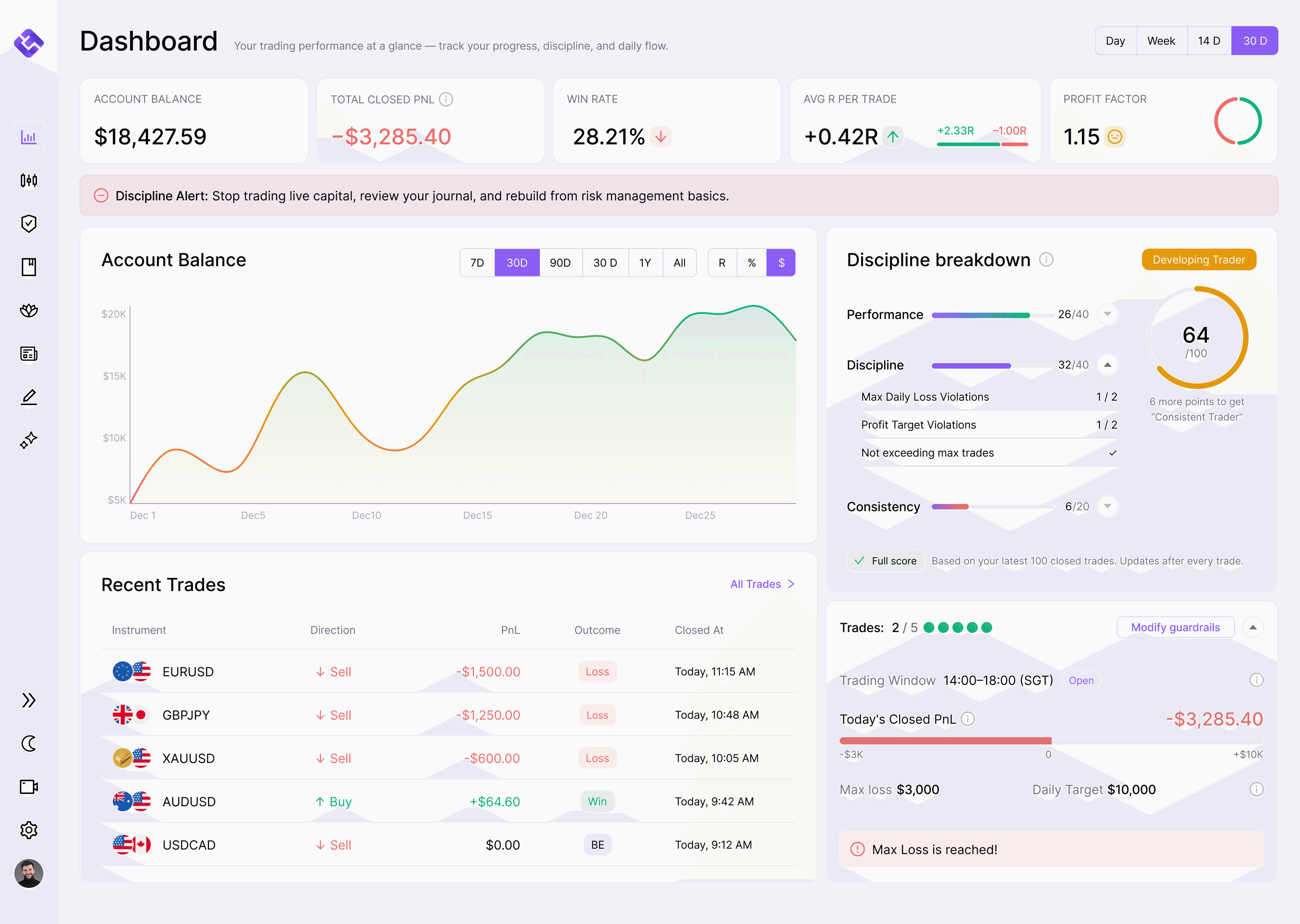
Choppy markets are where emotional trading peaks. Three consecutive losses make you want to size up and force a win. EdgeFlo's daily loss limit guardrail restricts further trading when you hit your defined threshold. You can override it if you choose, but the restriction forces a conscious decision rather than an emotional one.
The auto risk calculator recalculates your lot size from your stop distance, so when you manually cut your risk percentage from 1% to 0.5% during chop, your position size adjusts automatically. No mental math in the middle of a losing session.
Combine the guardrail with a pre-session note in your trading plan that defines your 3-strike rule, and the system does the heavy lifting when your judgment is compromised by frustration.
The Edge Brief
Receive Insights on trading psychology, discipline, and the behavioral patterns that create consistent traders from our Founder and the EdgeFlo team, delivered to your inbox.
Think different. Trade different.
How do I know if the market is choppy?
Should I stop trading in choppy markets?
What is the biggest risk in a choppy market?
When should I return to normal risk after chop?

Turn discipline on.
Every session.
EdgeFlo is the environment serious traders operate inside.
Start 7-Day Free Trial
Cancel anytime.
No long-term commitment.

Think Different, Trade Different.