

The Builder vs Wrecker Inside Every Trader
Every trader has a builder side that grows accounts and a wrecker side that tears them down. Learn to spot which mode you are in and switch before damage happens.
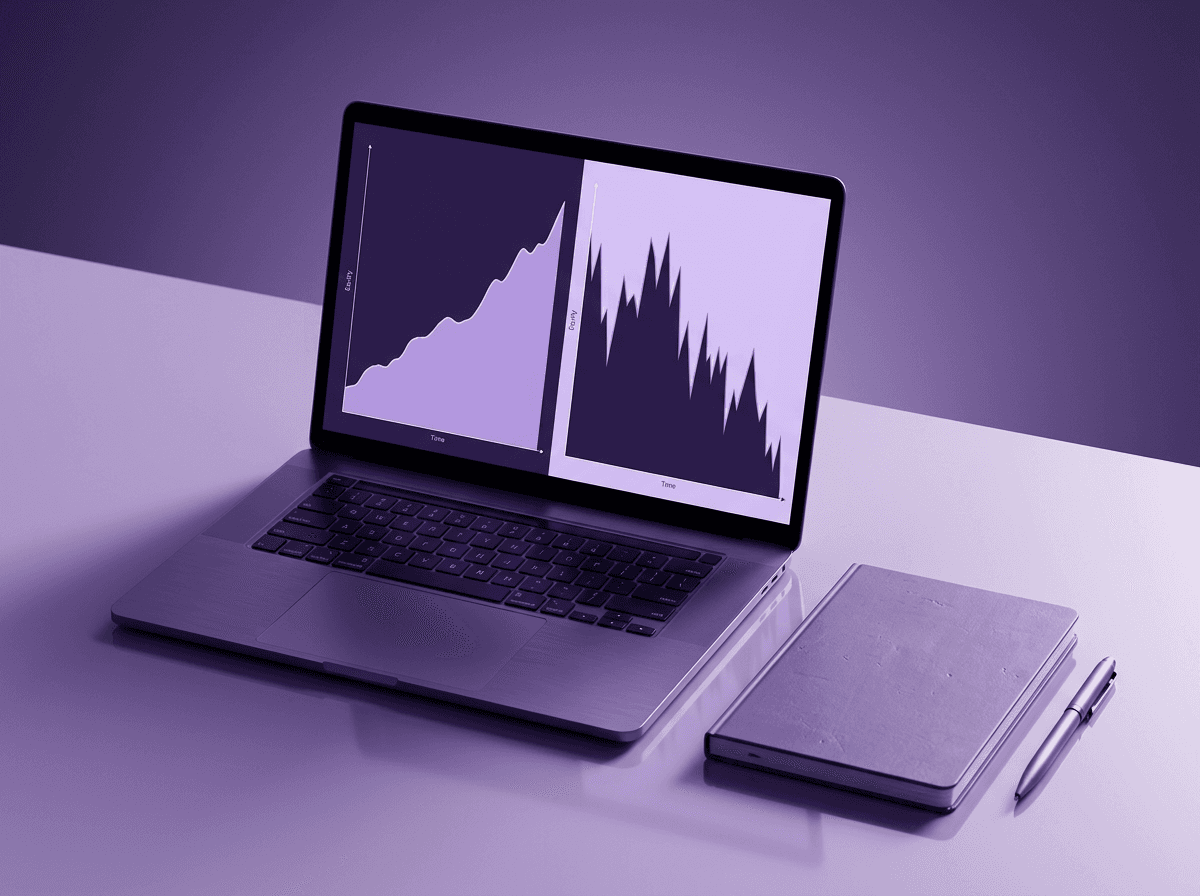
You have done this before. Strung together a great week, maybe two. Your account is at a personal best, your confidence is high, your plan is working. And then, almost like clockwork, you give it all back.
That cycle has a name. Inside every trader, two modes are constantly competing: the builder, who does the work and grows the account, and the wrecker, who undoes everything in a matter of days. The trader who learns to spot the switch between these two modes, and intervenes before the wrecker takes control, is the trader who finally breaks through.
TL;DR
Every trader cycles between a builder mode (disciplined, process-driven) and a wrecker mode (impulsive, results-chasing).
The switch from builder to wrecker almost always starts with overconfidence after a winning streak.
You cannot eliminate the wrecker; you can only build systems that catch it early.
The key signal is when you stop doing the things that created your success (journaling, following your plan, respecting risk).
Self-sabotage in trading is not a character flaw; it is a predictable pattern you can interrupt.
What the Builder and Wrecker Actually Look Like
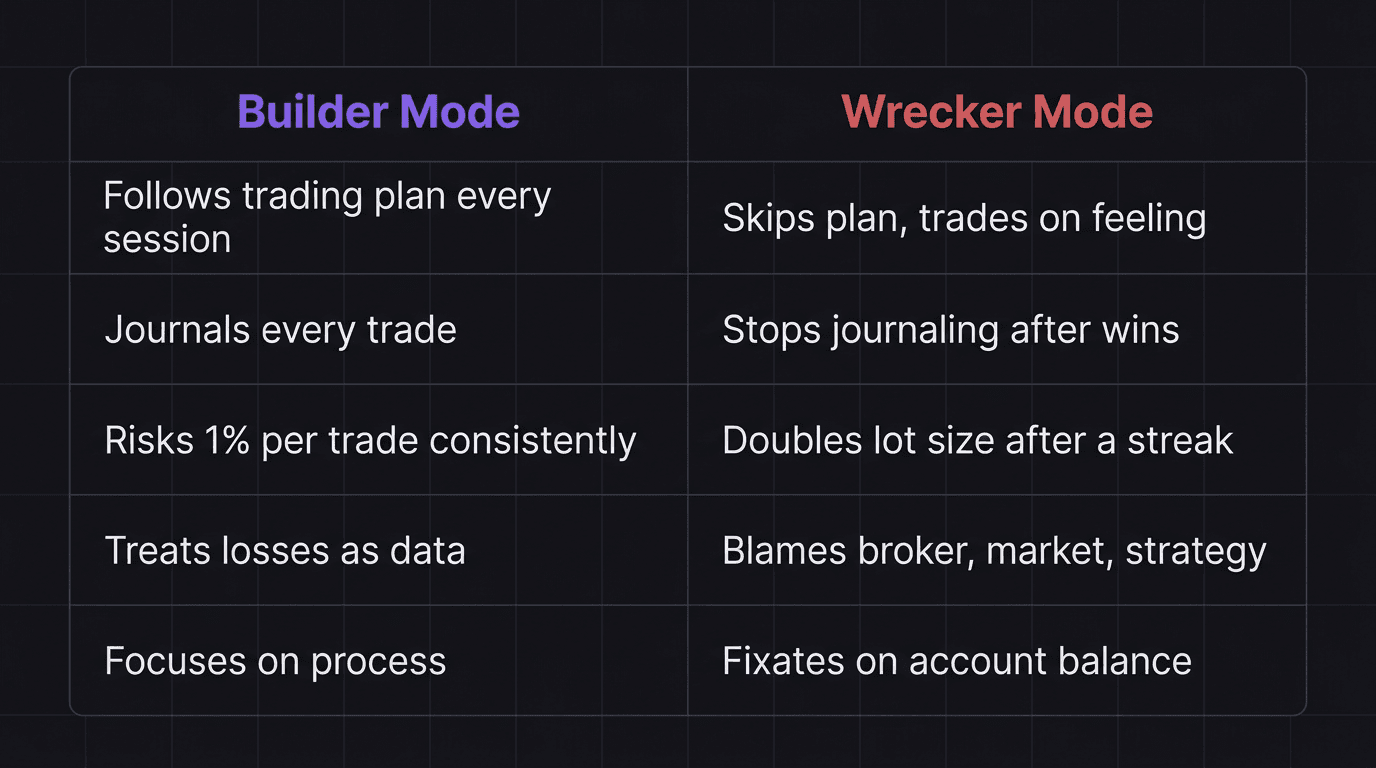
The builder is not flashy. This is the version of you that sits down before the session, reviews the plan, checks the charts, and takes only the setups that match your criteria. The builder journals every trade, win or loss. The builder respects position sizing even when the conviction feels strong.
Builder traits are specific: process-focused, treats losses as data, stays optimistic about long-term progress regardless of short-term results. The builder trusts that consistent action compounds into results.
The wrecker is the opposite. This version is fixated on outcomes, not process. The wrecker wants to get rich fast, with the least effort possible. When losses stack up, the wrecker blames the market, the broker, the strategy, everything except the person in the chair.
Walkthrough: Builder vs Wrecker in Action
A trader starts the month with a $5,000 account on EUR/USD. Builder mode: she follows her plan, takes 3 trades per day maximum, risks 1% per trade ($50), and journals every entry. After 12 trading days, she has 8 wins and 4 losses at a 2:1 reward-to-risk ratio.
Math check: 8 wins at $100 each = $800. 4 losses at $50 each = $200. Net profit = $600. Account grows to $5,600.
Then the wrecker shows up. She skips the journal ("I already know what I'm doing"). She bumps her risk to 3% per trade ($168) because "the streak is hot." She takes 6 trades in one session instead of 3. Two overleveraged losses later, she is down $336 in a single day, wiping out more than half her month's gains in hours.
The wrecker also carries a victim mentality. When things go wrong, the wrecker hops strategies instead of fixing execution. Jack of all trades, master of none. Sound familiar?
The Trigger Points Where You Switch Modes
The switch from builder to wrecker is rarely sudden. It follows a predictable sequence, and the trigger is almost always the same thing: comfort.
Here is how it works. You put in consistent effort. You follow your plan, journal your trades, respect your risk. Wins accumulate. Your account hits a personal best. You feel on top of the world. And that exact moment of peak confidence is where the danger lives.
Overconfidence is the bridge between builder and wrecker. When you think you have figured it out, you stop doing the things that got you there. The journal feels unnecessary. The pre-trade checklist feels like a chore. Your trading discipline starts to transform into complacency, and you barely notice.
The most dangerous version of this looks like permission. You tell yourself: "I have earned a break from the hard stuff." You start taking trades that are not in your plan. You increase lot sizes. You skip your review. And because the first few off-plan trades might still work (markets are random enough for that), the wrecker gets reinforced.
Then the losses start. And because you are now overleveraged and off-plan, the losses are bigger than they should be. That triggers frustration, then revenge trading, then more losses. The spiral accelerates until you hit rock bottom.
How to Catch the Wrecker Before It Takes Over
The wrecker announces itself through small behavioral changes. You will not wake up one morning as a completely different trader. Instead, watch for these signals:
Skipped journal entries. If you stop logging trades, builder mode is fading.
Increased lot sizes without a plan adjustment. The urge to "push it" after wins is the wrecker whispering.
Trades outside your setup criteria. One "feeling-based" trade opens the door for ten more.
Reduced pre-session preparation. When the pre-market routine feels optional, you are already drifting.
Inner monologue shifts to outcomes. If you are thinking about profits instead of process, the wrecker is gaining ground.
The earlier you catch these signals, the less damage the wrecker can do. A solid trading journal habit is your first line of defense, because when you are logging trades honestly, behavioral drift shows up on paper before it shows up in your account balance.
Building a System That Keeps the Builder in Charge
Willpower alone will not keep the builder in charge. You need structural support, because the wrecker shows up precisely when your discipline is lowest.
Here are concrete system rules that work:
1. Cap your daily trades. Set a hard number (3 to 5 trades per session) and stop when you hit it, regardless of how the session is going. This removes the wrecker's favorite tool: overtrading.
2. Lock your risk percentage. Write your risk per trade into your plan and do not change it mid-session. If your plan says 1%, it stays 1% whether you are up $500 or down $200.
3. Make journaling non-negotiable. Tie journaling to your next session. No journal entry for today's trades? No trading tomorrow. This creates accountability that the wrecker cannot bypass.
4. Schedule weekly reviews. Once a week, sit down with your data and look at the patterns. Did you follow the plan? Did your lot sizes creep up? Did you skip any entries? This catches drift before it becomes a spiral.
Walkthrough: What Catching the Wrecker Looks Like
A trader on GBP/USD notices something in his weekly review. Over the past 5 sessions, his average position size has crept from 0.2 lots to 0.35 lots. His plan says 0.2 lots for his $10,000 account at 1% risk with a 50-pip stop.
Math check: 0.2 lots on GBP/USD = $2/pip. $2 times 50 pips = $100 risk = 1% of $10,000. Correct.
Math check on the drift: 0.35 lots = $3.50/pip. $3.50 times 50 pips = $175 risk = 1.75% of $10,000. That is nearly double his planned risk.
He caught it in the review. He resets to 0.2 lots and adds a note to his pre-session checklist: "Confirm lot size matches plan before first trade." The wrecker was pushing his risk higher, and the review caught it before it compounded.
5. Use trading confidence as a warning light, not a green light. When you feel bulletproof, that is the moment to tighten your rules, not loosen them.
How EdgeFlo Keeps Your Builder Mode Running
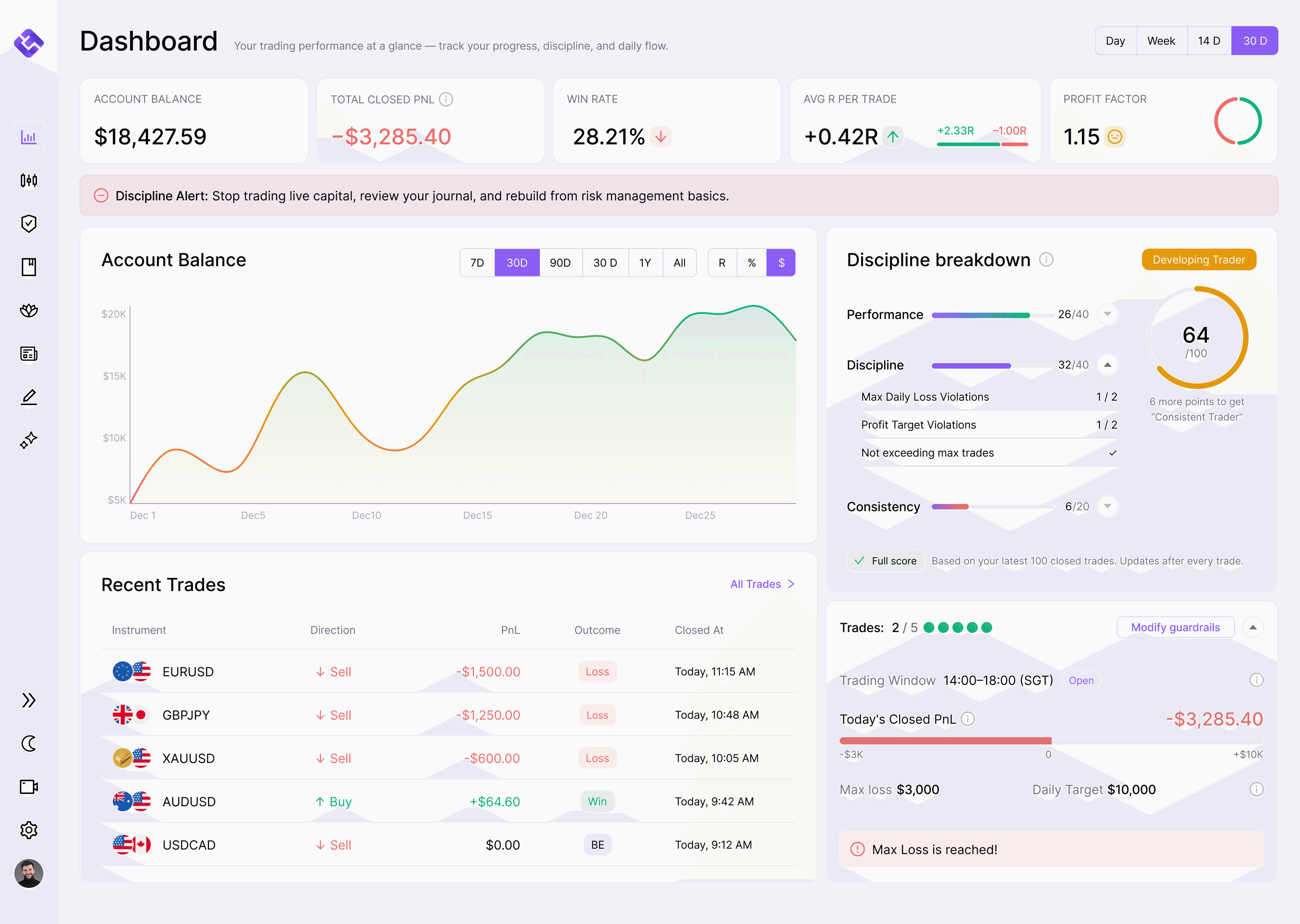
EdgeFlo is built around the idea that the right environment keeps the builder in charge. The guardrail system lets you set daily loss limits and trade caps that stay active even when your emotions want to push past them. You can override them, but you have to make a conscious choice to do so.
The AI-powered trading journal with emotion tagging gives you a record of exactly when the wrecker showed up. Over time, you can see the pattern: which emotions preceded your worst sessions, which days you skipped entries, and where lot sizes drifted away from plan.
Your dashboard surfaces the data that matters: win rate, profit factor, discipline score. When the wrecker is creeping in, the numbers show it before you feel it. That visibility keeps the builder accountable and gives you an early warning system for the cycle you already know too well.
The Edge Brief
Receive Insights on trading psychology, discipline, and the behavioral patterns that create consistent traders from our Founder and the EdgeFlo team, delivered to your inbox.
Think different. Trade different.
What is the builder vs wrecker mindset in trading?
How do I know if my wrecker side is taking over?
Can you permanently eliminate the wrecker mindset?
What triggers the switch from builder to wrecker?

Turn discipline on.
Every session.
EdgeFlo is the environment serious traders operate inside.
Start 7-Day Free Trial
Cancel anytime.
No long-term commitment.

Think Different, Trade Different.