

How to Build Trading Habits That Scale With Your Account
Bad habits on a $500 account cost $50. The same habits on a $50,000 account cost $5,000. Build the journal-risk-review loop now while the stakes are low.
Bad habits on a $500 account cost $50. The same habits on a $50,000 account cost $5,000. Habits do not magically improve when the account gets bigger. They scale.
The trader who skips journal entries on a small account will skip them on a large one. The trader who bumps risk from 1% to 3% "just this once" on a demo will do the same on a funded account, except the dollar amounts will be ten or fifty times larger.
This is why the best time to build the right habits is now, on whatever account size you currently have, while the financial stakes are low and the only thing at risk is time.
TL;DR
Habits formed on a small account follow you to every larger account.
The three habits that must be automatic before you scale: journal every trade, risk a fixed percentage, review weekly.
Habit drift is invisible until it shows up on a larger account as a significant loss.
Weekly journal reviews are the diagnostic tool that catches drift early.
Removing friction from journaling (through auto-import) prevents the most common habit failure: skipping entries.
Why Habits Scale With Account Size
A habit is a behavior pattern that runs automatically. That is what makes habits powerful and also what makes them dangerous. The automation does not discriminate between small and large accounts.
Consider overleveraging. On a $500 account, risking 5% per trade means $25 at stake. That feels manageable, so the trader does not bother fixing the habit. But the same 5% risk on a $50,000 account is $2,500 per trade. Suddenly the stakes are terrifying, and the trader either freezes up or revenge trades after the first loss.
The habit did not change. The account did. And the trader who was "going to fix the risk management when the account gets bigger" discovers that fixing habits under pressure is almost impossible. You cannot rewire a behavior while simultaneously dealing with the emotional weight of real financial consequences.
Build the habit at $500. By the time the account reaches $50,000, the 1% risk rule will be so automatic that it does not even feel like a decision anymore. It just happens.
The $50 Mistake That Becomes a $5,000 Mistake
Every habit failure has a cost. On small accounts, those costs are instructional. On large accounts, they are destructive.
Walkthrough: The Skip That Compounded
A trader on a $1,000 account develops a habit of skipping journal entries on winning days. "I already know what I did right, why bother?" On losing days, the trader journals reluctantly.
After three months, the journal contains 40 losing trades and only 12 winners (out of 25 actual winners). The trader thinks they are losing far more often than they actually are, because the data sample is skewed. That false perception leads to unnecessary system changes.
On a $1,000 account, those unnecessary changes might cost $100 in experimentation. Annoying but not fatal.
Fast forward 18 months. The same trader now has a $25,000 account. The skip-winning-days habit persists. The same skewed data leads to the same false perception. The trader abandons a system that was actually working and spends two months testing a replacement. Those two months of suboptimal trading cost $3,200 in preventable losses.
The habit never changed. The cost grew by 32x.
The Three Habits That Must Be Automatic Before You Scale
Three habits form the foundation that every other trading improvement builds on. Get these right on a small account, and scaling becomes a matter of account size, not behavior change.
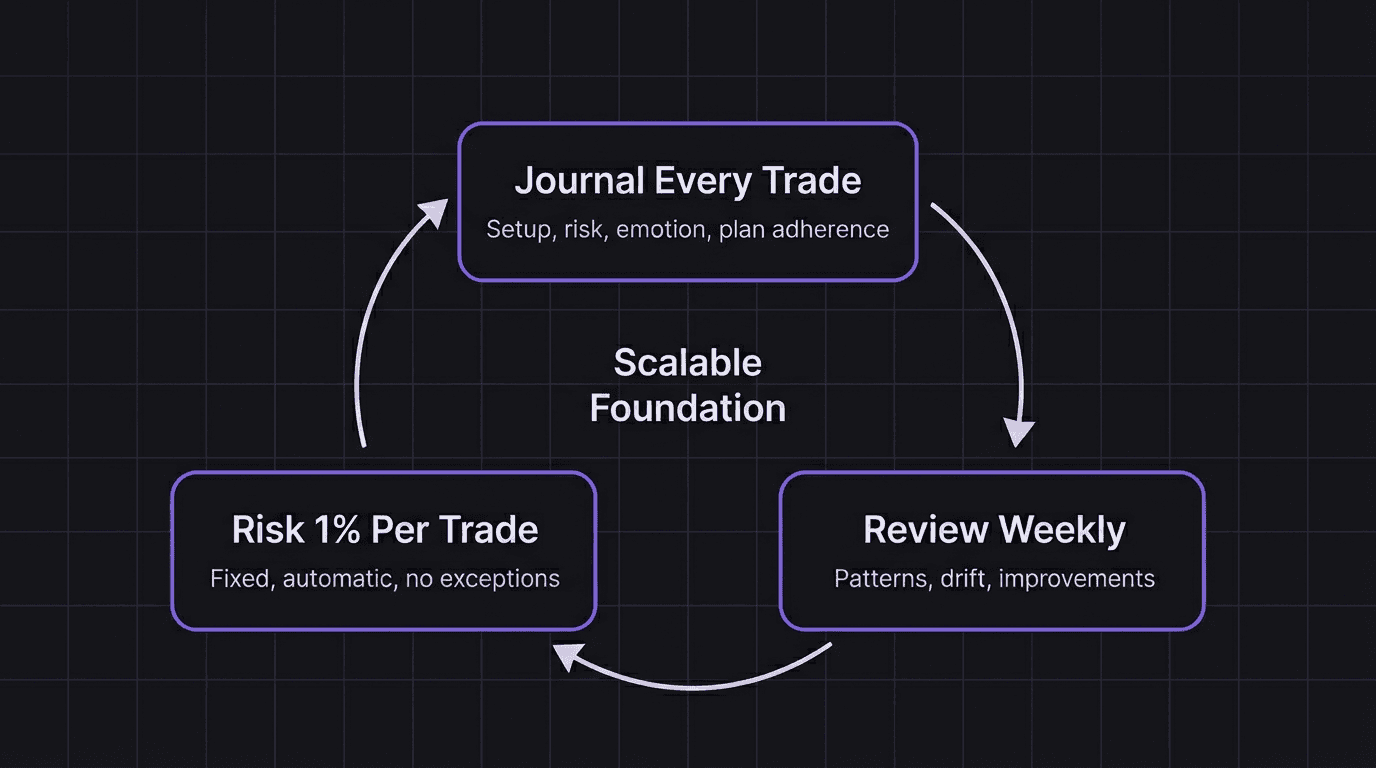
1. Journal every trade. Every single one. Winners, losers, breakevens, trades you closed early, trades you should not have taken. The journal habit is the raw material for every insight, pattern, and improvement you will ever make.
Record: the setup, your entry reason, your risk, your target, your actual exit, your emotional state, and whether you followed your plan. It takes three minutes per trade. There is no valid excuse for skipping it.
2. Risk a fixed percentage per trade. One percent is the standard starting point. Not "around 1%." Not "1% on good setups and 2% when I feel confident." Exactly 1% per trade, every trade, no exceptions. This habit, once automatic, is the single strongest protection against account destruction at any size.
3. Review weekly. One session per week, 30 to 60 minutes, reviewing every trade from the past seven days. What worked. What did not. Where you deviated from the plan. What patterns are emerging in your behavior.
This is where the journal pays off. Without reviews, the journal is just a diary. With weekly reviews, it becomes a feedback loop that accelerates improvement.
Using Journal Reviews to Catch Habit Drift
Habit drift is subtle. It does not announce itself. You do not wake up one morning and decide to abandon your risk rules. Instead, it happens gradually: a slightly larger position here, a skipped journal entry there, a review pushed to "next week."
Each individual slip feels harmless. But over a month, those small deviations accumulate into a measurably different behavior pattern. By the time you notice (usually because a large loss forces the issue), the drift has been compounding for weeks.
The weekly review catches drift early. Compare your actual behavior to your plan:
How many trades deviated from planned risk?
How many journal entries were incomplete or missing?
How many trades were taken outside your criteria?
Is your average loser growing (a sign you are moving stops or ignoring exit rules)?
Track these metrics alongside your P&L. If the process metrics are slipping while the P&L holds steady, you are running on borrowed time. The P&L will eventually catch up to the deteriorating process.
Tracking trades for improvement is not a one-time project. It is an ongoing diagnostic tool that keeps habits locked in as your account grows.
Walkthrough: Weekly Review Catches the Drift
A trader reviews the last 10 trades and finds: 8 out of 10 followed the plan (80% adherence). Average risk per trade: 1.1% (target is 1.0%). Two trades had no journal entry.
None of those numbers are catastrophic. But they represent a 20% deviation from the standard. If that drift continues for another month, adherence might drop to 70%, average risk might creep to 1.3%, and journal gaps might grow.
The fix is immediate: recommit to 1.0% risk and complete the two missing journal entries. A five-minute correction now prevents a much larger problem later. On a $50,000 account, the difference between 1.0% and 1.3% risk is $150 per trade, which adds up to thousands over a month of consistency metric erosion.
How EdgeFlo Journal Auto-Import Removes Excuses
The most common journal failure is not unwillingness. It is friction. After a long trading session, manually logging every trade, including entry, exit, risk, and outcome, feels like homework. The tired trader tells themselves "I will do it tomorrow." Tomorrow becomes next week. Next week becomes never.
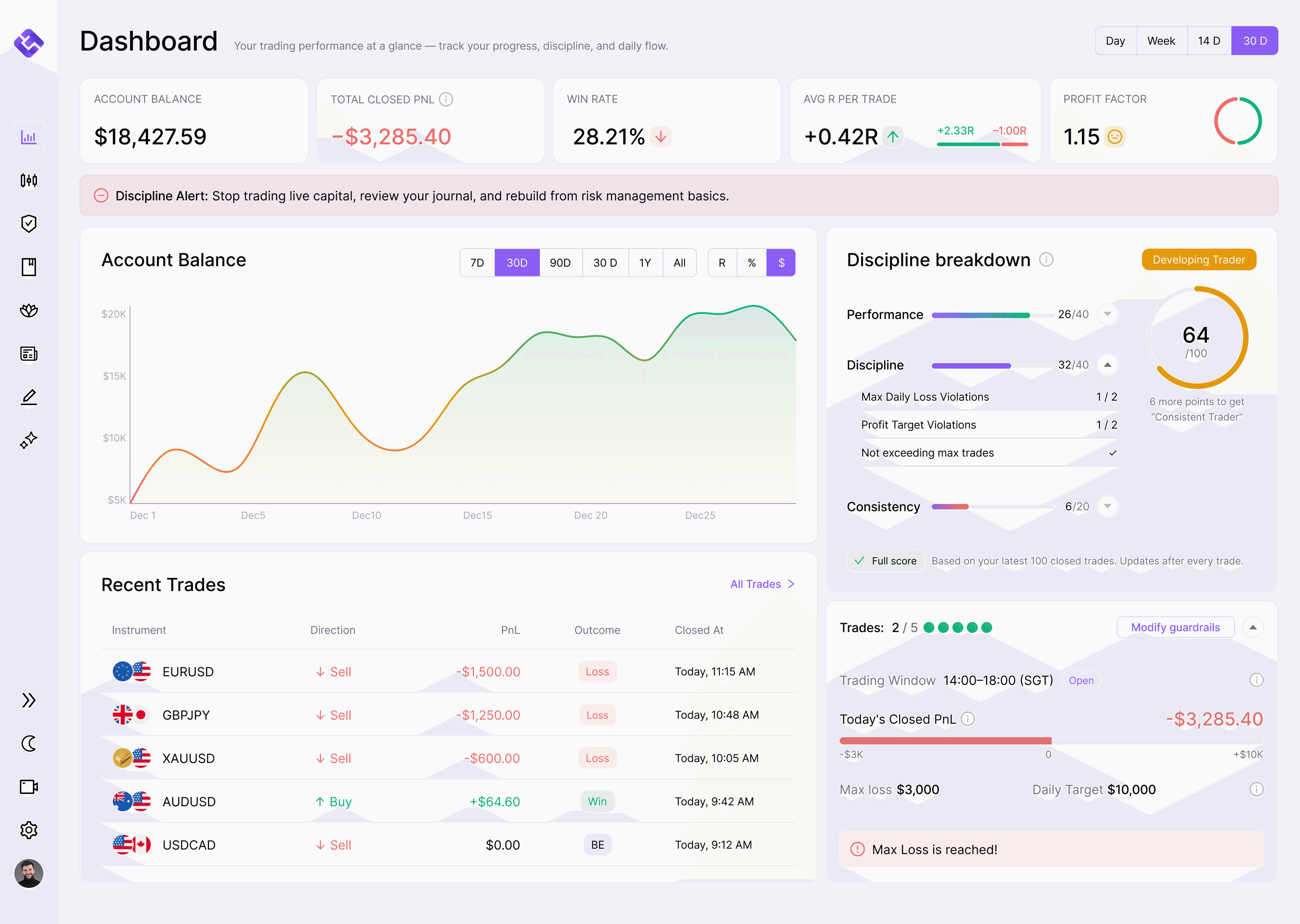
EdgeFlo's auto-import eliminates that friction entirely. Your trades are imported automatically from your broker connection. Entry, exit, pair, size, and outcome are pre-filled. All you need to add is the context: your emotional state, whether you followed the plan, and any notes about what you learned.
That reduces a 10-minute chore to a 2-minute annotation. And when something takes 2 minutes, you actually do it. Every day. Without fail. Which is exactly the habit you need to build before the account grows.
Emotion tagging adds another layer that manual journals rarely capture. Tagging each trade with your emotional state (calm, frustrated, anxious, confident) creates a dataset that reveals patterns no P&L report can show. "I revenge trade after Friday losses" or "I overtrade when I feel bored" are insights that only emerge from consistent emotion data. And those insights are the ones that prevent the $5,000 mistakes when the account scales.
The Edge Brief
Receive Insights on trading psychology, discipline, and the behavioral patterns that create consistent traders from our Founder and the EdgeFlo team, delivered to your inbox.
Think different. Trade different.
Why do bad habits get worse with a bigger account?
What are the most important trading habits to build early?
How do I catch habit drift before it costs real money?
When should I scale my account size?

Turn discipline on.
Every session.
EdgeFlo is the environment serious traders operate inside.
Start 7-Day Free Trial
Cancel anytime.
No long-term commitment.

Think Different, Trade Different.